Lefkada or Milos?
Our verdict in twelve categories, each scored against the same fixed benchmark cities, and the climate month by month, so you can choose for your trip.
Choose Lefkada for
- day trips
- prices
- nightlife
Lefkada suits travellers who like to keep moving. You can windsurf at Vasiliki, sail the sheltered channels to Meganisi, take a ferry to Ithaca or Kefalonia, or drive across the causeway to the mainland. It is easier to reach and cheaper to stay on than Milos, and its evenings are livelier, though high summer is noticeably hotter.
Choose Milos for
- culture and sights
- wellness
- food and drink
Milos is the better choice for a slower and quieter island, with more to see between swims: the catacombs below Plaka, the painted boathouses at Klima, and hot springs where you can soak at the end of the day. You pay more for rooms and it takes longer to get there. In return you get a volcanic coastline in colours Lefkada cannot match, and nights that stay calm.
Scoreboard
Twelve categories on one fixed scale from 0 to 100. The shaded stretch is the gap between the two.
Your match
Pick a travel style or drag the sliders, and both match scores follow your weighting.
Wins on day trips and prices with your weighting.
Wins on culture and sights and wellness with your weighting.
What matters to you?
Category by category
What the scores mean for a trip.
Beaches & swimming
Beaches are the main reason to visit either island, and both are excellent. They differ in their rock. Lefkada's west coast has long strands below white limestone cliffs at Porto Katsiki, Egremni and Kathisma. The water is a vivid turquoise, but it shelves steeply and the waves pick up in the afternoon, so the calm east-coast bays are the gentler option.
Milos is volcanic, with white, ochre, red and grey shores. Sarakiniko's pumice inlets are the famous sight, and the south coast has long sandy beaches, some of them reachable only by boat. Which beach to choose depends on the north wind, not on which side of the island you are staying. Many beaches have no sunbeds or shade, while Lefkada's best-known coves fill up in midsummer.
Food & drink
You eat about equally well on both islands, simply and in tavernas, so the difference is in what you eat. Lefkada has grilled fish on the harbours at Lefkada town and Nidri, slow-cooked meat in mountain villages such as Karya, and local lentils and cured salami from its own hillsides.
Milos serves Cycladic island cooking: pitarakia cheese pies, ladenia flatbread and grilled octopus in Klima. It also has a few more ambitious kitchens on sunset terraces in Plaka and Tripiti, which gives it a slightly more polished edge for one special dinner.
Culture & sights
Milos has more to see. The early Christian catacombs below Plaka are among the largest in Greece. Nearby are the field where the Venus de Milo was found and a marble Roman theatre, and further afield the Bronze Age site at Phylakopi. The syrmata boathouses at Klima make a fine sight of their own, and together they fill two days well.
Lefkada's sights are smaller in scale: the fortress of Santa Maura at the causeway, painted church ceilings and earthquake-proof timber houses in Lefkada town, and the Faneromeni monastery above the lagoon. They make a pleasant break from the beach rather than the purpose of a day.
Nightlife
Lefkada has more going on after dark. On summer nights the lanes of Lefkada town fill with cocktail bars and young Greek visitors, sailing crews gather on Nidri's harbour, and the windsurfers have their own bars in Vasiliki. It is still a scene for drinking and strolling, not clubbing.
Milos is quieter by design. Evenings are a sunset from Plaka's castle hill, a long dinner and a drink in Adamas or Pollonia, and the island goes to sleep long before dawn.
Nature & outdoors
Lefkada is the greener island. Olive and cypress slopes climb to a mountain interior above 1,100m, and the west coast drops in tall white limestone cliffs. The drive along them to Cape Lefkatas is worth a morning in itself, and kitesurfers head for Agios Ioannis in the north.
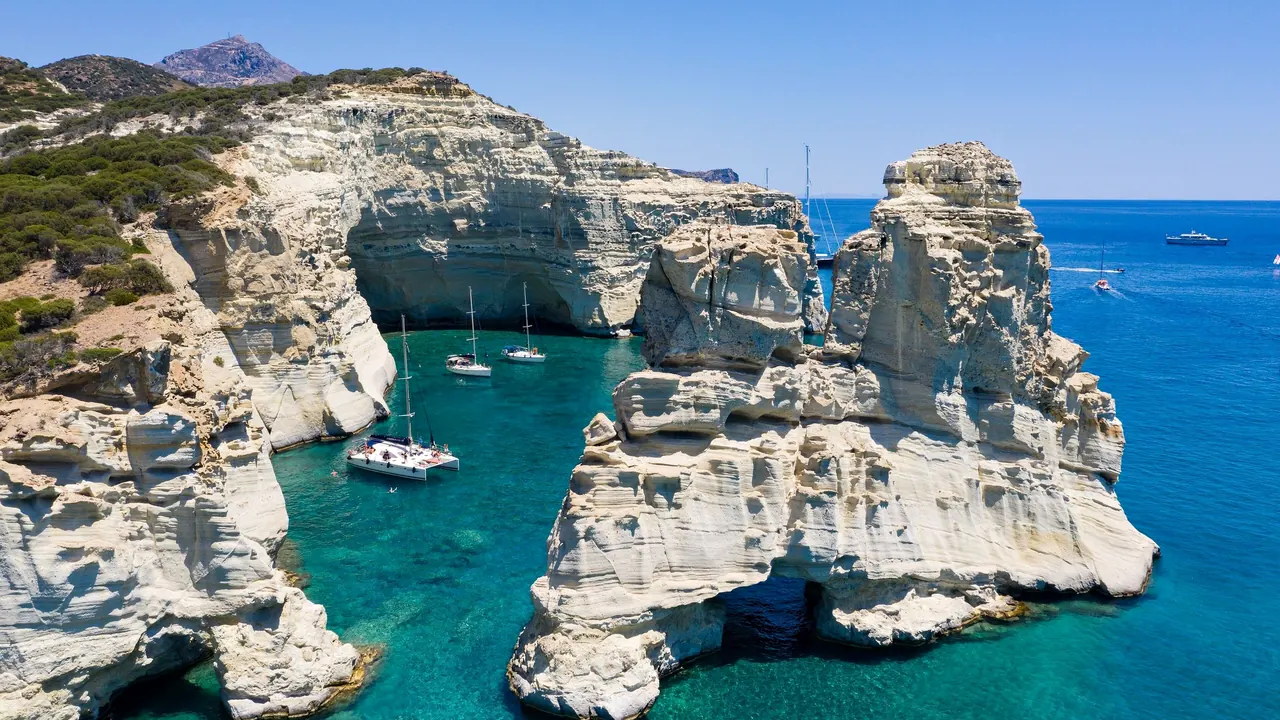
Milos looks nothing like it. The volcano has left a dry, low interior scarred by old quarries, so the drama is all on the shore: the rock towers and caves of Kleftiko and the red and yellow cliffs at Firopotamos and Papafragas, best seen by kayak or boat. The trails to the old sulphur mines and up Profitis Ilias are pleasant, but on foot Lefkada gives you more.
Day trips
Lefkada is the better base for day trips. Boats from Nidri visit Meganisi, Kalamos and Kastos, and ferries from Vasiliki reach Fiskardo on Kefalonia and Ithaca. Because the island is joined to the mainland, you can also drive to Roman Nikopolis, to Parga under its Venetian castle, or to the oracle site on the Acheron.
On Milos the outings are fewer and depend on the ferries and the wind. Kimolos, a short crossing from Pollonia, is the easy one. Sifnos works as a summer day trip, and the islands further out fit better into a multi-island itinerary.
Good for families
Both islands suit a simple beach vacation with children, and neither has attractions built for them. On Lefkada, base yourself on the east coast around Nikiana and Ligia, or at Agiofili, where the water is calm, and treat the surf and cliff staircases of the west as an occasional day out. The short transfer from Aktion airport also helps.
Milos has softer, sandier shallows on the south coast at Provatas and Paliochori, and Pollonia has a sheltered beach right in the village. Against that, the long ferry can be rough, there is little shade, and dirt tracks lead to many of the beaches.
Getting around
On both islands you need a hired car, quad or scooter, because the buses miss most of the coast. Where they differ is in getting there. Lefkada is joined to the mainland by a causeway and has an airport about half an hour away, but its mountain and west-coast roads wind slowly, and Nidri gets congested in summer.
Milos is compact, and nowhere is much more than forty minutes from Adamas. However, the western half has rough dirt roads that some rental agreements exclude, and reaching the island means a long ferry from Piraeus, a fast boat or a short flight from Athens.
Shopping & style
Neither island is somewhere to shop seriously, and both are best for browsing on an evening walk. Lefkada town has a proper pedestrian main street with clothing shops and jewellers, and you can buy hand embroidery in Karya. On Milos the browsing is in Plaka's whitewashed lanes, with linen, ceramics and island-made goods, and local capers and sweets to take home.
Affordability
Lefkada is clearly cheaper. It is mid-range for a Greek island, with plenty of family-run studios, and the costs that add up are mostly August rooms near the west-coast beaches, car hire and boat trips.
Milos is expensive in summer, mainly because of accommodation in Pollonia, Plaka and Adamas, which books out early. Ordinary taverna meals are fairly priced, and simple rooms in the inland villages are the way to save. On both islands, June and September are the months to keep costs down.
Live music & performing arts
Lefkada's international folklore festival is the one fixed date on either island's stage. Every August for decades it has brought dance groups from many countries to open-air stages in Lefkada town, and village festivals add traditional music through the summer. Outside the season there is very little.
Milos has no event of that kind. Its live music comes from the panigyria, saints'-day feasts in the villages and chapels where people dance to violin and lute late into the night. Beyond those, there is only the odd summer concert at the ancient theatre or in Adamas.
Wellness & relaxation
Milos offers more for an unhurried, restorative stay. Its volcano still warms the ground, so you can soak in the old baths at Lakkos in Adamas or the springs near Provatas, and the sand at Paliochori is warm underfoot.
Lefkada has no such tradition. Treatments are limited to the better hotels and a few yoga retreats in the hills, so its calm comes from quiet interior villages and the small east-coast harbours in the shoulder months.
When should you go?
Pick your month. The climate figures are measured averages, not a forecast.
Lefkada in July
Milos in July
Daytime high, °C
Rainfall in the month, mm
Where the figures come from
Lefkada has no rain gauge within 25 km of the centre, so its rainfall comes from a gridded climate dataset read at the destination rather than from a gauge further away.
Milos has no weather station within reach, so its figures come from a gridded climate model rather than a measured record, and read a broad area rather than one spot.
Temperature and rainfall are climate normals, averaged over the years shown. Lefkada: 1998-2020 (rainfall 1991-2020) normals, Aktion Airport (24.3 km from centre). Milos: 2001-2020 normals, NASA POWER reanalysis grid, no weather station within 90 km.
Both islands are beach destinations from June to early October, and the sea is warm enough for long swims through that whole period. They feel different in high summer. Lefkada heats up to around 31°C in August, which makes the middle of the day hard going on the cliff paths and in town. Milos stays milder at about 27°C because the north wind cools it. Milos is also the drier of the two. It has almost no rain from June to August, and September gets about 20mm against Lefkada's 77mm.
The two split apart in autumn. Lefkada's rain arrives in October and peaks at around 150mm in November, so it has a shorter season at both ends. On Milos the wet months are milder, and spring stays cool for longer. For walking, May and late September are best on both islands, when it is warm but not yet scorching.
Which traveller are you?
On a trip on a tight budget, Lefkada is the clear choice. Family-run studios are easy to find and few sights charge entry. On Milos, summer rooms in Pollonia, Plaka and Adamas cost a lot and book out early, and the long ferry adds to the bill.
For an outdoors trip, Lefkada gives you more to do. The steady winds at Vasiliki are famous among windsurfers, the channels are ideal for a week on a yacht, and the green interior has waterfalls and village paths. Milos is mainly about kayaking around its coast.
On a relaxing and wellness trip, Milos is the better pick. Volcanic hot springs at Lakkos and near Provatas, warm sand at Paliochori and very quiet evenings make it restful. Lefkada has no bathing tradition, and its busiest resorts are anything but calm in August.
Before you go
| Measure | Lefkada | Milos |
|---|---|---|
| Official language | Greek | Greek |
| Currency | Euro (EUR) | Euro (EUR) |
| Sockets | CF230 V, 50 Hz | CF230 V, 50 Hz |
| Driving side | Right | Right |
| Time zone | UTC+2, UTC+3 in summer | UTC+2, UTC+3 in summer |
| Emergency number | 112 | 112 |
| Main airport | Aktion National Airport (PVK)47 non-stop destinations | Milos Airport (MLO)2 non-stop destinations |
| Public holidays this year | 15 days | 15 days |
By the numbers
| Measure | Lefkada | Milos |
|---|---|---|
| Population | 22,652 | - |
| People per km² | 64 | - |
| Swim season, months above 21 °C | 5 months | 5 months |
Where else could you go?
Every comparison below shares a destination with this one, so you can follow Lefkada or Milos somewhere new.