Halkidiki or Milos?
Our verdict in twelve categories, each scored against the same fixed benchmark cities, and the climate month by month, so you can choose for your trip.
Choose Halkidiki for
- prices
- nightlife
- day trips
Halkidiki suits travellers who want an easy, flexible beach vacation on the mainland: a hire car, three peninsulas to choose from, and the option of organised sand on Kassandra or wilder coves in Sithonia. It is the better pick for families with small children, for anyone watching the budget, and for groups who want bars and open-air clubs after dark. Thessaloniki within driving distance adds a proper city day and serious food when the beach palls.
Choose Milos for
- nature and the outdoors
- culture and sights
- getting around
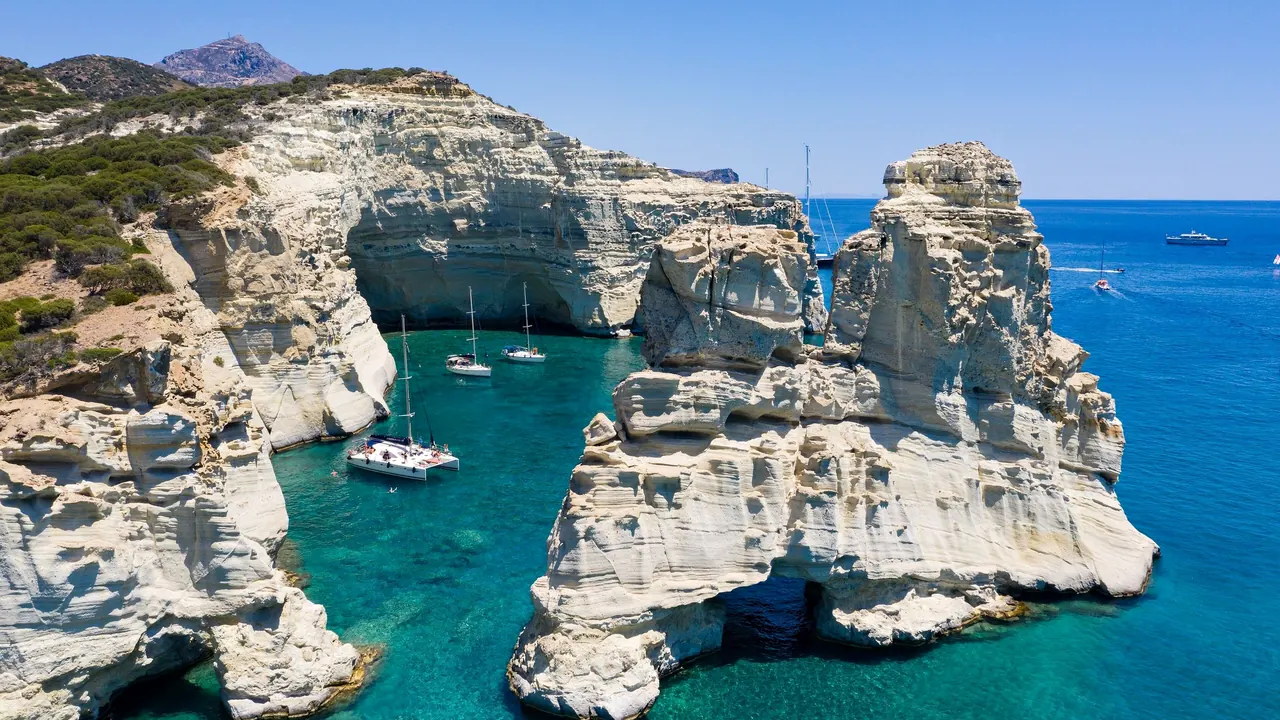
Milos is for people who want a single, compact Cycladic island and its strange volcanic coast: white pumice at Sarakiniko, coloured cliffs, the sea caves of Kleftiko reached by boat. Evenings are quiet, with sunsets from Plaka and long dinners, and there is no club scene to speak of. The trade-offs are higher room costs in summer, a longer journey to get there, and day trips that depend on ferries and the wind.
Scoreboard
Twelve categories on one fixed scale from 0 to 100. The shaded stretch is the gap between the two.
Your match
Pick a travel style or drag the sliders, and both match scores follow your weighting.
Wins on prices and nightlife with your weighting.
Wins on nature and the outdoors and culture and sights with your weighting.
What matters to you?
Category by category
What the scores mean for a trip.
Beaches & swimming
Both are first-rate beach destinations, but the shores look and work differently. Halkidiki offers sheer quantity: hundreds of kilometres of pale sand and fine pebble with pine forest behind, organised with sunbeds and beach bars on Kassandra, and rockier, quieter coves around Sithonia and Ammouliani.
Milos is smaller and more dramatic, its volcanic coast giving white, red and grey rock and sand, from the pumice inlets of Sarakiniko to the long south-coast beaches such as Firiplaka and Tsigrado. Many have no facilities and some are reachable only by boat, and the north wind decides which side of the island is swimmable on a given day.
Food & drink
Halkidiki eats a little better and with more variety close at hand. Fishing villages such as Nikiti and Toroni, family tavernas in the hill villages, local green olives, pine honey and Athos wines give it a clear sense of place, and Thessaloniki's kitchens are only a day trip away.
Milos offers honest Cycladic taverna cooking with a few island specialities worth ordering, such as pitarakia cheese pies and ladenia flatbread, plus a handful of more ambitious sunset terraces in Plaka. The range is narrower, and there is no larger food city to escape to.
Culture & sights
Neither is a culture destination, and they come out about even. Halkidiki's sights are spread across a big region: Mount Athos seen from a boat out of Ouranoupoli, the ruins of Olynthos, ancient Stagira and the Petralona cave, each needing a drive.
Milos packs its heritage into a small area: the early Christian catacombs, the field where the Venus de Milo was found, a Roman theatre, the castle village of Plaka and the painted boathouses of Klima. Two days covers it without a long drive.
Nightlife
Halkidiki is clearly the place to go out. In summer Kassandra has open-air clubs in Kallithea and strips of late cocktail bars in Pefkohori and Hanioti, fed by young crowds driving in from Thessaloniki at weekends.
Milos has nothing like it. A night there means a sunset drink in Plaka or Tripiti, dinner by the water and a few harbour bars in Adamas, and the island is asleep well before dawn.
Nature & outdoors
The two are close here, and the difference is in the landscape itself. Halkidiki is green: pine forest running to the sea, with Sithonia's granite headlands, islets and the wooded slopes of Mount Itamos making the best drives and walks.
Milos is bare and volcanic, with its drama on the coast: coloured cliffs at Firopotamos and Papafragas, sea arches and the rock towers of Kleftiko, best seen on a sailing or kayak trip around the island. Inland it is dry and quarried, with modest trails to the old sulphur mines.
Day trips
Halkidiki has far more within reach by road. Thessaloniki is about an hour or so away for Byzantine churches and the waterfront, with the royal tombs at Vergina, Pella, Kavala and Amphipolis on longer days.
Milos day trips mean boats: the short crossing to quiet Kimolos, or Sifnos by fast ferry in summer. They are rewarding but few, and every plan has to bend to timetables and the wind.
Good for families
Halkidiki is much the easier family destination. Beaches on Kassandra and around Gerakini and Psakoudia have sand and water that stays shallow a long way out, and large resorts come with pools and children's clubs.
Milos works for simple beach days, with gently shelving south-coast beaches and a sheltered beach in Pollonia. But many coves need dirt tracks, steep paths or a boat, shade is scarce in midsummer and the long ferry can be rough on children.
Getting around
Both need a car, and neither is easy in its own way. Halkidiki is simple to reach, about an hour from Thessaloniki airport, but its peninsulas force long detours, so crossing from Kassandra to the Athos side eats a day.
Milos is the opposite: once there, nowhere is more than about forty minutes from Adamas, though the west is rough dirt road and some beaches are best by boat. The hard part is the journey in, a long ferry or a short flight from Athens.
Shopping & style
Shopping is thin in both, and the difference is mostly in what you bring home. Halkidiki has resort strips of beachwear and souvenirs, while the icons, incense and herbal goods at Ouranoupoli and the olive oil and honey are the real finds, with Thessaloniki for anything more.
On Milos the browse is prettier, through Plaka's lanes of small boutiques selling linen, ceramics and jewellery, with capers and island sweets as the characteristic souvenirs.
Affordability
Halkidiki is noticeably kinder to the wallet. A market built on Greek and Balkan families driving in means plenty of simple apartments and fairly priced village tavernas, and only the big Kassandra resorts in high summer push costs up.
On Milos the rooms are the problem: Pollonia, Plaka and Adamas are expensive in July and August and book out early, with car hire and Kleftiko boat trips on top. Taverna meals stay reasonable, and both places cost less in June and September.
Live music & performing arts
Halkidiki has a short open-air season. Through July and August the Kassandra Festival brings concerts and theatre to the amphitheatre at Siviri, and the Sani Festival adds jazz and classical evenings along the resort coast. Outside those weeks, music means taverna players and the odd village feast.
Milos has almost nothing on a stage. Its live music is at the panigyria, the saints'-day feasts in villages and chapels, where violin and lute play for dancing late into the night. You can enjoy one if your dates happen to fall on one, but there is no programme to plan a trip around.
Wellness & relaxation
Halkidiki offers comfort in the form of facilities. The thermal pools at Agia Paraskevi, on the southern tip of Kassandra, are warm and look over the sea, and the large resorts have proper spas with hammam-style rooms and treatments. For quiet days, base yourself in Sithonia or near Ouranoupoli rather than in Kassandra's livelier resort villages.
Milos keeps things rustic. The volcano still heats the water at the old public baths at Lakkos in Adamas and in the springs near Provatas, both simple places to soak, and only a few hotels around Pollonia and Plaka have treatment rooms. The island is calmest in June and September, before and after August brings more people to the main beaches.
When should you go?
Pick your month. The climate figures are measured averages, not a forecast.
Halkidiki in July
Milos in July
Daytime high, °C
Rainfall in the month, mm
Where the figures come from
Halkidiki's temperatures are measured 64 km from the centre, at Thessaloniki Airport.
Halkidiki has no rain gauge within 25 km of the centre, so its rainfall comes from a gridded climate dataset read at the destination rather than from a gauge further away.
Milos has no weather station within reach, so its figures come from a gridded climate model rather than a measured record, and read a broad area rather than one spot.
Temperature and rainfall are climate normals, averaged over the years shown. Halkidiki: 1991-2020 normals, Thessaloniki Airport (63.7 km from centre). Milos: 2001-2020 normals, NASA POWER reanalysis grid, no weather station within 90 km.
Halkidiki has the hotter, more continental summer. July and August reach around 32°C, which makes midday walks and village visits heavy going, though the long sunny days and a sea warm from June into early October suit pure beach time. Winters are cold for the Aegean at about 10°C, and rain is spread across the year, heavier from October to December, so this is strictly a late spring to early autumn destination.
Milos stays milder at both ends. Summer highs sit nearer 27°C, tempered by the north wind, and June to August are almost completely dry, while the sea warms to roughly the same level as Halkidiki's by August. Winter is gentle at around 15°C but wet, with close to 100mm a month in December and January. For both, June and September give warm water without the peak heat; Milos is the more comfortable choice for walking in high summer.
Which traveller are you?
On a family trip with young children, Halkidiki is the easier choice. Its sandy Kassandra beaches stay shallow far out, big resorts have pools and children's clubs, and the airport is a drive away rather than a long ferry crossing.
For a trip on a tight budget, Halkidiki also wins. Greek and Balkan families keep a large supply of simple rooms and village tavernas, whereas Milos rooms in Pollonia, Plaka and Adamas are costly in summer and car hire and boat trips add up.
On a relaxing and wellness trip, Milos has the edge in mood. There is no club scene, evenings end with sunsets and long dinners, and volcanic hot springs at Lakkos and warm sand at Paliochori make for unhurried, rustic soaks.
Before you go
| Measure | Halkidiki | Milos |
|---|---|---|
| Official language | Greek | Greek |
| Currency | Euro (EUR) | Euro (EUR) |
| Sockets | CF230 V, 50 Hz | CF230 V, 50 Hz |
| Driving side | Right | Right |
| Time zone | UTC+2, UTC+3 in summer | UTC+2, UTC+3 in summer |
| Emergency number | 112 | 112 |
| Main airport | Thessaloniki Macedonia International Airport (SKG)93 non-stop destinations | Milos Airport (MLO)2 non-stop destinations |
| Public holidays this year | 15 days | 15 days |
By the numbers
| Measure | Halkidiki | Milos |
|---|---|---|
| Population | 110,587 | - |
| People per km² | 38 | - |
| Swim season, months above 21 °C | 5 months | 5 months |
Where else could you go?
Every comparison below shares a destination with this one, so you can follow Halkidiki or Milos somewhere new.