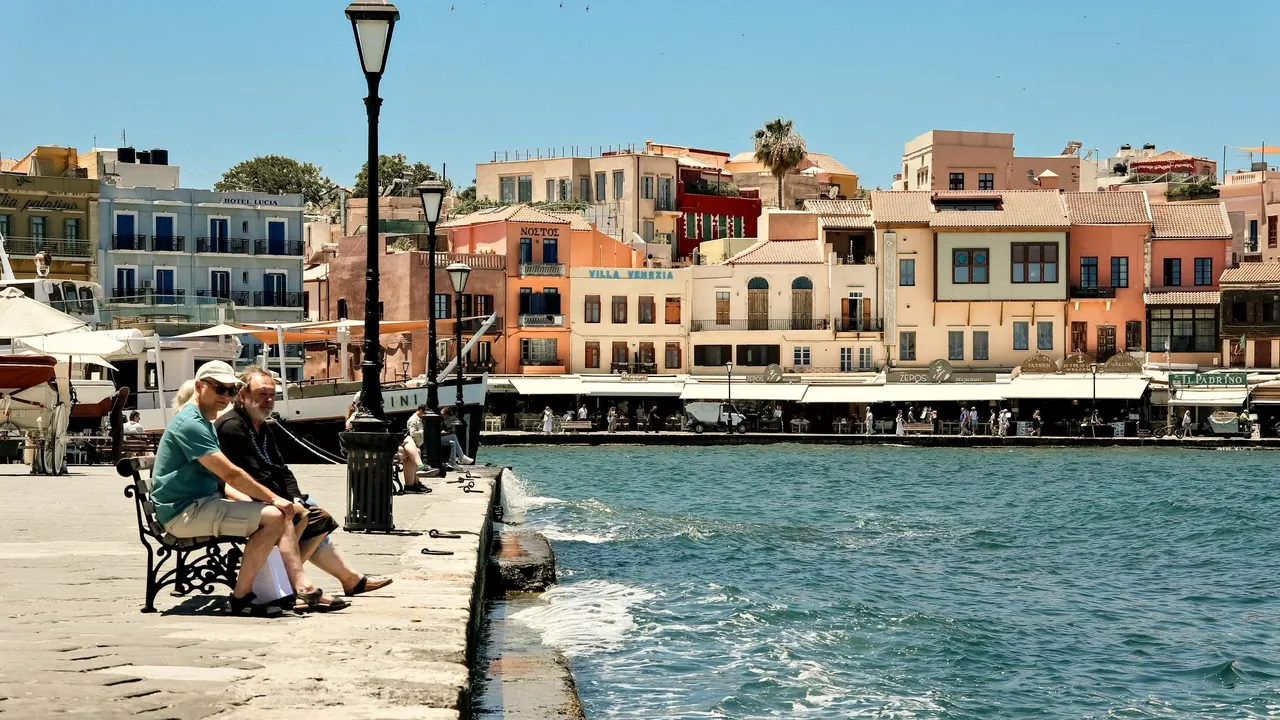
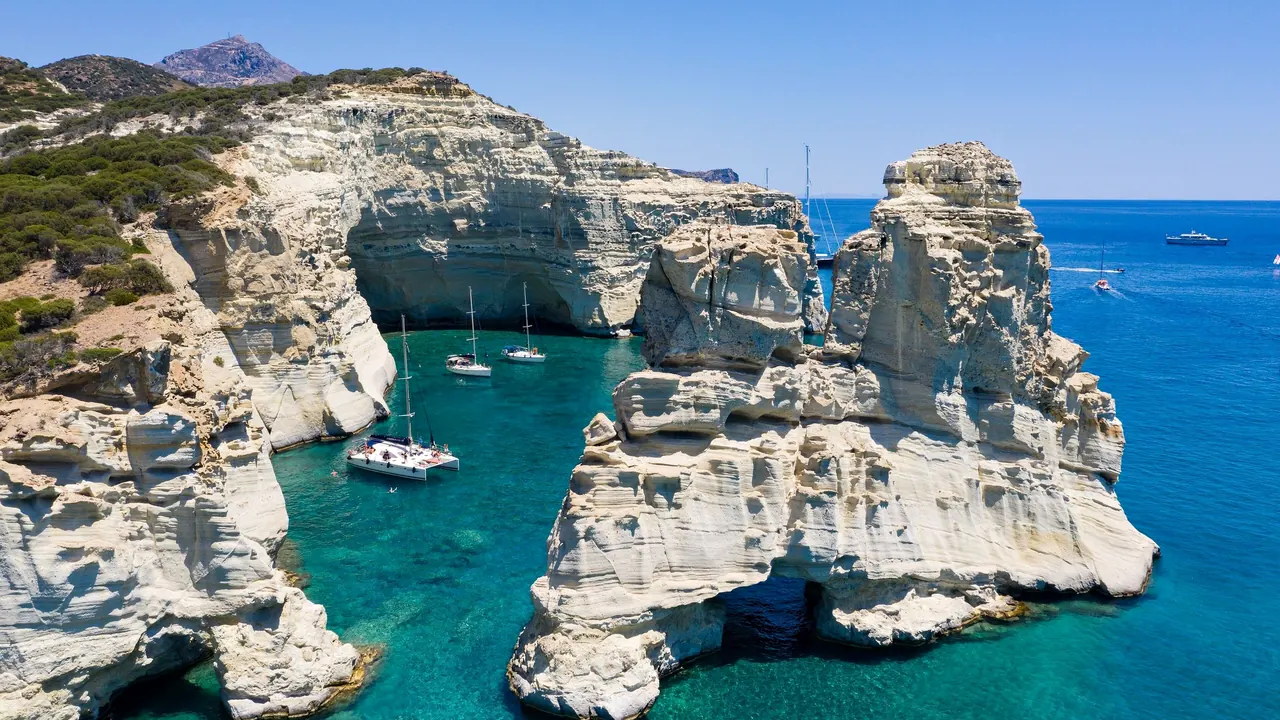
Photos: Crete by Piotr Baranowski, Pexels License; Milos by dronepicr, CC BY 2.0, cropped.
Crete or Milos?
Our verdict in twelve categories, each scored against the same fixed benchmark cities, and the climate month by month, so you can choose for your trip.
Choose Crete for
- culture and sights
- nightlife
- day trips
Crete suits a traveller who wants a whole island to explore. In one stay you can see Minoan palaces and the Heraklion museum, walk a gorge down to the Libyan Sea, eat village cooking built on the island's own olive oil and cheese, and spend evenings in the old towns of Chania and Rethymno. It is also the easier choice for families and for anyone watching costs, as long as they are happy to drive long distances.
Choose Milos for
Milos does not lead in any category we score.
Milos is for a smaller, quieter trip that is mostly about the sea. Its volcanic coastline of white pumice, red cliffs and clear water is the whole point of going, and you can swim it, sail it or kayak around it without ever driving far. Couples who like quiet nights and few distractions will be happy there. People who want sights, nightlife or a wide choice of restaurants will run out of things to do within a few days.
Scoreboard
Twelve categories on one fixed scale from 0 to 100. The shaded stretch is the gap between the two.
Your match
Pick a travel style or drag the sliders, and both match scores follow your weighting.
Wins on culture and sights and nightlife with your weighting.
Has no clear advantage with the weighting you have chosen.
What matters to you?
Category by category
What the scores mean for a trip.
Beaches & swimming
Both islands are first-rate for swimming, but they offer different kinds of beach. Crete has range and distance: the pink sand and shallow lagoon at Elafonissi, Balos under the Gramvousa peninsula and Falassarna's long strand in the far west, palms at Vai in the east, and long resort beaches with sunbeds along the north coast. The pebble coves of the south coast, such as Preveli, add a wilder side, but you can't fit them all into one stay.
Milos packs its beaches into a small volcanic island. The pumice inlets of Sarakiniko and the sandy bays of Firiplaka, Tsigrado and Paliochori are all short drives apart, and the colours of the rock make them unlike any beach on Crete. Many have no sunbeds or shade, and the north wind decides each day which coast is calm.
Food & drink
Crete is a place to travel for food, and Milos is not. Crete's cooking has a strong identity of its own: wild greens, graviera and mizithra cheeses, slow-cooked lamb, dakos and a glass of raki after the meal. The village tavernas and the backstreets of Chania and Rethymno are where it is best, and Heraklion adds a market street and wine from the vineyards to its south.
Milos eats well but more simply. Its tavernas serve grilled octopus and fresh fish on the waterfront, along with island specialities such as pitarakia cheese pies and ladenia flatbread. The choice is narrow, and in the busiest weeks the harbour places are cooking for the crowds.
Culture & sights
Crete has one of the great archaeological sites of Europe, and Milos has a pleasant few days of sightseeing. Knossos and the Heraklion museum, home to the Phaistos Disc and the Minoan frescoes, are reason enough to visit Crete. Venetian Chania, Ottoman Rethymno, Spinalonga and Arkadi monastery add later history across the island.
The heritage on Milos is worth seeing but on a much smaller scale. It includes the early Christian catacombs, the field where the Venus de Milo was found, a Roman theatre above the bay, Plaka's castle and the painted boathouses at Klima.
Nightlife
Crete has real choice after dark. The resort strips of Malia and Hersonissos have loud bars and clubs that stay open late for young groups. Chania's harbour, Rethymno's waterfront and Heraklion's old centre offer cocktail bars and terraces full of Greek students as well as visitors.
Milos ends the day early on purpose. Evenings mean sunset from Plaka's castle hill, a long dinner and a drink in Adamas or Pollonia, and nowhere to go dancing afterwards.
Nature & outdoors
Crete's interior is genuine mountain country. The White Mountains and Psiloritis rise above 2,400m, the Samaria gorge leads down to the sea, and the E4 path and the coast path through Loutro and Sfakia make for serious walking. Griffon vultures and the kri-kri goat live there, and climbers come for Agiofarago.
The natural drama on Milos is all on the coast. Its volcanic cliffs, sea arches and the rock towers at Kleftiko are best seen from a sailing boat or a kayak. Inland the island is low, dry and marked by quarries, and its trails are pleasant rather than demanding.
Day trips
From a base on Crete, the other towns, the wine villages around Peza and Archanes, and mountain villages like Anogia make easy days out. You can also take a boat to Chrissi, or the fast ferry to Santorini in about two hours. The catch is size: crossing the whole island takes most of a day.
From Milos the choice is smaller and depends on the boats. Kimolos is a short hop from Pollonia and shows a very quiet Cycladic island, and in summer Sifnos is about an hour away by fast ferry. Wind and timetables can upset any plan.
Good for families
Crete is far better set up for children. Resort hotels along the north coast have pools and kids' clubs, there are waterparks and the large aquarium at Gournes, and the warm, shallow lagoon at Elafonissi is ideal for toddlers. The drawbacks are midsummer heat and long, winding drives.
Milos works for families who only want simple beach days. Pollonia's sheltered village beach and the gently shelving sand at Provatas and Paliochori are good with small children. Beyond that there is nothing aimed at children, many beaches are down dirt tracks, and the long ferry crossing can be rough.
Getting around
On both islands you really need a car, but for different reasons. Crete is big and mountainous: buses link the north-coast towns well, but the south coast is reached on steep, winding roads, and drives take longer than the map suggests. On the other hand, getting there is easy, with international airports at Heraklion and Chania.
Milos is the reverse. Nowhere is more than about forty minutes from Adamas, although the west is reached on dirt roads and the buses miss most of the coast. Getting to the island is the hard part, by a long ferry or a short flight from Athens.
Shopping & style
Neither island is a shopping destination, but Crete gives you more to browse. Chania's leather-makers' lane, its knife-makers and covered market hall, and Heraklion's market street of cheese, herbs and raki are fun to explore. On Milos, shopping means a few linen and jewellery boutiques in Plaka and a jar of local capers or honey to take home.
Affordability
Crete is noticeably easier on the budget. Family-run rooms and generous village tavernas keep costs reasonable, and prices only climb around the famous western beaches, Chania's old town and the luxury resorts of Elounda.
Milos is expensive in high summer, mainly because rooms in Pollonia, Plaka and Adamas fill early and cost a lot, and boat trips and car hire add more. On both islands June and September are cheaper, and on Milos, staying in the inland villages saves money.
Live music & performing arts
Crete has a living music tradition that visitors can actually hear. The lyra and lute, improvised mantinades verses and fast circle dances fill the music tavernas of Rethymno and Chania, and Anogia is famous for its players. There are also summer festivals in the fortresses and open-air theatres of Heraklion and Chania.
On Milos, live music is almost entirely the summer panigyria, village saints'-day feasts with violin and lute. They are a joy if you happen to be there for one.
Wellness & relaxation
The volcano sets the two islands apart here. Milos has hot springs, and Crete has no bathing tradition of its own. On Crete, wellness means resort spas, the best of them around Elounda and the Gulf of Mirabello, or simply slowing down in Loutro, which you can only reach by boat or on foot.
On Milos you can soak in the rustic old baths at Lakkos in Adamas or in the springs near Provatas, and at Paliochori the sand and seabed are warm underfoot. There are only a few hotel spas, and the rest of the rest comes from slow mornings, siestas and long dinners.
When should you go?
Pick your month. The climate figures are measured averages, not a forecast.
Crete in July
Milos in July
Daytime high, °C
Rainfall in the month, mm
Where the figures come from
Milos has no weather station within reach, so its figures come from a gridded climate model rather than a measured record, and read a broad area rather than one spot.
Temperature and rainfall are climate normals, averaged over the years shown. Crete: 1991-2020 normals, Heraklion Airport (3.6 km from centre). Milos: 2001-2020 normals, NASA POWER reanalysis grid, no weather station within 90 km.
The two islands share a dry summer and a wet winter, but Crete runs warmer. Its summer highs reach about 29°C, hot enough to make midday walking at Knossos or in the old towns hard work, and from June to August it barely rains. Milos peaks a couple of degrees lower, and the north wind of high summer takes the edge off the heat. The sea is much the same on both: warm enough to swim from June to October, and around 25°C by late summer.
The real difference on land is in spring. Crete warms up quickly, and May is already about 24°C and very sunny, which makes it ideal for walking the gorges before the heat arrives. Milos warms more slowly, staying near 20°C in May, so spring there feels fresher and suits gentle walks to the old sulphur mines. The rain returns in October on both islands. Milos has the wetter winter, with over 100mm in December. In winter both islands are mild but grey and wet, and not beach weather.
Which traveller are you?
For a culture and arts trip, Crete is the clear choice. Knossos, the frescoes in the Heraklion Archaeological Museum, Phaistos and Gortyn, Chania's Venetian harbour and Rethymno's Ottoman lanes give you days of sightseeing. Milos has interesting catacombs and a castle village, but you can see them in two days.
For a food and nightlife trip, Crete again does better. Its regional cooking, the raki after meals and the wine villages near Heraklion beat Milos's fairly narrow taverna menus. After dinner, its old-town bar quarters and the Malia party strip go on far later than anything on Milos.
On a beach and sun trip where you want the coast unspoilt and close at hand, Milos makes a strong case. Sarakiniko, the sandy south-coast bays and Kleftiko by boat are all short drives apart, and on windy days you simply swim on the sheltered side.
Before you go
| Measure | Crete | Milos |
|---|---|---|
| Official language | Greek | Greek |
| Currency | Euro (EUR) | Euro (EUR) |
| Sockets | CF230 V, 50 Hz | CF230 V, 50 Hz |
| Driving side | Right | Right |
| Time zone | UTC+2, UTC+3 in summer | UTC+2, UTC+3 in summer |
| Emergency number | 112 | 112 |
| Main airport | Heraklion International Nikos Kazantzakis Airport (HER)129 non-stop destinations | Milos Airport (MLO)2 non-stop destinations |
| Public holidays this year | 15 days | 15 days |
By the numbers
| Measure | Crete | Milos |
|---|---|---|
| Population | 623,065 | - |
| People per km² | 75 | - |
| Swim season, months above 21 °C | 5 months | 5 months |
Where else could you go?
Every comparison below shares a destination with this one, so you can follow Crete or Milos somewhere new.