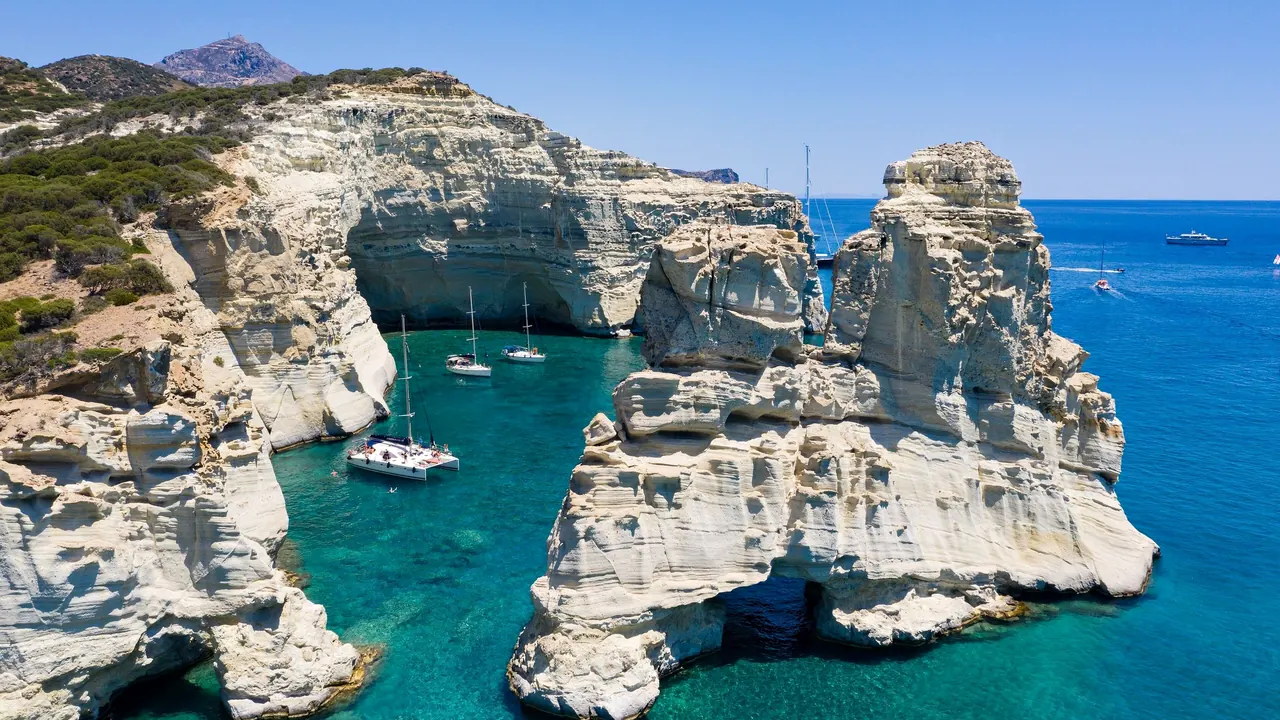
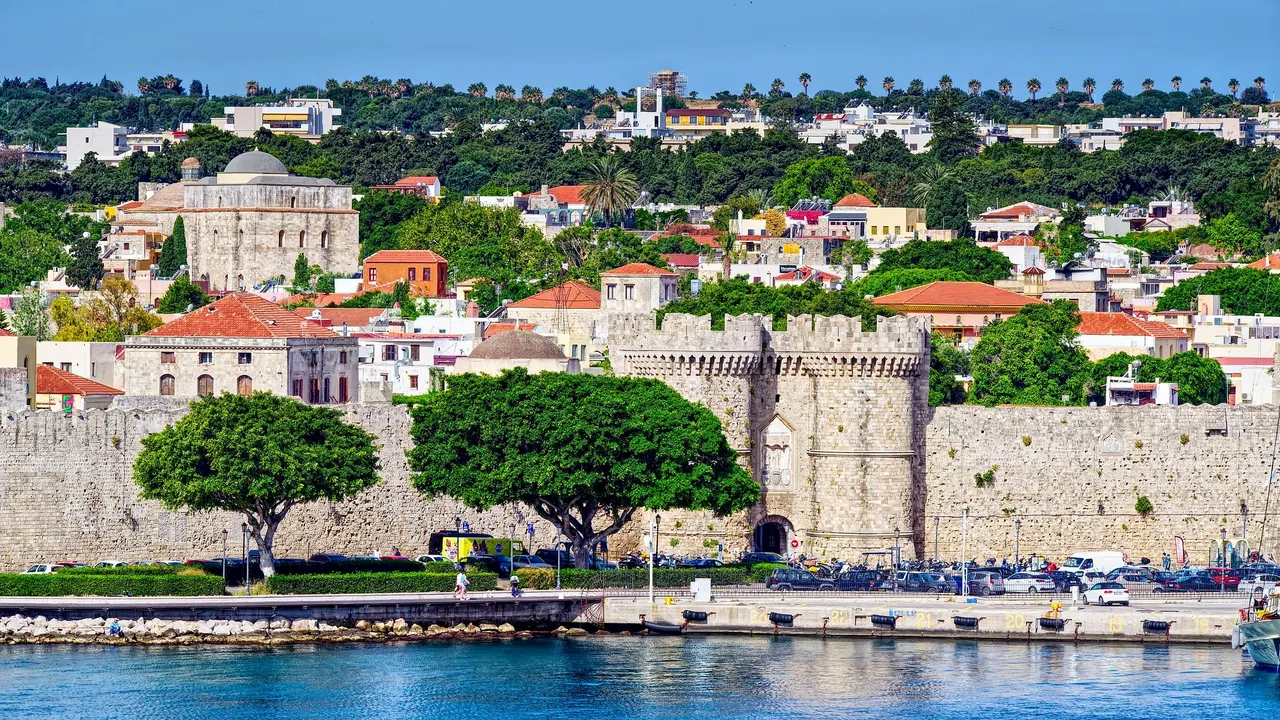
Photos: Milos by dronepicr, CC BY 2.0, cropped; Rhodes by Mark Thomas, Pexels License.
Milos or Rhodes?
Our verdict in twelve categories, each scored against the same fixed benchmark cities, and the climate month by month, so you can choose for your trip.
Choose Milos for
- wellness
- beaches
- nature and the outdoors
Milos is for travellers who come mainly to swim and want the coastline to be the whole trip. It has volcanic coves in white, red and grey, beaches you can only reach by boat, and evenings that end after a long taverna dinner. It suits couples and slow travellers who are happy to hire a car and pay more for a room. In return for the quiet they give up nightlife, big sights and anything built for children.
Choose Rhodes for
- culture and sights
- nightlife
- families
Rhodes makes for a broader vacation. The Knights' Old Town, Lindos and Kamiros give it far more history, and the east-coast resorts add calm family bays, a water park, a real party strip at Faliraki and boats to Symi and the Turkish coast. Rooms cost less too, so it is the better pick for families, mixed groups and anyone who wants more than the beach each day.
Scoreboard
Twelve categories on one fixed scale from 0 to 100. The shaded stretch is the gap between the two.
Your match
Pick a travel style or drag the sliders, and both match scores follow your weighting.
Wins on wellness and beaches with your weighting.
Wins on culture and sights and nightlife with your weighting.
What matters to you?
Category by category
What the scores mean for a trip.
Beaches & swimming
These are both first-rate beach islands, but the swimming feels very different. On Milos the volcanic shore makes the colours the attraction: Sarakiniko's white pumice inlets, long sandy beaches on the south coast such as Firiplaka and Tsigrado, and coves that only boats can reach. Many have no sunbeds at all, and the north wind decides each day which side of the island is calm.
Rhodes has a long, sheltered chain of bays down the east coast from Faliraki to Lindos. The sand there is often mixed with fine shingle, and there are snorkelling inlets at Anthony Quinn Bay. These beaches are easier to reach and better equipped, but in high summer the busiest are packed with rows of sunbeds. Prasonisi, at the southern tip, is the island's odd one out.
Food & drink
Rhodes gives the more interesting table, as long as you avoid the resort buffets and the Old Town's main lanes. Look for pitaroudia, matsi pasta and souma in village tavernas and the meze places of the modern town, and wine and honey from Embonas.
Milos cooks good Cycladic food in a narrower range. There are fish tavernas on the waterfront at Pollonia and Adamas, grilled octopus in Klima, and pitarakia and ladenia to try. On both islands fine dining is scarce.
Culture & sights
On sights, Rhodes is in another league. Its medieval Old Town is one of Europe's most complete fortified towns, with the inns of the Knights, mosques, a synagogue and an archaeological museum in the old hospital. Beyond it are Lindos, Kamiros, Filerimos and the stadium on Monte Smith.
Milos has more than most small islands, but on a smaller scale. There are the catacombs below Plaka, the field where the Venus de Milo was found, a Roman theatre, the colourful syrmata boathouses and Phylakopi, and two days is enough to see them.
Nightlife
If you want to go out, choose Rhodes. Faliraki's strip of bars and clubs runs until dawn in July and August. A lane in the Old Town and the bars around Mandraki stay open late, and Lindos has rooftop bars for an older crowd.
Milos is a sunset-and-dinner island. You watch the sun go down from Plaka's castle hill, then have a drink on the harbour at Adamas, and there is nowhere to dance.
Nature & outdoors
The scenery on the two islands is about equally rewarding, but in different ways. On Milos the drama is on the coast: the red and yellow cliffs of Firopotamos and Papafragas and the rock towers and caves of Kleftiko, all best seen from a sailing boat or a kayak. Inland it is dry and scarred by old quarries.
Rhodes is gentler and greener, with pine-covered hills, the shaded Valley of the Butterflies, Seven Springs and a real climb up Mount Attavyros. Its standout is the wind at Prasonisi, one of the Mediterranean's best-known spots for windsurfing and kitesurfing.
Day trips
Rhodes offers more ways to spend a day away. A fast boat takes you to Symi's pastel harbour and the monastery of Panormitis, Halki is reached from Kamiros Skala, and in about an hour you can be in Marmaris in Turkey. On the island itself there are the castles at Monolithos and Kritinia.
From Milos the choice is mostly Kimolos, a short hop from Pollonia, or Sifnos by summer fast ferry. Both depend on the wind and the ferry timetable.
Good for families
Rhodes is far better set up for children. It has shallow bays at Afandou and Kolymbia, resort hotels with kids' clubs, a water park above Faliraki and the aquarium in Rhodes Town. The heat of July and August and the stepped lanes of Lindos are the main drawbacks.
Milos offers simple beach days and nothing more. Pollonia's sheltered village beach and the calm water at Provatas work well, but you need a car to get almost anywhere, shade is scarce, and the long ferry crossing can be rough.
Getting around
Rhodes is easier without a car. Rhodes Town and its car-free Old Town are walkable, and buses run the length of the east coast to Lindos. A car is still useful for the south and the inland villages.
Milos is small, but its buses miss most of the coast, the west is reached on dirt roads some rental agreements exclude, and Kleftiko is best by boat. Just getting there takes hours by ferry, or a short flight from Athens.
Shopping & style
Neither island is a shopping destination, but Rhodes has more to browse. It has the souvenir lanes of Sokratous Street, ordinary Greek fashion around Mandraki, Lindian-style ceramics from Archangelos and lace from the villages. On Milos there is a handful of linen and jewellery boutiques in Plaka, and the best things to take home are the island's capers and honey.
Affordability
Rhodes is the cheaper island to stay on. Its large stock of package and all-inclusive hotels keeps the east coast moderately priced, and the buses and village tavernas are fairly priced too. Only Lindos and the Old Town's boutique hotels are expensive.
On Milos, rooms are the problem. In July and August Pollonia, Plaka and Adamas are costly and book up early, and car hire and boat trips add to the bill. June and September, or a room inland, make it easier.
Live music & performing arts
Live performance is thin on both islands, and on Milos it hardly exists outside the summer panigyria. At these saints'-day feasts in the villages and chapels, locals and visitors dance to violin and lute late into the night. The ancient theatre and Adamas only sometimes put on a concert.
Rhodes has a little more that you can plan an evening around. In season, a long-established company performs Greek folk dance in a small theatre in the Old Town, and summer concerts are held in the medieval moat and the ancient stadium. There is still no opera, orchestra or theatre season on either island.
Wellness & relaxation
Milos is the more restorative island, and part of the reason is its volcano. You can soak in the rustic baths at Lakkos in Adamas or the springs near Provatas, and lie on sand that steam warms at Paliochori. The island's whole pace is slow.
Rhodes has no bathing tradition of its own, and the Kallithea rotunda is only something to look at. Wellness there means good resort spas on the east coast and around Lindos, or the quiet southern villages such as Lahania and Asklipio.
When should you go?
Pick your month. The climate figures are measured averages, not a forecast.
Milos in July
Rhodes in July
Daytime high, °C
Rainfall in the month, mm
Where the figures come from
Milos has no weather station within reach, so its figures come from a gridded climate model rather than a measured record, and read a broad area rather than one spot.
Rhodes has no rain gauge within 25 km of the centre, so its rainfall comes from a gridded climate dataset read at the destination rather than from a gauge further away.
Temperature and rainfall are climate normals, averaged over the years shown. Milos: 2001-2020 normals, NASA POWER reanalysis grid, no weather station within 90 km. Rhodes: 1991-2020 normals, Rhodes Airport (12.6 km from centre).
Both islands have dry, hot summers and wet winters, but Milos is the milder of the two. In August its days reach about 27°C, so Plaka's lanes stay pleasant for walking even in midsummer. Rhodes reaches about 31°C in July and August, which makes the Old Town and the climb at Lindos hard going in the middle of the day. Rhodes warms up sooner, though. Its sea is warm enough to swim from late May, while on Milos swimming starts in June.
On both islands the sea stays warm enough into October, and Rhodes has the warmer water, close to 27°C in August. Spring and autumn are the best seasons for sightseeing on Rhodes and walking on Milos. From November to February the rain sets in on both, and Rhodes is the wetter island, with about 170mm in each of December and January against about 105mm on Milos.
Which traveller are you?
On a culture and arts trip, choose Rhodes. The walled Old Town with the Street of the Knights and the Grand Master's palace, the acropolis at Lindos and ancient Kamiros fill several days. Milos has the catacombs and the Venus de Milo field, but two days covers them.
On a family trip with children, Rhodes is the easier island. The east coast has shallow, sandy bays such as Tsambika and Kolymbia, resort hotels with pools and kids' clubs, a water park and an aquarium. Milos has gentle beaches, but many are reached by dirt tracks and there is little shade.
On a relaxing and wellness trip, Milos suits better. Hot springs at Lakkos and Provatas, warm sand at Paliochori and an island that goes quiet after dinner set a slow pace. On Rhodes, wellness mostly means resort spas, and you have to drive south to find calm.
Before you go
| Measure | Milos | Rhodes |
|---|---|---|
| Official language | Greek | Greek |
| Currency | Euro (EUR) | Euro (EUR) |
| Sockets | CF230 V, 50 Hz | CF230 V, 50 Hz |
| Driving side | Right | Right |
| Time zone | UTC+2, UTC+3 in summer | UTC+2, UTC+3 in summer |
| Emergency number | 112 | 112 |
| Main airport | Milos Airport (MLO)2 non-stop destinations | Rhodes International Airport "Diagoras" (RHO)136 non-stop destinations |
| Public holidays this year | 15 days | 15 days |
By the numbers
| Measure | Milos | Rhodes |
|---|---|---|
| Population | - | 127,613 |
| People per km² | - | 91 |
| Swim season, months above 21 °C | 5 months | 6 months |
Where else could you go?
Every comparison below shares a destination with this one, so you can follow Milos or Rhodes somewhere new.