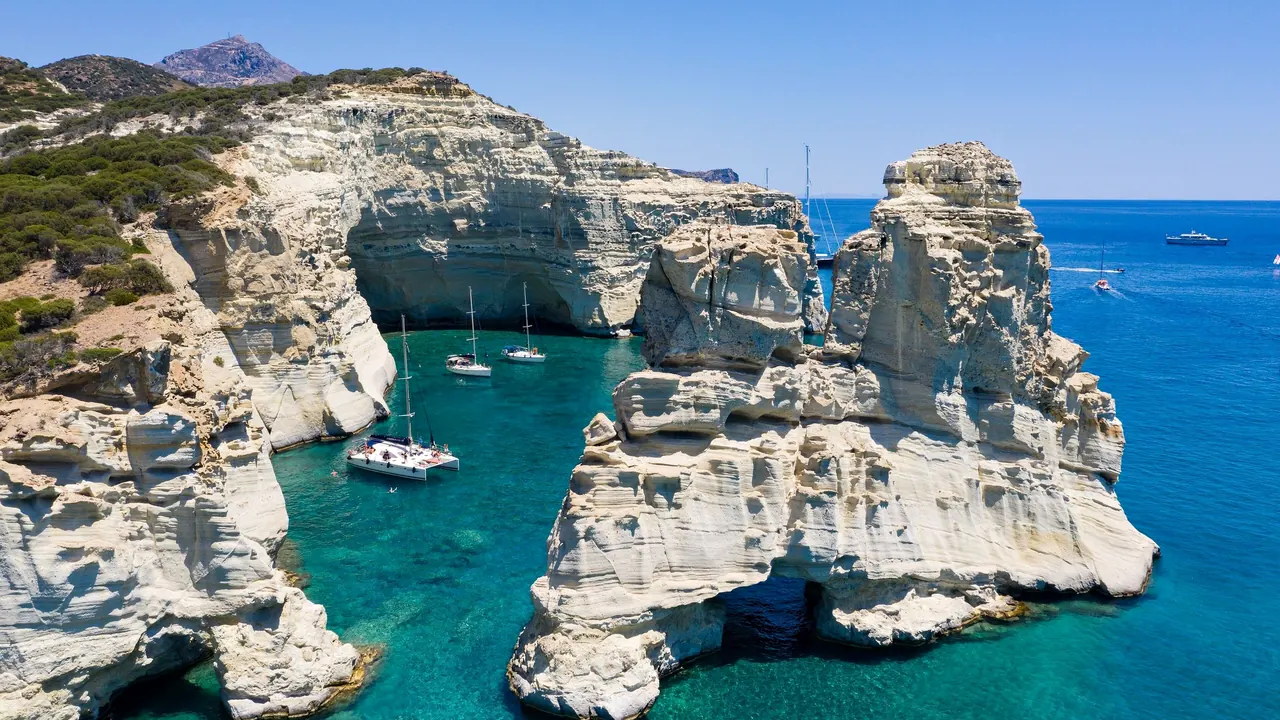
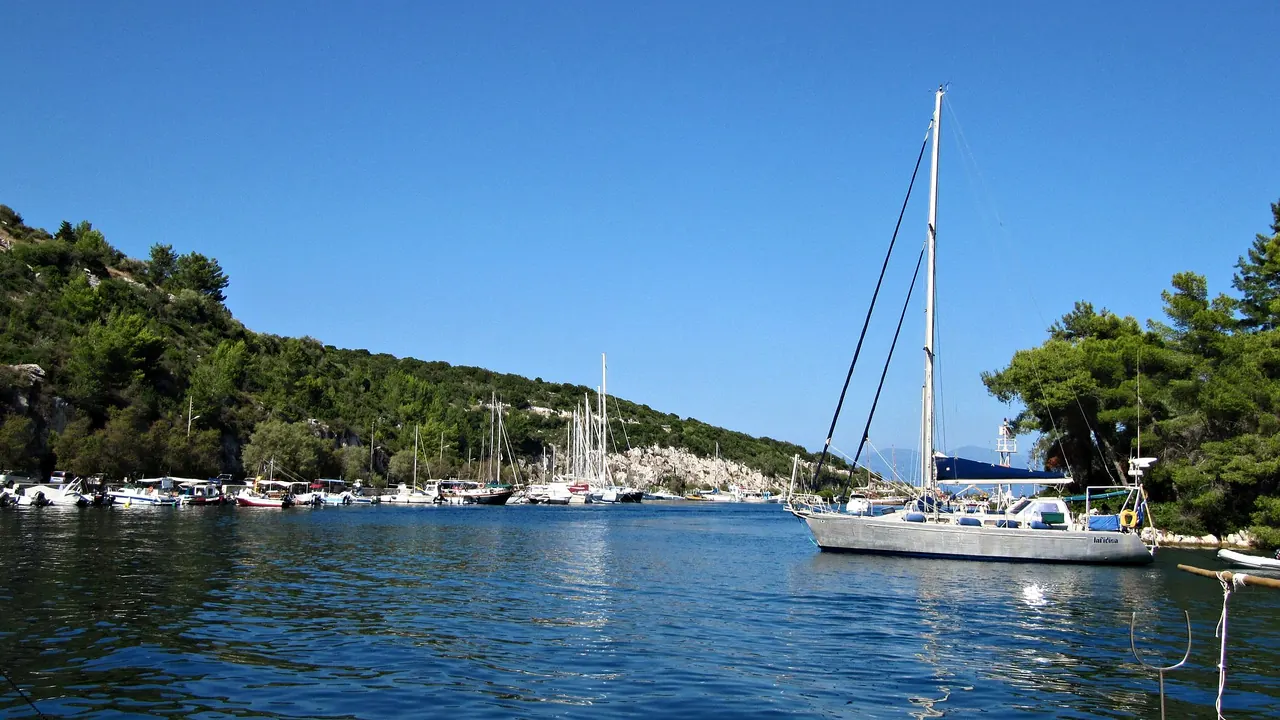
Photos: Milos by dronepicr, CC BY 2.0, cropped; Paxos by Poiesia, CC BY-SA 4.0, cropped.
Milos or Paxos?
Our verdict in twelve categories, each scored against the same fixed benchmark cities, and the climate month by month, so you can choose for your trip.
Choose Milos for
- culture and sights
- food and drink
- nightlife
Milos is the better choice for travellers who want variety from a small Greek island. Its volcanic coast gives sandy beaches in white, red and grey, sea caves to sail round and a south coast that stays calm when the north wind blows. Inland there is real history to fill a couple of days: the catacombs below Plaka, the Venus de Milo site and the Bronze Age ruins at Phylakopi. It also has a little more going on in its villages after dark, and the flight from Athens makes it the easier island to reach.
Choose Paxos for
- day trips
- getting around
- live music and the arts
Paxos suits people who want to do very little, slowly. Its pleasures are a villa in the olive groves, a hired boat for pebble coves and the turquoise water of Antipaxos, and a long dinner on the harbour at Gaios or Lakka. There is less to see and less to eat, but it has the calm of a tiny Ionian island. Corfu Town and Parga are a boat ride away when you want a change of scene.
Scoreboard
Twelve categories on one fixed scale from 0 to 100. The shaded stretch is the gap between the two.
Your match
Pick a travel style or drag the sliders, and both match scores follow your weighting.
Wins on culture and sights and food and drink with your weighting.
Wins on day trips and getting around with your weighting.
What matters to you?
Category by category
What the scores mean for a trip.
Beaches & swimming
Both islands are swimming destinations first, with very clear water from June to October, but the shoreline is quite different. Milos has the wider and more varied choice: long sandy beaches along the south coast at Firiplaka, Tsigrado and Agia Kyriaki, the white pumice inlets of Sarakiniko, and north-shore coves for still days. Because there are two coasts, you can always find calm water whichever way the wind blows.
On Paxos the coast is smaller and mostly pebble: little coves along the sheltered east side and the sandy shallows of Lakka bay, with no beaches at all on the cliff-lined west. Its best sand is on Antipaxos, a short boat ride south, where Voutoumi and Vrika are beautiful but crowded with day boats at midday.
Food & drink
Neither island is a reason to travel for food, but Milos gives you a little more to discover. It has its own island dishes, such as pitarakia cheese pies, ladenia flatbread and watermelon pie, and fishing villages like Klima where octopus and the morning's catch go on the grill. Plaka and Tripiti add a handful of more ambitious terraces.
Paxos cooks Ionian dishes, bourdeto and sofrito, dressed with oil from its own groves, and the villa crowd keeps standards fairly careful. The menus repeat from Gaios to Loggos, though, and many kitchens close once summer ends.
Culture & sights
Milos has far more history to visit. The early Christian catacombs, the field where the Venus de Milo was found, a marble Roman theatre and the Bronze Age site at Phylakopi make it one of the richer small Cycladic islands, and the painted syrmata boathouses of Klima and Mandrakia are a sight of their own.
Paxos offers views more than sights: the Venetian fort and the Panagia monastery on islets off Gaios, a folk museum in an old schoolhouse, and old olive presses passed on inland walks. Anyone wanting more takes the ferry to Corfu Town.
Nightlife
Both are quiet islands after dark, though Milos has slightly more to its evenings. There is sunset on Plaka's castle hill or a terrace in Tripiti, then late bars in Adamas through July and August. Paxos narrows down to the harbour at Gaios, where a waterfront drink beside the moored yachts and the odd place to dance keep things going in high summer, and it goes silent soon after dinner the rest of the year.
Nature & outdoors
The volcano gives Milos the more striking landscape: red and yellow cliffs at Firopotamos and Papafragas, the pumice ravines of Sarakiniko and the rock towers and caves of Kleftiko, best seen on a sailing or kayak trip. Inland trails lead to the abandoned sulphur mines and up Profitis Ilias.
Paxos is gentler and greener. Ancient olive groves and stone-walled mule tracks are linked by an end-to-end trail, and the west coast's limestone cliffs, the Tripitos arch and the sea caves give the drama. There is no high ground, though, and once you have walked the length of the island and seen the cliffs by boat, the range runs out.
Day trips
From Milos the outings lead to quieter islands. Kimolos is a short crossing from Pollonia, with a fortified village and very few visitors, and in summer the fast ferries put Sifnos, with its hill villages and pottery, about an hour away.
Paxos looks to bigger places. Corfu Town's Venetian fortresses and UNESCO-listed old town are about an hour away, and excursion boats run to the harbour town of Parga on the mainland. Paxos gives the bigger change of scene, Milos the more Cycladic one, and on both the wind and the boat timetable decide what is possible.
Good for families
Neither island has anything built for children, but Milos is the easier choice with little ones. Provatas, Paliochori and Achivadolimni are sandy and shelve gently, and Pollonia puts a sheltered beach right in the village. The long ferry and the lack of shade in high summer are the catches.
On Paxos, Lakka's shallow bay is the one really easy spot for small children. Elsewhere it is pebble coves and steep paths, so the island suits older children who will enjoy a day hopping between coves by boat.
Getting around
You will want your own wheels on both islands, but the details differ. Milos is larger and has a small airport with flights from Athens, though the western half means rough dirt roads that some rental agreements exclude, and summer buses miss most of the coast.
Paxos has no airport, so every arrival is by ferry from Corfu or the mainland, and rough seas can cancel boats. Once there, the island is only about 10km long, its three villages are easy on foot and footpaths join them through the olive groves. On both islands a boat is often the best way to reach the finest coves.
Shopping & style
Shopping is a browse on both. Plaka's whitewashed lanes on Milos have a slightly better spread of linen, jewellery and ceramics, while Paxos has a few summer boutiques behind the harbours in Gaios and Lakka. The best souvenirs are edible in each case: capers, honey and sweets from Milos, and the island's own olive oil from Paxos.
Affordability
Both are expensive islands in summer, and the cost comes mainly from rooms, transport and boats. On Milos it is the hotels and rooms in Pollonia, Plaka and Adamas, plus car hire and boat trips to Kleftiko, though an ordinary taverna meal stays fair. Paxos is mostly villas and guesthouses, harbourside restaurants charge for their location, and ferry crossings add to the bill. On either island, June and September are the way to spend less.
Live music & performing arts
Paxos has the one fixed date for music lovers: a small chamber music festival at the end of summer, held in churches and village squares, alongside saints' days such as the August feast of the Panagia in Gaios. Milos has nothing comparable. Its music comes from the summer panigyria, chapel and village feasts where violin and lute keep people dancing late, and from an occasional concert at the ancient theatre. On either island, a stage is a bonus and not something to plan a trip around.
Wellness & relaxation
Neither island is a spa destination, and both restore people mostly by slowing them down, but the rest takes a different form on each. On Milos it comes out of the landscape. A soak in the old bathhouse at Lakkos or at the springs by Provatas fits easily between a beach and dinner, and lying on the heated sand at Paliochori is simply part of the day. Anyone wanting proper treatments has only a handful of hotel spas around Pollonia and Plaka.
Paxos has no thermal water, so its rest lies in the stay itself: a week in one villa, mornings on the terrace and evenings by the harbour. A few of the larger hotels have massage rooms, and some country estates host yoga or retreat weeks. Paxos is at its calmest from May, while on Milos it is June and September that keep even the busier villages calm.
When should you go?
Pick your month. The climate figures are measured averages, not a forecast.
Milos in July
Paxos in July
Daytime high, °C
Rainfall in the month, mm
Where the figures come from
Milos has no weather station within reach, so its figures come from a gridded climate model rather than a measured record, and read a broad area rather than one spot.
Paxos's temperatures are measured 52 km from the centre, at Kerkyra Airport.
Paxos has no rain gauge within 25 km of the centre, so its rainfall comes from a gridded climate dataset read at the destination rather than from a gauge further away.
Temperature and rainfall are climate normals, averaged over the years shown. Milos: 2001-2020 normals, NASA POWER reanalysis grid, no weather station within 90 km. Paxos: 1991-2020 normals, Kerkyra Airport (52.1 km from centre).
Both islands are at their best from June to September, but their summers feel quite different. Milos stays fairly mild, with highs around 27°C in August and almost no rain from June to August, so walking Plaka's lanes is comfortable even in midsummer. Paxos runs much hotter, reaching about 32°C in July and August, so the middle of the day is for the water rather than the footpaths. The sea warms in step on both, swimmable from June and at about 26°C off Paxos in late summer, and Paxos gets long sunny days through June, July and August.
The difference shows most in autumn. Milos stays largely dry through September and only turns wet from October. On Paxos the rain arrives early: September already brings about 91mm, and by November it reaches around 163mm. For spring and autumn walking that makes May and early June the better window on Paxos, while on Milos it stretches into October.
Which traveller are you?
On a culture and arts trip, Milos is the clear pick. Plaka's archaeological and folk museums and the mining museum in Adamas tell a story of obsidian, sulphur and Venetian rule. Paxos has little beyond its harbour islets, and serious history means a day in Corfu Town.
For an outdoors trip, Milos gives more variety. Its coast changes colour from cove to cove, a small sailing and snorkelling scene runs boats round to the far south-west, and spring walks reach old mines. Paxos is greener but smaller, and you cover its range within a few days.
For a relaxing and wellness trip, Paxos is the gentler choice. Reaching it only by ferry keeps it small and slow, a hired boat fills the days, and evenings end early by the harbour. Milos has hot springs to soak in, but its main beaches get busier in August.
Before you go
| Measure | Milos | Paxos |
|---|---|---|
| Official language | Greek | Greek |
| Currency | Euro (EUR) | Euro (EUR) |
| Sockets | CF230 V, 50 Hz | CF230 V, 50 Hz |
| Driving side | Right | Right |
| Time zone | UTC+2, UTC+3 in summer | UTC+2, UTC+3 in summer |
| Emergency number | 112 | 112 |
| Main airport | Milos Airport (MLO)2 non-stop destinations | Corfu Ioannis Kapodistrias International Airport (CFU)88 non-stop destinations |
| Public holidays this year | 15 days | 15 days |
By the numbers
| Measure | Milos | Paxos |
|---|---|---|
| Population | - | 2,300 |
| People per km² | - | 91 |
| Swim season, months above 21 °C | 5 months | 5 months |
Where else could you go?
Every comparison below shares a destination with this one, so you can follow Milos or Paxos somewhere new.