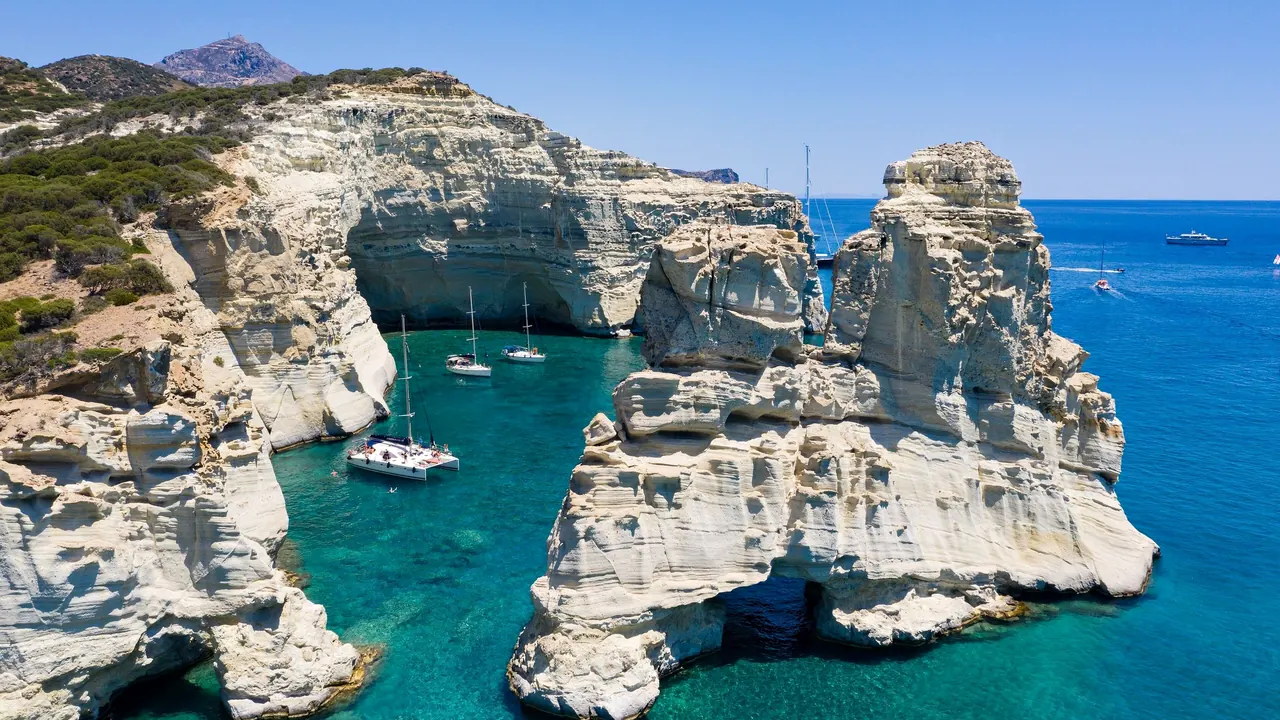
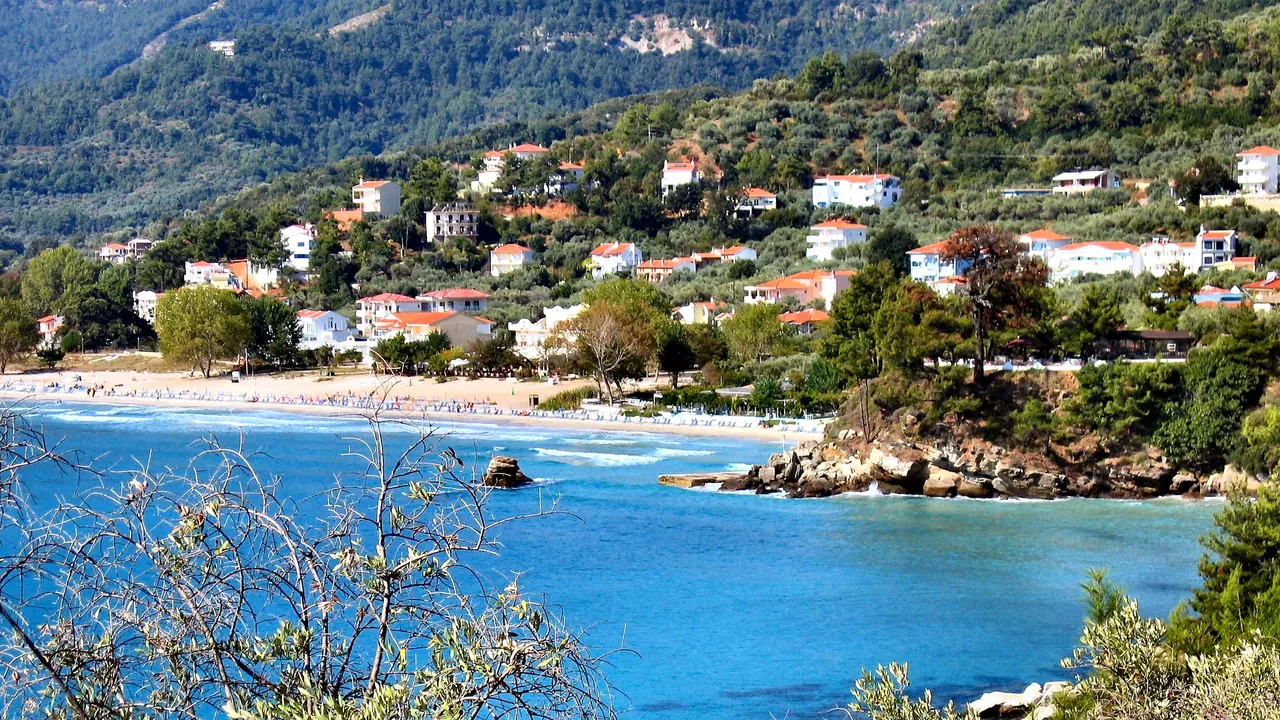
Photos: Milos by dronepicr, CC BY 2.0, cropped; Thassos by Ronald Saunders from Warrington, UK, CC BY-SA 2.0, cropped.
Milos or Thassos?
Our verdict in twelve categories, each scored against the same fixed benchmark cities, and the climate month by month, so you can choose for your trip.
Choose Milos for
- wellness
- food and drink
- day trips
Milos is for travellers who want the coastline itself to be the event. Its volcanic shore of white pumice, red cliffs and sea caves is best seen from a boat, and the island adds simple hot springs and a slow Cycladic pace in Plaka and Pollonia. It suits couples and beach purists who will pay summer room rates and hire a car for the dirt roads in return for a coast that looks unlike the rest of the Cyclades.
Choose Thassos for
- prices
- getting around
- families
Families and anyone watching their spending will find Thassos the easier and kinder island. Rooms and taverna meals cost far less, a short ferry from Kavala or Keramoti replaces the long sea crossing, and one ring road reaches every beach and village. Walkers get a different kind of hill as well: shaded paths through pine and chestnut forest up to Ypsario at about 1,200m, a longer and greener climb than the milder trails up Profitis Ilias on Milos.
Scoreboard
Twelve categories on one fixed scale from 0 to 100. The shaded stretch is the gap between the two.
Your match
Pick a travel style or drag the sliders, and both match scores follow your weighting.
Wins on wellness and food and drink with your weighting.
Wins on prices and getting around with your weighting.
What matters to you?
Category by category
What the scores mean for a trip.
Beaches & swimming
Both islands are built around their beaches and both deliver, but the character differs. Milos has a volcanic shore in white, ochre, red and grey, with Sarakiniko's pumice inlets and south-coast sands like Firiplaka and Tsigrado, several of them reachable only by boat and many with no sunbeds or shade. The north wind decides which side of the island you swim on.
Thassos is greener and gentler: long fine sand at Golden Beach under the mountain, pine-backed coves at Paradise Beach and Aliki, and white marble pebbles at Saliara. More of its beaches have tavernas and sunbeds, and the coastal road makes quiet coves easy to find by car.
Food & drink
Milos edges ahead at the table, mainly because it has a stronger set of its own dishes, from pitarakia cheese pies to ladenia flatbread, plus a few more ambitious kitchens on the sunset terraces of Plaka and Tripiti. Klima's grilled octopus and the waterfront fish in Pollonia are its staples.
Thassos cooks honestly but more simply, and resort menus repeat themselves. Its best meals are in the mountain tavernas of Theologos and Panagia, with slow-roasted goat under plane trees, and its pine honey and spoon sweets are worth seeking out.
Culture & sights
Neither island is a reason to travel for sightseeing alone, and each fills about two days. Milos has the more varied set: the catacombs below Plaka, the field where the Venus de Milo was found, a Roman theatre, Bronze Age Phylakopi and the colourful syrmata boathouses of Klima.
Thassos concentrates its history in one ancient city around Limenas, with its agora, theatre in the pines, acropolis and long city walls, plus the marble quarries and basilicas at Aliki and the slate-roofed village of Theologos.
Nightlife
Both are quiet islands after dark with no club scene. Milos evenings are about the sunset from Plaka's castle hill, a long dinner and a drink on the harbour in Adamas. Thassos has a little more going on in high summer, with the bar strip at Potos drawing younger visitors and music in the beach bars at Golden Beach.
Nature & outdoors
The outdoors here splits between sea and mountain. Milos is at its most striking from the water: the coloured cliffs of Firopotamos and Papafragas and the rock towers and caves of Kleftiko are best seen by sailing boat or kayak, while its dry, quarry-scarred interior makes for pleasant rather than memorable walks.
Thassos is the walker's island, forested from shore to the 1,200m summit of Ypsario, with mule tracks between villages, waterfalls near Kallirachi and Maries, and forest tracks for mountain biking.
Day trips
Both have only a handful of outings, and they point in opposite directions. From Milos you go island-hopping: tiny Kimolos is a short hop from Pollonia, and Sifnos works as a summer day trip by fast ferry, all subject to wind and timetables. From Thassos the trip is to the mainland, where Kavala's castle and Ottoman quarter and the ancient city of Philippi fit easily into one day.
Good for families
Thassos is the more relaxed choice with children. Gently shelving bays such as Skala Prinou and Pefkari, small easy resorts and a short ferry crossing that children enjoy make it simple to manage.
Milos asks more of parents. Pollonia's village beach and the calm south-coast sands at Provatas work well, but many of the best beaches mean dirt tracks, steep paths or a boat, shade is scarce and the long ferry from the mainland can be rough.
Getting around
Thassos is noticeably simpler. A single ring road links every resort and beach, and the ferry from Keramoti takes well under an hour, though summer weekend queues can be long.
Milos is small, but its western half is on rough dirt roads that some rental agreements exclude, buses miss most of the coast, and places like Kleftiko are best by boat. Reaching it means hours by ferry from Piraeus or a short flight from Athens.
Shopping & style
Plaka gives Milos the nicer stroll, with small boutiques in its whitewashed lanes selling linen, jewellery and ceramics on the way up to the sunset, and capers, honey and sweets to take home. Thassos has no lane like it, only a short street of beachwear and souvenirs in Limenas, but its village stalls sell pine honey, olives and walnut or fig spoon sweets, and a few workshops carve the island's white marble.
Affordability
This is where the islands differ most. Thassos is one of the more affordable Greek islands, with family-run studios and modest taverna prices aimed at visitors driving down from the Balkans; the ferry and a hire car are the main extras.
Milos is expensive in July and August, above all for rooms in Pollonia, Plaka and Adamas, and car hire and boat trips add up. Taverna meals stay fair, and June or September brings the cost down on both islands.
Live music & performing arts
Formal performance barely exists on either island. On Milos, music means the summer panigyria, village saints'-day feasts with violin and lute late into the night. Thassos has a little more structure, with summer festival plays and concerts in the ancient theatre above Limenas and dancing in village squares around mid-August.
Wellness & relaxation
Milos has something Thassos lacks: a still-warm volcano. You can soak in the rustic old baths at Lakkos in Adamas or the springs near Provatas and feel the heat in the sand at Paliochori, with a few hotel spas around Pollonia and Plaka besides.
Thassos offers rest rather than treatments, with a handful of resort spas, the odd yoga class, and long lunches in Theologos and quiet south-east bays doing most of the work.
When should you go?
Pick your month. The climate figures are measured averages, not a forecast.
Milos in July
Thassos in July
Daytime high, °C
Rainfall in the month, mm
Where the figures come from
Milos has no weather station within reach, so its figures come from a gridded climate model rather than a measured record, and read a broad area rather than one spot.
Thassos has no rain gauge within 25 km of the centre, so its rainfall comes from a gridded climate dataset read at the destination rather than from a gauge further away.
Temperature and rainfall are climate normals, averaged over the years shown. Milos: 2001-2020 normals, NASA POWER reanalysis grid, no weather station within 90 km. Thassos: 1997-2020 (rainfall 1991-2020) normals, Chrysoupoli Airport (24.5 km from centre).
The two islands share a summer swimming season from June to September, with the sea at its warmest in August, but they get there differently. Milos stays mild and breezy, with August highs of about 27°C and almost no rain from May to September, so even midsummer is comfortable for wandering Plaka, and the sea holds its warmth well into October. Winter there is soft but wet, and the rain sets in properly from November.
Thassos, further north, runs to both extremes. Its summers are hotter, around 31°C in August, which makes walking and mountain climbs hard work in July and August, and its winters are clearly colder, with January highs near 10°C. Its sea is chillier in spring but reaches about 26°C in August. A few showers can still arrive in June, while May and late September are the gentlest months for combining swimming with walks in the hills.
Which traveller are you?
On a family trip with children, Thassos is the easier choice. Its sandy bays such as Golden Beach and Pefkari shelve gently, the ferry is short, and the ring road keeps drives brief, while Milos needs a long crossing and rough tracks.
On a trip on a tight budget, Thassos wins clearly. Family-run studios and modestly priced tavernas are the norm there, whereas Milos charges heavily for summer rooms, car hire and boat trips, and only inland villages offer real savings.
For a relaxing and wellness trip, Milos has the edge. Volcanic hot springs at Lakkos and near Provatas, warm sand at Paliochori and a few hotel spas add something to its slow pace, while Thassos offers rest but no bathing tradition.
Before you go
| Measure | Milos | Thassos |
|---|---|---|
| Official language | Greek | Greek |
| Currency | Euro (EUR) | Euro (EUR) |
| Sockets | CF230 V, 50 Hz | CF230 V, 50 Hz |
| Driving side | Right | Right |
| Time zone | UTC+2, UTC+3 in summer | UTC+2, UTC+3 in summer |
| Emergency number | 112 | 112 |
| Main airport | Milos Airport (MLO)2 non-stop destinations | Kavala Alexander the Great International Airport (KVA)15 non-stop destinations |
| Public holidays this year | 15 days | 15 days |
By the numbers
| Measure | Milos | Thassos |
|---|---|---|
| Population | - | 13,100 |
| People per km² | - | 35 |
| Swim season, months above 21 °C | 5 months | 4 months |
Where else could you go?
Every comparison below shares a destination with this one, so you can follow Milos or Thassos somewhere new.