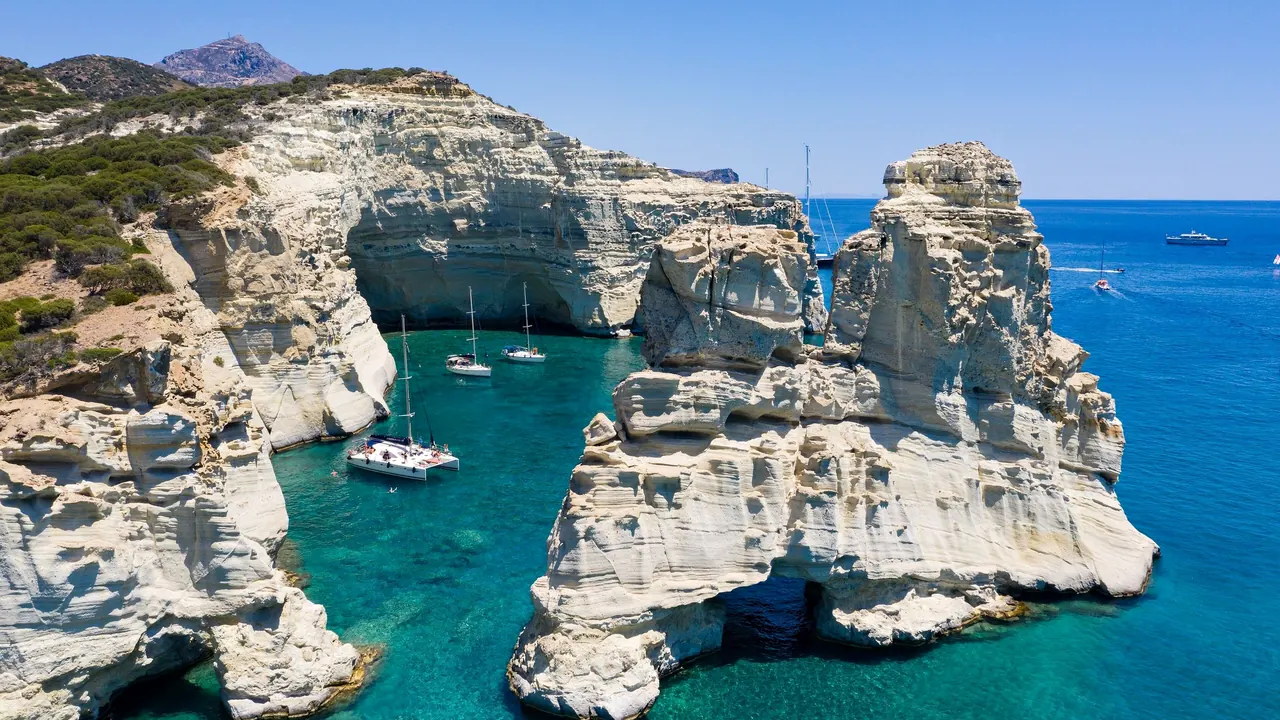
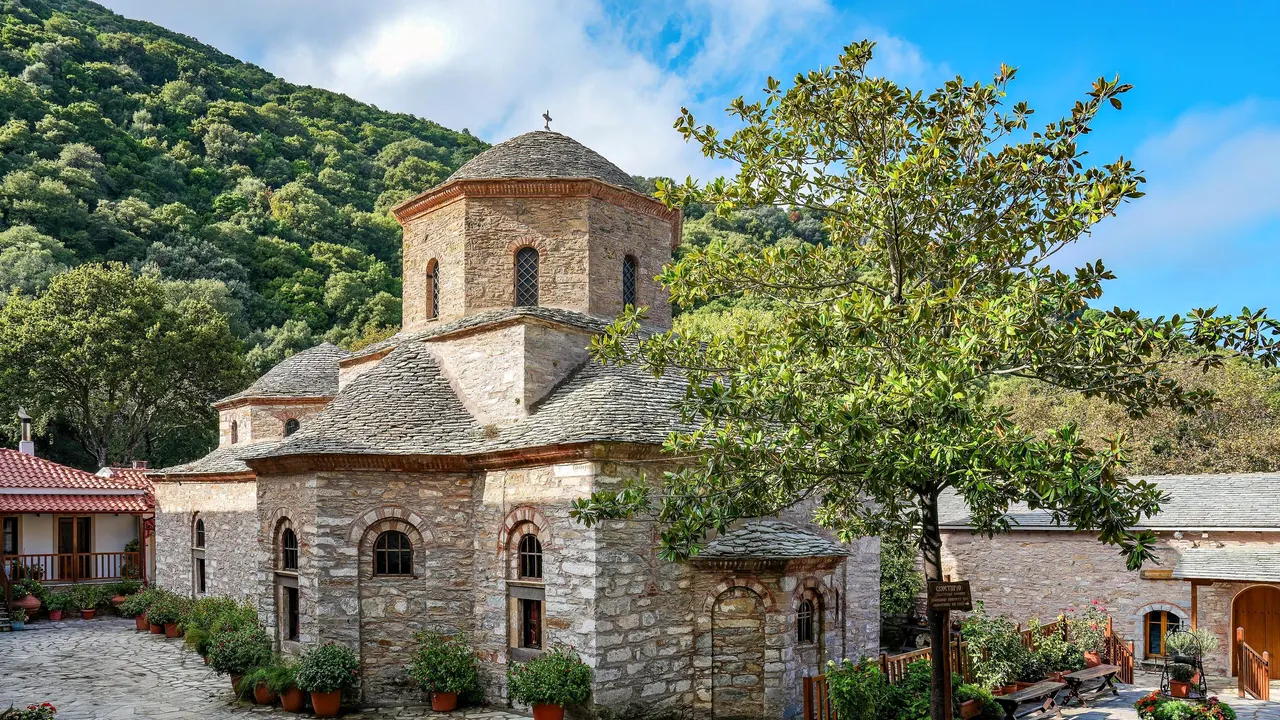
Photos: Milos by dronepicr, CC BY 2.0, cropped; Skiathos by Giles Laurent, CC BY-SA 4.0, cropped.
Milos or Skiathos?
Our verdict in twelve categories, each scored against the same fixed benchmark cities, and the climate month by month, so you can choose for your trip.
Choose Milos for
- culture and sights
- wellness
- food and drink
Milos is the island for travellers who like their scenery strange and their evenings quiet. Its volcanic coast of white pumice, red cliffs and boat-only coves around Kleftiko is the more striking, and it adds catacombs, the Venus de Milo field and hot springs to soak in. In return you need a car, a longer journey to get there and a bigger budget for rooms.
Choose Skiathos for
- nightlife
- getting around
- prices
Skiathos makes more sense for an easy, sociable beach vacation. The airport sits at the edge of town, a bus runs the south coast past pine-backed sands like Koukounaries, and Skiathos Town has a real bar street after dark. Families and anyone counting costs will find it simpler and gentler on the wallet, though the sights are thin and the town can be loud in high season.
Scoreboard
Twelve categories on one fixed scale from 0 to 100. The shaded stretch is the gap between the two.
Your match
Pick a travel style or drag the sliders, and both match scores follow your weighting.
Wins on culture and sights and wellness with your weighting.
Wins on nightlife and getting around with your weighting.
What matters to you?
Category by category
What the scores mean for a trip.
Beaches & swimming
Both islands are built around their beaches and both deliver, but the look and feel differ completely. Milos has volcanic shores in white, ochre, red and grey, with the moonscape inlets of Sarakiniko and long south-coast sands like Firiplaka and Tsigrado, many without a sunbed in sight.
Skiathos offers softer, greener scenery: pale sand and fine shingle with pine trees reaching the water, best at Koukounaries and the beaches around Banana Beach. It has more organised beaches with facilities, and more crowds on them in August. On both islands the wind picks the coast, with the north side rough when the meltemi blows and the south coast calm.
Food & drink
Milos eats a little better. Beyond the fish tavernas of Pollonia and Adamas it has its own dishes, such as pitarakia cheese pies and ladenia flatbread, plus a few more ambitious terraces in Plaka and Tripiti.
Skiathos serves pleasant Greek island cooking in the old town lanes and in beach tavernas under the pines, but many menus are pitched at package visitors. Neither island has fine dining or much international food.
Culture & sights
Milos has far more to see. The catacombs below Plaka are among the largest in Greece, and there is the field where the Venus de Milo was found, a marble Roman theatre, the prehistoric site at Phylakopi and the painted syrmata boathouses at Klima.
Skiathos has a short list: the Papadiamantis house museum, the Evangelistria Monastery in the woods and the clifftop ruins of the Kastro, which is its most memorable sight. Either island is covered in a couple of days, but on Milos those days are fuller.
Nightlife
Skiathos is the clear choice for going out. In July and August the bar street climbing from the harbour fills after midnight, waterfront clubs run until dawn, and Banana Beach holds sunset parties for a young international crowd.
Milos keeps its evenings to the sunset from Plaka's castle hill, a long dinner and a drink in Adamas or Pollonia. There is no club scene, which is exactly why many of its visitors choose it.
Nature & outdoors
Milos has the more dramatic landscape. Its volcanic coast of sea arches, coloured cliffs at Papafragas and the caves of Kleftiko is best seen by sailing boat or kayak, though the dry, quarried interior is less inspiring on foot.
Skiathos is the opposite: an unusually green island of pine and oak forest crossed by old footpaths, with the Strofilia wetland behind Koukounaries and boat trips towards the Alonissos marine park. It is gentler, better for shady walks, but less striking from the sea.
Day trips
Skiathos has the easier outings. Skopelos, with its steep white town, Glossa and the clifftop chapel of Agios Ioannis, is about an hour by ferry, and Alonissos makes a longer day.
From Milos, the short hop to quiet Kimolos is lovely and Sifnos works by fast boat in summer, but everything hangs on ferry times and the wind.
Good for families
Skiathos is the easier island with children. The flight lands minutes from the beaches, the southern sands shelve gently, and older children enjoy the planes landing low over the road. Parents should keep clear of the town's bar streets and watch the busy coast road.
Milos suits families too, especially based in Pollonia with its sheltered village beach, and south-coast sands like Provatas are calm. But the long ferry, scarce shade and dirt tracks to the best beaches make it harder work.
Getting around
Skiathos is simpler to reach and to move around. The airport is at the edge of town, and one 12km coast road with a summer bus and numbered beach stops serves most visitors, helped by water taxis from the old harbour.
Milos is compact too, but its buses miss most of the coast, the west is rough dirt road, and getting there means several hours on a ferry or a small plane from Athens. Here a car or quad is close to essential.
Shopping & style
Neither island is a shopping destination. Milos has a few boutiques of linen, jewellery and ceramics in the lanes of Plaka, with capers and honey the best things to take home. Skiathos has a longer resort main street in town with sandals, summer clothes and olive oil, most of it shut in winter.
Affordability
Skiathos is the cheaper island. Studios and family-run rooms are plentiful, and the bus and ordinary tavernas keep daily costs reasonable, even if peak-season rooms by the best beaches are dear.
Milos is pricier in summer, chiefly for rooms in Pollonia, Plaka and Adamas, with car hire and Kleftiko boat trips on top. On both, June and September bring the bill down while the sea stays warm.
Live music & performing arts
There is little formal performance on either island, so this should not decide the trip. Milos has its village panigyria with violin and lute late into the night. Skiathos has the same kind of saints'-day feasts, plus summer concerts in the open-air theatre on the Bourtzi and live sets in a few bars.
Wellness & relaxation
Milos has the edge, thanks to its volcano. You can soak in the rustic baths at Lakkos in Adamas or the springs near Provatas, and at Paliochori the sand is warm where steam escapes.
Skiathos has no bathing tradition, only spas in the larger south-coast hotels. Its restful side is cool pine shade and the quieter north coast, away from the town's loud summer nights.
When should you go?
Pick your month. The climate figures are measured averages, not a forecast.
Milos in July
Skiathos in July
Daytime high, °C
Rainfall in the month, mm
Where the figures come from
Milos has no weather station within reach, so its figures come from a gridded climate model rather than a measured record, and read a broad area rather than one spot.
Skiathos's temperatures are measured 60 km from the centre, at Anchialos Airport.
Skiathos has no rain gauge within 25 km of the centre, so its rainfall comes from a gridded climate dataset read at the destination rather than from a gauge further away.
Temperature and rainfall are climate normals, averaged over the years shown. Milos: 2001-2020 normals, NASA POWER reanalysis grid, no weather station within 90 km. Skiathos: 1998-2020 (rainfall 1991-2020) normals, Anchialos Airport (59.8 km from centre).
Both islands are summer places, with sea warm enough to swim from June to early October, but they feel different in the heat. Milos stays moderate, peaking around 27°C in August, so a climb to Plaka or a walk out to the old mines is bearable in midsummer, if shadeless. Skiathos runs much hotter, about 32°C in July and August, so the stepped lanes of the old town and the forest paths are better left to early morning. By late summer the sea is about 25°C around both islands, and June and September are the sweet spots on either.
For walking, spring is when they differ most. Milos is mild and nearly dry in April and May, ideal for the trails to Paliorema and Profitis Ilias. Skiathos is already warm by May, so April suits its pine paths better. October is much the same on both. In winter Milos stays milder but takes heavy rain from November to February, up to 106mm in December. Skiathos is cooler, around 12°C in January, with rain spread more evenly through the year and the odd summer shower.
Which traveller are you?
On a culture and arts trip, Milos is clearly the better island. It has the early Christian catacombs, the Roman theatre, the Bronze Age site at Phylakopi and a mining museum, against the handful of modest sights around Skiathos Town and the Kastro.
For a food and nightlife trip, Skiathos wins on the night. Its bar street and waterfront clubs keep going until morning in high summer, while Milos goes to bed after dinner, even if its tavernas and island pies are slightly more rewarding.
On a family trip with children, Skiathos is easier. The airport transfer takes minutes, a bus links the calm sandy southern beaches, and Koukounaries is simple with toddlers. Milos asks for a long ferry, a hire car and dirt tracks to its best beaches.
Before you go
| Measure | Milos | Skiathos |
|---|---|---|
| Official language | Greek | Greek |
| Currency | Euro (EUR) | Euro (EUR) |
| Sockets | CF230 V, 50 Hz | CF230 V, 50 Hz |
| Driving side | Right | Right |
| Time zone | UTC+2, UTC+3 in summer | UTC+2, UTC+3 in summer |
| Emergency number | 112 | 112 |
| Main airport | Milos Airport (MLO)2 non-stop destinations | Skiathos Island National Airport (JSI)37 non-stop destinations |
| Public holidays this year | 15 days | 15 days |
By the numbers
| Measure | Milos | Skiathos |
|---|---|---|
| Swim season, months above 21 °C | 5 months | 5 months |
Where else could you go?
Every comparison below shares a destination with this one, so you can follow Milos or Skiathos somewhere new.