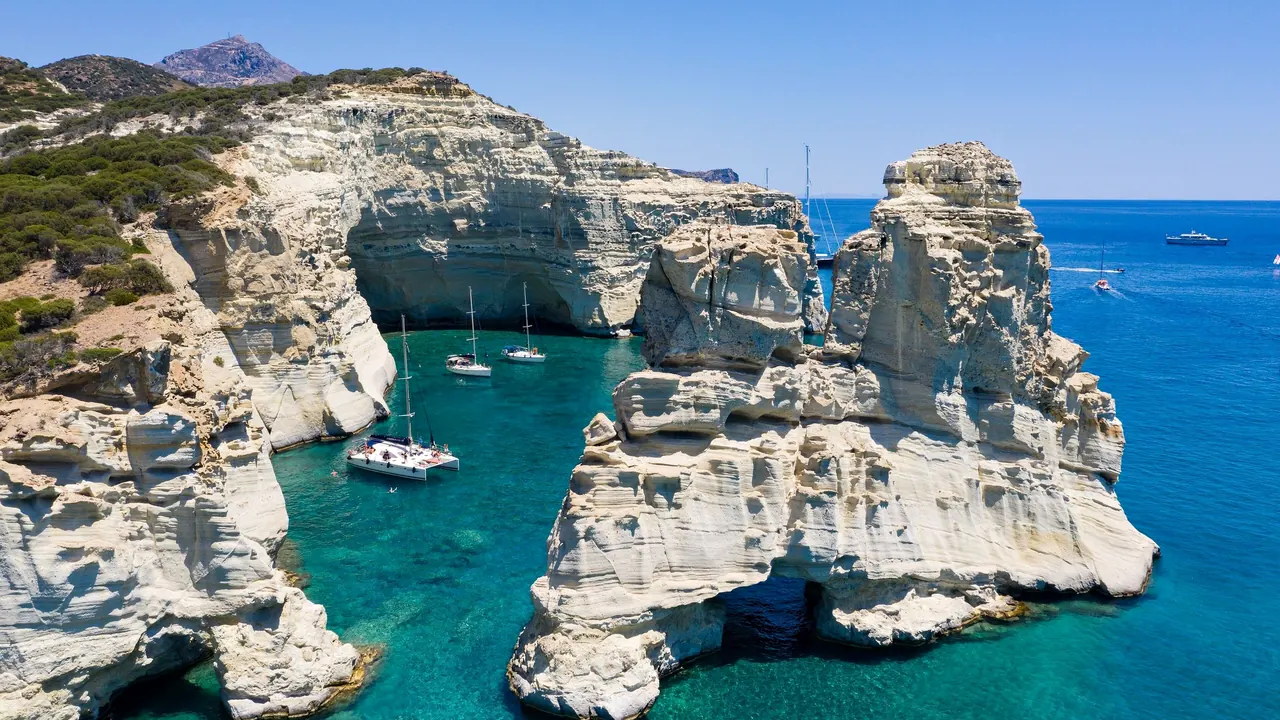
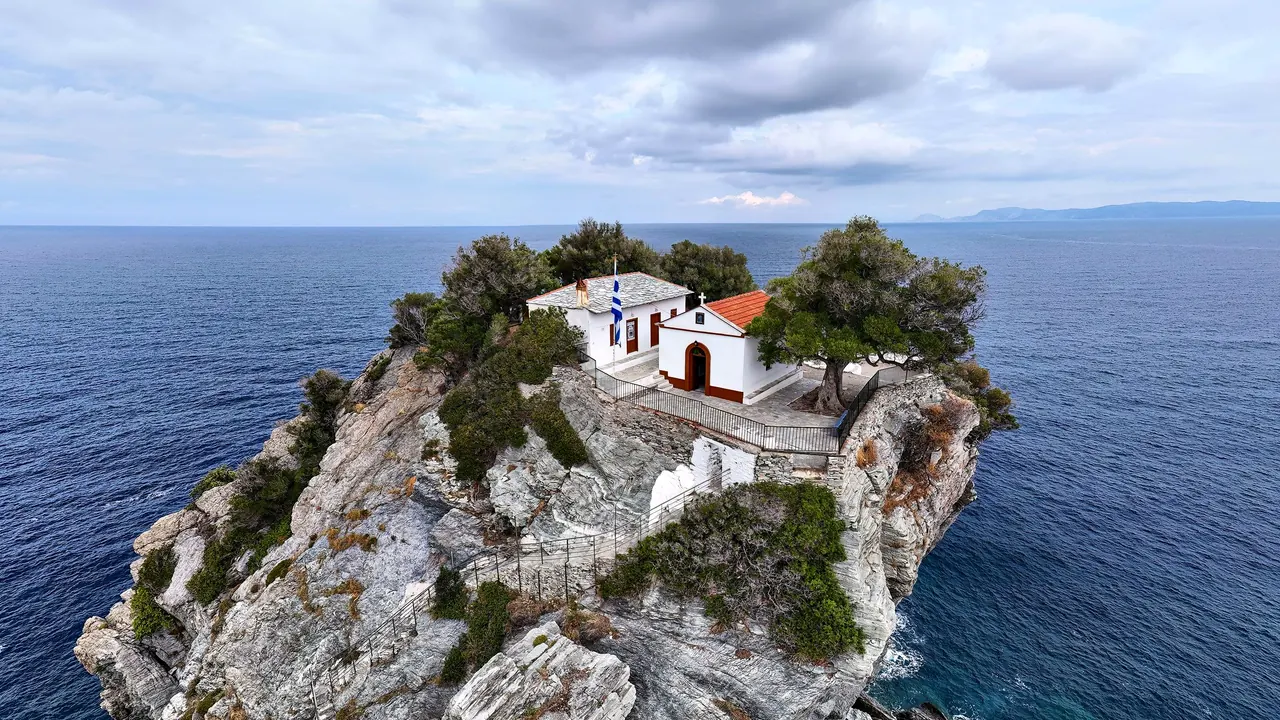
Photos: Milos by dronepicr, CC BY 2.0, cropped; Skopelos by Giles Laurent, CC BY-SA 4.0, cropped.
Milos or Skopelos?
Our verdict in twelve categories, each scored against the same fixed benchmark cities, and the climate month by month, so you can choose for your trip.
Choose Milos for
- wellness
- food and drink
- beaches
Milos is for travellers who come mainly for the sea and want it to look unlike anywhere else: white pumice at Sarakiniko, red and ochre cliffs, long sandy beaches on the south coast that some days you can only reach by boat. It also gives you more to do around the swimming, with the catacombs, the Roman theatre and Phylakopi, warm volcanic springs to soak in, and a short flight from Athens if you don't want the long ferry. Expect to pay more for rooms in summer.
Choose Skopelos for
- prices
- live music and the arts
- nature and the outdoors
If you'd rather swim from pine-shaded pebble coves and walk through green hills between monasteries, Skopelos is the better fit, and it usually costs less. Skopelos Town, with its slate roofs climbing up from the harbour, is a lovely place to stay, and boats run out into the marine park where monk seals and dolphins live. You won't find hot springs here, and getting to the island is slower, but you get a softer, wooded version of the Aegean at a more moderate price.
Scoreboard
Twelve categories on one fixed scale from 0 to 100. The shaded stretch is the gap between the two.
Your match
Pick a travel style or drag the sliders, and both match scores follow your weighting.
Too close to call, 2 points apart
Wins on wellness and food and drink with your weighting.
Wins on prices and live music and the arts with your weighting.
What matters to you?
Category by category
What the scores mean for a trip.
Beaches & swimming
Both islands are excellent for swimming and the water is very clear on both, but the beaches look and feel different. Milos is volcanic, so you get white pumice inlets at Sarakiniko and long sandy beaches such as Firiplaka and Paliochori. Many have no shade at all, and some can only be reached by boat.
On Skopelos the pine forest runs down to the beach in a string of sheltered bays along the south and west coasts, from Stafylos to Panormos and Kastani. Most are fine pebble or mixed sand and pebble, and there is usually a taverna nearby. On both islands the summer wind decides which coast to use: the south on Milos, the south shore on Skopelos.
Food & drink
Milos eats a little better and has a wider range of local dishes. Pitarakia cheese pies, ladenia flatbread and fresh catch in fishing villages like Klima give it a clear island identity, and Plaka and Tripiti have a few more ambitious kitchens with sunset terraces.
Skopelos is good, simple taverna food: its fried, coiled cheese pie, dishes made with its old-orchard plums, and goat and lamb in the hill villages. Fine dining hardly exists on either island, and many places on Skopelos close once summer ends.
Culture & sights
Neither island has a headline site, and a day or two covers either one, but the interest is different. On Milos it is archaeology: the early Christian catacombs below Plaka, the field where the Venus de Milo was found, the marble Roman theatre and the Bronze Age site at Phylakopi, along with the painted boathouses at Klima.
On Skopelos the town itself is the sight, with tiers of slate-roofed houses, a church on almost every corner and monasteries on Mount Palouki that you can walk up to. The Mamma Mia chapel on its rock is a striking view rather than history.
Nightlife
Both are quiet after dark and neither has clubs. On Milos the evening is built around sunset from Plaka's castle hill, then a few late bars in Adamas in high summer. On Skopelos it happens in the small bars in the town's lanes, some playing Greek music until late.
Nature & outdoors
Both islands are good for the outdoors, but they are very different landscapes. The best of Milos is along its coast: coloured cliffs at Papafragas, sea arches, and the rock towers and caves of Kleftiko, which you see best by sailing or kayaking round. Inland it is dry, bare and marked by old quarries.
Skopelos is the reverse, green and wooded from the shoreline up to Mount Delfi, with old mule tracks linking chapels and quiet bays. Its boat trips go into the marine park where monk seals and dolphins live, which Milos cannot offer.
Day trips
Day trips from both islands go by boat, depend on the timetable and are much thinner outside summer. From Milos, quiet Kimolos is a short crossing from Pollonia, and Sifnos, with its pottery and cooking, is within reach on the fast ferry.
From Skopelos you can choose between livelier Skiathos and the restored old village on Alonissos, often combined with swimming stops in the marine park.
Good for families
For simple beach days with children the two are about the same. Neither has attractions made for children, and in both, children are welcome at every taverna. On Milos, Pollonia with its beach in the village is the easiest base, but many good beaches need a dirt track or a boat, and there is little shade.
Skopelos has sheltered, gently shelving bays like Limnonari with tavernas close by, though the steps of Skopelos Town are hard work with a pushchair.
Getting around
Getting around is roughly equal, with the differences at the edges. Milos has a small airport with flights from Athens, which saves you the long ferry. Once there, you will want a car or quad, because the buses miss most of the coast and the west is all dirt roads.
Skopelos has no airport, so you arrive by boat, usually via Skiathos. A single main road with summer buses reaches the well-known beaches, and the car-free town is a place to explore on foot.
Shopping & style
Shopping on either island is an evening browse rather than a reason to go. Plaka's lanes have a few boutiques with linen and ceramics, and Skopelos Town has similar shops behind the harbour. The best things to bring home are food: capers and honey from Milos, prunes and almond sweets from Skopelos.
Affordability
Skopelos is clearly the cheaper island. Family-run studios and taverna meals there are moderately priced, and rooms only get scarce in July and August.
Milos costs more in summer, mostly because rooms in Pollonia, Plaka and Adamas are expensive and book out early, and car hire and boat trips to Kleftiko add to that. On both islands, June and September are noticeably cheaper.
Live music & performing arts
Neither island has a theatre or a programme of performances. Skopelos has a bit more regular live music, with rebetiko and island songs in town tavernas on summer nights. On Milos the music comes mainly from the village saints'-day feasts, with violin and lute late into the night, plus the occasional concert at the ancient theatre.
Wellness & relaxation
Milos is ahead here because its volcano still heats the ground. You can soak in the simple old baths at Lakkos or the springs near Provatas, feel the warm seabed at Paliochori, and find a few hotel spas around Pollonia and Plaka.
Skopelos has no springs or bathhouses and only a handful of treatments in season. What it offers instead is a slow pace in quiet, shaded villages.
When should you go?
Pick your month. The climate figures are measured averages, not a forecast.
Milos in July
Skopelos in July
Daytime high, °C
Rainfall in the month, mm
Where the figures come from
Milos has no weather station within reach, so its figures come from a gridded climate model rather than a measured record, and read a broad area rather than one spot.
Skopelos's temperatures are measured 68 km from the centre, at Skyros Airport.
Skopelos has no rain gauge within 25 km of the centre, so its rainfall comes from a gridded climate dataset read at the destination rather than from a gauge further away.
Temperature and rainfall are climate normals, averaged over the years shown. Milos: 2001-2020 normals, NASA POWER reanalysis grid, no weather station within 90 km. Skopelos: 1998-2025, 11 years observed (rainfall 1991-2020) normals, Skyros Airport (67.7 km from centre).
The two islands follow the same summer pattern, but Skopelos runs a little hotter. From June to September there is almost no rain on either, and the sea is warm enough to swim on both from June into early October. Milos peaks at about 27°C in August, and the north wind keeps it a little fresher. Skopelos reaches about 29°C in July and August, which makes walking its stepped lanes and hill paths hard work at midday. The sea there is a touch warmer at its peak, about 26°C.
The real difference comes in winter. Milos gets heavy rain from November to February, around 100mm a month at its wettest, while Skopelos is cooler but gets noticeably less. On both islands, the best time for walking and sightseeing is April, May and October, when it is mild and the summer heat has gone.
Which traveller are you?
For a beach and sun trip, Milos has the edge. Its volcanic coast gives you white, red and grey shores and long sandy beaches on the south coast, and when the summer wind blows you can always find a calm side of the island.
On a tight budget, Skopelos goes further. Summer buses on its main road reach the best-known bays, Skopelos Town is explored on foot, and grilled fish with local wine makes an ordinary evening. Much of Milos needs a hired car or a boat.
For a relaxing and wellness trip, Milos gives you more. Days can end with a soak in volcano-warmed water and the sunset from Plaka, and in June and September even the busier villages are calm. On Skopelos, rest means pine shade and quiet rather than treatments.
Before you go
| Measure | Milos | Skopelos |
|---|---|---|
| Official language | Greek | Greek |
| Currency | Euro (EUR) | Euro (EUR) |
| Sockets | CF230 V, 50 Hz | CF230 V, 50 Hz |
| Driving side | Right | Right |
| Time zone | UTC+2, UTC+3 in summer | UTC+2, UTC+3 in summer |
| Emergency number | 112 | 112 |
| Main airport | Milos Airport (MLO)2 non-stop destinations | Skiathos Island National Airport (JSI)37 non-stop destinations |
| Public holidays this year | 15 days | 15 days |
By the numbers
| Measure | Milos | Skopelos |
|---|---|---|
| Swim season, months above 21 °C | 5 months | 5 months |
Where else could you go?
Every comparison below shares a destination with this one, so you can follow Milos or Skopelos somewhere new.