Milos or Zakynthos?
Our verdict in twelve categories, each scored against the same fixed benchmark cities, and the climate month by month, so you can choose for your trip.
Choose Milos for
- culture and sights
- wellness
- day trips
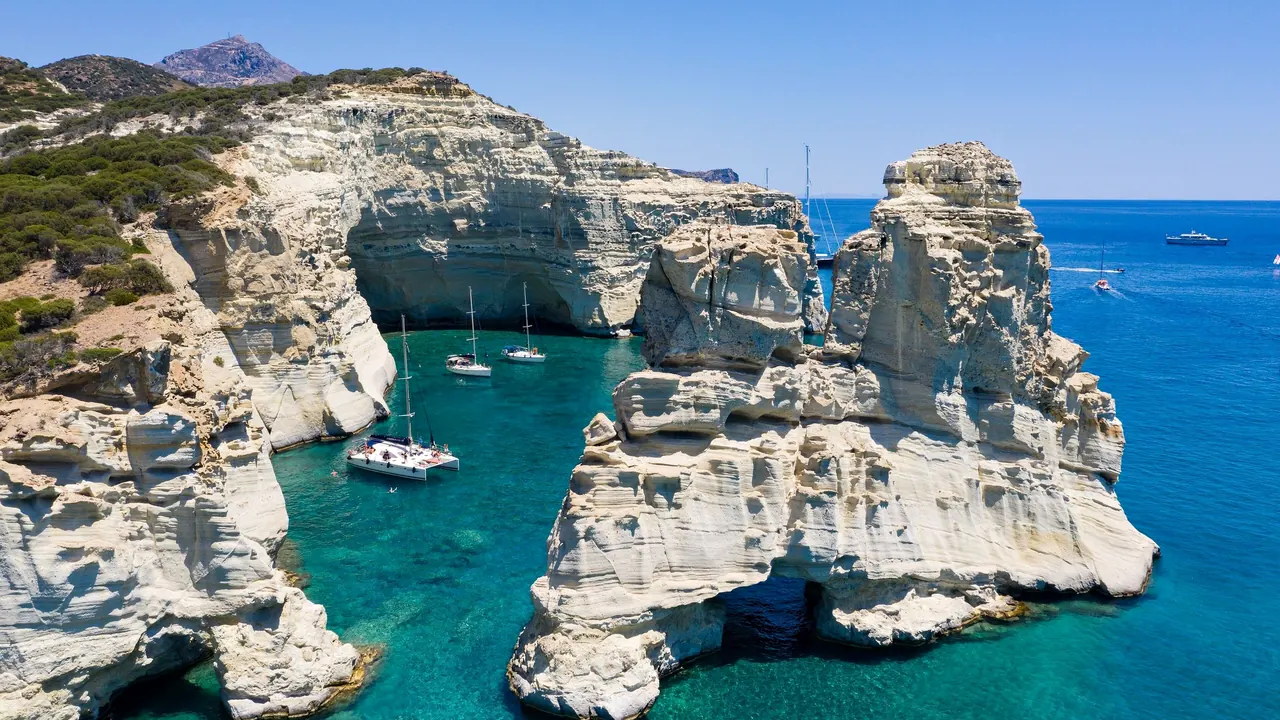
Milos suits travellers who want a quiet island and an unusual coast. Its volcanic shore of white pumice, red cliffs and boat-only sands is best seen by sailing round to Kleftiko. Evenings are taverna dinners and sunsets from Plaka, and there are natural hot springs to soak in. It also has more history to fill a spare day. In return you pay more for rooms, need a car and face a longer journey to get there.
Choose Zakynthos for
- nightlife
- prices
- families
Zakynthos is the easier and cheaper choice, especially for families and for groups who want a party. Package resorts keep rooms moderately priced, the north-east coast has calm sand and hotels with pools and kids' clubs, and Laganas runs loud nights until dawn all summer. Turtle-spotting boats and the clifftop view of Navagio make good outings. It is hotter in midsummer, and the busy strips are less peaceful than anywhere on Milos.
Scoreboard
Twelve categories on one fixed scale from 0 to 100. The shaded stretch is the gap between the two.
Your match
Pick a travel style or drag the sliders, and both match scores follow your weighting.
Wins on culture and sights and wellness with your weighting.
Wins on nightlife and prices with your weighting.
What matters to you?
Category by category
What the scores mean for a trip.
Beaches & swimming
Beaches are the main reason to visit either island, and both are excellent, but they feel quite different. Milos has a volcanic shore. There are the white pumice inlets of Sarakiniko and coloured sand and rock elsewhere, while the long south-coast beaches like Firiplaka and Tsigrado are often bare of sunbeds and sometimes reachable only by boat. The north wind decides each day which coast is calm.
Zakynthos is softer and more developed. The long sandy curve of Laganas Bay, Banana Beach and the shallow water at Tsilivi and Alykes are classic resort beaches, and the sunbeds fill up in high summer. Its quieter sands are the protected turtle-nesting beaches at Gerakas and Dafni. Navagio is something you look at from the clifftop or a boat, not a beach to spend the day on.
Food & drink
The two are broadly level: honest Greek taverna cooking, with the best meals in the villages rather than on the busy waterfronts. Milos has pitarakia cheese pies, ladenia flatbread and the morning's catch grilled in Klima, plus a few more ambitious kitchens with sunset terraces in Plaka.
Zakynthos has garlicky skordostoumbi, ladotyri cheese kept in oil, mantolato nougat and its own Verdea wine, best found in the villages around Keri. Laganas and Tsilivi serve full English breakfasts and international menus that Milos barely has.
Culture & sights
Milos has more to see. The early Christian catacombs below Plaka, the field where the Venus de Milo was found and a marble Roman theatre lie close together. Add the Bronze Age site at Phylakopi, the castle ruins above Plaka and the boathouses at Klima, and you have a good two days of sightseeing.
On Zakynthos the 1953 earthquake took most of the Venetian capital. Today's offer is the Byzantine Museum with its Ionian school icons, the Solomos museum, Agios Dionysios and the castle on Bochali hill, which fill about half a day.
Nightlife
Zakynthos has a real night out, though it is all in one place. The Laganas strip runs bars, clubs and foam parties until dawn from June to September, mostly for young British groups. Outside Laganas, the rest of the island is as quiet as Milos.
On Milos an evening means the sunset from Plaka's castle hill or a terrace in Tripiti, a long dinner, then a drink on the harbour at Adamas or Pollonia. A few bars stay open late in high summer, but there is nowhere to dance.
Nature & outdoors
The outdoors are evenly matched, and both are best seen from the water, but the scenery is different. Milos is pure volcano: red and yellow cliffs at Firopotamos and Papafragas, pumice ravines, and the arches and caves of Kleftiko on a sailing or kayak trip. Inland it is dry and marked by old quarries.
Zakynthos has wildlife and greenery as well. Laganas Bay is a marine park where early boats often spot loggerhead turtles. The diving is good off the Keri caves and the north. Its olive-covered hills climbing to Mount Vrachionas are kinder to walkers and cyclists than the bare interior of Milos.
Day trips
On both islands, day trips depend on the ferries, and neither offers much. From Milos you can sail to other Cyclades: Kimolos is a short hop from Pollonia, and in summer Sifnos is about an hour away. The wind can disrupt the schedule.
From Zakynthos you can reach southern Kefalonia from the northern tip, or cross to the mainland at Kyllini for Chlemoutsi castle and a long but rewarding day at ancient Olympia, a bigger sight than anything near Milos.
Good for families
Zakynthos is far better set up for children. The north-east coast around Tsilivi, Planos and Alykes has shallow sand, and its resort hotels have pools and kids' clubs. There is an inland water park, and children love the turtle and sea-cave boat trips.
Milos gives families simple beach days: Pollonia has a sheltered beach in the village, and Provatas and Paliochori are gentle. But there is nothing built for children, you need a car to get almost anywhere, shade is scarce and the ferry crossing can be rough.
Getting around
On both islands you need a car or scooter, since buses only serve the main resorts and villages. On Milos the western half is reached on rough dirt roads that some rental agreements exclude, and getting to the island itself means a long ferry from Piraeus or a small flight from Athens.
Zakynthos has an international airport used by package flights, so arrival is simpler. Its buses link the town with Laganas, Tsilivi and Alykes, and the resort strips are walkable, but the cliffs and villages of the west need your own wheels.
Shopping & style
Neither island is a place to shop. On Milos the boutiques in Plaka's lanes sell linen, jewellery and ceramics, and capers and honey are the things to take home. On Zakynthos there is everyday shopping on Alexandrou Roma street in town, village lace around Volimes, and mantolato and Verdea to pack.
Affordability
Zakynthos is clearly cheaper. Package tourism keeps rooms in the big resorts at moderate prices even in summer, so mostly it is boat trips, car hire and sunbeds that add up.
On Milos the rooms are the problem: in July and August, Pollonia, Plaka and Adamas are costly and book out early, and boat trips to Kleftiko add more. Taverna meals are fair on both islands, and on both June and September cost noticeably less.
Live music & performing arts
Neither island has a stage season, but Zakynthos has more music of its own. Small groups sing kantades and arekia serenades in the town and village tavernas, an old philharmonic band plays at feasts, and at carnival villagers perform omilies street theatre. On Milos live music means dancing to violin and lute at the summer panigyria, the village saints'-day feasts, plus the odd concert at the ancient theatre.
Wellness & relaxation
Milos is better for unwinding, thanks partly to its volcano. You can soak in the old baths at Lakkos in Adamas or the springs near Provatas, and at Paliochori the sand is warm underfoot. A few hotels around Pollonia and Plaka have spas.
Zakynthos has resort spas and the cool sulphur springs at Xigia. For real calm you have to choose your base, such as the villages around Keri or the Vasilikos peninsula, well away from Laganas.
When should you go?
Pick your month. The climate figures are measured averages, not a forecast.
Milos in July
Zakynthos in July
Daytime high, °C
Rainfall in the month, mm
Where the figures come from
Milos has no weather station within reach, so its figures come from a gridded climate model rather than a measured record, and read a broad area rather than one spot.
Temperature and rainfall are climate normals, averaged over the years shown. Milos: 2001-2020 normals, NASA POWER reanalysis grid, no weather station within 90 km. Zakynthos: 1991-2020 normals, Zakinthos / Agrilia (4.3 km from centre).
Both islands are beach destinations from June to October, and their seas warm at almost the same pace, reaching about 25°C by August. The real difference is the air. Milos stays milder, with summer highs around 27°C, so walking up to Plaka or along the coast is still pleasant in July and August. On Zakynthos the days reach about 33°C in August under very long hours of sunshine, which makes the middle of the day hard going for sightseeing or walks.
Autumn also plays out differently. Milos stays fairly dry into October, but on Zakynthos the rain returns in September and gets much heavier, with November bringing about 150mm. For a late-season swim, Milos is the safer bet. In May both islands are warm, dry and good for walking, but the sea is still cool. Winters are mild and wet on both, and neither is a beach destination then.
Which traveller are you?
On a relaxing and wellness trip, choose Milos. Stay in Pollonia or an inland village and come in June or September, when the sea is still warm and the island is at its slowest. Zakynthos is restful only in pockets, and its midsummer heat is harder to idle through.
For a food and nightlife trip, Zakynthos is the pick, because Milos has nowhere to dance. The tavernas are equally good on both islands. Stay in Kalamaki, close enough to the Laganas strip but quieter at night, and spend your evenings off in the villages around Keri.
On a family trip with young children, Zakynthos is easier. A package flight lands on the island itself, a north-east coast resort keeps every drive short, and June avoids the worst of the heat. Milos only suits families who are happy with a hire car and simple beaches.
Before you go
| Measure | Milos | Zakynthos |
|---|---|---|
| Official language | Greek | Greek |
| Currency | Euro (EUR) | Euro (EUR) |
| Sockets | CF230 V, 50 Hz | CF230 V, 50 Hz |
| Driving side | Right | Right |
| Time zone | UTC+2, UTC+3 in summer | UTC+2, UTC+3 in summer |
| Emergency number | 112 | 112 |
| Main airport | Milos Airport (MLO)2 non-stop destinations | Zakynthos International Airport "Dionysios Solomos" (ZTH)69 non-stop destinations |
| Public holidays this year | 15 days | 15 days |
By the numbers
| Measure | Milos | Zakynthos |
|---|---|---|
| Population | - | 41,180 |
| People per km² | - | 102 |
| Swim season, months above 21 °C | 5 months | 5 months |
Where else could you go?
Every comparison below shares a destination with this one, so you can follow Milos or Zakynthos somewhere new.