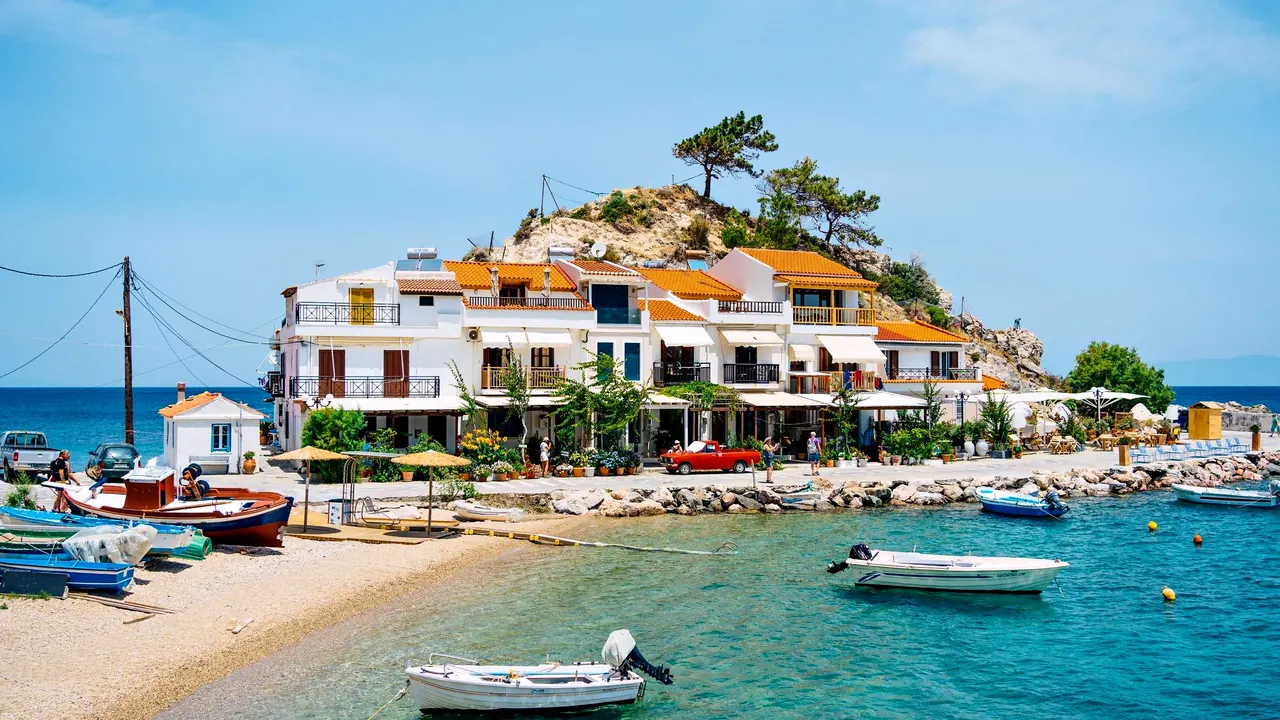
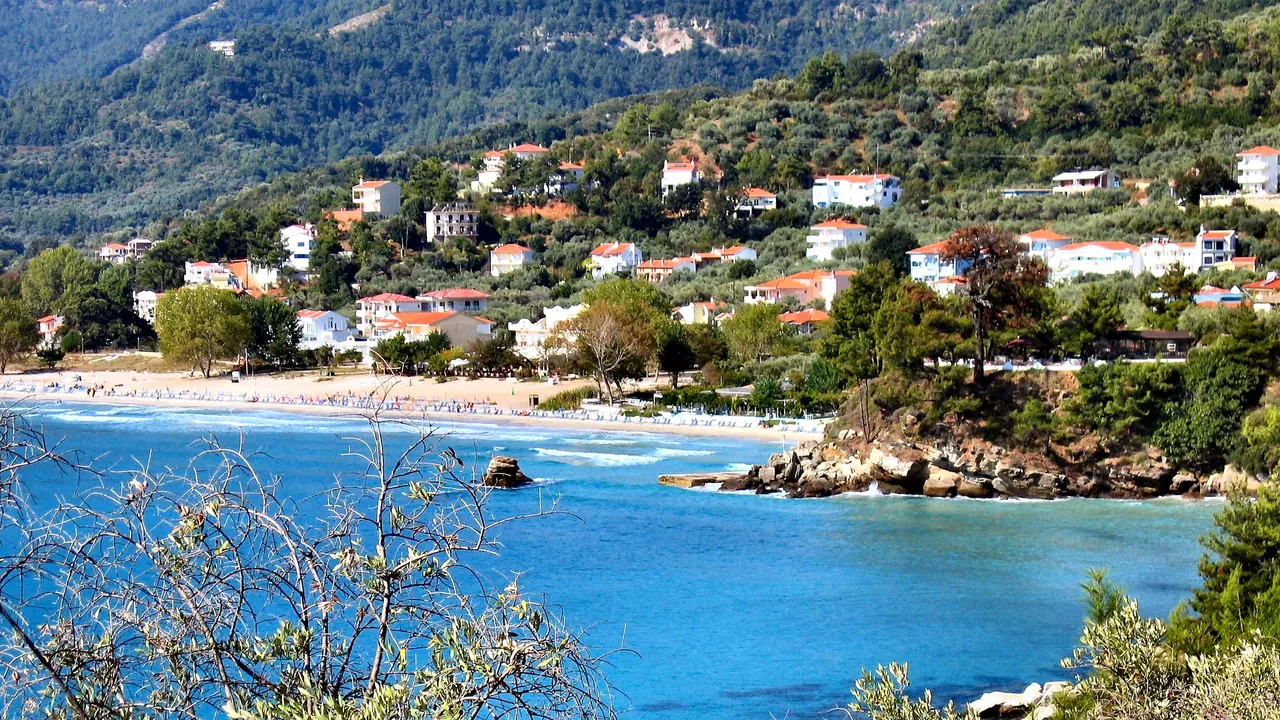
Photos: Samos by Thomas Ronveaux, Pexels License; Thassos by Ronald Saunders from Warrington, UK, CC BY-SA 2.0, cropped.
Samos or Thassos?
Our verdict in twelve categories, each scored against the same fixed benchmark cities, and the climate month by month, so you can choose for your trip.
Choose Samos for
- day trips
- culture and sights
- food and drink
Samos suits travellers who want more than a beach from their island. Around Pythagoreio stand the Heraion and the Tunnel of Eupalinos, the Muscat wine villages above Kokkari give the eating some character, and the boat to Kusadasi for Ephesus or to Patmos makes for outings few Greek islands can match. It also has wilder walking country in the west. You pay for that with more driving between scattered beaches and higher prices in August.
Choose Thassos for
- getting around
- prices
- families
Thassos is the easier and cheaper choice for a straightforward sea-and-sand vacation. One ring road reaches every bay, several beaches shelve gently into calm water, and the small resorts are simple to manage with children. Its ancient sights and mainland excursions are pleasant extras rather than the point of the trip, so it works best for people who want to swim, eat in tavernas and not plan much.
Scoreboard
Twelve categories on one fixed scale from 0 to 100. The shaded stretch is the gap between the two.
Your match
Pick a travel style or drag the sliders, and both match scores follow your weighting.
Too close to call, 2 points apart
Wins on day trips and culture and sights with your weighting.
Wins on getting around and prices with your weighting.
What matters to you?
Category by category
What the scores mean for a trip.
Beaches & swimming
Both islands are built around swimming, and the real difference is the kind of beach. Samos leans to fine pebble and sand-and-shingle bays backed by pines and olives. Its most striking water, on the north coast around Kokkari, Lemonakia and Tsamadou, catches the meltemi wind, so on breezy days you head south to sandy Psili Ammos or the long, quiet shore at Votsalakia. The Seitani bays reward those willing to walk.
Thassos has more proper sand, most of all the long curve of Golden Beach at Skala Potamia, along with Psili Ammos, Pefkari and Potos in the south. It also has some unusual swims: the white marble pebbles of Saliara and the Giola rock pool near Astris. Wild coves are easy to find by car around its ring road.
Food & drink
Samos eats a little better, mainly thanks to its Muscat. The sweet wine and the dry whites from the terraces of Vourliotes and Manolates give meals a local signature, and the mountain villages serve slow-cooked goat and wild greens that taste more of the island than the harbour tavernas do.
Thassos offers the same honest taverna cooking, with fish at Limenaria and Skala Marion and roast lamb under the plane trees of Theologos. Its resort menus are more repetitive, though, and many kitchens close outside summer. Pine honey, spoon sweets and an afternoon tsipouro are its pleasures. On neither island will you find fine dining or much variety.
Culture & sights
Samos has a sight of real rank. The Heraion sanctuary and the Tunnel of Eupalinos, dug through a mountain from both ends in the 6th century BC, form a UNESCO site around Pythagoreio, and the museum in Vathy displays a kouros about 5m tall. Monasteries and stone villages fill the rest of a two- or three-day programme.
Thassos has its own kouros, one carrying a ram, plus a good ancient city at Limenas: the agora by the harbour, a theatre in the pines and gate reliefs in the old walls. The marble quarries and basilicas at Aliki are atmospheric too. Still, it makes an enjoyable morning away from the beach rather than a reason to choose the island.
Nightlife
Evenings are equally low-key on both, with long dinners and a drink by the water and no clubs to speak of. On Samos the busiest scene is the cocktail bars on Pythagoreio's harbour, and the best nights are the village festivals with dancing in the square.
Thassos has more of a young crowd, on the bar strip at Potos and at the beach bars of Golden Beach playing music late in July and August, with Limenas's old port as the other hub.
Nature & outdoors
Both are unusually green for the Aegean, but Samos is the wilder island. Mount Kerkis rises bare and limestone to about 1,430m in the west, the Potami gorge has its waterfalls, and monk seals are sometimes seen off the protected Seitani coast. Spring adds orchids and birdlife at the salt lake near Psili Ammos.
Thassos is forested from shore to summit, and the walk up Ypsario looks out to Mount Athos. Its outdoors is more about activity: sea kayaking around the eastern and southern coves, snorkelling and diving in clear water, and mountain biking on forest tracks.
Day trips
Samos wins easily here. A ferry to Kusadasi puts Ephesus within a day, as long as you bring a passport, and Patmos with its Monastery of St John and Cave of the Apocalypse is a couple of hours away by fast boat. Ikaria, Fourni and the islet of Samiopoula offer slower days at sea.
From Thassos the outings point to the mainland: Kavala's castle and Ottoman quarter, with Philippi just beyond, fit into one good day, and Xanthi's old town is a longer drive. Every trip starts with a ferry, so most visitors make only one or two.
Good for families
Thassos is the more practical choice with children. Several of its sandy bays, Golden Beach, Skala Prinou and Pefkari among them, shelve into calm water, the resorts are small, and the short crossing from the mainland feels like an outing in itself. Choose a sandy bay as your base, as some coves need steep paths.
Samos has one excellent family beach in Psili Ammos and an easy, flat base in Pythagoreio, but its prettier northern beaches are pebbly and windy, and reaching them means more driving. Neither island has water parks or zoos, so both suit families happy with sand, sea and tavernas.
Getting around
Thassos is simpler to grasp: one road rings the coast, every beach and village sits on it or just above, and no drive is long. The catch is getting there, since you need a ferry from Keramoti or Kavala, and queues build on summer weekends.
Samos has its airport right by Pythagoreio, and its three main towns are under half an hour apart. Beyond them, though, buses miss most beaches, the roads to the hill villages and around Kerkis are narrow and slow, and ferries leave from three different ports, so it takes more planning.
Shopping & style
Neither island is for shopping, and on both the best things to take home are edible. Samos means bottles of Muscat and thyme honey, with a few ceramics and jewellery shops in Vathy's backstreets. Thassos has pine honey and spoon sweets from roadside stalls, and its one craft is the local white marble, carved in a few workshops.
Affordability
Thassos is the cheaper of the two. Its studios and tavernas are priced for the many visitors who drive down from the Balkans, and staying in June or September gets you the same sea for less. The ferry and a hire car are the only real extras.
Samos is reasonable by Greek island standards, well below the famous Cyclades, but August brings Greek visitors and higher prices. A car is again a must, and its best day trips, especially the boat to Turkey, cost more than anything on the Thassos itinerary.
Live music & performing arts
Both islands are thin on performance, and what there is happens outdoors in summer. Samos stages concerts and plays at the castle in Pythagoreio and near the Heraion, and it holds panigiria in July and August. Thassos uses its ancient theatre above Limenas for festival plays, and its village feasts peak around mid-August. Samos at least has the odd concert in Vathy out of season.
Wellness & relaxation
Neither island has hot springs or a bathing tradition, and spas are limited to a few resort hotels on both. Samos is slightly better for switching off: its shaded hill-village squares and the quiet south coast around Marathokampos are made for slow days, especially in June and September.
Thassos offers rest of a similar kind, with lunches under the plane trees of Theologos or Panagia and calm south-eastern bays, plus the occasional yoga session. Its evenings get louder around Limenas and Potos.
When should you go?
Pick your month. The climate figures are measured averages, not a forecast.
Samos in July
Thassos in July
Daytime high, °C
Rainfall in the month, mm
Where the figures come from
Samos's sunshine is measured 82 km from the centre, at Aydin.
Thassos has no rain gauge within 25 km of the centre, so its rainfall comes from a gridded climate dataset read at the destination rather than from a gauge further away.
Temperature and rainfall are climate normals, averaged over the years shown. Samos: 1991-2020 normals, Samos Airport (2.4 km from centre). Thassos: 1997-2020 (rainfall 1991-2020) normals, Chrysoupoli Airport (24.5 km from centre).
Samos is the hotter and drier island. From June to September it hardly rains, July and August reach about 33°C under long sunny days, and the sea stays warm enough to swim from June well into October. That midsummer heat makes the mountain paths and even the streets of Vathy hard going in the middle of the day, so May and early October are the best months to mix sightseeing, walks and swimming. Winter is wet, with close to 147mm of rain in December, and the beach season is over from November to April.
Thassos lies further north and is a few degrees cooler all year, peaking around 31°C in August. Its summer is not quite as dry, with the odd shower in June. The sea is chilly in spring but warms fast, reaching about 26°C in August, slightly warmer than Samos, then cools sooner in October, so swimming there is really June to September. Winters are colder than on Samos but less rainy. On both islands, spring and September are the comfortable months for walking.
Which traveller are you?
On a culture and arts trip, Samos gives you a real programme: stay in Pythagoreio, see the ancient sites before the heat builds, and keep a day for Ephesus across the strait. On Thassos, the ruins at Limenas fill a morning before the beach.
On a family trip with young children, Samos has its calm, sandy water in one southern corner, and going anywhere else means pebbles, wind and driving. Thassos is easier: choose a sandy bay and you can stay put all week.
For a trip on a tight budget, Samos asks for some discipline: stay on the quieter south coast, eat inland and ration the ferries. Thassos makes it easier, since a modest room and a taverna table already cover most of what the island offers.
Before you go
| Measure | Samos | Thassos |
|---|---|---|
| Official language | Greek | Greek |
| Currency | Euro (EUR) | Euro (EUR) |
| Sockets | CF230 V, 50 Hz | CF230 V, 50 Hz |
| Driving side | Right | Right |
| Time zone | UTC+2, UTC+3 in summer | UTC+2, UTC+3 in summer |
| Emergency number | 112 | 112 |
| Main airport | Samos Airport (SMI)20 non-stop destinations | Kavala Alexander the Great International Airport (KVA)15 non-stop destinations |
| Public holidays this year | 15 days | 15 days |
By the numbers
| Measure | Samos | Thassos |
|---|---|---|
| Population | 32,642 | 13,100 |
| People per km² | 69 | 35 |
| Swim season, months above 21 °C | 5 months | 4 months |
Where else could you go?
Every comparison below shares a destination with this one, so you can follow Samos or Thassos somewhere new.