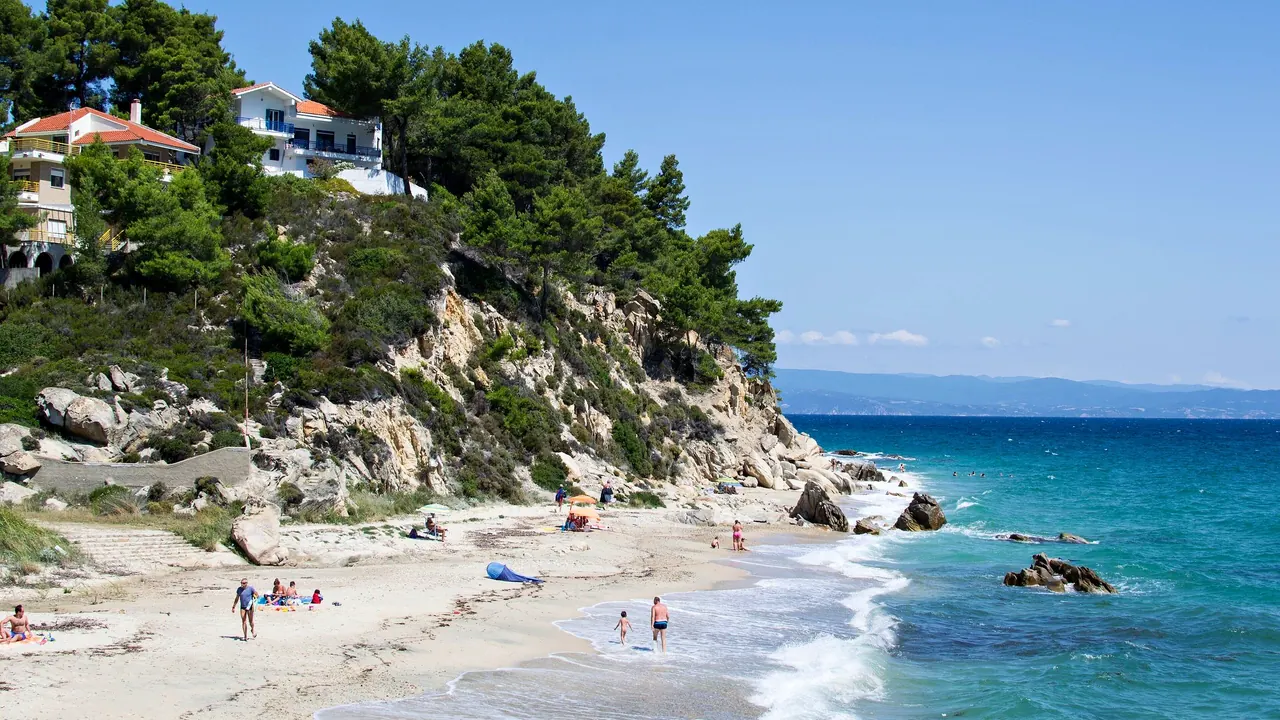
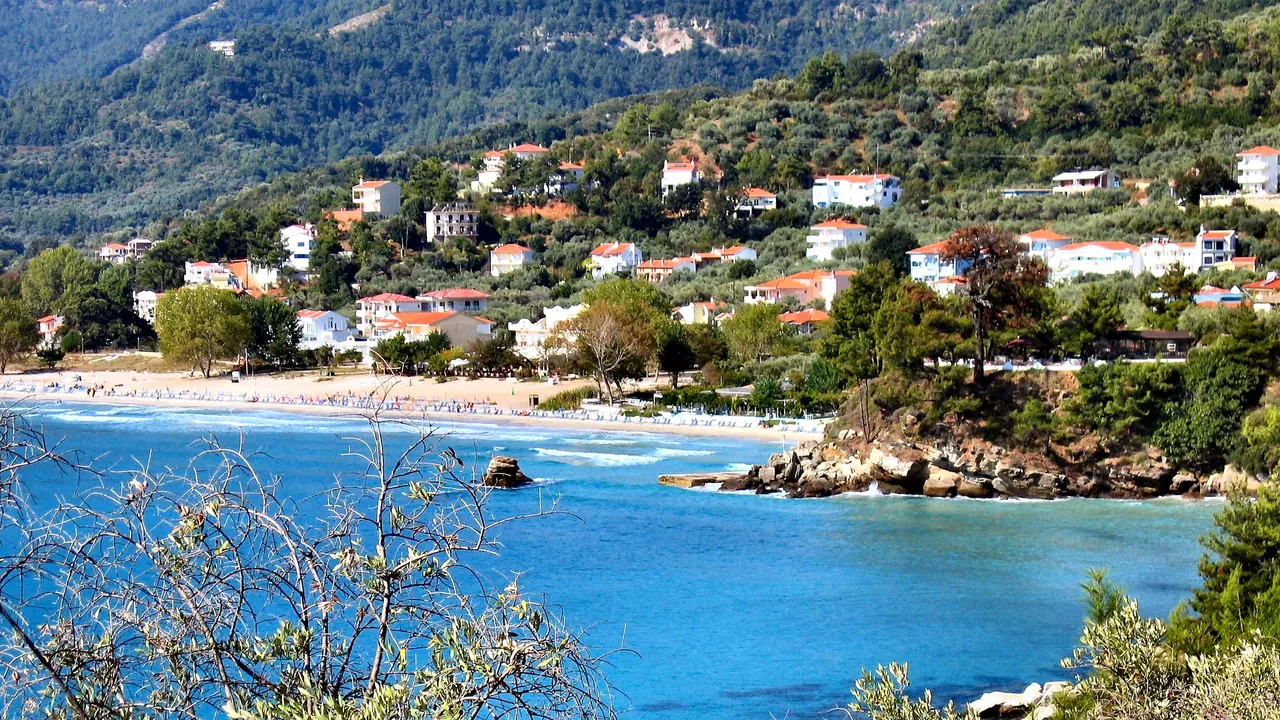
Photos: Halkidiki by Sprint28, CC BY-SA 3.0, cropped; Thassos by Ronald Saunders from Warrington, UK, CC BY-SA 2.0, cropped.
Halkidiki or Thassos?
Our verdict in twelve categories, each scored against the same fixed benchmark cities, and the climate month by month, so you can choose for your trip.
Choose Halkidiki for
- day trips
- nightlife
- wellness
Halkidiki suits travellers who want choice and some range within one trip. Its three peninsulas give you lively Kassandra, with organised beaches, family resorts, late clubs and proper spas, and wilder Sithonia, with granite coves and quiet evenings. Thessaloniki is close enough for a day of Byzantine churches and serious food. The price is more driving, a busier and pricier high season, and a base that you'll want to choose carefully.
Choose Thassos for
- getting around
- prices
- culture and sights
Thassos is for travellers who want a compact island that's easy to manage and costs less. One coast road reaches every bay, from the sand at Golden Beach to the marble pebbles at Saliara. The green mountain villages and the ancient city above Limenas fill the hours away from the sea. Evenings stay quiet and the mainland is a ferry ride away, so it fits a slow, simple beach vacation better than a varied one.
Scoreboard
Twelve categories on one fixed scale from 0 to 100. The shaded stretch is the gap between the two.
Your match
Pick a travel style or drag the sliders, and both match scores follow your weighting.
Wins on day trips and nightlife with your weighting.
Wins on getting around and prices with your weighting.
What matters to you?
Category by category
What the scores mean for a trip.
Beaches & swimming
Both are first-rate beach destinations, and the difference is scale against compactness. Halkidiki has hundreds of kilometres of shore across three peninsulas. Kassandra has long organised beaches with sunbeds and bars, while Sithonia has rocky granite coves such as Kavourotrypes and Karydi, and Ammouliani is good for calmer water.
Thassos packs its variety into one loop of coast. There's fine sand at Golden Beach, white marble pebbles at Saliara, pine-backed coves at Paradise Beach and Aliki, and the rock pool at Giola. Quiet coves are easy to find by car even in August, whereas Halkidiki's beaches fill with weekend crowds from Thessaloniki.
Food & drink
Halkidiki eats better. Its fishing villages, Nikiti, Toroni and Ouranoupoli, cook mussels and grilled fish for Greek visitors, and there are Athos wines and vineyards above Neos Marmaras to explore. Thessaloniki, a real food city, makes an easy lunch trip.
On Thassos the cooking is honest but narrower. The highlights are slow-roasted goat under the plane trees in Theologos and Panagia, along with pine honey and walnut or fig spoon sweets. Resort menus repeat themselves, and many kitchens close once summer ends.
Culture & sights
Neither is a cultural destination, but the sights differ in kind. Halkidiki's great heritage is Mount Athos, which most visitors only see from a cruise boat out of Ouranoupoli. Its other sites, Olynthos, ancient Stagira and the Petralona cave, are spread far apart.
Thassos keeps its history in one place. The agora, the theatre in the pines, the acropolis, the city walls and the archaeological museum are all walkable from the harbour at Limenas. Aliki's marble quarries and the stone village of Theologos round out a few easy half-days.
Nightlife
Halkidiki has the real summer scene, almost all of it on Kassandra. Kallithea's open-air clubs run latest, bar strips in Pefkohori, Hanioti and Polychrono fill after midnight, and young crowds drive in from Thessaloniki at weekends.
Thassos has no club scene to speak of. Evenings mean harbour bars in Limenas, the younger strip at Potos and a few beach bars at Golden Beach in high summer, and most villages are quiet soon after midnight.
Nature & outdoors
The outdoors are about equal but point in different directions. Halkidiki looks to the sea: Sithonia's granite headlands and islets, kayaking the coves, and boat trips to Diaporos and its lagoon. Its one serious hike, the mule paths between the Athos monasteries, is open only to men with a permit.
Thassos is greener and more of a mountain island. Pine, plane and chestnut forest climbs to Mount Ypsario at about 1,200m, and there are waterfalls near Kallirachi and Maries. Old mule tracks between villages and mountain-bike trails give walkers more to do inland.
Day trips
Thessaloniki is the day out that tips this towards Halkidiki. It is an hour or so by road for the Byzantine churches, the White Tower and the waterfront. The royal tombs at Vergina and old Pella make a longer day, Kavala and Amphipolis lie beyond the Athos side, and the stone village of Arnea is a change from the coast without leaving the region.
From Thassos, every excursion starts with a ferry. Kavala's castle and Ottoman quarter pair well with ancient Philippi in one day, and Xanthi's old town is possible by car. After that, most visitors stay on the island.
Good for families
Halkidiki has the edge for young children. Large resorts on Kassandra come with pools and children's clubs, and beaches such as Gerakini and Psakoudia stay shallow a long way out. The catch is the long drives between peninsulas.
Thassos offers a smaller, simpler version. Golden Beach, Skala Prinou and Pefkari shelve gently, the resorts are easy to manage, and children often enjoy the ferry. Some of the prettiest coves need steep paths, though. Neither destination has zoos, aquariums or theme parks.
Getting around
Thassos is much easier. A single ring road links every resort and beach, the crossing from Keramoti takes well under an hour, and no drive on the island is long. The only real waits are the summer-weekend ferry queues.
Halkidiki's shape works against you. Each peninsula is a long finger, so getting from Kassandra to Sithonia or Athos means driving back to the base and down again. Southern Sithonia is close to two hours from the airport, and buses are too sparse to rely on.
Shopping & style
Neither is a place to shop, and on both the best things to take home are edible: honey, olives and olive oil. Halkidiki adds icons and incense from Ouranoupoli at the gate to Athos, and Thessaloniki is close for proper shopping. Thassos has its marble workshops and walnut and fig spoon sweets.
Affordability
Thassos is the cheaper of the two. Rooms are mostly family-run studios and taverna bills stay modest even in Potos or Limenas. The extra costs to budget for are the ferry and the hire car you'll almost certainly need.
Halkidiki has plenty of simple rooms and fair-priced village tavernas too. Costs rise faster at the big Kassandra resort hotels and on organised beaches, where sunbeds add up over a week. Outside July and August, both are noticeably cheaper for the same sea.
Live music & performing arts
Open-air summer festivals give Halkidiki the fuller programme. The Kassandra Festival stages concerts and theatre in the amphitheatre at Siviri, the Sani Festival adds jazz and classical evenings on the resort coast, and Thessaloniki's stages are within reach the rest of the year.
On Thassos, live performance is occasional. There are a few plays and concerts in the ancient theatre above Limenas, plus music and dancing in the village squares around the mid-August feast days.
Wellness & relaxation
For actual treatments, Halkidiki is ahead. The thermal springs at Agia Paraskevi have warm mineral pools above the sea on Kassandra's southern tip, and the large resorts run full spas with hammam-style rooms. Sithonia supplies the calm.
Thassos offers rest rather than pampering. There are only a few hotel spas, so the restorative part is the long lunches in Theologos or Panagia and the quiet bays of the south-east.
When should you go?
Pick your month. The climate figures are measured averages, not a forecast.
Halkidiki in July
Thassos in July
Daytime high, °C
Rainfall in the month, mm
Where the figures come from
Halkidiki's temperatures are measured 64 km from the centre, at Thessaloniki Airport.
Halkidiki has no rain gauge within 25 km of the centre, so its rainfall comes from a gridded climate dataset read at the destination rather than from a gauge further away.
Thassos has no rain gauge within 25 km of the centre, so its rainfall comes from a gridded climate dataset read at the destination rather than from a gauge further away.
Temperature and rainfall are climate normals, averaged over the years shown. Halkidiki: 1991-2020 normals, Thessaloniki Airport (63.7 km from centre). Thassos: 1997-2020 (rainfall 1991-2020) normals, Chrysoupoli Airport (24.5 km from centre).
The two follow the same northern Aegean year. The sea is warm enough to swim from June, reaches about 26°C in August on both coasts and stays pleasant through September. Halkidiki's resort coast runs a degree or two hotter, with highs near 32°C in July and August and long, dry, sunny days all summer, while Thassos peaks a little lower. Midsummer is too hot for comfortable walking on Sithonia's hill paths or the climbs to the Thassos mountain villages, so May and late September are the months to combine the beach with walking.
From October the daytime air is the same in both places, mild through autumn and cool in winter, but the rain is not. Halkidiki's autumn and winter are fairly damp, and Thassos is noticeably wetter, with November and December near 80mm. The sea also holds its warmth slightly better off Halkidiki, at 21°C in October against 20°C, so it is the safer pick for an early-autumn swim.
Which traveller are you?
On a food and nightlife trip, Halkidiki is the better choice. Kallithea's open-air clubs and the bar strips of Pefkohori and Hanioti keep going well past midnight. The fishing villages and Athos wines beat Thassos's simpler tavernas, and Thessaloniki is close by for a day of eating.
For a trip on a tight budget, Thassos goes further. Its family-run studios and village tavernas are priced for visitors driving down from the Balkans, and its single ring road keeps journeys short. Halkidiki's Kassandra resorts and paid sunbeds push the bill up in summer.
For a relaxing and wellness trip, choose Halkidiki. It has the thermal pools at Agia Paraskevi above the sea, large resort spas with hammam-style rooms, and Sithonia's calm pine-shaded coves. Thassos offers a slow pace but little in the way of real treatments.
Before you go
| Measure | Halkidiki | Thassos |
|---|---|---|
| Official language | Greek | Greek |
| Currency | Euro (EUR) | Euro (EUR) |
| Sockets | CF230 V, 50 Hz | CF230 V, 50 Hz |
| Driving side | Right | Right |
| Time zone | UTC+2, UTC+3 in summer | UTC+2, UTC+3 in summer |
| Emergency number | 112 | 112 |
| Main airport | Thessaloniki Macedonia International Airport (SKG)93 non-stop destinations | Kavala Alexander the Great International Airport (KVA)15 non-stop destinations |
| Public holidays this year | 15 days | 15 days |
By the numbers
| Measure | Halkidiki | Thassos |
|---|---|---|
| Population | 110,587 | 13,100 |
| People per km² | 38 | 35 |
| Swim season, months above 21 °C | 5 months | 4 months |
Where else could you go?
Every comparison below shares a destination with this one, so you can follow Halkidiki or Thassos somewhere new.
- Skiathosvs Halkidiki
- Skopelosvs Halkidiki
- Skopelosvs Thassos
- Skiathosvs Thassos
- Aeginavs Halkidiki
- Lefkadavs Halkidiki