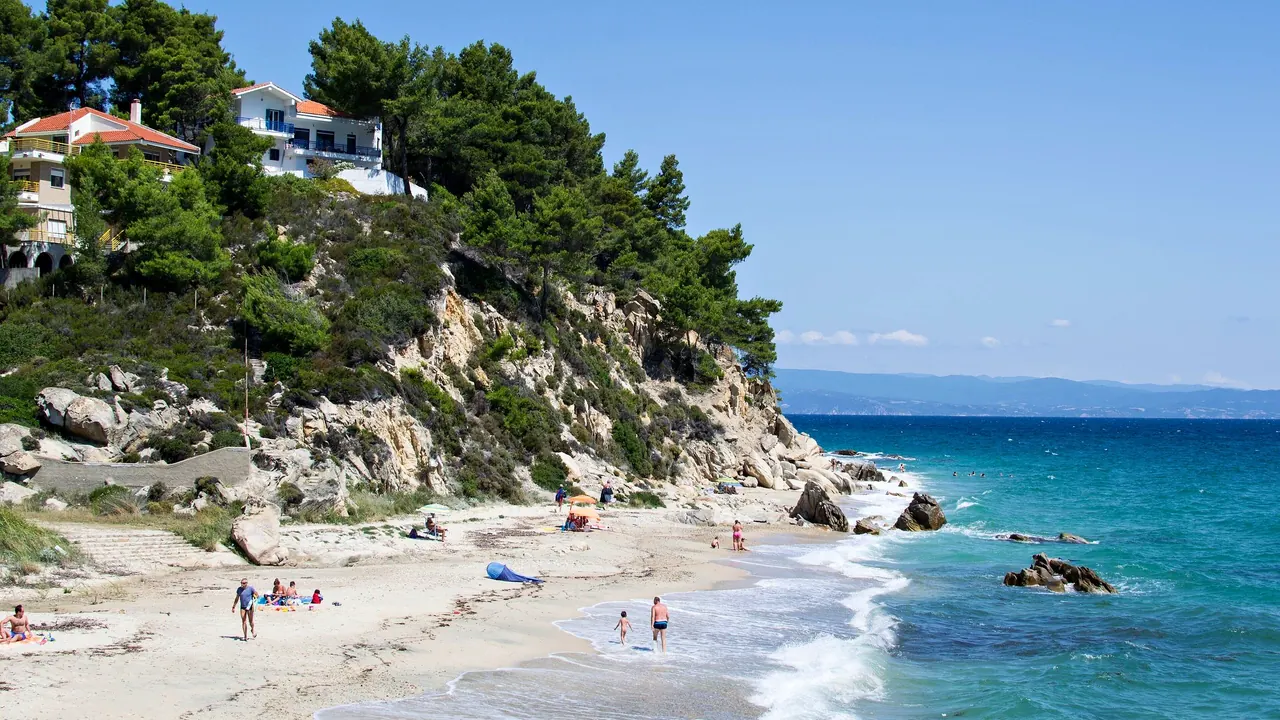
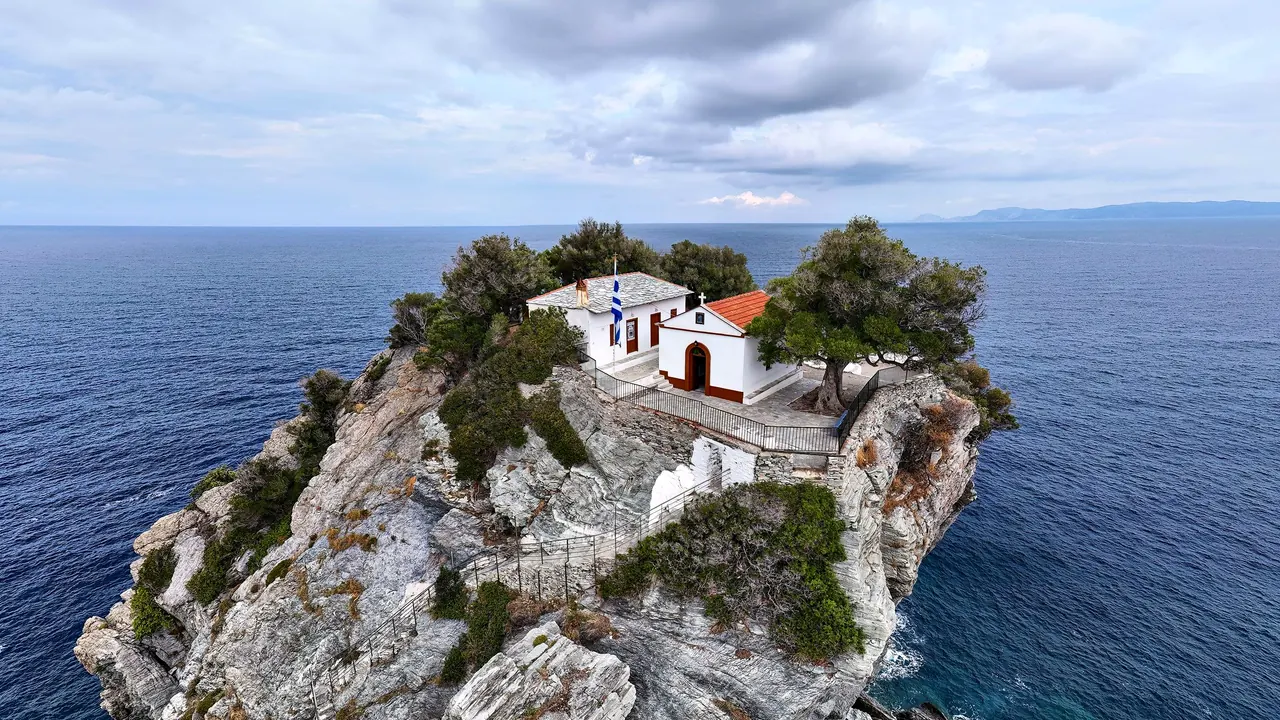
Photos: Halkidiki by Sprint28, CC BY-SA 3.0, cropped; Skopelos by Giles Laurent, CC BY-SA 4.0, cropped.
Halkidiki or Skopelos?
Our verdict in twelve categories, each scored against the same fixed benchmark cities, and the climate month by month, so you can choose for your trip.
Choose Halkidiki for
- nightlife
- day trips
- families
Halkidiki is the better pick for a bigger, more varied beach vacation, especially with children or with a group that wants evenings out. Its three peninsulas give you several trips in one: organised sandy beaches and late clubs on Kassandra, wilder granite coves on Sithonia, a boat trip along Mount Athos from Ouranoupoli, and Thessaloniki within reach for a day of churches and food. The price is a hire car and a lot of driving between peninsulas.
Choose Skopelos for
- nature and the outdoors
Travellers who want one small, green island and a slower pace will be happier on Skopelos. The pleasure is in walking pine-covered paths to monasteries, picking a different pebble cove each day on the south and west coasts, and ending the evening at dinner by the harbour of a slate-roofed town. You give up nightlife, varied day trips and an easy arrival, since every journey involves a boat, but in return the whole island stays quiet.
Scoreboard
Twelve categories on one fixed scale from 0 to 100. The shaded stretch is the gap between the two.
Your match
Pick a travel style or drag the sliders, and both match scores follow your weighting.
Wins on nightlife and day trips with your weighting.
Wins on nature and the outdoors with your weighting.
What matters to you?
Category by category
What the scores mean for a trip.
Beaches & swimming
Halkidiki has more beach, and more kinds of beach. Its three peninsulas have hundreds of kilometres of shore, much of it fine pale sand. It ranges from the organised stretches with sunbeds and bars at Kallithea and Pefkohori to Sithonia's granite coves at Kavourotrypes and Karydi. The catch is the weekend crowd from Thessaloniki in July and August.
Skopelos is a smaller, simpler version: a string of pine-backed coves along the south and west, mostly fine pebble or sand and pebble, many with only a taverna and a few sunbeds. Agnontas, Panormos and sandy Limnonari are the classics. When the meltemi blows on the north coast, the sheltered south shore is the place to go.
Food & drink
Both serve Greek seaside taverna food, grilled fish and octopus by the water and slow-cooked meat inland, but Halkidiki gives you more to choose from. Fishing villages such as Nikiti, Toroni and Ouranoupoli cook for Greek visitors, there are Athos wines and vineyards above Neos Marmaras, and Thessaloniki, a real food city, is close enough for lunch.
Skopelos has a couple of specialities worth trying, the coiled fried cheese pie and dishes made with the island's plums. Beyond those the range is narrow, and many kitchens close once summer ends.
Culture & sights
Neither is a culture trip, and the two are broadly level. Halkidiki's great sight is Mount Athos, which most visitors see from a cruise boat out of Ouranoupoli because entry is restricted to men with permits. Beyond that there are scattered half-days at Olynthos, ancient Stagira and the Petralona cave.
Skopelos keeps its heritage in one place: Skopelos Town itself, with white houses under slate roofs climbing in tiers to a Venetian castle and the monasteries of Mount Palouki a walk above. It is the nicer place to wander, though a day or two covers it.
Nightlife
Halkidiki has a real summer scene, almost all of it on Kassandra. The open-air clubs at Kallithea stay open latest, and the bar strips in Pefkohori, Hanioti and Polychrono fill after midnight with young Greeks who drive down from Thessaloniki at weekends. Stay on Sithonia instead and your evenings will be as quiet as on any small island.
Skopelos has no clubs at all. A night out means a long dinner, then a drink on the harbour or in a bar in the lanes of Skopelos Town, where some play Greek music late in high summer. That suits couples well but will disappoint anyone who wants to dance.
Nature & outdoors
The landscapes are close relatives, pine forest running down to clear water, and the difference is in how you use them. Skopelos is green almost from end to end. Waymarked paths and mule tracks link monasteries, chapels and bays, and the marine park of the Northern Sporades, home to monk seals and dolphins, lies just offshore.
Halkidiki's best scenery is on Sithonia, with its granite headlands and the slopes of Mount Itamos. It is stronger on the water, with kayaking, diving and boat trips to Diaporos island and its lagoon, while Kassandra is flatter and more built up.
Day trips
Halkidiki is joined to the mainland, and it shows. Thessaloniki, with its Byzantine churches and waterfront, is about an hour or so away. A longer day reaches the royal tombs at Vergina and ancient Pella, or Kavala and Amphipolis from the Athos side.
Skopelos can only look to its neighbours. Skiathos and Alonissos are short boat trips, often combined with swimming stops in the marine park, but the mainland is hours away and the boats thin out outside summer.
Good for families
Halkidiki is the easier choice with small children, because the beaches do most of the work. The water is calm and shallow, and resorts built around families mean a day needs little planning. When the children tire of the sea, there is a boat trip or the Petralona cave. The hard parts are the midsummer heat and the drives between peninsulas, so pick one base and stay there.
Skopelos suits a quieter family stay, best on the south coast or just outside town, close to sheltered bays such as Limnonari and Panormos. Getting there takes a flight and a ferry, and the stepped lanes of Skopelos Town are hard going with a pushchair. Older children get the most out of the island, with boat trips and kayaking. Neither place has zoos or theme parks.
Getting around
You need your own transport in both, for different reasons. In Halkidiki you drive. The main roads from Thessaloniki airport are good, but each peninsula is a long finger, so getting from Kassandra to Athos means driving back up one and down the other, slowly on summer weekends.
Skopelos is smaller but harder to reach: there is no airport, so every arrival is by boat, usually via Skiathos. Once you are there, a summer bus runs along the main road to the best-known beaches, a car or scooter gets you down the narrow roads to the coves, and you explore the car-free town on foot.
Shopping & style
Shopping is no reason to choose either. Halkidiki has resort strips of beachwear and souvenirs, the icons and incense sold in Ouranoupoli, and Thessaloniki for anything serious. Skopelos offers an hour of evening browsing in the lanes behind the harbour, with ceramics, linen, prunes and almond sweets.
Affordability
Costs are similar. Halkidiki is a touch easier because so many of its visitors are Greek and Balkan families who drive in, which keeps up a large supply of simple apartments and village tavernas. On Skopelos the ferry, a hire car and boat excursions add up over a stay. In both, June and September cost noticeably less than high summer for the same sea.
Live music & performing arts
Halkidiki has a little more on offer: open-air concerts and theatre at the Kassandra Festival in Siviri, and jazz and classical evenings at the Sani Festival, both through July and August. Skopelos has no stage at all, only rebetiko and island songs in the tavernas of Skopelos Town and dancing at village festivals on saints' days in August, which are charming but slight.
Wellness & relaxation
Halkidiki offers real treatments: the thermal pools at Agia Paraskevi above the sea on the tip of Kassandra, and large resort spas with hammam-style rooms. For pure calm, stay on Sithonia or towards Ouranoupoli.
Skopelos has no springs and only a few hotel spas, so you rest through the pace alone: late breakfasts, shaded tavernas and empty roads, best of all in June and September.
When should you go?
Pick your month. The climate figures are measured averages, not a forecast.
Halkidiki in July
Skopelos in July
Daytime high, °C
Rainfall in the month, mm
Where the figures come from
Halkidiki's temperatures are measured 64 km from the centre, at Thessaloniki Airport.
Halkidiki has no rain gauge within 25 km of the centre, so its rainfall comes from a gridded climate dataset read at the destination rather than from a gauge further away.
Skopelos's temperatures are measured 68 km from the centre, at Skyros Airport.
Skopelos has no rain gauge within 25 km of the centre, so its rainfall comes from a gridded climate dataset read at the destination rather than from a gauge further away.
Temperature and rainfall are climate normals, averaged over the years shown. Halkidiki: 1991-2020 normals, Thessaloniki Airport (63.7 km from centre). Skopelos: 1998-2025, 11 years observed (rainfall 1991-2020) normals, Skyros Airport (67.7 km from centre).
Both are summer destinations with the same swimming season. The sea is warm enough from June to early October and reaches about 26°C in August at both. The difference is on land. Halkidiki, measured around the resort coast, runs hotter, with July and August highs of 32°C and long, very sunny days that make walking around at midday hard work. Skopelos stays a few degrees cooler, at about 29°C, and is almost completely dry from June to August.
For walking, go in the shoulder months. April, May and October suit both places. June is already hot on the Halkidiki coast, at about 30°C, while Skopelos is still a little gentler then. In winter Halkidiki is colder and Skopelos is wetter, with 77mm of rain in December. Neither works as a beach trip between November and April.
Which traveller are you?
On a family trip with young children, Halkidiki is the stronger choice if you stay on Kassandra or around Gerakini and Psakoudia, where sandy beaches stay shallow far out. Skopelos's coves are mostly pebble, and only Halkidiki has big family resorts with pools and children's clubs.
For a food and nightlife trip, Halkidiki wins comfortably. Kassandra is the only place in either destination with late clubs and bars that fill after midnight, and Thessaloniki's food scene is close enough for a day out. On Skopelos the evening ends with dinner and a drink on the harbour.
On an outdoors trip built around walking, Skopelos is more rewarding. The whole island is green, and you can set off on foot from your door to villages, chapels and bays, with the marine park a short boat ride away. In Halkidiki the good walking is mostly on Sithonia, and most outdoor time is spent on the water.
Before you go
| Measure | Halkidiki | Skopelos |
|---|---|---|
| Official language | Greek | Greek |
| Currency | Euro (EUR) | Euro (EUR) |
| Sockets | CF230 V, 50 Hz | CF230 V, 50 Hz |
| Driving side | Right | Right |
| Time zone | UTC+2, UTC+3 in summer | UTC+2, UTC+3 in summer |
| Emergency number | 112 | 112 |
| Main airport | Thessaloniki Macedonia International Airport (SKG)93 non-stop destinations | Skiathos Island National Airport (JSI)37 non-stop destinations |
| Public holidays this year | 15 days | 15 days |
By the numbers
| Measure | Halkidiki | Skopelos |
|---|---|---|
| Population | 110,587 | - |
| People per km² | 38 | - |
| Swim season, months above 21 °C | 5 months | 5 months |
Where else could you go?
Every comparison below shares a destination with this one, so you can follow Halkidiki or Skopelos somewhere new.
- Skiathosvs Skopelos
- Skiathosvs Halkidiki
- Thassosvs Halkidiki
- Aeginavs Skopelos
- Peloponnesevs Skopelos
- Hydravs Skopelos