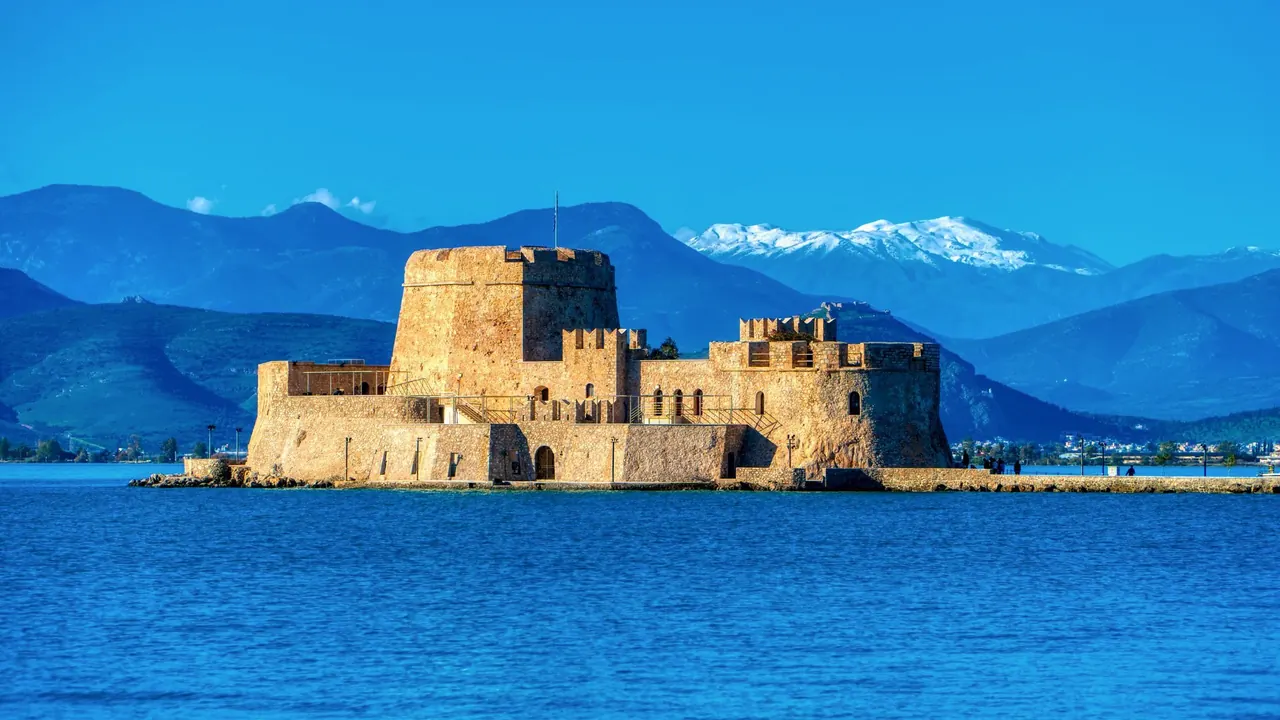
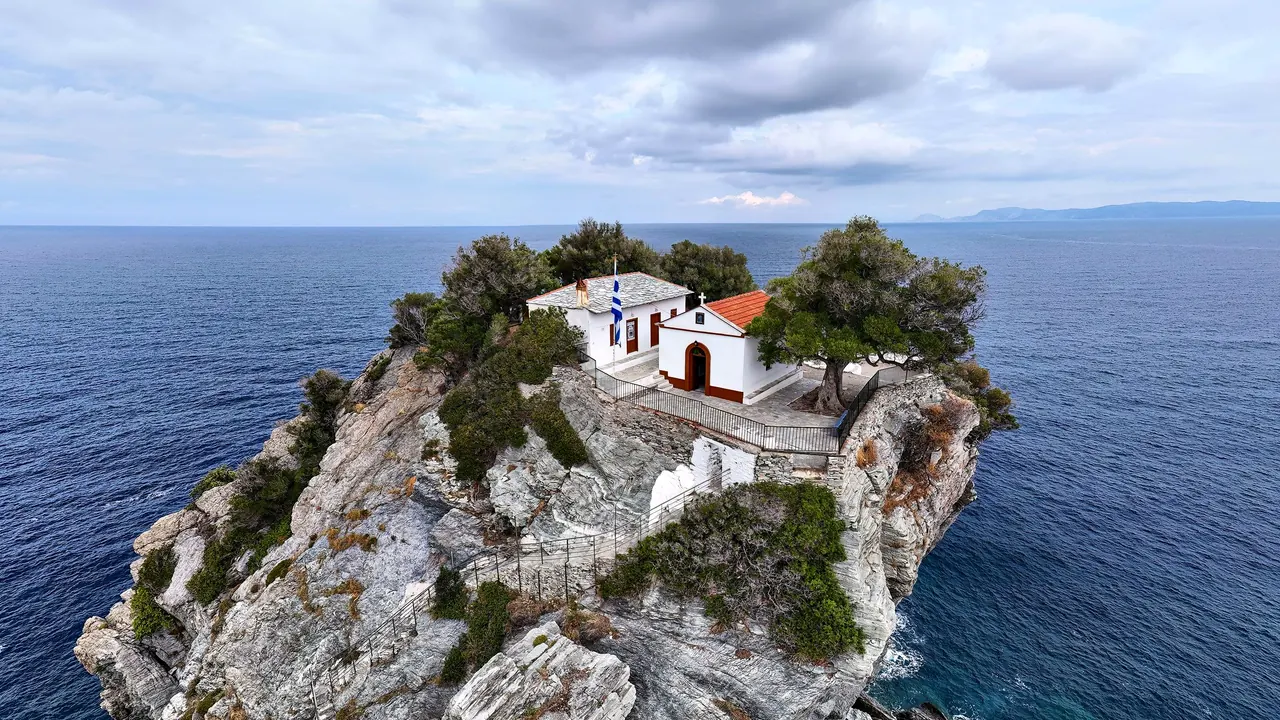
Photos: Peloponnese by Alex Ravvas, Pexels License; Skopelos by Giles Laurent, CC BY-SA 4.0, cropped.
Peloponnese or Skopelos?
Our verdict in twelve categories, each scored against the same fixed benchmark cities, and the climate month by month, so you can choose for your trip.
Choose Peloponnese for
- culture and sights
- day trips
- food and drink
Choose the Peloponnese for a road trip through the ancient and medieval Greek world. Mycenae, Epidaurus, Olympia, Mystras and Monemvasia are all within one region, and you can stop for swims at Voidokilia or Elafonisos and eat well around Kalamata and Nafplio along the way. It is the better pick for travellers who want variety, mountain walking and good value, and who are happy to drive a lot and move between two or three bases.
Choose Skopelos for
Skopelos does not lead in any category we score.
Skopelos is the simpler trip: one green island, one base and a different pine-backed cove each day. It has far less to see and do, with no great sights, little nightlife and a narrow food scene, so it suits couples and families who mainly want to swim, walk old mule tracks and take a boat into the marine park. You give up variety, and in return you get a slow island routine with no long drives.
Scoreboard
Twelve categories on one fixed scale from 0 to 100. The shaded stretch is the gap between the two.
Your match
Pick a travel style or drag the sliders, and both match scores follow your weighting.
Wins on culture and sights and day trips with your weighting.
Has no clear advantage with the weighting you have chosen.
What matters to you?
Category by category
What the scores mean for a trip.
Beaches & swimming
The two are equally good for swimming, but the beaches are different. The Peloponnese has more sand and more variety: the horseshoe of Voidokilia, long beaches running up the Messinian coast, the white sand and pale water of Elafonisos, and rocky Mani coves for those who prefer to swim off the rocks. These beaches are spread around the edge of a large region, so a beach vacation there means choosing a coast or driving between them.
Skopelos packs its beaches into one sheltered south and west coast. Agnontas, Panormos, Limnonari and Milia are each a short hop from the next, and pine forest runs down to fine pebble or mixed shingle. Facilities are simple, often just a taverna and some sunbeds. When the meltemi blows, the north coast gets rough and everyone heads south.
Food & drink
The Peloponnese is the better place to eat, mainly because it is a farming and wine region rather than a small island. Kalamata olives and oil, Mani cured pork, Nemea Agiorgitiko and Moschofilero from the Tripoli plateau give its tavernas real depth, and Kalamata and Nafplio offer the widest choice, from ouzeri to more ambitious kitchens.
Skopelos has a few things you won't find elsewhere, above all the coiled, fried cheese pie and dishes made with the island's plums. Beyond those, it is the standard island menu of grilled fish, octopus and mezze, done well but with little variety, and many places shut once summer ends.
Culture & sights
The gap here is wide. The Peloponnese holds Bronze Age Mycenae and Tiryns, the theatre at Epidaurus, Olympia, Messene and lonely Bassae, plus a medieval layer of Mystras, Monemvasia and the Venetian castles at Methoni and Koroni. You could spend a fortnight on sights alone, using Nafplio as the base for the Argolid.
On Skopelos, the main sight is the town itself: slate-roofed houses climbing to a ruined Venetian castle, a small folk museum, and monasteries on Mount Palouki. The Mamma Mia chapel of Agios Ioannis is a striking spot for photographs rather than history. A day or two covers it all.
Nightlife
Neither is a place for big nights out, but the Peloponnese has more going on. Nafplio's waterfront bars stay busy in summer and Kalamata's centre fills with locals. Patras, a university city on the north coast, has proper clubs and a famous carnival, though it is a long way from the Argolid and Messinia, where most visitors stay.
Skopelos ends the evening with a drink by the harbour or in a lane bar in town, sometimes with Greek music late into July and August nights. There are no clubs at all.
Nature & outdoors
Both are green by Greek standards, but the Peloponnese has the real mountains. Taygetos rises to about 2,400m above the Mani, the Lousios gorge links cliff monasteries and stone villages, the Menalon Trail crosses Arcadia, and Chelmos has winter skiing. Add the stark walking of the Mani down to Cape Tainaron and the birdlife of the Gialova lagoon.
Skopelos is gentler: pine forest from shore to summit, mule tracks between chapels and bays, and plum orchards around the villages. Its distinctive asset is the marine park next door, where boat trips go looking for dolphins and the rare monk seal.
Day trips
The Peloponnese gives far more choice of outings. From Nafplio you can take the ferry to car-free Hydra or Spetses, visit the Nemea wineries or drive to Athens. The south adds Monemvasia, Elafonisos and the Mani villages, and the Arcadian mountains are close by. Almost every outing needs a car.
Skopelos's outings are mostly by boat: Skiathos for its livelier port, Alonissos for its hilltop old village, and marine park cruises with swimming stops. The mainland is too far for a day, and the boats run much less often outside summer.
Good for families
The Peloponnese works a little better with children. It has shallow sandy bays at Tolo, in Messinia and on Elafonisos, Messinian resort hotels with kids' clubs and pools, and sites like Mycenae and Olympia that grip older children if you go early. The price is long hours in the car.
Skopelos is calm and safe, with gently shelving bays such as Limnonari and Panormos. However, getting there takes a flight plus a ferry, there are no family resorts to speak of, and the steep stepped lanes of town are hard with a pushchair.
Getting around
You need a car in both places, but the Peloponnese makes driving easier. Motorways link the Corinth Canal, Kalamata and the road towards Olympia, so the main towns are quick to reach, even if mountain and Mani roads are slow. Buses link the towns but rarely reach the sites or beaches.
Skopelos has no airport, so even arriving means a ferry, usually via Skiathos. Once there, a single main road with summer buses serves the best-known beaches. For the coves, the monasteries and the north coast you need a hired car or scooter on narrow, sometimes unpaved roads.
Shopping & style
Neither is worth visiting for shopping, though the Peloponnese has a bit more. Nafplio's old lanes have jewellery, worry beads and ceramics, and Kalamata and Tripoli have weekly street markets. Its best buys are edible: olive oil, mountain honey and wine bought at the wineries in Nemea. Skopelos has an hour's evening browse behind the harbour, mostly ceramics, linen, prunes and almond sweets.
Affordability
The mainland Peloponnese is the cheaper of the two. Family-run rooms in Arcadian and Mani villages, taverna meals and local wine cost less than on the islands, though a hire car and fuel are hard to avoid. Nafplio and the Messinian resorts cost more.
Skopelos is moderately priced for a Greek island, but the extras add up: the ferry, a scooter or car, and boat trips. It also has fewer budget places to stay, and those get scarce in July and August.
Live music & performing arts
The Peloponnese has one of the great summer experiences in Greece: ancient drama performed at night in the theatre of Epidaurus, where the acoustics need no microphones. There are also concerts at the Little Theatre nearby and a dance festival in Kalamata in July.
Skopelos has no stage at all. What it offers is rebetiko and island songs in town tavernas, and dancing at village saints' day festivals in August, which can be charming when you find them.
Wellness & relaxation
Both are restful mostly because of their slow pace, but only the Peloponnese has real bathing. It has thermal springs at Loutraki and Methana, the warm sulphur lake at Kaiafas, and full spas in the Messinian resort hotels.
Skopelos has no springs and only a few hotel spas and massages in season. Its calm comes from late breakfasts, shaded tavernas and very little traffic, especially in June and September.
When should you go?
Pick your month. The climate figures are measured averages, not a forecast.
Peloponnese in July
Skopelos in July
Daytime high, °C
Rainfall in the month, mm
Where the figures come from
Peloponnese's temperatures are measured 89 km from the centre, at Kalamata Airport.
Peloponnese has no rain gauge within 25 km of the centre, so its rainfall comes from a gridded climate dataset read at the destination rather than from a gauge further away.
Skopelos's temperatures are measured 68 km from the centre, at Skyros Airport.
Skopelos has no rain gauge within 25 km of the centre, so its rainfall comes from a gridded climate dataset read at the destination rather than from a gauge further away.
Temperature and rainfall are climate normals, averaged over the years shown. Peloponnese: 1991-2020 normals, Kalamata Airport (89 km from centre). Skopelos: 1998-2025, 11 years observed (rainfall 1991-2020) normals, Skyros Airport (67.7 km from centre).
Summer is hotter on the Peloponnese coast, where most visitors stay. Highs reach 32°C in July and August, which is fine for the beach but hard work at exposed sites like Mycenae or Olympia around midday. Skopelos peaks nearer 29°C, so its stepped lanes and forest paths stay more comfortable. Both are almost completely dry from June to August. On both, the sea is warm enough to swim from June to early October and reaches about 26°C in August.
May and the second half of September are the best months for combining sightseeing with swimming in the Peloponnese, and the days there are already long and sunny by May. Skopelos is cooler in spring, which suits walking but means the sea stays fresh until June. Rain returns in October on both. The Peloponnese gets its wettest weather in November and December, close to 95mm a month, and Skopelos is wettest in December, so winter on either is mild but damp.
Which traveller are you?
On a culture and arts trip, the Peloponnese wins easily. Mycenae, Epidaurus, Olympia, Messene and Byzantine Mystras are among the great sites of Greece, and Epidaurus stages ancient drama in summer. Skopelos offers its harbour town and a few monasteries.
On a food and nightlife trip, the Peloponnese gives more. Kalamata's market and olive oil, Nemea's red wines and Nafplio's range of tavernas beat Skopelos's narrow island menu, and Kalamata and Patras have real bars, where Skopelos has a handful of harbour-front spots.
On a beach and sun trip, both are excellent, so the question is how you want to spend it. Skopelos suits those who want pine-fringed coves along one sheltered coast from a single base. The Peloponnese suits those who prefer long sandy beaches and don't mind driving between them.
Before you go
| Measure | Peloponnese | Skopelos |
|---|---|---|
| Official language | Greek | Greek |
| Currency | Euro (EUR) | Euro (EUR) |
| Sockets | CF230 V, 50 Hz | CF230 V, 50 Hz |
| Driving side | Right | Right |
| Time zone | UTC+2, UTC+3 in summer | UTC+2, UTC+3 in summer |
| Emergency number | 112 | 112 |
| Main airport | Athens Eleftherios Venizelos International Airport (ATH)176 non-stop destinations | Skiathos Island National Airport (JSI)37 non-stop destinations |
| Public holidays this year | 15 days | 15 days |
By the numbers
| Measure | Peloponnese | Skopelos |
|---|---|---|
| Swim season, months above 21 °C | 5 months | 5 months |
Where else could you go?
Every comparison below shares a destination with this one, so you can follow Peloponnese or Skopelos somewhere new.
- Skiathosvs Skopelos
- Aeginavs Peloponnese
- Hydravs Peloponnese
- Halkidikivs Skopelos
- Aeginavs Skopelos
- Zakynthosvs Peloponnese