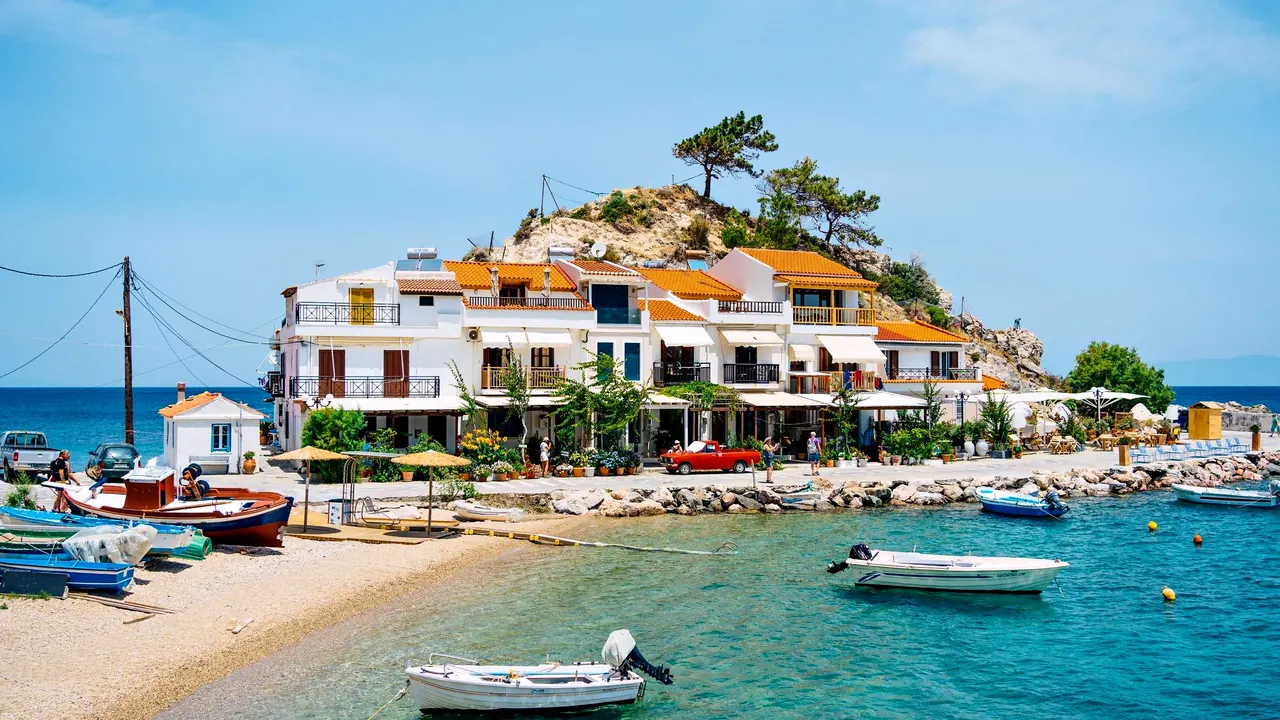
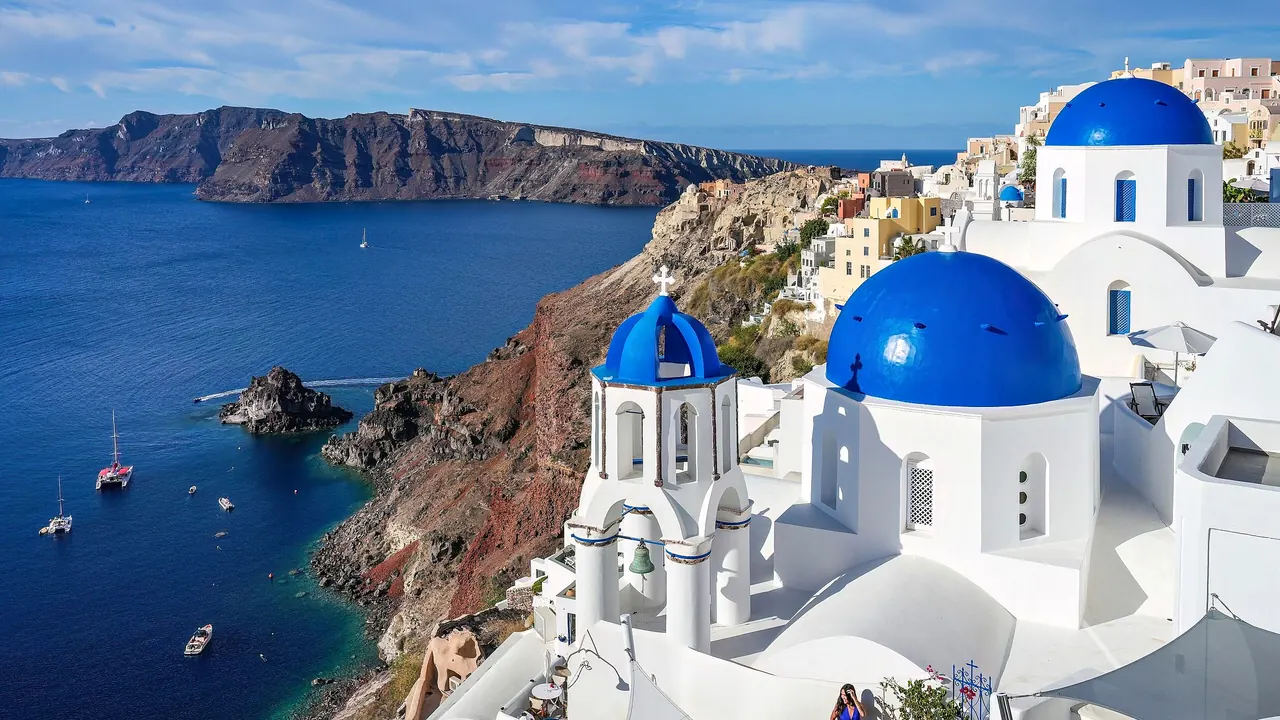
Photos: Samos by Thomas Ronveaux, Pexels License; Santorini by Giles Laurent, CC BY-SA 4.0, cropped.
Samos or Santorini?
Our verdict in twelve categories, each scored against the same fixed benchmark cities, and the climate month by month, so you can choose for your trip.
Choose Samos for
- prices
- beaches
- families
Samos suits travellers who want swimming first, at a gentler cost. It is a greener, steeper island with coves along both coasts, sandy shallows on the south side for children, hill villages for long taverna lunches, and the Heraion and the Eupalinos tunnel for a morning among ruins. It also gives the easier crossing to Ephesus. The price is less polish: plainer food, quiet nights and almost nothing to shop for.
Choose Santorini for
- shopping
- food and drink
- nightlife
Choose Santorini for the scenery and the wine. The caldera cliffs, the rim path from Fira to Oia, the buried Bronze Age streets of Akrotiri and the Assyrtiko wineries inland make a more striking and eventful stay, and Fira's lanes give real late nights in summer. It is a trip for couples rather than children. The dark volcanic beaches are not the main reason to go, and prices follow the view, so many visitors sleep on the east coast and visit the rim in the evening.
Scoreboard
Twelve categories on one fixed scale from 0 to 100. The shaded stretch is the gap between the two.
Your match
Pick a travel style or drag the sliders, and both match scores follow your weighting.
Too close to call, 1 point apart
Wins on prices and beaches with your weighting.
Wins on shopping and food and drink with your weighting.
What matters to you?
Category by category
What the scores mean for a trip.
Beaches & swimming
Samos is the stronger swimming island. Almost every stretch of its coast has a cove within reach of a road. Lemonakia and Tsamadou on the north coast have the clearest water, Psili Ammos on the calmer south has sandy shallows, and the Seitani bays in the northwest reward the walk. Pine-backed pebble and sand beaches like these are a reason to come in themselves.
Santorini's beaches are black sand and pebble below cliffs of red and ochre, at Kamari, Perissa and Perivolos, with Red Beach and Vlychada for the scenery. They are fine for a swim, but the sand burns by midday. The caldera villages have no beach at all, so a stay in Oia or Fira means travelling to the coast to swim.
Food & drink
Samos eats well but simply: grilled octopus on the harbours, slow-cooked goat in the hill villages, and a sweet Muscat from the terraces at Vourliotes and Manolates. Once you look past the taverna there is little range.
Santorini's table is more distinctive. Its volcanic soil gives fava, cherry tomato fritters, white aubergines and capers, and wineries making Assyrtiko and Vinsanto around Pyrgos and Megalochori turn tasting into part of the stay. The catch is that many cliff-edge restaurants charge mainly for the sunset, so the best meals are inland or at Ammoudi Bay.
Culture & sights
Both islands carry major antiquity. Samos has the Heraion and the Tunnel of Eupalinos, a UNESCO pair around Pythagoreio, and the giant archaic kouros in the Vathy museum, with monasteries and stone villages beyond.
Santorini edges ahead thanks to Akrotiri, a Bronze Age town preserved under volcanic ash, whose frescoes are partly shown in Fira. It also has its built landscape: the cliff-hung villages of Oia and Imerovigli and the medieval kastelli of Pyrgos and Emporio. Each island needs two or three days, but Santorini's sights are far more crowded, especially Oia at sunset.
Nightlife
Neither is a party island, but Santorini has more going on after midnight. A few lanes in Fira have cocktail bars and clubs that run into the early hours in high summer, and Kamari and Perissa add beach bars with music. Samos goes no further than the harbour bars of Pythagoreio and short strips in Kokkari and Vathy. Its village panigiria, with dancing in the square, can still be the best night of the trip.
Nature & outdoors
For an outdoors trip, Santorini is the more remarkable island, though Samos does better in some ways. Samos is green and mountainous: the Ampelos ridge is wooded with pine and chestnut, Mount Kerkis makes a long day's climb to about 1,430m, and the Potami gorge and the old mule paths between villages give shade and variety that Santorini cannot offer.
Still, Santorini's landscape is the one people travel to see. It is the rim of a drowned volcano, with cliffs dropping more than 300m into the caldera. The rim path from Fira to Oia, the walk up the lava cone of Nea Kameni and sailing or diving along the caldera walls have no equal on Samos. They make Santorini the stronger choice for most outdoor trips, even though its dry interior is covered in a day or two.
Day trips
Samos has the standout excursion: a ferry to Kusadasi and a short drive on to Ephesus, for which you need a passport. Patmos and its Monastery of St John are within reach by fast boat, and Ikaria and Fourni make slower days.
From Santorini every outing is to another island: Thirasia across the caldera, Ios and Folegandros, Naxos, or Crete for Knossos on a long day. Most boats leave from the single port at Athinios and thin out outside summer. On both islands the meltemi can cancel crossings.
Good for families
Samos is the easier island for a family. Psili Ammos has warm, shallow, sandy water, Pythagoreio is flat and compact, and tavernas welcome children at any hour. There is nothing built for children, though, and a car is needed to get around.
Santorini's caldera villages are a maze of steps, unfenced terraces and summer crowds, and many cliff hotels do not take young children. Families get on better in Kamari and Perissa, which has a small water park, but dark sand in midsummer heat needs managing.
Getting around
Both islands are small and both really call for a hired car or scooter, so the difference is in the kind of hassle. On Samos the roads are quiet and the main towns are under half an hour apart. The problems are sparse buses and narrow, winding climbs to the hill villages and around Kerkis.
On Santorini the buses reach more places, but they all run through Fira and are packed in summer. Tour coaches and scarce parking in Oia slow down driving, which makes Fira the workable base without a car. Ferries on Samos use three different ports, while Santorini's leave from Athinios.
Shopping & style
Shopping is minor on both islands, but Santorini gives a browser more. There are jewellers near the cathedral in Fira, and galleries of island painters and linen boutiques in Oia, all aimed at visitors with money to spend. Samos offers little beyond Muscat, thyme honey and olive oil, with a few ceramics in the backstreets of Vathy. On both islands the most rewarding things to take home are bottles of local wine.
Affordability
Samos is far easier on the wallet. Studios and small hotels in Kokkari, Pythagoreio and the south coast villages cost noticeably less, taverna meals with local wine stay moderate, and the main extras are a hired car and ferries.
On Santorini the caldera view drives prices. Cave suites on the rim at Oia and Imerovigli are among the costliest rooms in Greece, and meals with a sunset view are priced to match. Staying in Kamari or Perissa and going in spring or late autumn narrows the gap, but does not close it.
Live music & performing arts
Neither island is a place to go for live performance, and both fall silent in winter. On Samos the best bets are the panigiria of July and August, where visitors join live Greek bands and dancing, and open-air concerts at the castle in Pythagoreio. Santorini's offer is more formal: a long-running classical music festival in Fira at the end of summer, and occasional concerts in old wineries and mansions.
Wellness & relaxation
Samos offers slowness rather than treatments. It has no springs or bathing tradition and only a few resort spas near Pythagoreio and Kokkari. Instead it has shaded squares in the hill villages and quiet coves around Marathokampos, where switching off comes easily.
Santorini's version is the luxury cave hotel: suites cut into the cliff at Imerovigli and Oia, with heated plunge pools and spa treatments. Boats also stop for a swim in the warm volcanic spring water off Palea Kameni. For quiet, stay in Imerovigli or the wine villages of Pyrgos and Megalochori, because the rim at Oia and Fira fills with day crowds in summer.
When should you go?
Pick your month. The climate figures are measured averages, not a forecast.
Samos in July
Santorini in July
Daytime high, °C
Rainfall in the month, mm
Where the figures come from
Samos's sunshine is measured 82 km from the centre, at Aydin.
Santorini's station stands 182 m below the place it is measured for, so that place is likely a little cooler than the figures say.
Santorini has no rain gauge within 25 km of the centre, so its rainfall comes from a gridded climate dataset read at the destination rather than from a gauge further away.
Temperature and rainfall are climate normals, averaged over the years shown. Samos: 1991-2020 normals, Samos Airport (2.4 km from centre). Santorini: 2000-2025, 12 years observed (rainfall 1991-2020) normals, Santorini Island / Monólithos (5 km from centre).
Both islands follow the Aegean pattern of a dry, bright summer and a wet winter, and the sea warms on the same timetable. On both it is comfortable for swimming from June to October and reaches about 24°C in August. The real difference is heat. Around the main resorts on Samos, July and August reach 33°C, which makes the slopes and villages hard going at midday. Santorini peaks nearer 30°C, although its shadeless rim still feels hot. Samos has long, reliably sunny days from May to September.
For walking, May, early June and late September into October suit both islands best. Winter is wetter on Samos, with December rainfall around 147mm against noticeably less on Santorini. From November the beach season is over on both.
Which traveller are you?
On a beach and sun trip, Samos is the better pick. There are coves and bays along both coasts, with clear water in the north and calm sand around Psili Ammos in the south. Santorini's dark volcanic beaches are pleasant but secondary, and hot underfoot by midday.
For a trip on a tight budget, Samos makes the money go further. Family-run studios in Kokkari and Pythagoreio cost less, and taverna meals stay moderate. On Santorini the caldera view sets prices, so saving means staying in Kamari or Perissa.
For a food and nightlife trip, Santorini offers more. There are Assyrtiko and Vinsanto tastings around Pyrgos and Megalochori, fava and tomato fritters, and late lanes of bars and clubs in Fira. On Samos, evenings usually mean a taverna dinner and a harbour drink in Pythagoreio.
Before you go
| Measure | Samos | Santorini |
|---|---|---|
| Official language | Greek | Greek |
| Currency | Euro (EUR) | Euro (EUR) |
| Sockets | CF230 V, 50 Hz | CF230 V, 50 Hz |
| Driving side | Right | Right |
| Time zone | UTC+2, UTC+3 in summer | UTC+2, UTC+3 in summer |
| Emergency number | 112 | 112 |
| Main airport | Samos Airport (SMI)20 non-stop destinations | Santorini International Airport (JTR)60 non-stop destinations |
| Public holidays this year | 15 days | 15 days |
By the numbers
| Measure | Samos | Santorini |
|---|---|---|
| Population | 32,642 | 17,430 |
| People per km² | 69 | 220 |
| Swim season, months above 21 °C | 5 months | 5 months |
Where else could you go?
Every comparison below shares a destination with this one, so you can follow Samos or Santorini somewhere new.
- Iosvs Santorini
- Folegandrosvs Santorini
- Naxosvs Santorini
- Parosvs Santorini
- Sifnosvs Santorini
- Kosvs Samos