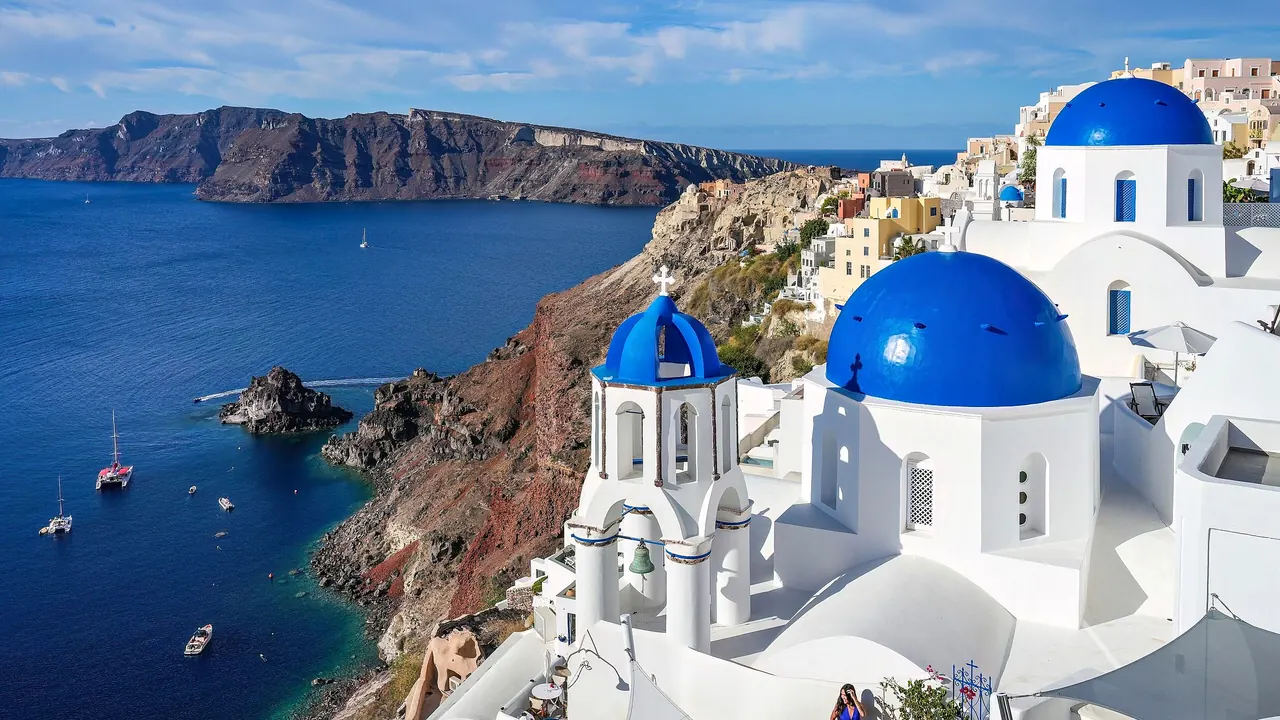
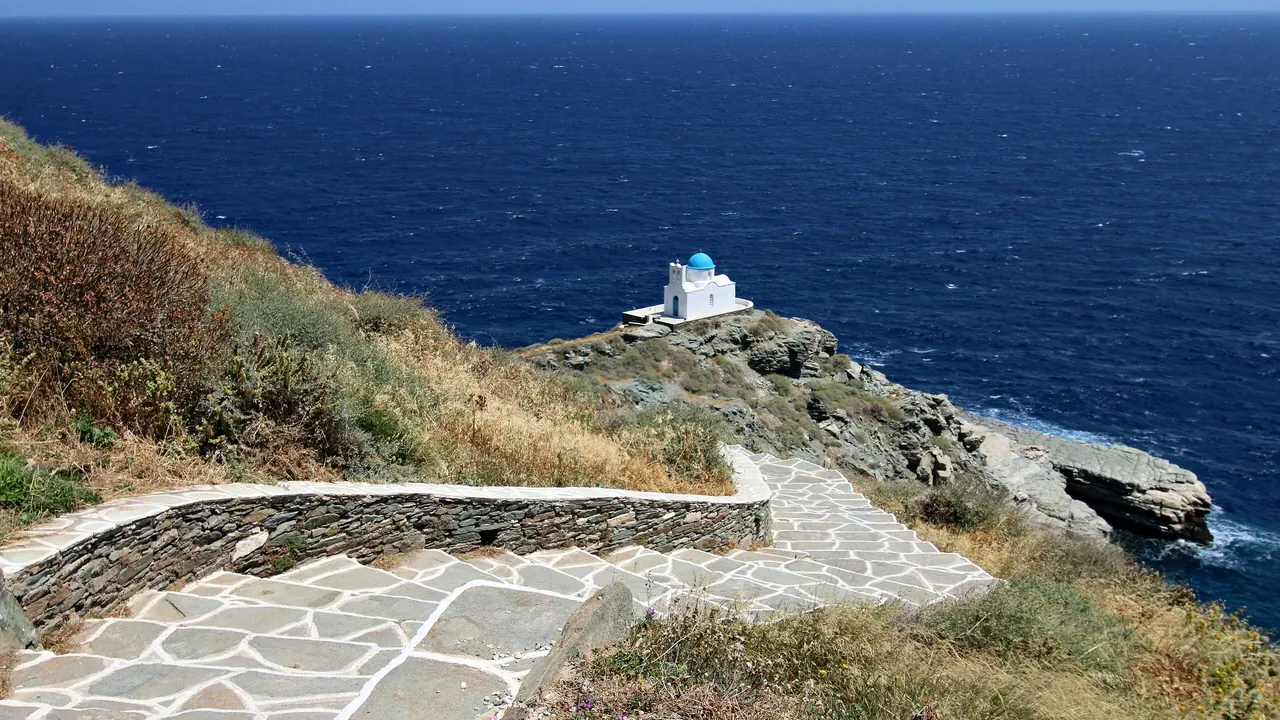
Photos: Santorini by Giles Laurent, CC BY-SA 4.0, cropped; Sifnos by Zde, CC BY-SA 4.0, cropped.
Santorini or Sifnos?
Our verdict in twelve categories, each scored against the same fixed benchmark cities, and the climate month by month, so you can choose for your trip.
Choose Santorini for
- culture and sights
- nature and the outdoors
- nightlife
Santorini is the island for a traveller who wants spectacle. The drowned caldera, the cliff-top villages of Oia and Fira, the Bronze Age town at Akrotiri and the Assyrtiko wineries inland give a short stay a lot to see, and Fira's lanes give you a proper night out in summer. The cost of all that is crowds on the rim, dark beaches that come second to the view, and prices driven by the sunset.
Choose Sifnos for
- beaches
- families
- prices
Sifnos is better for a slower vacation built around the sea. Its sandy, shallow bays at Platis Gialos, Vathi and Kamares are easier and gentler than anything on Santorini, the old mule tracks link villages and chapels on foot, and the clay-pot cooking is reason enough to linger. It suits families and anyone happy to spend a week in one place. You give up the big sights and the easy arrival, because the only way in is by ferry.
Scoreboard
Twelve categories on one fixed scale from 0 to 100. The shaded stretch is the gap between the two.
Your match
Pick a travel style or drag the sliders, and both match scores follow your weighting.
Too close to call, 1 point apart
Wins on culture and sights and nature and the outdoors with your weighting.
Wins on beaches and families with your weighting.
What matters to you?
Category by category
What the scores mean for a trip.
Beaches & swimming
Sifnos is the better swimming island. Platis Gialos on the south coast is a broad sweep of fine sand over shallow, clear water, Kamares has an easy sandy beach by the port, and Vathi's nearly enclosed bay stays calm on days when the meltemi churns the open coast. Small coves near Faros, Glyfo and Chrysopigi add variety, and nothing is overbuilt.
Santorini's beaches are dramatic rather than comfortable: black sand and fine pebble that burns underfoot, under cliffs of red and ochre rock. The long strip at Perissa and Perivolos and the beach at Kamari are well set up with sunbeds. Red Beach and Vlychada are worth seeing more than spending the day at. If you stay in Oia or Fira, you have to travel down to the coast to swim.
Food & drink
The two are evenly matched at the table, but they reward different appetites. Santorini is the place for wine. You can taste low-trained Assyrtiko and sun-dried Vinsanto at wineries around Pyrgos, Megalochori and Exo Gonia, and the food is built on volcanic-soil produce such as fava, cherry-tomato fritters and white aubergines. The catch is the caldera rim, where many kitchens charge for the sunset more than the cooking.
Sifnos is about slow home cooking. Chickpeas baked overnight in clay pots, lamb or goat stewed in red wine with dill, and manoura cheese aged in wine lees fill the tables. You will find the best of it in village tavernas and at Cheronissos, where the fishing boats land beside the tables.
Culture & sights
Santorini has much more to see. Akrotiri, the Bronze Age town buried by the eruption, is one of the great archaeological sites of the Aegean, and its wall paintings carry on into the museum in Fira. Add the ruins of Ancient Thera, the cliff villages with their cave houses and captains' mansions, and the medieval kastelli of Pyrgos and Emporio, and two or three full days are easily filled.
On Sifnos the heritage is quieter and spread out. Kastro, a fortified village whose houses form its walls, the white lanes of Apollonia and Artemonas, the monastery of Chrysopigi and the Hellenistic watchtowers from the island's mining days reward slow wandering rather than sightseeing.
Nightlife
Neither is a party island, but Santorini goes later. In July and August a few lanes in Fira hold cocktail bars and a handful of clubs that run into the early hours, and Kamari and Perissa add beach bars with music. Sifnos has no clubs at all. Its one late street is the pedestrian lane through Apollonia, with small music bars, and outside the peak weeks the island goes quiet soon after dinner.
Nature & outdoors
Santorini has the more extraordinary landscape. Its caldera walls drop more than 300m into the flooded crater, and the 10km rim path from Fira through Imerovigli to Oia follows the edge all the way. You can also take a boat out to climb the black lava cone of Nea Kameni, sail round the caldera or dive along its sunken walls. Away from the cliffs the island is low, dry and treeless, and a day or two covers it.
Sifnos is gentler, though it rewards walkers who stay longer. Waymarked stone mule tracks cross terraced hills of thyme and olive groves to monasteries, watchtowers and bays. The climb to the monastery on Profitis Ilias, the island's highest point, looks out over the western Cyclades. On the water it is snorkelling in rocky coves and boat trips to bays with no road, pleasant rather than spectacular.
Day trips
On either island every outing is a ferry ride, but Santorini has slightly more choice. Boats cross to quiet Thirasia, fast ferries reach Ios, Folegandros and Anafi, and Naxos, Paros and even Knossos on Crete are within reach of a long day. Almost everything leaves from the single port at Athinios.
From Sifnos the list is shorter but good. Milos is about an hour away, with its hilltop Plaka and painted boathouses, and Serifos's chora is close by. Kimolos can be added through Milos. On both islands the meltemi and the thin off-season timetable can wreck a plan.
Good for families
Sifnos makes for the easier family stay. Platis Gialos, Kamares and Vathi have sand and shallow water for small children, and no beach is a long drive away. The tavernas are happy with children late into the evening. There is nothing built for children, and the stepped villages defeat a pushchair.
Santorini's caldera villages are hard work with children: steep steps, unfenced terraces, summer crowds, and cliff hotels that often refuse young guests. Basing yourself in Kamari or Perissa solves much of this with flat promenades and a small water park. Older children will enjoy the volcano boat and Akrotiri.
Getting around
Once you are there, Sifnos is the simpler island. From Apollonia, summer buses reach Kamares, Kastro, Platis Gialos, Faros and Vathi in a short ride, and footpaths join the villages. Arriving is harder, because there is no airport and the ferry from Piraeus takes a few hours and can be held up by wind.
Santorini is easier to reach, with its own airport as well as ferries, but harder to move around in summer. Every bus route runs through Fira, so cross-island trips mean a change there on crowded buses. Narrow roads, tour coaches and very little parking in Oia and Fira slow down drivers too.
Shopping & style
Neither island is worth a trip for the shopping, and the difference is in what you browse. Santorini's cliff lanes in Oia and Fira lean towards jewellers, galleries of island painters and photographers, and linen resort wear, among a lot of souvenir shops. Its best buys are bottles of Assyrtiko and Vinsanto.
On Sifnos the thing to buy is pottery. Workshops around Kamares, Vathi and Platis Gialos still make the clay casseroles used in the island's kitchens, and Apollonia has a few boutiques and shops selling capers, honey and almond sweets.
Affordability
Both are costly in summer, but Sifnos is the more forgiving of the two. Its rooms are mostly boutique hotels and rented houses that fill early in July and August, while taverna meals stay fair for the quality. June and September cut room costs with the same warm sea.
Santorini's caldera rim is among the most expensive places to stay in Greece, and sunset dinners, boat trips and tastings soon add up. A careful budget is still possible there if you sleep in a studio in Kamari or Perissa, take the bus, and walk up to the rim only for the evening.
Live music & performing arts
Neither island has a theatre, an opera or a concert season. Santorini's main event is its long-running classical music festival in Fira at the end of summer, alongside occasional concerts in old mansions and wineries. Sifnos offers something more local: the panigyri, a saint's-day feast at a chapel where violin and lute music and circle dancing can go on all night, and visitors are welcome to join in.
Wellness & relaxation
On Santorini you pay for your rest, and on Sifnos the island's pace provides it. Santorini's version is the cave suite at Imerovigli or Oia, with a heated plunge pool, spa treatments and the caldera in front of you. Boats also stop off Palea Kameni for a swim in warm, rust-coloured spring water. The rim at Oia and Fira fills with day visitors in summer, so Imerovigli and the wine villages of Pyrgos and Megalochori are the quieter places to stay.
Sifnos has no springs and only a few hotel spas. What it has is car-free lanes, long lunches, the evening stroll from Apollonia to Artemonas and bays where the day needs no plan. June and September are its calmest months.
When should you go?
Pick your month. The climate figures are measured averages, not a forecast.
Santorini in July
Sifnos in July
Daytime high, °C
Rainfall in the month, mm
Where the figures come from
Santorini's station stands 182 m below the place it is measured for, so that place is likely a little cooler than the figures say.
Santorini has no rain gauge within 25 km of the centre, so its rainfall comes from a gridded climate dataset read at the destination rather than from a gauge further away.
Sifnos has no weather station within reach, so its figures come from a gridded climate model rather than a measured record, and read a broad area rather than one spot.
Temperature and rainfall are climate normals, averaged over the years shown. Santorini: 2000-2025, 12 years observed (rainfall 1991-2020) normals, Santorini Island / Monólithos (5 km from centre). Sifnos: 2001-2020 normals, NASA POWER reanalysis grid, no weather station within 90 km.
Both islands have the same swimming season, June to October, and the same sea, which holds at about 24°C from July to September. Santorini runs hotter on land, with afternoons around 30°C in July and August. That makes its shadeless rim path and dark sand hard going at midday. On Sifnos the summer highs stay nearer 27°C, which is a little kinder for walking between villages. Both are almost completely dry from June to August.
The shoulder seasons are when walking is best on either island. May and late September to October are warm without the peak heat. Sifnos usually turns showery slightly earlier in September, and from November to March both islands are cool and wet, with Sifnos the wetter of the two at over 100mm a month in midwinter. Neither is a winter beach destination.
Which traveller are you?
On a culture and arts trip, Santorini is the clear choice. Akrotiri's preserved Bronze Age streets, the frescoes in Fira's prehistoric museum, Ancient Thera on its ridge and the fortified inland villages add up to far more than Sifnos's chapels and small museums.
For a beach and sun trip, Sifnos wins. Platis Gialos is a long curve of fine sand on shallow water, and Vathi stays calm in the meltemi. Santorini's black sand and pebble scorches by midday, and its cliff villages have no beaches at all.
On a family trip with children, Sifnos is the easier island. Short drives, sandy shallows and relaxed tavernas make the days simple. Santorini's caldera villages are all steps and unfenced terraces, and many cliff hotels turn young children away.
Before you go
| Measure | Santorini | Sifnos |
|---|---|---|
| Official language | Greek | Greek |
| Currency | Euro (EUR) | Euro (EUR) |
| Sockets | CF230 V, 50 Hz | CF230 V, 50 Hz |
| Driving side | Right | Right |
| Time zone | UTC+2, UTC+3 in summer | UTC+2, UTC+3 in summer |
| Emergency number | 112 | 112 |
| Main airport | Santorini International Airport (JTR)60 non-stop destinations | Milos Airport (MLO)2 non-stop destinations |
| Public holidays this year | 15 days | 15 days |
By the numbers
| Measure | Santorini | Sifnos |
|---|---|---|
| Population | 17,430 | - |
| People per km² | 220 | - |
| Swim season, months above 21 °C | 5 months | 5 months |
Where else could you go?
Every comparison below shares a destination with this one, so you can follow Santorini or Sifnos somewhere new.