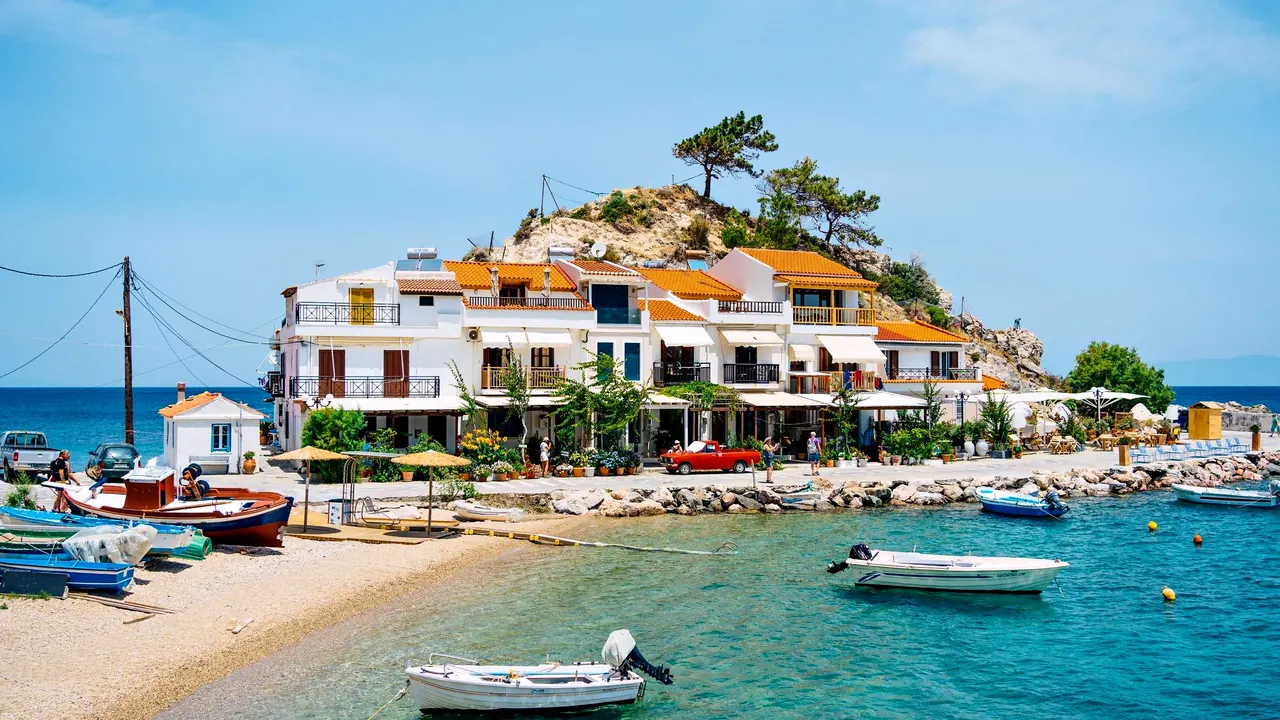
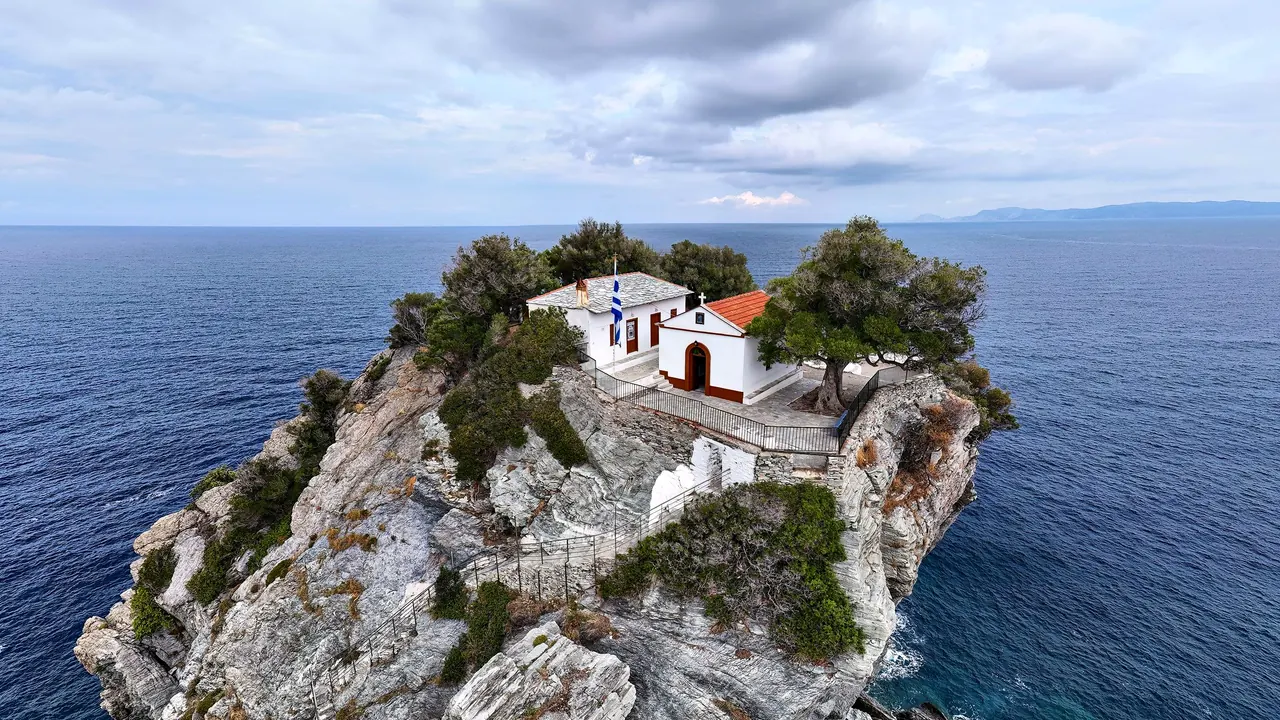
Photos: Samos by Thomas Ronveaux, Pexels License; Skopelos by Giles Laurent, CC BY-SA 4.0, cropped.
Samos or Skopelos?
Our verdict in twelve categories, each scored against the same fixed benchmark cities, and the climate month by month, so you can choose for your trip.
Choose Samos for
- culture and sights
- day trips
- food and drink
Samos suits travellers who want more than the beach. The Heraion and the Tunnel of Eupalinos give it real ancient sights, Ephesus and Patmos are both within a day by boat, and the hill villages around Vourliotes add Muscat wine and mountain walking. An airport on the island, slightly gentler prices and a few more bars at night make it the easier and fuller choice for a first Greek island trip.
Choose Skopelos for
- beaches
- shopping
Skopelos is for people who want to slow right down. It is a pine-covered island where the plan is a different sheltered cove each day along the south and west coasts, dinner in the harbour lanes of a whitewashed town, and boat trips into the Northern Sporades marine park. Summers here are milder than on Samos. You trade sights and day trips for quiet, and the ferry over is part of getting away.
Scoreboard
Twelve categories on one fixed scale from 0 to 100. The shaded stretch is the gap between the two.
Your match
Pick a travel style or drag the sliders, and both match scores follow your weighting.
Wins on culture and sights and day trips with your weighting.
Wins on beaches and shopping with your weighting.
What matters to you?
Category by category
What the scores mean for a trip.
Beaches & swimming
Both islands are made for swimming, with clear water, fine pebble or sand-and-shingle shores, and the same summer meltemi on their north coasts. The difference is in the layout. On Samos the most dramatic water lies on the windswept north around Kokkari and Lemonakia. The south has the sandy shallows of Psili Ammos and the long, quiet shore at Votsalakia, and the Seitani bays reward a walk.
Skopelos gathers its best swimming along one sheltered south and west coast. It is a string of pine-fringed coves from Stafylos and Velanio near town out to Agnontas, Panormos and sandy Limnonari, easy to work through one a day. It has fewer long beaches than Samos but more small, simple bays with just a taverna behind them.
Food & drink
Neither island is a food destination, but Samos gives a little more to eat and drink. Its sweet Muscat from the terraces of Vourliotes and Manolates is a real regional wine, and the hill villages serve slow-cooked goat and wild greens on summer evenings.
Skopelos has small specialities of its own: the fried, coiled cheese pie, plum dishes and almond sweets. Beyond those it is standard harbour taverna cooking, and more places close once summer ends.
Culture & sights
Here Samos is in another league. The Heraion sanctuary and the Tunnel of Eupalinos at Pythagoreio form a UNESCO site of real ancient weight, and the 5m kouros in the museum at Vathy is worth the trip on its own.
On Skopelos the main sight is the town itself, tiers of whitewashed houses under slate roofs climbing to a Venetian castle. Add the monasteries on Mount Palouki and the Mamma Mia chapel of Agios Ioannis on its rock. It is lovely to wander, but slight next to the antiquities of Samos, and a day or two covers it.
Nightlife
Both are quiet islands after dark, and neither has a club scene. Samos has a bit more going on: the harbour cocktail bars of Pythagoreio stay busy past midnight in high summer, and Kokkari and Vathy each add a short strip of music bars.
Skopelos keeps its evenings to the harbour front and the small bars in the town lanes, some playing Greek music late in July and August. Its villages go silent after dinner, so it suits couples rather than anyone hoping to stay out.
Nature & outdoors
Samos is mountain country. It has the forested Ampelos ridge, the bare limestone of Mount Kerkis to climb in a long day from Marathokampos, and the Potami gorge with its small waterfalls in the wild northwest. In spring there are also orchids and birdwatching at the salt lake near Psili Ammos.
Skopelos is gentler, with pine from the shore up to Mount Delfi and waymarked paths linking monasteries and quiet bays. Its strength is the sea. It borders the National Marine Park of Alonissos and the Northern Sporades, so boat trips to look for dolphins and monk seals, and kayaking along the indented coast, are easy to arrange.
Day trips
Samos has much the stronger outings. The ferry to Kusadasi puts Ephesus within a day if you bring a passport, and Patmos with its Monastery of St John is a couple of hours away by fast boat. Ikaria, Fourni and Samiopoula are there for quieter days.
From Skopelos the choices stay within the Sporades: livelier Skiathos close by, and Alonissos with its old hilltop village in the other direction, often combined with swimming stops in the marine park. These are pleasant days, but nothing compares with Ephesus, and the mainland is too far for a day trip.
Good for families
For a simple beach vacation with children the two islands are much alike: safe, relaxed, with tavernas that welcome children at any hour and nothing built for them. Samos is easier to reach, with its airport by Pythagoreio, and a south coast base pairs the shallow sand of Psili Ammos with a flat harbour town for evening strolls.
Skopelos has more sheltered, gently shelving bays such as Limnonari and Panormos. The journey involves a ferry, though, and the stepped lanes of the town are hard going with a pushchair. Older children get boat trips and kayaking in return.
Getting around
On both islands a hired car or scooter is the realistic way to explore, and buses cover little beyond the main road. The practical advantage of Samos is arrival: its airport sits beside Pythagoreio, and Vathy, Kokkari and Pythagoreio are all within half an hour of one another.
Skopelos has no airport, so every trip starts with a boat, usually from Skiathos. Once you are there, one road runs from town to Glossa and summer buses reach the well-known beaches. Skopelos Town itself is a car-free maze of steps, best explored on foot.
Shopping & style
On Samos the souvenirs are things to eat and drink: bottles of Muscat from the wine villages, thyme honey and olive oil, plus a few everyday shops and some ceramics in the backstreets of Vathy. Skopelos turns its shopping into an evening stroll through the harbour lanes, where you'll find local ceramics, linen and jewellery next to prunes, herbal teas and almond sweets. Neither island has any fashion or design shops.
Affordability
Samos is the easier island on the budget. Family-run studios in Kokkari, Pythagoreio and the south coast villages cost less than on the better-known islands, and taverna meals with local wine stay moderate inland, though August pushes prices up.
Skopelos sits in the middle for a Greek island, with fewer cheap options and rooms hard to find in July and August. Both need a hired car, but on Skopelos the ferry in and the boat excursions add a cost you can't avoid.
Live music & performing arts
Samos puts its performances on open-air stages, with a summer season of concerts and plays at the castle in Pythagoreio and around the Heraion. Skopelos has no stage at all. Its music happens in the tavernas and small bars of the town on summer nights, mostly rebetiko and island songs, so you come across it rather than book it.
On both islands the village saints' day festivals of July and August are the nights to look out for, with live bands and dancing in the square. Outside summer there is almost nothing on either island.
Wellness & relaxation
Samos gives a little more help with unwinding. A handful of resort hotels near Pythagoreio and Kokkari offer spa treatments, and the shaded squares of the hill villages and the quiet coast around Marathokampos are good places to do nothing. Neither island has thermal springs or a bathing tradition.
Skopelos relaxes you through its quiet roads, late breakfasts and sleepy villages, especially in June and September. Treatments, though, come down to a few hotel spas and massage in season.
When should you go?
Pick your month. The climate figures are measured averages, not a forecast.
Samos in July
Skopelos in July
Daytime high, °C
Rainfall in the month, mm
Where the figures come from
Samos's sunshine is measured 82 km from the centre, at Aydin.
Skopelos's temperatures are measured 68 km from the centre, at Skyros Airport.
Skopelos has no rain gauge within 25 km of the centre, so its rainfall comes from a gridded climate dataset read at the destination rather than from a gauge further away.
Temperature and rainfall are climate normals, averaged over the years shown. Samos: 1991-2020 normals, Samos Airport (2.4 km from centre). Skopelos: 1998-2025, 11 years observed (rainfall 1991-2020) normals, Skyros Airport (67.7 km from centre).
The swimming season on both islands runs from June into early October, when the sea is warm enough to stay in for a long time. Samos is the hotter and sunnier of the two. July and August reach about 33°C with almost no rain and very long sunny days, which is tiring for walking round the Heraion or climbing up to the hill villages. June and September are better if you want to combine sightseeing with swimming. The rain arrives in earnest in November, and winters are wet, with about 147mm in December.
Skopelos stays milder, peaking around 29°C in midsummer, so walking the town's steps is easier in high summer. Its sea also warms a little more, to about 26°C in August against 24°C off Samos. Summer showers are slightly more likely than on Samos and the autumn rain starts earlier, in October, but its winters are less rainy. On both islands spring and autumn are the seasons for walking.
Which traveller are you?
On a culture and arts trip, Samos is the clear choice. The UNESCO ensemble of the Heraion and the Eupalinos tunnel, the giant kouros in Vathy, and day trips to Ephesus and Patmos give it far more to see than Skopelos Town and its monasteries.
For a trip on a tight budget, Samos is easier on the wallet. Family-run studios in Kokkari and the south coast villages cost less, taverna meals inland stay moderate, and an island airport saves the ferry leg that every Skopelos stay needs.
For a beach and sun trip built around small coves, Skopelos edges ahead. Its sheltered south and west coasts give you a pine-backed bay for every day, from Agnontas to Limnonari, with milder midsummer heat and slightly warmer August water than Samos.
Before you go
| Measure | Samos | Skopelos |
|---|---|---|
| Official language | Greek | Greek |
| Currency | Euro (EUR) | Euro (EUR) |
| Sockets | CF230 V, 50 Hz | CF230 V, 50 Hz |
| Driving side | Right | Right |
| Time zone | UTC+2, UTC+3 in summer | UTC+2, UTC+3 in summer |
| Emergency number | 112 | 112 |
| Main airport | Samos Airport (SMI)20 non-stop destinations | Skiathos Island National Airport (JSI)37 non-stop destinations |
| Public holidays this year | 15 days | 15 days |
By the numbers
| Measure | Samos | Skopelos |
|---|---|---|
| Population | 32,642 | - |
| People per km² | 69 | - |
| Swim season, months above 21 °C | 5 months | 5 months |
Where else could you go?
Every comparison below shares a destination with this one, so you can follow Samos or Skopelos somewhere new.