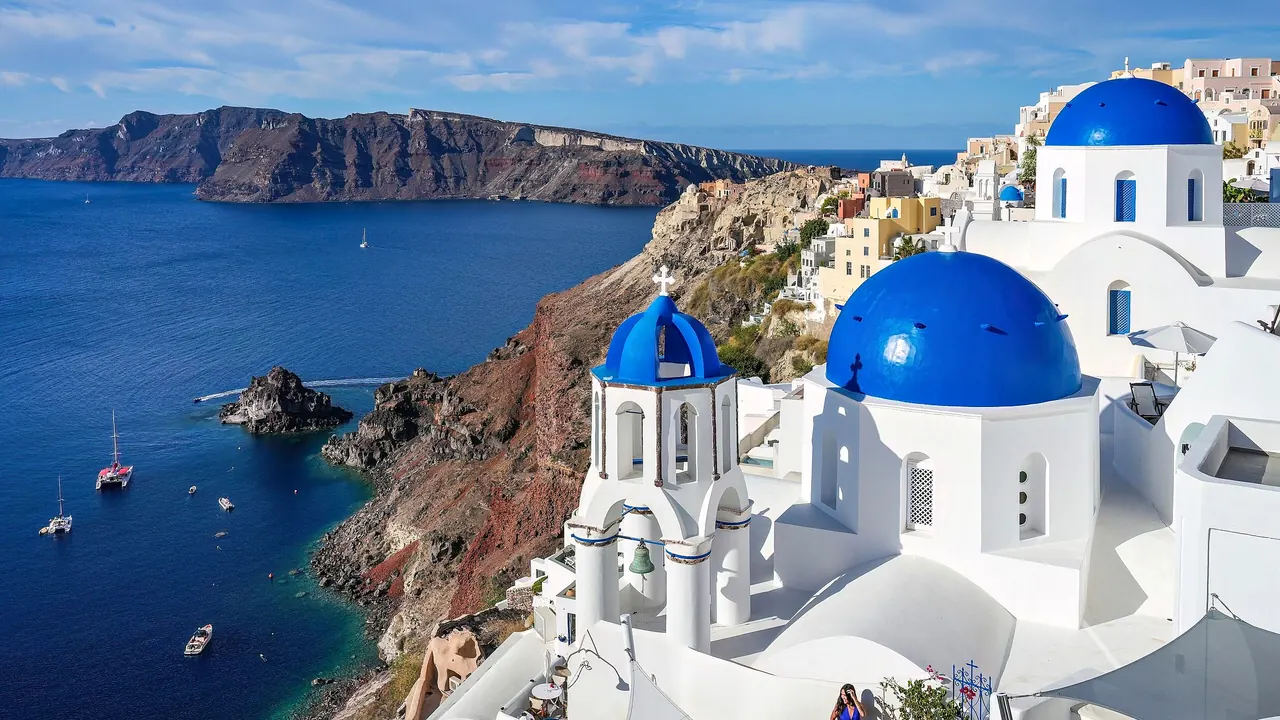
Photos: Santorini by Giles Laurent, CC BY-SA 4.0, cropped.
Kos or Santorini?
Our verdict in twelve categories, each scored against the same fixed benchmark cities, and the climate month by month, so you can choose for your trip.
Choose Kos for
- prices
- families
- beaches
Kos suits travellers who want plenty of sandy beach, easy days and a budget that goes a fair way. The north coast gives long, shallow strands for children, Kos Town is flat enough to cycle, and the buses run along the main road. When the evening comes, the old-quarter bars or Kardamena's clubs keep going late. It is the more practical island, and it costs less, though its food and landscapes rarely stay in the memory.
Choose Santorini for
- nature and the outdoors
- food and drink
- culture and sights
Santorini is for the trip where the setting is the point. Couples, walkers and wine lovers get the caldera cliffs, the rim path to Oia, Assyrtiko tastings in the inland villages and the buried Bronze Age town at Akrotiri. In exchange you pay a good deal more, climb a lot of steps, share the views with crowds and settle for dark, hot beaches that few people come for.
Scoreboard
Twelve categories on one fixed scale from 0 to 100. The shaded stretch is the gap between the two.
Your match
Pick a travel style or drag the sliders, and both match scores follow your weighting.
Wins on prices and families with your weighting.
Wins on nature and the outdoors and food and drink with your weighting.
What matters to you?
Category by category
What the scores mean for a trip.
Beaches & swimming
Kos is the better beach island by a distance. It has long, open sand from Tigaki through Marmari to Mastichari, with shallow water and room to spread out. The calmer, clearer coves are in the south around Kardamena and on the Kefalos peninsula, where Paradise Beach and Agios Stefanos are the prettiest bays.
Santorini's beaches are volcanic black sand and fine pebble that burns underfoot by midday. Perissa, Perivolos and Kamari are comfortable, and Red Beach is striking but small. Anyone staying in the caldera villages has to travel down to the coast to swim. On both islands the meltemi can roughen the exposed shores in high summer.
Food & drink
Santorini eats and drinks better, mostly because of what its volcanic soil grows. There is fava from yellow split peas, tomato fritters, white aubergines and capers, and above all the wine. Assyrtiko and the sweet Vinsanto can be tasted at wineries around Pyrgos, Megalochori and Exo Gonia, though many cliff-edge tables mostly charge for the sunset.
Kos offers friendly, straightforward island cooking, with grilled octopus, chickpea pitaroudia and krasotyri cheese aged in red wine. It is best in Zia, Pyli and the harbour tavernas at Mastichari. In the big resorts, much of the food is aimed at all-inclusive guests.
Culture & sights
Santorini has the stronger heritage, and its two strengths are of different kinds. Akrotiri is a Bronze Age town preserved under volcanic ash, with frescoes on show in Fira. The second strength is the islands' built landscape: cave houses and blue domes on the caldera rim, and the medieval kastelli of Pyrgos and Emporio.
Kos is about Roman and Hellenistic ruins scattered through a working town: the Agora, the Odeon, the Casa Romana mosaics and the Knights' Neratzia Castle by the harbour. Its finest site, the Asklepieion, is a terraced healing sanctuary just outside town. Either island's sights fill two or three days.
Nightlife
Kos is the island for a proper night out. The lanes of Kos Town's old quarter are full of bars that stay loud into the small hours, and Kardamena is an out-and-out party resort with late clubs and a young Northern European crowd.
On Santorini, evenings are built around sunset, dinner and a cocktail facing the caldera, which suits couples more than night owls. Only a few lanes in Fira keep clubs going late in high summer. On both islands, going out stops almost entirely in winter.
Nature & outdoors
Santorini's scenery is the reason many people go. Ash-and-lava cliffs drop more than 300m into a flooded volcano, and the 10km rim path from Fira to Oia is one of the great walks in the Aegean. Boats cross to the black cone of Nea Kameni, and divers explore the submerged caldera walls.
Kos is gentler and greener in places. Pine woods climb the Dikeos range to Mount Christos for the sunset, peacocks wander in the Plaka forest and flamingos winter on the Alikes salt lake. Where it does better is wind and wheels: Marmari and Tigaki are good for windsurfing and kitesurfing, and the flat coast is easy to cycle.
Day trips
Both islands' day trips go by sea, and Kos has the slight edge thanks to its range and easier logistics. Bodrum is a short ferry ride away, so you can add a Turkish castle and bazaar if you bring a passport. Nisyros offers a walk into a volcanic crater, and Kalymnos is a quick crossing from Mastichari, with boats leaving from three ports.
From Santorini, Thirasia is a quiet caldera crossing, and Ios, Folegandros and Naxos are within reach. A long day can even take in Knossos on Crete. However, almost everything leaves from the single port at Athinios, and timetables thin sharply outside summer.
Good for families
Kos is clearly the family island. The beaches at Tigaki, Marmari and Mastichari shelve gently into shallow water, many resorts come with pools and kids' clubs, and there is a large water park near Marmari. Families can also cycle together on the flat paths around town.
Santorini's caldera villages are hard going with children: steep steps, crowds, no pushchair access and cliff hotels that often refuse young guests. Kamari and Perissa work far better, with flat promenades and a small water park, and older children enjoy the volcano boat. Neither island has a zoo or aquarium.
Getting around
Getting around Kos is simpler. The island is long and flat along its coast, buses link Kos Town, the airport and the main resorts, and cycle lanes run to the beaches either side of town. You only need a hire car for the hill villages and the far south-west.
On Santorini, distances are short but progress is slow. Every bus route runs through Fira, so cross-island trips mean changing there, and the buses are packed in summer. Narrow roads and scarce parking in Oia add to the delays, and the caldera villages are steps on foot. Fira is the only practical base without a car.
Shopping & style
Santorini offers more to browse, although neither island is a shopping destination. The cliff-top lanes of Oia and Fira have galleries of island painters and photographers, jewellers near Fira's cathedral, and linen and ceramics. The best things to take home are bottles of Assyrtiko and Vinsanto, capers and fava.
Kos Town's old quarter is mostly souvenirs, leather and sandals. Its Italian-era market hall on Eleftherias Square is good for herbs, spices, honey and olive oil, and the resorts offer little more than beach shops.
Affordability
Kos is much the cheaper of the two. Because it is built for package travel, it has plenty of mid-range apartments in Kardamena, Tigaki and Marmari, and tavernas, buses and archaeological sites cost little. Harbour-front meals and sunbeds are where costs add up.
Santorini's prices are driven by the view. Cave suites on the rim at Oia, Imerovigli and Fira are among the dearest rooms in Greece, and boat trips and tastings add more. Keeping costs down there means staying in Kamari or Perissa and walking up to watch the sunset. Both islands are cheaper outside July and August.
Live music & performing arts
Neither island is worth choosing for performances, and both go quiet outside summer. The difference is in the settings. Kos stages its Hippokrateia festival in the Asklepieion, the Roman Odeon and the castle, and village saints' days bring Greek music and dancing. Santorini's main event is a classical music festival in Fira at the end of summer, with occasional concerts in old mansions and wineries.
Wellness & relaxation
The two are about even for a restful stay, but they offer opposite kinds of rest. On Kos, the highlight is Therma, a free hot sulphur spring running onto a pebble beach, where bathers pile stones into pools. The rest of the time, unwinding means slow days around Kefalos or in Zia and Pyli.
On Santorini, rest comes from the luxury cave hotel at Imerovigli or Oia, with a heated plunge pool facing the caldera, plus a boat swim into Palea Kameni's warm, rust-coloured spring. For quiet, choose Imerovigli or the inland wine villages, not the crowded rim at Oia and Fira.
When should you go?
Pick your month. The climate figures are measured averages, not a forecast.
Kos in July
Santorini in July
Daytime high, °C
Rainfall in the month, mm
Where the figures come from
Kos has no rain gauge within 25 km of the centre, so its rainfall comes from a gridded climate dataset read at the destination rather than from a gauge further away.
Santorini's station stands 182 m below the place it is measured for, so that place is likely a little cooler than the figures say.
Santorini has no rain gauge within 25 km of the centre, so its rainfall comes from a gridded climate dataset read at the destination rather than from a gauge further away.
Temperature and rainfall are climate normals, averaged over the years shown. Kos: 1993-2020 (rainfall 1991-2020) normals, Kos Airport (23.2 km from centre). Santorini: 2000-2025, 12 years observed (rainfall 1991-2020) normals, Santorini Island / Monólithos (5 km from centre).
The two islands follow almost the same summer. June to September is hot and close to rainless, with highs around 31°C on Kos and only slightly lower on Santorini in July and August. That is beach weather but tiring for walking ruins or caldera paths in the middle of the day. The sea is warm enough to swim from June to October on both, peaking at about 25°C, so for beach time and comfortable sightseeing together, June and September are the best balance.
The real difference shows in winter. Kos, at the point where most visitors stay, is much wetter, with around 170mm in January against 98mm on Santorini. Its autumn rain also starts earlier, so September there is a little less reliably dry. Both are mild but grey from November to March. April, May and October are the months for walking, and Santorini's drier shoulder seasons give it the edge for a spring or late-autumn stay.
Which traveller are you?
On a family trip with young children, choose Kos. Beach-and-pool days are what it does best, and nothing is far away. Santorini works with small children only from a coastal base, away from the views that justify the trip.
For an outdoors trip, Kos suits windsurfers and cyclists, but Santorini is the stronger pick: its walks and boat outings are what people remember. The catch is that a day or two covers them, and summer leaves little shade.
On a tight budget, pick Kos, which is priced for package travel rather than for a famous view. Santorini can be done cheaply only by sleeping away from the caldera, giving up much of what you came for.
Before you go
| Measure | Kos | Santorini |
|---|---|---|
| Official language | Greek | Greek |
| Currency | Euro (EUR) | Euro (EUR) |
| Sockets | CF230 V, 50 Hz | CF230 V, 50 Hz |
| Driving side | Right | Right |
| Time zone | UTC+2, UTC+3 in summer | UTC+2, UTC+3 in summer |
| Emergency number | 112 | 112 |
| Main airport | Kos International Airport "Ippokratis" (KGS)75 non-stop destinations | Santorini International Airport (JTR)60 non-stop destinations |
| Public holidays this year | 15 days | 15 days |
By the numbers
| Measure | Kos | Santorini |
|---|---|---|
| Population | 33,387 | 17,430 |
| People per km² | 115 | 220 |
| Swim season, months above 21 °C | 5 months | 5 months |
Where else could you go?
Every comparison below shares a destination with this one, so you can follow Kos or Santorini somewhere new.