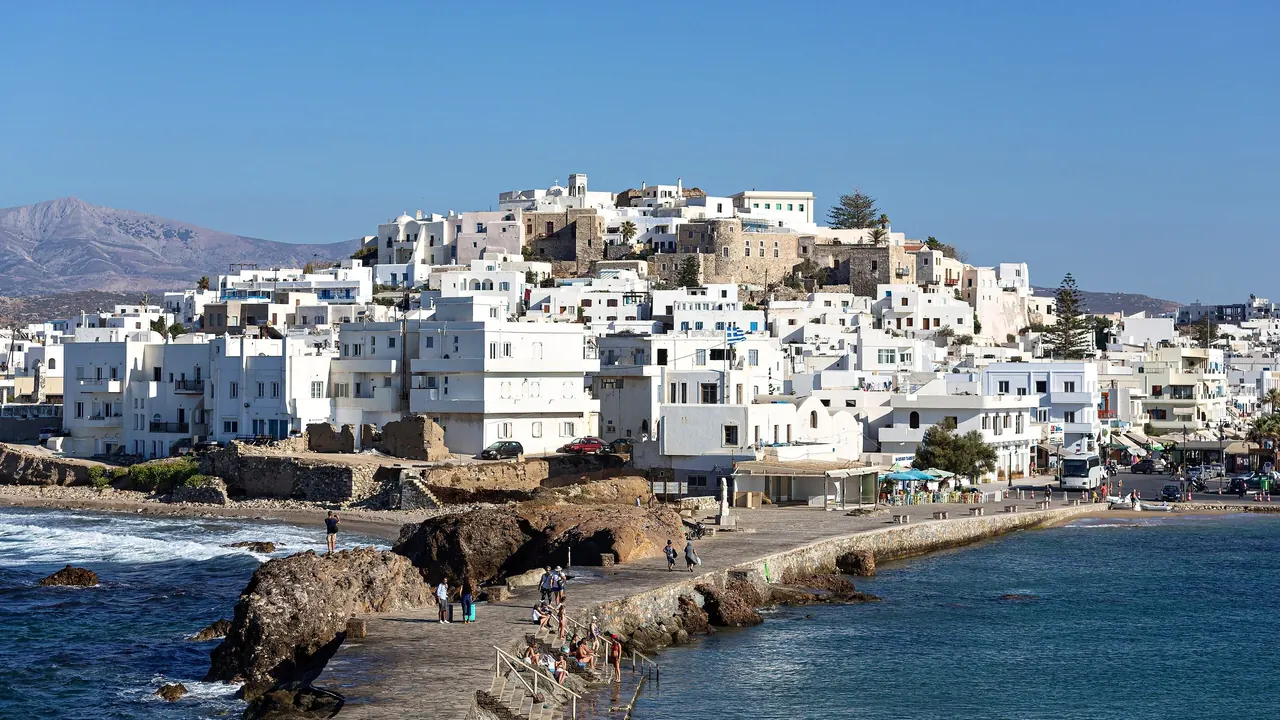
Photos: Naxos by Manfred Werner (Tsui), CC BY-SA 4.0, cropped.
Kos or Naxos?
Our verdict in twelve categories, each scored against the same fixed benchmark cities, and the climate month by month, so you can choose for your trip.
Choose Kos for
- nightlife
- wellness
- getting around
Kos is the easier island for a sociable, low-effort beach vacation. It is flat and compact, with buses along the main road and cycle lanes around Kos Town. Evenings run from loud bars in the old quarter to the late clubs of Kardamena, and the hot spring at Therma and the many resort spas suit a lazy week. Families who want pools, kids' clubs and a water park will find everything in place.
Choose Naxos for
- food and drink
- nature and the outdoors
- culture and sights
Naxos rewards people who want to explore the island itself. Its mountain villages make their own cheese and kitron, and Mount Zas and the old mule paths through the Tragaea valley give real walking. Marble ruins, Venetian towers and Byzantine chapels are spread across the interior. The evenings are quieter and you will want a hired car for the inland villages, but the island feels more rooted and more varied once you leave the beach.
Scoreboard
Twelve categories on one fixed scale from 0 to 100. The shaded stretch is the gap between the two.
Your match
Pick a travel style or drag the sliders, and both match scores follow your weighting.
Too close to call, 2 points apart
Wins on nightlife and wellness with your weighting.
Wins on food and drink and nature and the outdoors with your weighting.
What matters to you?
Category by category
What the scores mean for a trip.
Beaches & swimming
Both islands have excellent sandy beaches, and they are close to level here. The difference is how the sand is laid out. On Naxos it runs almost unbroken down the west coast from Agios Georgios through Agios Prokopios and Plaka to the dune-backed strands of Mikri Vigla and Alyko, so you can stay by the water and walk to a quieter stretch.
The Kos beaches are spread around the island. The long, open north coast from Tigaki to Mastichari can get choppy in the meltemi, the south coast around Kardamena is more sheltered, and the most beautiful bays, Paradise Beach and Agios Stefanos with its islet chapel, are out on the Kefalos peninsula. Both islands get the summer wind. On windy days Kos has a whole sheltered coast to switch to, while Naxos has Agios Georgios and a few coves behind headlands.
Food & drink
Naxos eats better because so much of what reaches the table is grown or made on the island. Its valleys grow potatoes, its herds supply graviera and arseniko cheese, and kitron liqueur is distilled in Halki. The tavernas in Filoti, Apiranthos and Koronos cook slow stews and grill local meat.
Kos has its own specialities, chickpea pitaroudia and krasotyri cheese aged in red wine, and good meals in Zia, Pyli and the harbours at Mastichari and Kamari. Too much of its eating, though, is shaped by all-inclusive resorts and multilingual seafront menus. Neither island offers much beyond Greek cooking.
Culture & sights
Naxos has the richer heritage, spread across the whole island. The Portara stands over Chora's harbour, the Venetian kastro has its mansions and Cycladic figurines, and inland there are unfinished kouroi lying in the quarries at Flerio and Apollonas, the Temple of Demeter near Sangri and frescoed chapels such as Panagia Drosiani. Seeing it means several days of driving.
On Kos the history is concentrated in and around Kos Town. Roman mosaics, the Odeon and the Casa Romana sit among the streets, the Knights' castle guards the harbour, and the Asklepieion is a short ride away. It is easy to see on foot, but there is less of it.
Nightlife
Kos is the island for going out. The old-quarter lanes of Kos Town stay loud into the small hours, Lambi has beach clubs, and Kardamena is a full party resort with late clubs and a young crowd.
Evenings on Naxos are built around a long dinner. After that come cocktail bars along Chora's harbourfront, a couple of clubs and sunset drinks at the beach bars of Agios Prokopios and Plaka. People who want to dance all night usually take a ferry to another island. On both, the scene runs from June to September and fades out of season.
Nature & outdoors
Naxos has much more varied landscape. It is the greenest and most mountainous of the Cyclades, with Mount Zas and its summit cave, olive groves along the Tragaea mule paths and rocky, empty coasts to the north and east.
Kos is mostly low farmland and scrub. Its highlights are smaller: pine trails up to Mount Christos for the sunset, peacocks in the Plaka forest and flamingos on the Alikes salt lake in winter and spring. Both catch the meltemi for kitesurfing and windsurfing, at Mikri Vigla on Naxos and at Marmari, Tigaki and Psalidi on Kos.
Day trips
The two are about equal for day trips, but the trips are very different. From Kos you can cross to another country, as Bodrum and its crusader castle on the Turkish coast are a short ferry ride away if you carry a passport. Nearer home there is the volcanic crater on Nisyros and the sponge-diving harbour of Kalymnos.
Naxos sits at the centre of the Cyclades. Paros is under an hour away, the Small Cyclades make quiet days out, and Mykonos leads on to Delos, with Santorini possible in a long day. On both islands the trips depend on summer timetables and the wind.
Good for families
Kos has more built for children. Many resorts are organised around pools, kids' clubs and all-inclusive dining, there is a large water park near Marmari, and families cycle the flat paths around Kos Town together. The north-coast sand at Tigaki and Marmari shelves gently, but if you want quiet nights, stay away from Kardamena.
Naxos has no water park and nothing else aimed at children, so days are beach, boat and an ice cream in a village. In return it has soft, shallow sand along the west coast, welcoming family-run studios and tavernas, and room to spread out even in August. Agios Georgios is a short walk from Chora and stays calm when the meltemi makes the open beaches too rough for small swimmers.
Getting around
Kos is simpler to get around. It is long, narrow and mostly flat, nowhere is much more than an hour's drive away, and buses run along the main road between the town, the airport and the main resorts. The cycle lanes make bikes a practical choice around Kos Town, although Paradise Beach and the hill villages still call for a hired car or scooter.
On Naxos you can manage without a car if you stay in Chora or Agios Prokopios, as summer buses run along the west-coast beaches. The interior villages and the empty coasts are reached on narrow, winding mountain roads, and the drive to Apollonas takes well over an hour.
Shopping & style
Neither island is worth visiting for shopping, and there is little fashion or design on either. In Kos Town's old quarter the shops lean towards souvenirs, leather sandals and sponges, though the Italian-era market hall on Eleftherias Square is good for herbs and spices. Naxos has more local character. Graviera, kitron and thyme honey come from village co-operatives, and Apiranthos and Halki sell weaving and marble work.
Affordability
Both are moderately priced Greek islands, and neither is a budget destination. Kos keeps costs down through scale. It is built for package and all-inclusive travel, with plenty of mid-range rooms in Kardamena, Tigaki and Marmari, and buses and bike hire are cheap.
Naxos depends more on family-run studios and village rooms, while the boutique hotels around Chora and Plaka cost more. On both, prices rise in high summer, and June or September gives better value while the sea is still warm.
Live music & performing arts
Kos has the more dramatic settings. In summer the Hippokrateia festival puts on concerts, theatre and dance in the Asklepieion, the Roman Odeon and the castle. Saints' day festivals in the villages add Greek music and dancing, but the rest of the island's live music is resort entertainment and Greek-night shows.
The best music on Naxos comes from the village panigyria, where island violin and lute play late into the night and everyone joins the dancing. A summer festival in a restored Venetian tower inland and small recitals in Chora's kastro add a little more. Neither island has a theatre or concert season outside the summer.
Wellness & relaxation
Kos has something Naxos lacks: Therma, beyond Agios Fokas, where a hot sulphur spring runs onto a pebble beach and bathers pile up stones to make warm pools in the sea. Spas are also common in its larger resorts.
Naxos has no thermal water and only a handful of hotel spas and yoga retreats on the south-west coast. What it offers is quiet. Outside August, a stay in the hills around Halki or on the emptier southern beaches is truly unhurried.
When should you go?
Pick your month. The climate figures are measured averages, not a forecast.
Kos in July
Naxos in July
Daytime high, °C
Rainfall in the month, mm
Where the figures come from
Kos has no rain gauge within 25 km of the centre, so its rainfall comes from a gridded climate dataset read at the destination rather than from a gauge further away.
Naxos's temperatures are measured 79 km from the centre, at Santorini Island / Monólithos.
Naxos has no rain gauge within 25 km of the centre, so its rainfall comes from a gridded climate dataset read at the destination rather than from a gauge further away.
Temperature and rainfall are climate normals, averaged over the years shown. Kos: 1993-2020 (rainfall 1991-2020) normals, Kos Airport (23.2 km from centre). Naxos: 2000-2025, 12 years observed (rainfall 1991-2020) normals, Santorini Island / Monólithos (78.8 km from centre).
The two islands follow almost the same summer. Both are warm enough for the beach from June to September, and the sea stays swimmable into October. July and August reach about 31°C on Kos and a degree less on Naxos, which is hot enough to push sightseeing and walking into the early morning and evening. Kos has slightly warmer water, about 25°C in August against a degree less around the Naxos west coast. May and late September to October are the comfortable months for exploring either island on foot, with long dry days and fewer hot afternoons.
Winter is where they differ. Kos turns properly wet, with around 170mm in January and heavy rain from November to February. Naxos gets roughly half that, about 83mm in its wettest month. Neither is a beach destination from November to April, but Naxos stays the drier choice for a walking trip in early spring or late autumn.
Which traveller are you?
On an outdoors trip, Naxos is the clear choice. Its mountain spine climbs to about 1,000m at Mount Zas, mule paths link the marble villages and the empty north and east coasts are wild. Kos is lower and drier, with walking mostly confined to the Dikeos hills.
For a relaxing and wellness trip, Kos has more to offer. The hot sulphur spring at Therma flows straight into the sea, and spas are common in the larger beach resorts. On Naxos, unwinding mostly comes down to a slow pace and a few yoga retreats.
On a culture and arts trip, Naxos gives you more days of discovery: the Portara, the Venetian kastro, abandoned kouroi in the quarries and frescoed chapels inland. The Roman remains and the Asklepieion on Kos are rewarding, but you will have seen them within two or three days.
Before you go
| Measure | Kos | Naxos |
|---|---|---|
| Official language | Greek | Greek |
| Currency | Euro (EUR) | Euro (EUR) |
| Sockets | CF230 V, 50 Hz | CF230 V, 50 Hz |
| Driving side | Right | Right |
| Time zone | UTC+2, UTC+3 in summer | UTC+2, UTC+3 in summer |
| Emergency number | 112 | 112 |
| Main airport | Kos International Airport "Ippokratis" (KGS)75 non-stop destinations | Naxos Island National Airport (JNX)3 non-stop destinations |
| Public holidays this year | 15 days | 15 days |
By the numbers
| Measure | Kos | Naxos |
|---|---|---|
| Population | 33,387 | 17,930 |
| People per km² | 115 | 42 |
| Swim season, months above 21 °C | 5 months | 5 months |
Where else could you go?
Every comparison below shares a destination with this one, so you can follow Kos or Naxos somewhere new.