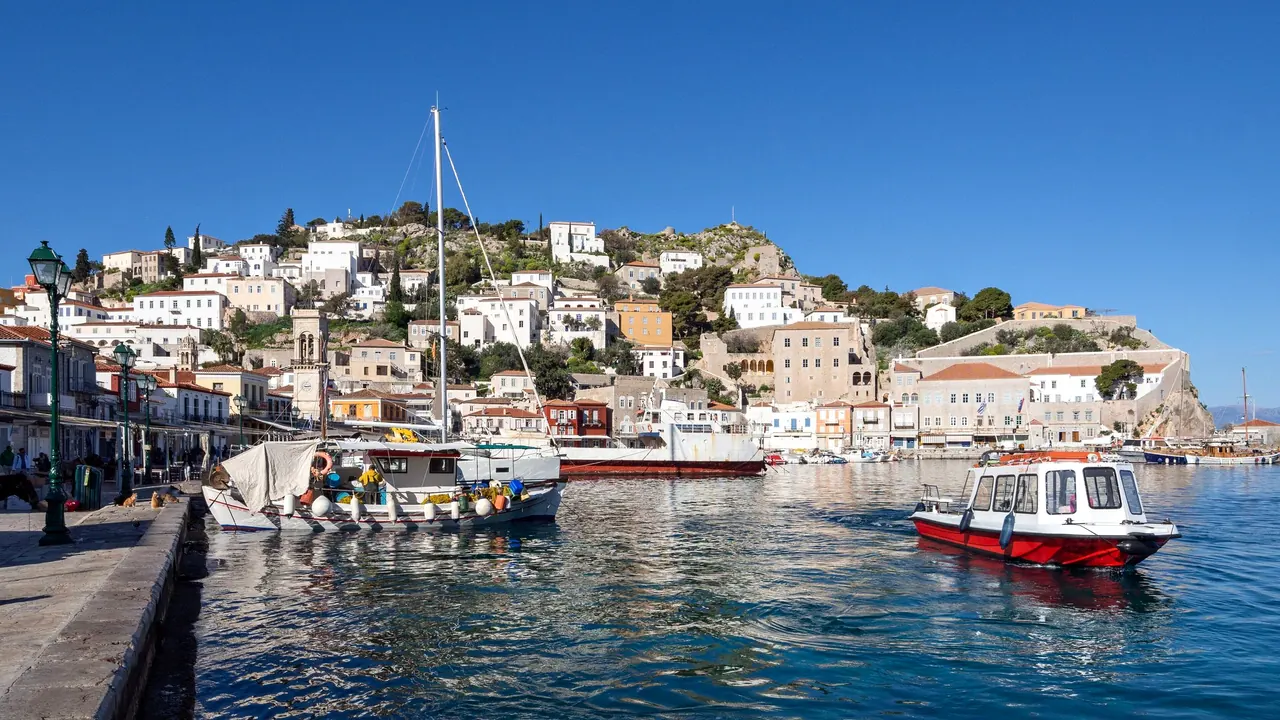
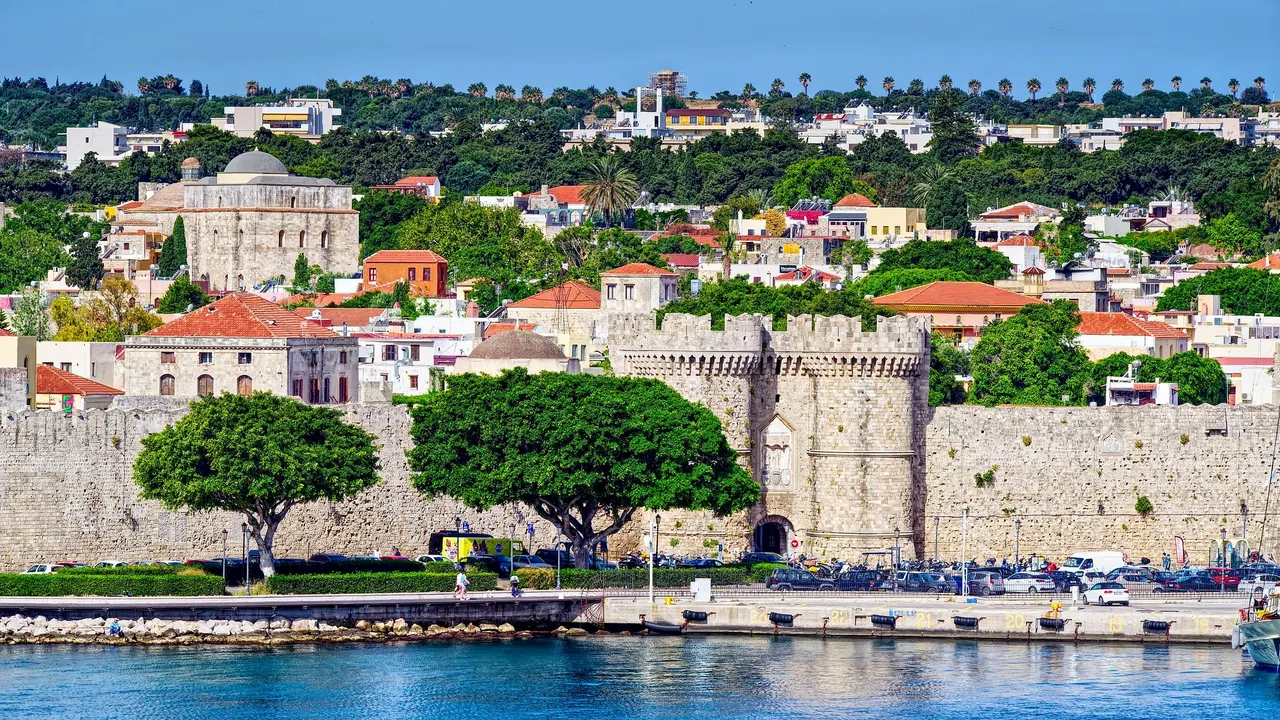
Photos: Hydra by C messier, CC BY-SA 4.0, cropped; Rhodes by Mark Thomas, Pexels License.
Hydra or Rhodes?
Our verdict in twelve categories, each scored against the same fixed benchmark cities, and the climate month by month, so you can choose for your trip.
Choose Hydra for
- wellness
Hydra suits a couple or a solo traveller who wants a few slow days somewhere silent. With no cars on the island, the stone harbour town stays intact, and the days pass with a swim off the rocks, a long lunch at Kamini and an evening drink watching the boats. It works best as a short, quiet escape from Athens rather than a full fortnight, because the food, the sights and the coves run out quickly.
Choose Rhodes for
- families
- culture and sights
- nightlife
Rhodes is the island for a longer, busier vacation. The east coast has wide, sheltered bays where children can paddle, and the walled medieval Old Town and the acropolis at Lindos give you several days of real sightseeing. There are also lively bars, boats to Symi and Turkey, and resort hotels at more moderate prices. You lose Hydra's stillness and gain room, range and an easier family trip.
Scoreboard
Twelve categories on one fixed scale from 0 to 100. The shaded stretch is the gap between the two.
Your match
Pick a travel style or drag the sliders, and both match scores follow your weighting.
Wins on wellness with your weighting.
Wins on families and culture and sights with your weighting.
What matters to you?
Category by category
What the scores mean for a trip.
Beaches & swimming
Rhodes is the better beach island by a wide margin. The east coast from Faliraki to Lindos is a run of broad, sheltered bays, with soft sand at Tsambika and rocky snorkelling inlets at Anthony Quinn Bay. The far south has Prasonisi's sandbar. The trade-off is rows of sunbeds on the busiest stretches in high summer.
Hydra is about swimming rather than lying on a beach. You climb down ladders from rocks and concrete platforms near the port into deep, very clear water. Kamini and Vlychos have small pebble coves, and the pine-backed bays at Bisti and Agios Nikolaos need a water taxi. Anyone who wants whole days on sand should choose Rhodes.
Food & drink
Neither island is a food destination, but Rhodes has more to discover. Its inland village tavernas and the meze places in the newer part of Rhodes Town serve local dishes such as pitaroudia, matsi pasta and slow-cooked goat, with wine and honey from the slopes of Attavyros. You do have to steer clear of the resort buffets and the Old Town's tourist lanes.
Hydra keeps to a narrower taverna menu of grilled fish, octopus and mezedes. Its best moments come from the setting, eating beside the water at Kamini or Vlychos as the light goes. Almond amygdalota from the town bakeries are its one speciality, and on a longer stay the choice starts to feel thin.
Culture & sights
Rhodes is in a different league for sightseeing. Its walled Old Town, built by the Knights of St John and later added to by the Ottomans, is among the most complete medieval fortified towns in Europe. Mosques, a synagogue and the Archaeological Museum in the Knights' Hospital lie within the walls. Beyond them are the acropolis at Lindos, ancient Kamiros and the stadium on Monte Smith, enough for several days.
Hydra's appeal is a single, intact harbour town of eighteenth- and nineteenth-century shipowners' mansions, protected as a whole and free of cars. You can visit the Monastery of the Dormition, the naval archives and a mansion or two, and all of it fits into a couple of unhurried days.
Nightlife
Evenings on Hydra are a long drink on the waterfront among well-dressed Athenians and yachting visitors. A few bars keep the music going into the small hours, with some dancing, but there are no big clubs, and from November most of them close.
For a proper night out, Rhodes wins easily. Faliraki's strip of bars and clubs runs until dawn in July and August, one Old Town lane goes late, and Lindos has rooftop and courtyard bars for an older crowd. Outside late spring to early autumn, most of this closes too.
Nature & outdoors
Rhodes edges ahead for outdoor variety, mainly thanks to the sea and the wind. Prasonisi is one of the Mediterranean's best-known windsurfing and kitesurfing spots. Inland, the shaded gorge of the Valley of the Butterflies and Seven Springs offer relief from the heat, and Mount Attavyros is a proper 1,216m climb. Away from those, the pine hills are pleasant rather than dramatic.
Hydra has the better walking for its size. It is a bare limestone ridge laced with car-free mule paths up to Profitis Ilias and Mount Eros, and you can walk alone for hours above the Saronic Gulf. The clear water below the cliffs suits snorkelling and sea kayaking.
Day trips
Rhodes offers the more rewarding outings. The fast boat to Symi's pastel harbour is a classic and is often combined with the monastery at Panormitis. Quieter Halki leaves from Kamiros Skala, and a ferry of about an hour reaches Marmaris in Turkey. The castles at Monolithos and Kritinia make good drives on the island itself.
From Hydra, the easy trips are to the neighbouring Saronic islands. Spetses and Poros are each under an hour away. Reaching Epidaurus or Nafplio means crossing to the mainland at Metochi and then arranging a car, so most people simply stay put.
Good for families
For children, the gap is large. Rhodes has gently sloping sand on the east coast and resort hotels designed around pools and kids' clubs. There is a water park above Faliraki and an aquarium in Rhodes Town, and the Old Town ramparts and the Valley of the Butterflies are both popular with children.
Hydra's car-free lanes and luggage-carrying donkeys appeal to children, but nothing on the island is built for them. Steep steps make pushchairs useless, and most swimming is into deep water. It suits older children who swim confidently, ideally with a base near the sheltered bay at Mandraki.
Getting around
Hydra is the simpler place to be, since everything is on foot, by donkey or by water taxi. It is also harder work: almost every route away from the harbour is a stone staircase, and the ferry from Piraeus can be cancelled in strong wind.
Rhodes is easier to get around for a bigger trip. Buses run well along the east coast to Lindos, and a hire car opens up the south and the inland villages on good roads. Rhodes Town's car-free Old Town is a pleasure to walk.
Shopping & style
Neither island is worth a trip for shopping, though Rhodes has slightly more range. Sokratous Street is packed with souvenir stalls, the new town has ordinary high-street fashion, and the villages sell Lindian-style ceramics and lace.
Hydra has less but chooses better. A few lanes hold jewellery workshops, galleries showing resident artists and linen boutiques, all well suited to an evening stroll.
Affordability
Rhodes is noticeably cheaper. Its large stock of package and all-inclusive hotels keeps the east coast at moderate prices, and village tavernas and buses are reasonable. Only Lindos and the Old Town's boutique hotels push costs up.
On Hydra, the expense is the room. There are only a few boutique guesthouses and converted mansions, and they fill early for midsummer. Water taxis and the harbour-front bars add to the bill, although back-lane taverna meals are fair value. Coming in May, June or late September helps.
Live music & performing arts
Both islands are thin on performance, and neither has a theatre or concert season. What differs is the occasion. Rhodes has a long-established folk dance company in a small theatre in the Old Town, along with summer concerts in the moat and the ancient stadium.
Hydra's high point is the Miaoulia in June, a naval festival that ends with a fireship burned in the harbour. Apart from that there are occasional recitals and late taverna music.
Wellness & relaxation
Hydra is the more restful island, and the reason is silence rather than spas. Without cars or motorbikes, and with the day-trippers gone by evening, the upper town and Kamini settle into a routine of swim, lunch and siesta. Treatments are limited to a few hotel rooms and the occasional yoga retreat.
Rhodes offers better-equipped spas in its east coast and Lindos resort hotels, but they have little local character. To find real calm there, head south to villages such as Lahania and Asklipio, far from the noise of the northern resorts.
When should you go?
Pick your month. The climate figures are measured averages, not a forecast.
Hydra in July
Rhodes in July
Daytime high, °C
Rainfall in the month, mm
Where the figures come from
Hydra's temperatures are measured 66 km from the centre, at Athinai Airport.
Hydra has no rain gauge within 25 km of the centre, so its rainfall comes from a gridded climate dataset read at the destination rather than from a gauge further away.
Rhodes has no rain gauge within 25 km of the centre, so its rainfall comes from a gridded climate dataset read at the destination rather than from a gauge further away.
Temperature and rainfall are climate normals, averaged over the years shown. Hydra: 1991-2020 normals, Athinai Airport (65.5 km from centre). Rhodes: 1991-2020 normals, Rhodes Airport (12.6 km from centre).
Both islands follow the Greek pattern of dry, hot summers and wet winters. The details differ, though. Hydra gets hotter in midsummer, with highs around 33°C in July and August, which makes its shadeless mule paths hard going. Rhodes stays a couple of degrees cooler, at about 31°C. On both islands the sea is warm enough to swim from June to October, and Rhodes is pleasant a little earlier, in late May. September is the sweet spot on either island: the water is still at its warmest and the heat has eased.
The real contrast is winter. On Rhodes, rain sets in from October and becomes heavy by midwinter, reaching about 171mm in January. Hydra's wettest months, November and December, see roughly half that, at around 89mm. Rhodes is the milder of the two in winter, but neither is a beach destination then. For walking, April, May and October suit both islands, and on Hydra spring brings long sunny days while the hills are still green.
Which traveller are you?
On a family trip with young children, Hydra's stepped lanes and deep-water swimming make every day hard work, so Rhodes is the easier pick. Base yourselves in an east coast resort and come in June or September, before or after the hottest weeks.
For a relaxing and wellness trip, Hydra is the better choice if you want quiet more than treatments. Stay in the upper town or at Kamini in May, June or September. On Rhodes you get proper hotel spas, but finding real calm means heading south.
On a culture and arts trip, Hydra makes a graceful two-day stop, while Rhodes rewards a week. Sleep inside the Old Town walls so you can walk the lanes early and late, hire a car for Lindos and Kamiros, and avoid the midday heat of high summer.
Before you go
| Measure | Hydra | Rhodes |
|---|---|---|
| Official language | Greek | Greek |
| Currency | Euro (EUR) | Euro (EUR) |
| Sockets | CF230 V, 50 Hz | CF230 V, 50 Hz |
| Driving side | Right | Right |
| Time zone | UTC+2, UTC+3 in summer | UTC+2, UTC+3 in summer |
| Emergency number | 112 | 112 |
| Main airport | Athens Eleftherios Venizelos International Airport (ATH)176 non-stop destinations | Rhodes International Airport "Diagoras" (RHO)136 non-stop destinations |
| Public holidays this year | 15 days | 15 days |
By the numbers
| Measure | Hydra | Rhodes |
|---|---|---|
| Population | 1,966 | 127,613 |
| People per km² | 40 | 91 |
| Swim season, months above 21 °C | 5 months | 6 months |
Where else could you go?
Every comparison below shares a destination with this one, so you can follow Hydra or Rhodes somewhere new.