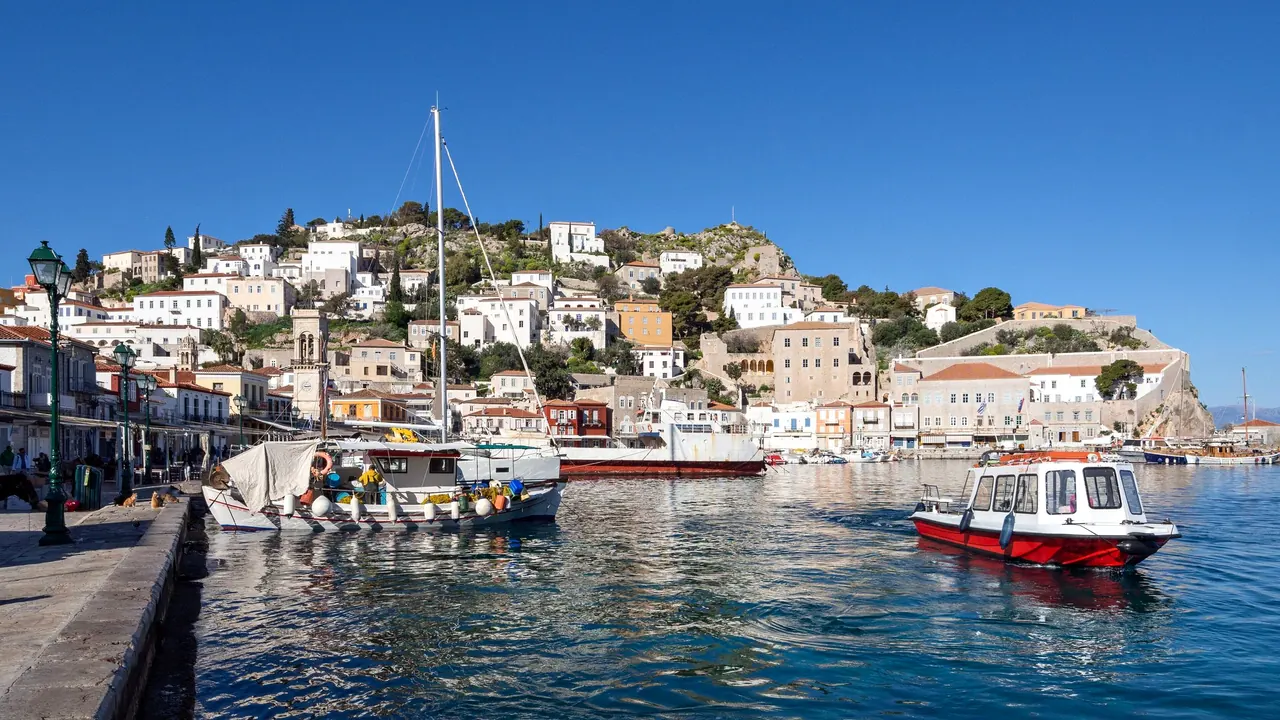
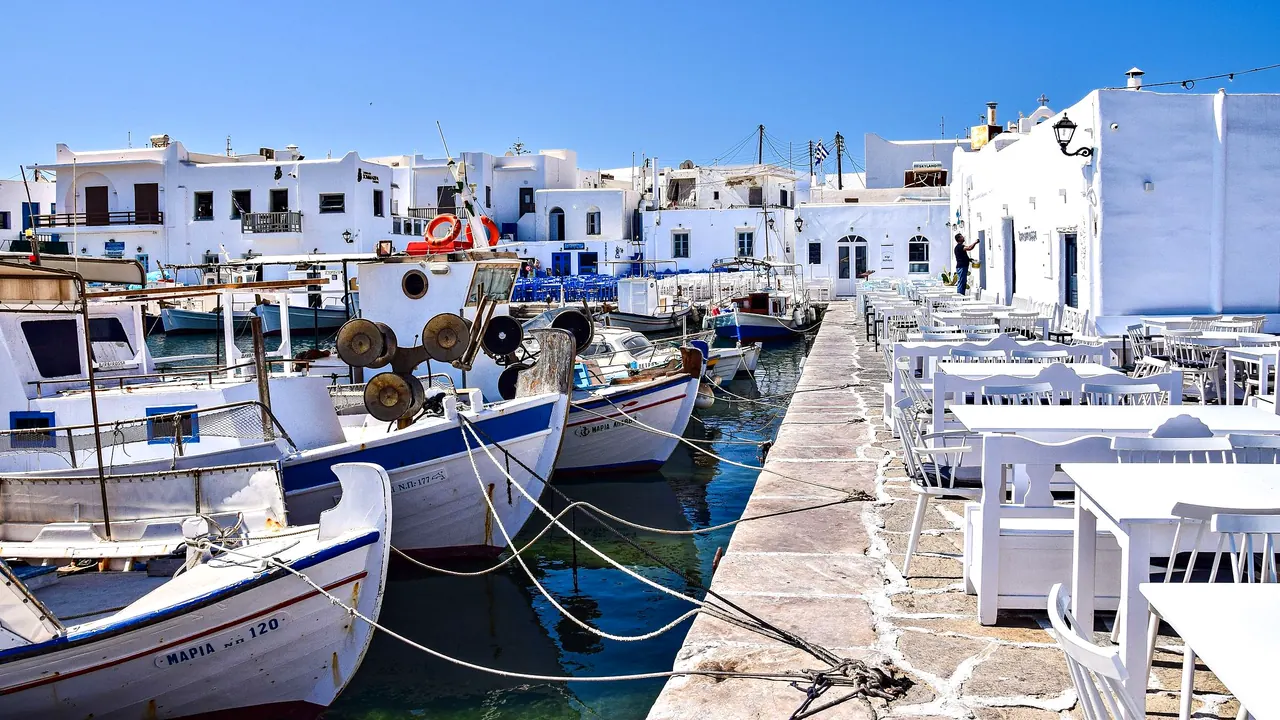
Photos: Hydra by C messier, CC BY-SA 4.0, cropped; Paros by AXP Photography, Pexels License.
Hydra or Paros?
Our verdict in twelve categories, each scored against the same fixed benchmark cities, and the climate month by month, so you can choose for your trip.
Choose Hydra for
- wellness
- nature and the outdoors
Hydra suits travellers who want a car-free harbour town of grey and white stone mansions, long walks on old mule paths and swims off rocks into deep, clear water, and don't need much more. It is the quieter and more self-contained stay. It works best for couples and walkers who can manage the steps and are happy without sandy beaches or a wide choice of restaurants.
Choose Paros for
- families
- beaches
- nightlife
For a classic Cycladic beach vacation, Paros is the better pick. It has sandy bays all round the coast, shallow water for children, a broader taverna table with its own wines, livelier evenings in Naoussa and ferries to Antiparos, Naxos and beyond. That gives a week far more variety. The price is more time on buses or in a hired car, and busier lanes in August.
Scoreboard
Twelve categories on one fixed scale from 0 to 100. The shaded stretch is the gap between the two.
Your match
Pick a travel style or drag the sliders, and both match scores follow your weighting.
Wins on wellness and nature and the outdoors with your weighting.
Wins on families and beaches with your weighting.
What matters to you?
Category by category
What the scores mean for a trip.
Beaches & swimming
Hydra's swimming is mostly off rocks and concrete platforms west of the harbour, with ladders into deep, very clear water. There are small pebble coves at Kamini and Vlychos and the sheltered bay at Mandraki, but the prettier pine-backed coves such as Bisti and Agios Nikolaos need a water taxi.
Paros is the stronger beach island by a distance, and its beaches are sandy. There are the boulder-framed coves of Kolymbithres, longer stretches at Santa Maria and Lageri, and the wide, gently shelving sands of Golden Beach and Drios. When the meltemi blows, Farangas and the bays near Pounta stay calmer, and Antiparos adds more quiet coves.
Food & drink
Both islands serve Greek taverna cooking built on grilled fish and octopus, but Hydra's range is narrow. The harbour tables charge for the view, the better meals are in the back lanes and at Kamini and Vlychos, and the local treat is amygdalota, almond sweets flavoured with rosewater.
Paros has more to eat over a week. There are the tables on Naoussa's fishing harbour with octopus drying in the sun, chickpeas slow-baked in clay pots, local graviera and the grape spirit souma. The island makes its own wines from Monemvasia and Mandilaria grapes, and Lefkes and Marpissa offer cheaper home cooking.
Culture & sights
The two are level on sights, but they differ in kind. On Hydra the town itself is the monument. It is a protected harbour of mansions built by the shipowners whose fleet fought in the War of Independence, with the Monastery of the Dormition, the Historical Archives Museum and the old cannon batteries, all seen on foot in about two days.
Paros has one major building, the early Christian Ekatontapiliani in Parikia, near a small archaeological museum and a Frankish castle built from reused marble. The rest is spread around the island: Naoussa's Venetian fort, the windmills of Lefkes and the ancient quarries at Marathi that supplied Parian marble. So sightseeing comes in half-days with travel in between.
Nightlife
On Hydra an evening out means a long drink on the harbour among Athenians and yachting visitors. A few bars stay open late with some dancing, and there are no clubs at all.
Paros gives you more of a night out. In July and August, Naoussa has cocktail bars spilling into its lanes, Parikia's seafront has a looser strip and a few late clubs for a younger crowd, and some beach bars hold parties. Neither is a party island, and both go quiet after the summer.
Nature & outdoors
For nature the islands are about even, but they appeal to different people. Hydra is the island for walkers. With no cars, old mule paths climb through pine and scrub to the monasteries of Profitis Ilias and Agia Efpraxia and up Mount Eros at nearly 600m. The cliffs are good for snorkelling and sea kayaking.
The walking on Paros is gentler, mainly the marble-paved Byzantine path from Lefkes down to Prodromos and the trails on the headland at Agios Ioannis Detis. Its real outdoor strength is the meltemi wind, which makes Golden Beach, New Golden Beach and Pounta first-rate spots for windsurfing and kitesurfing.
Day trips
From Hydra the outings are along the Saronic Gulf. Spetses and Poros are each well under an hour away, and Aegina with the Temple of Aphaia takes longer. Epidaurus or Nafplio mean a boat to Metochi and then a car or a tour.
Paros lies on the busy Cyclades ferry routes, which gives it far more choice. Antiparos and its stalactite cave are a short crossing, and Naxos with its marble Portara is under an hour away. In summer, fast boats reach Mykonos, Ios and Sifnos, and organised trips go to Delos and Santorini. Outside the season boats are scarcer, and the meltemi can cancel the smaller ones.
Good for families
Hydra's car-free lanes, luggage donkeys and water taxis amuse children. But the steep stone steps make pushchairs useless, and most swimming is off rocks into deep water, so the island works mainly for older children who swim and walk well.
Paros is much easier with young children. Shallow sandy bays at Livadia, Golden Beach, Logaras and Piso Livadi make simple beach days, and Parikia or the east-coast villages give a calm base with short distances. Neither island has anything built for children beyond the sea.
Getting around
Hydra has no cars. You walk, hire a donkey or take a water taxi, and nearly every walk away from the harbour front goes up or down steps. The town is compact enough for this to be part of the charm, but the far coves mean a boat. Getting there at all means a ferry from Piraeus, which strong winds can cancel.
Paros is easier to cover. In summer a bus network runs from Parikia's port to Naoussa, Lefkes and the main beaches, and a hired car or scooter crosses the island in under half an hour and reaches the smaller coves. The drawbacks are fewer buses out of season and tight parking around Naoussa in August.
Shopping & style
On Hydra the shopping fills a few lanes behind the harbour. The quality is good, with jewellery workshops and galleries selling work by the island's resident artists, but there is little else, and serious shopping is better done in Athens.
Paros offers more to browse. Naoussa's whitewashed lanes, Parikia's old market street and the craft workshops of Lefkes sell linen, Greek designer jewellery, sandals, ceramics, and capers, honey and wine to take home. Naoussa's prices run high, though, and neither island has a real market.
Affordability
Both islands are expensive in high summer, and on both the room is the main cost. On Hydra the problem is supply: there are few places to stay, mostly boutique guesthouses and converted mansions that fill early. Water taxis and luggage donkeys add to the bill, while back-lane tavernas and swimming off the rocks cost little.
Paros has more range. Naoussa and the famous beaches are dear, but Parikia and the east-coast and inland villages have simpler rooms and cheap buses. Hired cars, sunbeds and ferry hops add up over a week instead. Both islands are noticeably better value in June and September.
Live music & performing arts
Neither island is a place for a night at the theatre or a concert season. Hydra's one big occasion is the Miaoulia in June, a naval celebration with music that ends with a fireship burned in the harbour. Otherwise there are occasional summer recitals.
On Paros the music worth catching is folk tradition: island violin and lute at village feast days through the summer, and the mid-August feast of the Virgin at the Ekatontapiliani. Naoussa also re-enacts a pirate raid with fireworks.
Wellness & relaxation
Neither island has a spa culture. On both, wellness comes down to hotel treatment rooms, the occasional yoga retreat and a massage. The real difference is the quiet. On Hydra it reaches every corner because the whole island is free of traffic, and even the harbour empties by evening once the midday excursion boats have gone, leaving the upper town and Kamini very still.
On Paros you have to go looking for calm. Roads, hired scooters and the August crowds in Naoussa keep the busier parts moving, so the peace is in the inland villages of Lefkes, Marpissa and Prodromos, on the south-east coast, or across the water on Antiparos.
When should you go?
Pick your month. The climate figures are measured averages, not a forecast.
Hydra in July
Paros in July
Daytime high, °C
Rainfall in the month, mm
Where the figures come from
Hydra's temperatures are measured 66 km from the centre, at Athinai Airport.
Hydra has no rain gauge within 25 km of the centre, so its rainfall comes from a gridded climate dataset read at the destination rather than from a gauge further away.
Paros's temperatures are measured 82 km from the centre, at Santorini Island / Monólithos.
Paros has no rain gauge within 25 km of the centre, so its rainfall comes from a gridded climate dataset read at the destination rather than from a gauge further away.
Temperature and rainfall are climate normals, averaged over the years shown. Hydra: 1991-2020 normals, Athinai Airport (65.5 km from centre). Paros: 2000-2025, 12 years observed (rainfall 1991-2020) normals, Santorini Island / Monólithos (81.8 km from centre).
Both islands have the Aegean pattern of dry, hot summers and wet winters, but Hydra runs hotter. Its highs reach 33°C in July and August under long hours of sunshine, which makes midday walking on the steps and mule paths hard work. Paros peaks around 30°C and gets almost no rain from June to September. On both, the sea is warm enough to swim from June to early October. It is a degree or two warmer off Hydra, while Paros reaches about 24°C in August.
For walking and sightseeing, May and late September into October suit both islands best. On Hydra the rain sets in from November, when it reaches 89mm. On Paros the wettest months are December and January, and its winter days stay a couple of degrees milder.
Which traveller are you?
On a family trip with young children, Paros is far easier. Small children can paddle safely in warm shallows, beach days need no planning, and a base in Parikia keeps every outing short. Save Hydra's stepped lanes and deep water for when the children are older.
For a beach and sun trip, choose Paros. The whole island is organised around days on the sand, with a bay for every wind, and the next cove is never far by bus. Hydra suits strong swimmers but has little room to stretch out.
On a relaxing and wellness trip, Hydra is the gentler choice. Stepping off the ferry means leaving engines behind, and the island keeps a walking pace from morning to night. Paros can be just as peaceful, but you have to seek out its inland villages.
Before you go
| Measure | Hydra | Paros |
|---|---|---|
| Official language | Greek | Greek |
| Currency | Euro (EUR) | Euro (EUR) |
| Sockets | CF230 V, 50 Hz | CF230 V, 50 Hz |
| Driving side | Right | Right |
| Time zone | UTC+2, UTC+3 in summer | UTC+2, UTC+3 in summer |
| Emergency number | 112 | 112 |
| Main airport | Athens Eleftherios Venizelos International Airport (ATH)176 non-stop destinations | Paros National Airport (PAS)5 non-stop destinations |
| Public holidays this year | 15 days | 15 days |
By the numbers
| Measure | Hydra | Paros |
|---|---|---|
| Population | 1,966 | 13,715 |
| People per km² | 40 | 71 |
| Swim season, months above 21 °C | 5 months | 5 months |
Where else could you go?
Every comparison below shares a destination with this one, so you can follow Hydra or Paros somewhere new.