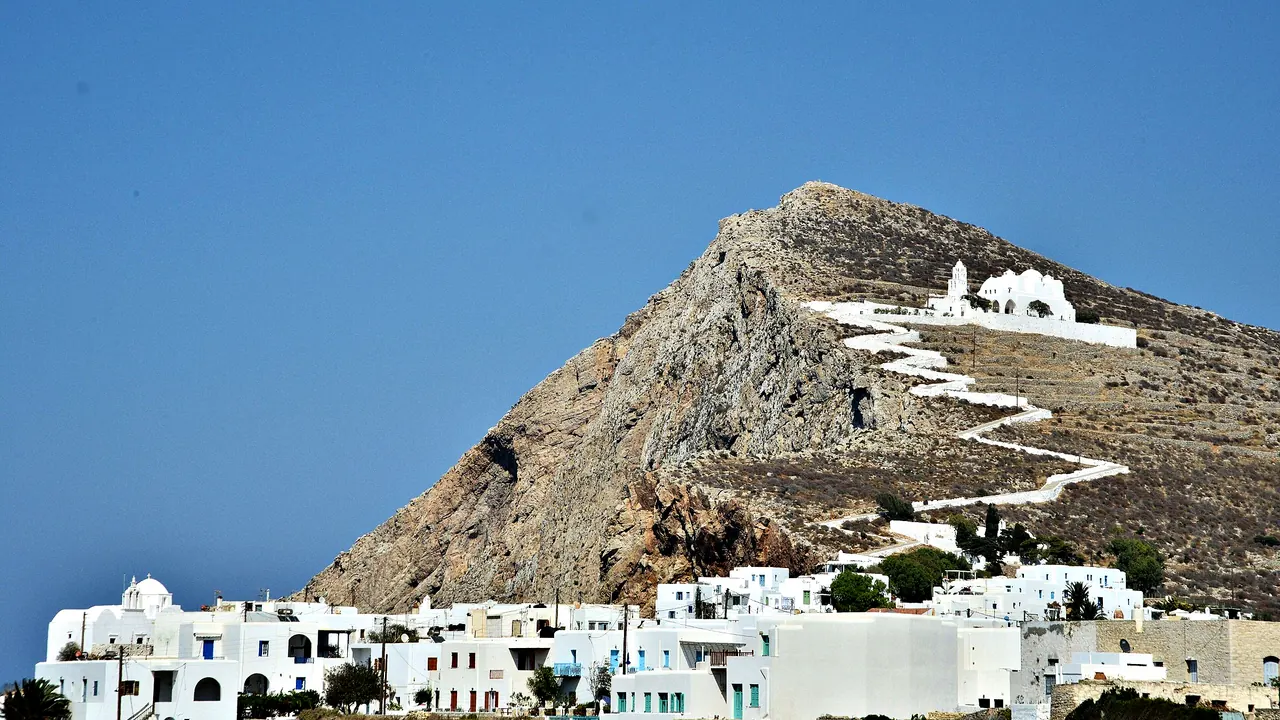
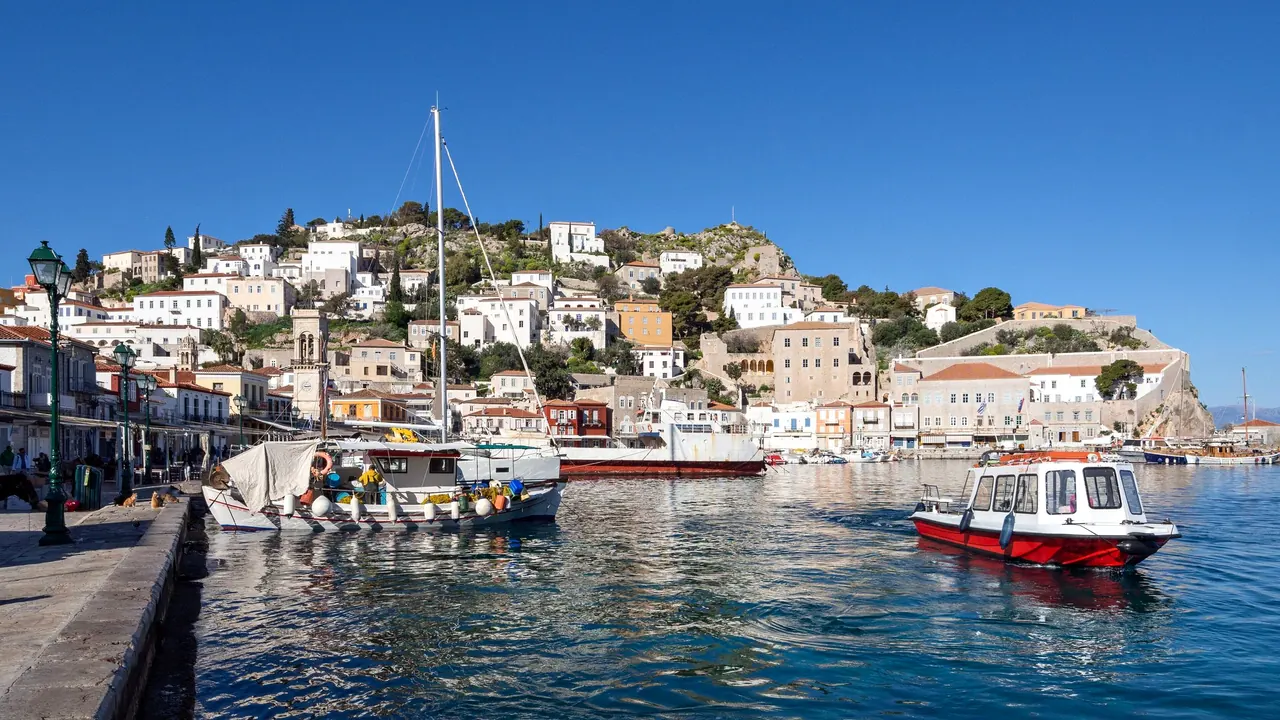
Photos: Folegandros by Chris Kar, CC BY-SA 4.0, cropped; Hydra by C messier, CC BY-SA 4.0, cropped.
Folegandros or Hydra?
Our verdict in twelve categories, each scored against the same fixed benchmark cities, and the climate month by month, so you can choose for your trip.
Choose Folegandros for
- beaches
- nature and the outdoors
- families
Folegandros suits swimmers and walkers who want to get far from everything. It has the better coves, from the sandy bays near the port to the pale shingle of Katergo, a cliff-edge village that empties into its squares each evening, and paths across a bare, high-cliffed ridge. You give up sights, shops and any real night out, and you should accept that the ferry decides when you arrive and leave.
Choose Hydra for
- culture and sights
- shopping
- nightlife
Hydra is the better pick if you want a handsome town as well as the sea. Its harbour of shipowners' mansions, with no cars anywhere, gives you more to look at, more to do after dark and easier outings to Spetses, Poros and the Peloponnese. The swimming is mostly off rocks and ladders rather than from beaches, and the summer heat is fiercer, but the boat from Athens is short enough for a few days away.
Scoreboard
Twelve categories on one fixed scale from 0 to 100. The shaded stretch is the gap between the two.
Your match
Pick a travel style or drag the sliders, and both match scores follow your weighting.
Wins on beaches and nature and the outdoors with your weighting.
Wins on culture and sights and shopping with your weighting.
What matters to you?
Category by category
What the scores mean for a trip.
Beaches & swimming
Folegandros has more places to spend a day by the sea. Near the port, Livadi and Vardia have sand and shingle, Agali has tavernas on the beach, and boats and paths go on to Livadaki, Galifos and the striking bay at Katergo. Many coves have no shade, and the north wind decides which side of the island is calm.
On Hydra you mostly swim rather than lie on a beach. Rock platforms and ladders west of the harbour drop into deep, clear water, Kamini and Vlychos have small pebble coves, and the pine-backed bays at Bisti and Agios Nikolaos need a water taxi. The swimming is excellent, but there is little room to spread a towel.
Food & drink
The two eat equally well, but in different ways. Folegandros has a cooking of its own: matsata pasta with rooster or rabbit, soft souroto cheese and watermelon pie, eaten under the trees in Chora's squares.
Hydra's cooking is more general Greek taverna food, grilled fish, octopus and mezedes, with a few smarter modern kitchens. The best meals are in the back lanes and at the coves of Kamini and Vlychos rather than on the expensive harbour front, and almond amygdalota are the sweet to take home. Neither offers much variety over a long stay.
Culture & sights
Hydra is the island for sightseeing. Its whole town of grey and white shipowners' mansions is protected, and it tells the story of a fleet that led the War of Independence. You can visit the Historical Archives Museum, the Koundouriotis mansion and the cloister of the Monastery of the Dormition, and summer exhibitions carry on the island's long link with artists.
Folegandros has one fine sight in Chora, whose Kastro houses form a defensive wall on the cliff edge, plus the climb to the Panagia and a small folklore museum at Ano Meria. That fills an afternoon, against two days on Hydra.
Nightlife
Hydra has more going on after dark. Cocktail bars and cafés along the harbour fill after dinner with Athenians and yacht crews, a few play music with some dancing until the small hours, and summer weekends are busier still.
Folegandros keeps its evenings quieter: people linger in Chora's squares, then go on to a handful of small bars in the lanes and along the cliff. Neither island has clubs, and many people choose Folegandros because it has no party scene.
Nature & outdoors
Folegandros has the more dramatic scenery. Some of the highest sea cliffs in the Cyclades drop below Chora, waymarked paths cross the terraced, almost treeless ridge, and boat trips go to the Chrysospilia sea cave. Spring wild flowers make it a fine place to walk before the summer wind and heat arrive.
Hydra's walking is just as free of traffic, on old mule paths through pine and scrub to the hilltop monasteries and up Mount Eros at nearly 600m, with views over the Peloponnese. Its clear water also suits snorkelling and sea kayaking along the cliffs.
Day trips
Hydra is much easier to explore from. Spetses and Poros are each well under an hour away by hydrofoil, Aegina and its Temple of Aphaia take a little longer, and a short hop to Metochi on the mainland puts Epidaurus and Nafplio within reach by car or tour.
From Folegandros the summer ferries reach quiet Sikinos, and faster boats get to Milos or Santorini. Routes do not run every day and the wind can cancel them, so island-hoppers here usually move on rather than coming back the same day.
Good for families
Both islands are calm and safe but have nothing built for children, so they suit older children who swim and walk well. Folegandros is easier at the beach: Livadi, the coves near Karavostasis and Agali have gentler entries, and a bus spares little legs. Its cliffs and wind call for care, though.
Hydra wins children over with donkeys, water taxis and lanes with no traffic, but its steep stone steps make pushchairs useless, and most swimming is off rocks into deep water. The sheltered bay at Mandraki is the best base for families.
Getting around
Both islands are small and reached only by ferry, and the wind can cancel boats to either. Folegandros has a few roads, a bus linking the port, Chora, Ano Meria and Agali, and scooters or quads for hire. The remoter coves still need a hike or a caique.
Hydra has no cars or motorbikes at all. You walk up and down stone steps, send your luggage by donkey and take water taxis to the far coves. It is also the closer island, with fast boats from Piraeus taking under two hours.
Shopping & style
Hydra gives you better browsing. Jewellery workshops, galleries selling work by resident artists, linen and resort-wear boutiques fill the lanes behind the harbour, and the quality is above that of most island ports.
Folegandros has a few shops in Chora selling ceramics, summer clothes, honey, capers and herbs, which make a pleasant stroll after dinner. Neither is worth the trip for shopping, and Athens is the place for that.
Affordability
Both islands are expensive in summer, and the cost comes mainly from small boutique rooms that are booked out early for July and August. Folegandros has more ways round this: simpler rooms near Karavostasis or in Ano Meria, cheap buses and fair taverna prices.
On Hydra, beyond the room, the harbour-front cafés, water taxis and luggage donkeys all add up. Back-lane tavernas and free swimming from the rocks keep daily spending reasonable, and on both islands the shoulder months are kinder to the budget.
Live music & performing arts
Neither island has a theatre or concert hall, but Hydra offers a little more. It has occasional open-air concerts and recitals in summer, late Greek music in some tavernas and the Miaoulia in June, when a fireship is burned in the harbour.
Live music on Folegandros means the summer saints'-day panigyria, with island violin and lute playing into the night, and the Easter procession of the Panagia icon from village to village.
Wellness & relaxation
Hydra is a little quieter. With no engines on the island, you hear only bells, donkeys and the sea, and there are occasional yoga retreats and massage in boutique hotels. Midday excursion boats crowd the harbour, so the upper town and Kamini are the calmer places to stay.
Folegandros offers the same slow routine of a cove, lunch and a nap, with car-free Chora at its heart but some scooters on the roads outside it. It has no big resorts and only a few hotel treatments. Both are calmest in June and September.
When should you go?
Pick your month. The climate figures are measured averages, not a forecast.
Folegandros in July
Hydra in July
Daytime high, °C
Rainfall in the month, mm
Where the figures come from
Folegandros has no weather station within reach, so its figures come from a gridded climate model rather than a measured record, and read a broad area rather than one spot.
Hydra's temperatures are measured 66 km from the centre, at Athinai Airport.
Hydra has no rain gauge within 25 km of the centre, so its rainfall comes from a gridded climate dataset read at the destination rather than from a gauge further away.
Temperature and rainfall are climate normals, averaged over the years shown. Folegandros: 2001-2020 normals, NASA POWER reanalysis grid, no weather station within 90 km. Hydra: 1991-2020 normals, Athinai Airport (65.5 km from centre).
Folegandros has the gentler summer. Around Chora, highs stay near 27°C even in August, the sea is warm enough to swim from June to October, and the strong north wind of July and August takes the edge off the heat but can make some coves rough. Hydra's harbour town gets much hotter, about 33°C in July and August, when the steps and mule paths are only comfortable early in the morning or in the evening. Its sea warms to 26°C, and from May to August the days are long and almost cloudless.
For walking, April and May are the best months on both islands. They are mild and nearly dry, with spring flowers on Folegandros and green hills on Hydra. October is still warm enough for swimming and walking, but the rain starts to come back then, more on Folegandros than on Hydra. Winter is cool and wet on both. Folegandros is at its wettest in December and January, close to 97mm a month, while on Hydra the rain arrives suddenly in November, at around 89mm.
Which traveller are you?
On a beach and sun trip, Folegandros is the stronger choice. The sand and shingle coves at Livadi, Vardia and Agali are easy to reach, the walk or boat to Katergo is worth the effort, and the milder summer heat makes long days by the water more comfortable.
For a culture and arts trip, Hydra has much more to offer. A whole protected town of stone mansions, a naval history museum, a harbour monastery and summer art exhibitions fill two days, while Folegandros has its Kastro and little else.
On a food and nightlife trip, Hydra edges it. Both islands cook simple, good taverna food, but Hydra adds cocktail terraces and harbour bars that stay open into the small hours, while Folegandros settles for a quiet drink in Chora's squares.
Before you go
| Measure | Folegandros | Hydra |
|---|---|---|
| Official language | Greek | Greek |
| Currency | Euro (EUR) | Euro (EUR) |
| Sockets | CF230 V, 50 Hz | CF230 V, 50 Hz |
| Driving side | Right | Right |
| Time zone | UTC+2, UTC+3 in summer | UTC+2, UTC+3 in summer |
| Emergency number | 112 | 112 |
| Main airport | Santorini International Airport (JTR)60 non-stop destinations | Athens Eleftherios Venizelos International Airport (ATH)176 non-stop destinations |
| Public holidays this year | 15 days | 15 days |
By the numbers
| Measure | Folegandros | Hydra |
|---|---|---|
| Population | - | 1,966 |
| People per km² | - | 40 |
| Swim season, months above 21 °C | 5 months | 5 months |
Where else could you go?
Every comparison below shares a destination with this one, so you can follow Folegandros or Hydra somewhere new.
- Iosvs Folegandros
- Milosvs Folegandros
- Aeginavs Hydra
- Sifnosvs Folegandros
- Santorinivs Folegandros
- Parosvs Folegandros