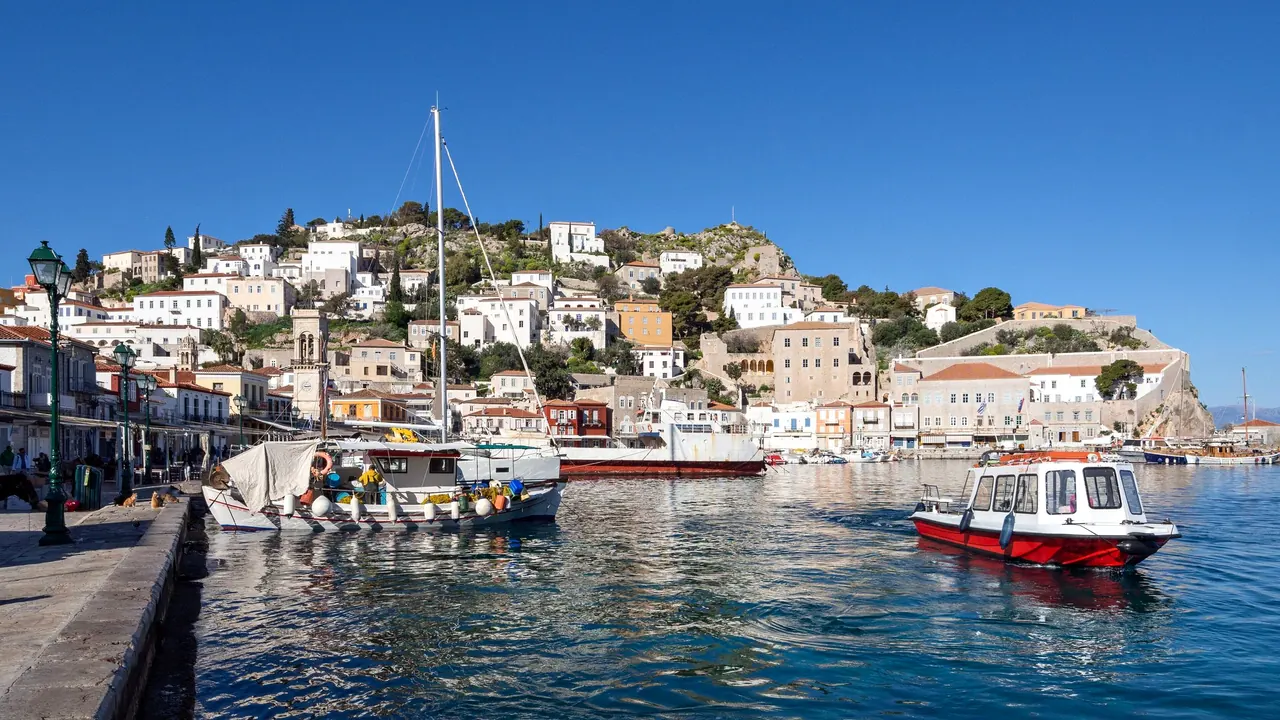
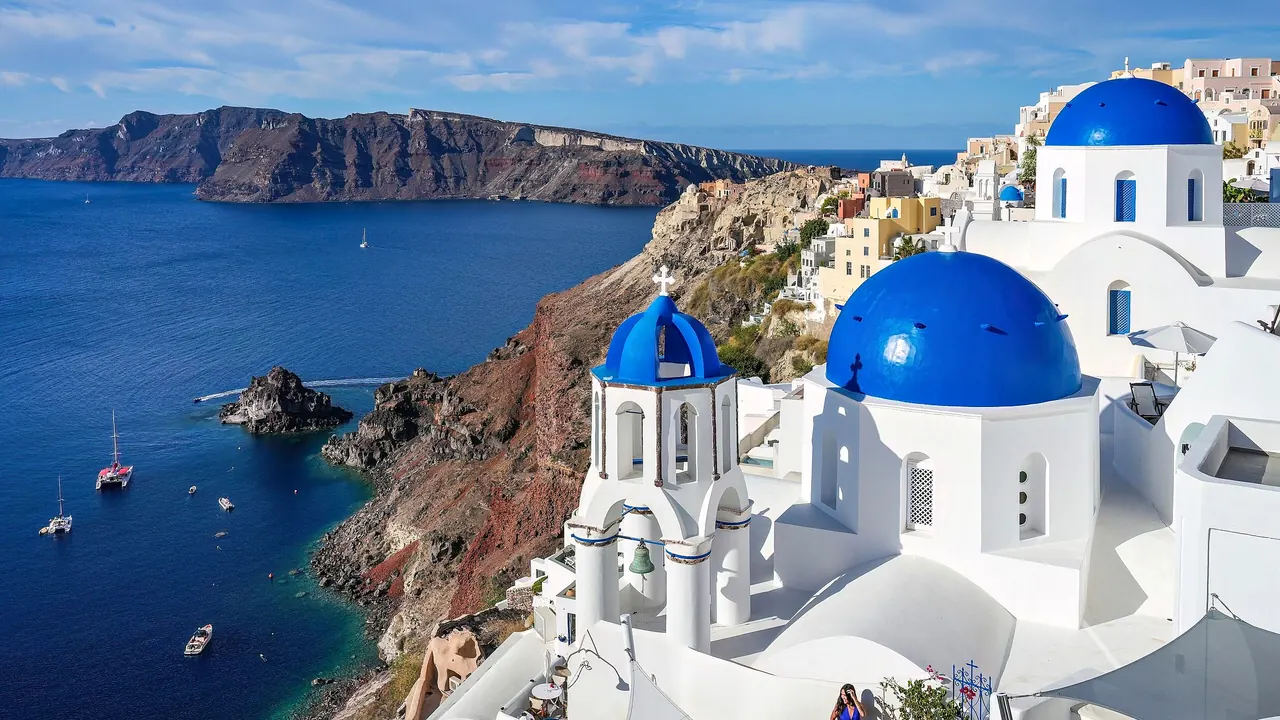
Photos: Hydra by C messier, CC BY-SA 4.0, cropped; Santorini by Giles Laurent, CC BY-SA 4.0, cropped.
Hydra or Santorini?
Our verdict in twelve categories, each scored against the same fixed benchmark cities, and the climate month by month, so you can choose for your trip.
Choose Hydra for
- prices
- getting around
- wellness
Hydra is the island for someone who wants a car-free harbour town of stone mansions, a morning swim off the rocks and long, quiet evenings that end with a drink by the boats. It costs less than Santorini for the same kind of stay, it is closer to Athens, and its mule paths empty out within minutes of leaving the port. You give up variety: the food stays narrow, there are only a few sights, and after two days there is little to do beyond swimming, walking and slowing down.
Choose Santorini for
- food and drink
- nature and the outdoors
- culture and sights
Santorini makes a bigger trip. The drowned volcano, the Bronze Age streets of Akrotiri, the wine villages inland and a properly local cuisine give a week far more to fill it, and Fira can keep you out later. It suits travellers who want the famous caldera views and are prepared to pay for them, and to share the cliff-top villages with crowds at sunset. The quieter, cheaper side of the island is the black-sand east coast.
Scoreboard
Twelve categories on one fixed scale from 0 to 100. The shaded stretch is the gap between the two.
Your match
Pick a travel style or drag the sliders, and both match scores follow your weighting.
Wins on prices and getting around with your weighting.
Wins on food and drink and nature and the outdoors with your weighting.
What matters to you?
Category by category
What the scores mean for a trip.
Beaches & swimming
On Hydra you swim off rocks, while on Santorini you lie on black sand. Near Hydra's port you climb down ladders from rocks and concrete platforms into deep, very clear water. Water taxis take you to small pebble coves backed by pines, such as Bisti and Agios Nikolaos.
Santorini has proper beach strips on its east and south coasts. Kamari and the long stretch of Perissa and Perivolos have sunbeds, tavernas and gently shelving water. The dark sand gets very hot by midday, though, and if you stay on the caldera rim you have to travel down to the coast.
Food & drink
Santorini has much more to offer at the table. Its volcanic soil produces ingredients you will not find elsewhere: yellow fava, cherry-tomato fritters, white aubergines and capers. There is also a real wine culture, with low basket-trained Assyrtiko vines and old Vinsanto cellars around Pyrgos and Megalochori.
Hydra serves good, simple taverna cooking: grilled fish and octopus, and almond amygdalota from the town bakeries. Over a week, though, the menus start to repeat. On both islands the best meals are away from the most famous views, in the back lanes and coves on Hydra and in the inland villages and at Ammoudi Bay on Santorini.
Culture & sights
Santorini has the stronger heritage. Akrotiri, a Bronze Age town preserved by the eruption, has its multi-storey houses still standing under a protective roof, and its wall paintings are shown in Fira. Add the ruins of Ancient Thera on its ridge and the fortified medieval kastelli of Pyrgos and Emporio, and there are two or three full days of sightseeing.
On Hydra the town itself is the sight. The shipowners' mansions around the horseshoe harbour recall the fleet that fought in the War of Independence, and there is a monastery cloister, the naval archives and the old cannon batteries. It is a complete, unspoilt whole, but a smaller one.
Nightlife
Hydra's evenings happen on the harbour front, among well-dressed Athenians and yacht crews. A few bars keep the music and some dancing going into the small hours. There are no big clubs and there is no party scene, so a night out means a long drink looking out at the boats.
Santorini gives you more of a night out. A few lanes in Fira have cocktail bars and a handful of clubs that stay open into the early hours in high summer, and Kamari and Perissa add beach bars with music.
Nature & outdoors
Santorini's landscape is the more dramatic: the cliffs drop more than 300m into a flooded caldera. You can walk the rim from Fira to Oia, climb the black lava cone of Nea Kameni, or sail across the caldera and dive along its submerged walls.
Hydra offers a different kind of outdoor time: hours alone on old mule paths over a bare limestone ridge, up to the monasteries and Mount Eros, with the Peloponnese spread out below you. Its cliffs are good for snorkelling and sea kayaking. Neither island has much shade, so summer walks need to start early.
Day trips
Santorini has more places to reach. Boats cross to sleepy Thirasia, fast ferries reach Ios, Folegandros, Naxos and Paros, and a long day can include Knossos on Crete. All of it depends on the single port at Athinios and on the wind.
From Hydra, the easy trips are to its Saronic neighbours Spetses and Poros, each well under an hour away, with Aegina a little further. There is also the short crossing to the Peloponnese, where Epidaurus and Nafplio are within reach by car or on a tour.
Good for families
Santorini works slightly better with children, provided you stay on the right coast. Kamari and Perissa have flat promenades, gently shelving water and a small water park, and older children enjoy the volcano boat. The steep, crowded caldera villages are another matter, and some cliff hotels do not take young children at all.
Hydra has the advantage of lanes with no traffic, and its donkeys and water taxis are fun for children, but it has nothing built for them. Its stone steps make pushchairs useless, and most swimming is into deep water. It suits older children who swim confidently.
Getting around
On both islands you spend a lot of time on steps, but in different ways. Hydra has no cars at all. You walk, hire a mule or take a water taxi, everything in town is close, and luggage goes up by donkey or porter.
Santorini has roads, and that brings its own hassles. All the buses run through Fira and are packed in summer, and if you hire a car or quad you face narrow roads, tour coaches and very little parking. Both islands depend on ferries to get there. Hydra is the shorter crossing from Piraeus.
Shopping & style
Neither island is a place to shop. Santorini has a little more choice in the cliff-top lanes of Oia and Fira, including a street of jewellers near the cathedral, and the best thing to bring home is edible: wine from the wineries, capers and fava.
Hydra's few lanes behind the harbour sell jewellery, linen and work by resident artists, and the quality is high. You can see them in one evening's walk. For anything more, shop in Athens.
Affordability
Hydra is cheaper, although neither island is a bargain in summer. On Hydra the expense is the room, in a small boutique guesthouse or a converted mansion, and the back-lane tavernas and free rock swimming help keep the rest of the trip reasonable.
On Santorini the caldera view raises the price of rooms, dinners and boat trips. Staying on the rim in Oia or Imerovigli costs far more than most places in Greece. The way to save money is to base yourself in Kamari or Perissa and take the bus up for the sunset.
Live music & performing arts
Neither island is a reason to travel for music or theatre, and neither has a stage with a regular season. Each has one notable event. On Hydra it is the Miaoulia in June, a naval celebration that ends with a fireship burning in the harbour. On Santorini it is a long-running classical music festival held in Fira at the end of summer.
Wellness & relaxation
The two islands are about equally restful, but their crowds come at different times and in different places. On Hydra the busy hours are in the middle of the day in summer, when cruise and excursion boats tie up in the harbour. By evening they have gone and the town is quiet again. To miss them, spend late morning up in the higher lanes or out at Kamini and come back down for dinner.
Santorini's crowds are on the caldera rim at Oia and Fira, at peak hours and again for sunset. A calm stay there means sleeping in Imerovigli or in the inland wine villages of Pyrgos and Megalochori. The island's one natural spot for bathing is a boat stop off Palea Kameni, where you swim in slightly warm, rust-coloured volcanic spring water. Both islands are calmest in spring and autumn, and on Hydra that means May, June and September.
When should you go?
Pick your month. The climate figures are measured averages, not a forecast.
Hydra in July
Santorini in July
Daytime high, °C
Rainfall in the month, mm
Where the figures come from
Hydra's temperatures are measured 66 km from the centre, at Athinai Airport.
Hydra has no rain gauge within 25 km of the centre, so its rainfall comes from a gridded climate dataset read at the destination rather than from a gauge further away.
Santorini's station stands 182 m below the place it is measured for, so that place is likely a little cooler than the figures say.
Santorini has no rain gauge within 25 km of the centre, so its rainfall comes from a gridded climate dataset read at the destination rather than from a gauge further away.
Temperature and rainfall are climate normals, averaged over the years shown. Hydra: 1991-2020 normals, Athinai Airport (65.5 km from centre). Santorini: 2000-2025, 12 years observed (rainfall 1991-2020) normals, Santorini Island / Monólithos (5 km from centre).
Both islands have the usual Aegean pattern of a dry summer, a wet winter and a swimming season from June to October. Hydra is hotter, with highs around 33°C in July and August against about 30°C on Santorini, and its sea is a little warmer too, reaching 26°C in August. That heat makes Hydra's stone steps and shadeless paths hard going in the middle of the day. Santorini is the drier of the two in high summer, with almost no rain from June to September, although its open coast can be windy.
If you want to swim and walk on the same trip, early June and late September suit both islands best. May is pleasant for walking, but the sea is still cool. Winter on both islands is cool and wet. On Hydra the rain arrives in November, at almost 90mm, and the long summer sunshine falls to a fraction of its peak. Santorini's wettest month is January. Neither island works as a beach trip between November and May.
Which traveller are you?
On a trip on a tight budget, Hydra goes further. Its rooms are still not cheap, but back-lane tavernas are fair value, the rock swimming near town is free, and you never need a car, whereas on Santorini the caldera view adds to the price of almost everything.
For a food and nightlife trip, Santorini is clearly better. Fava, tomato fritters, Assyrtiko and Vinsanto tastings in the inland wineries give the meals a sense of place, and the lanes of Fira stay lively long after Hydra's harbour bars have settled down.
For a relaxing and wellness trip, the choice is about what kind of calm you want. Hydra has no cars and no engines, and its days follow a slow pattern of swimming, lunch and a siesta. Santorini's version is a cliff-side cave suite with its own plunge pool and spa treatments.
Before you go
| Measure | Hydra | Santorini |
|---|---|---|
| Official language | Greek | Greek |
| Currency | Euro (EUR) | Euro (EUR) |
| Sockets | CF230 V, 50 Hz | CF230 V, 50 Hz |
| Driving side | Right | Right |
| Time zone | UTC+2, UTC+3 in summer | UTC+2, UTC+3 in summer |
| Emergency number | 112 | 112 |
| Main airport | Athens Eleftherios Venizelos International Airport (ATH)176 non-stop destinations | Santorini International Airport (JTR)60 non-stop destinations |
| Public holidays this year | 15 days | 15 days |
By the numbers
| Measure | Hydra | Santorini |
|---|---|---|
| Population | 1,966 | 17,430 |
| People per km² | 40 | 220 |
| Swim season, months above 21 °C | 5 months | 5 months |
Where else could you go?
Every comparison below shares a destination with this one, so you can follow Hydra or Santorini somewhere new.
- Iosvs Santorini
- Aeginavs Hydra
- Folegandrosvs Santorini
- Peloponnesevs Hydra
- Naxosvs Santorini
- Parosvs Santorini