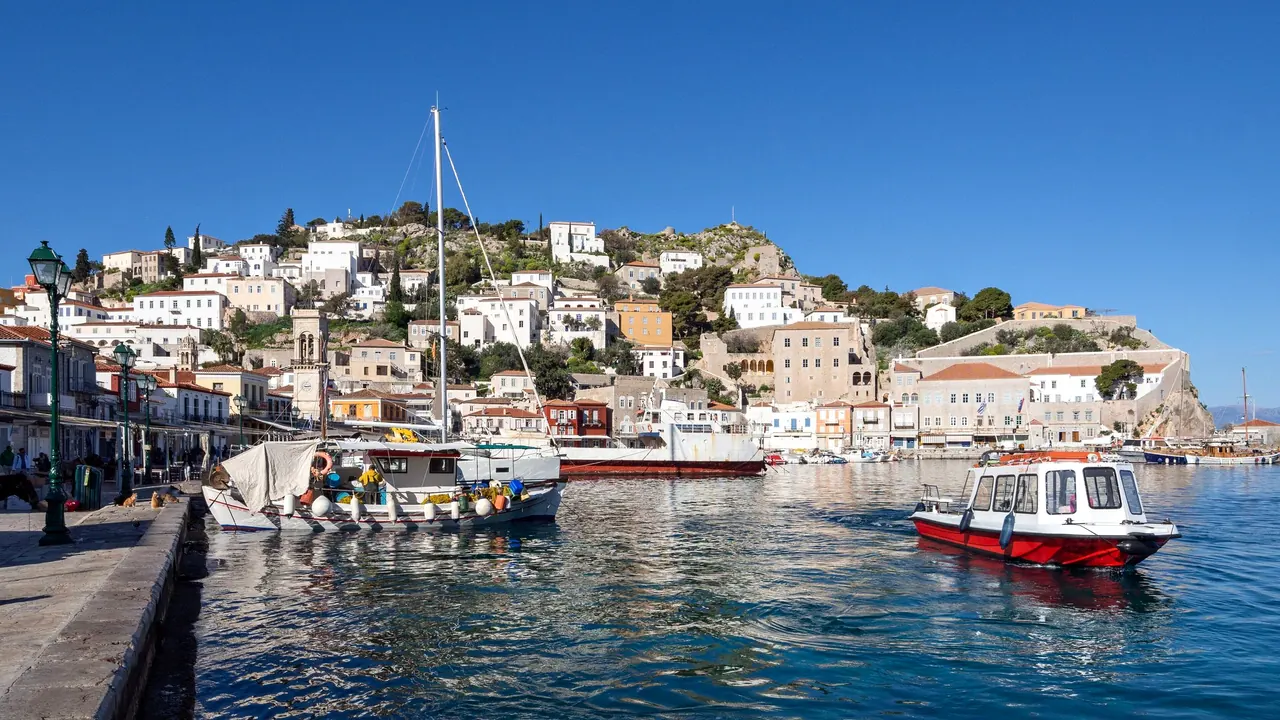
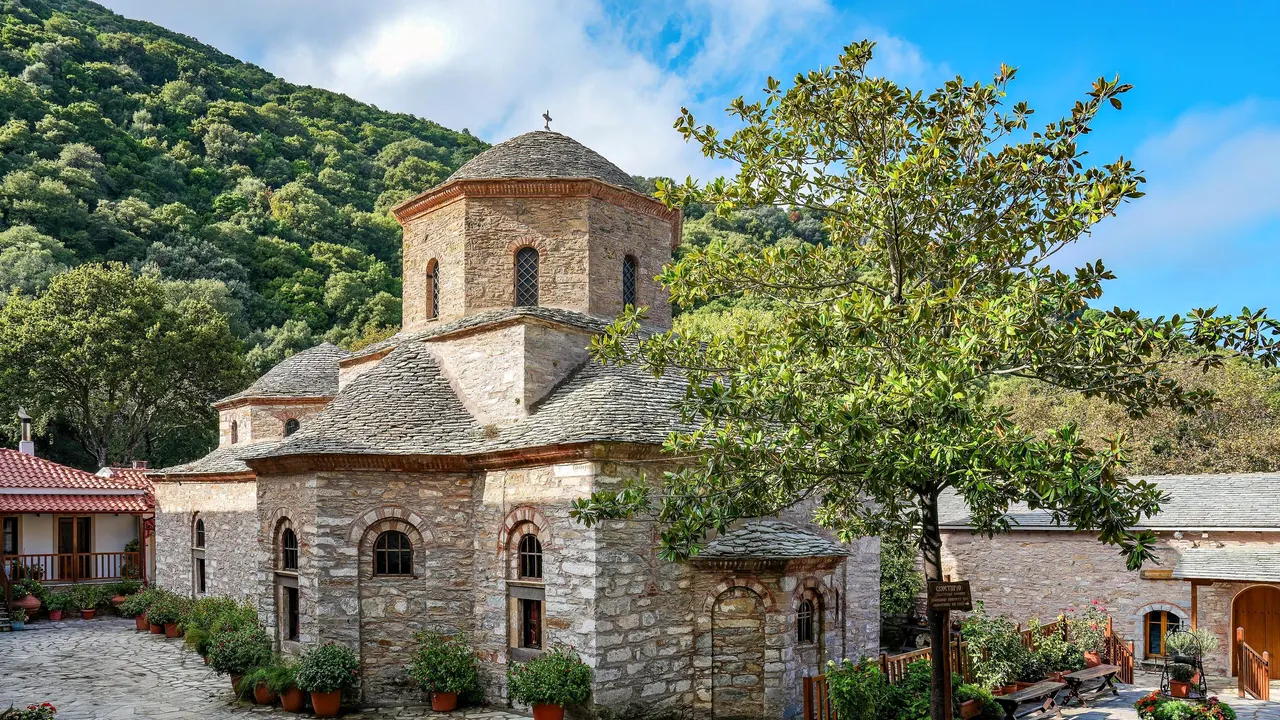
Photos: Hydra by C messier, CC BY-SA 4.0, cropped; Skiathos by Giles Laurent, CC BY-SA 4.0, cropped.
Hydra or Skiathos?
Our verdict in twelve categories, each scored against the same fixed benchmark cities, and the climate month by month, so you can choose for your trip.
Choose Hydra for
- culture and sights
- wellness
- shopping
Hydra suits travellers who want a place rather than a beach. Its harbour town of stone shipowners' mansions is protected as a whole and has no cars, so the days pass on foot, on mule paths and in water taxis, with swims off the rocks and long dinners by the water. It is the better choice for couples, walkers and anyone who values quiet and looks, as long as they accept steep steps, small coves and higher room costs.
Choose Skiathos for
- families
- beaches
- nightlife
For a classic island beach vacation, Skiathos is the stronger pick. Pine forest runs down to dozens of sandy and shingle beaches, Koukounaries leads a south coast of calm, shallow water, and a bus and water taxis link them all. Families and groups of friends do better here, because the airport sits at the edge of town and summer nights in the bar lanes run late, though the sights are few and the town has more resort about it.
Scoreboard
Twelve categories on one fixed scale from 0 to 100. The shaded stretch is the gap between the two.
Your match
Pick a travel style or drag the sliders, and both match scores follow your weighting.
Wins on culture and sights and wellness with your weighting.
Wins on families and beaches with your weighting.
What matters to you?
Category by category
What the scores mean for a trip.
Beaches & swimming
Here the islands differ most. Hydra is for swimming rather than lounging: you climb down ladders from rocks and concrete platforms west of the port into deep, very clear water, or walk to the small pebble coves at Kamini and Vlychos. The pine-backed coves at Bisti and Agios Nikolaos mean a water taxi.
Skiathos is built around its beaches. Koukounaries is a long curve of pale sand in front of pine forest, Banana Beach and Agia Eleni lie just beyond it, and the north coast adds wilder bays and the white pebbles of Lalaria. For whole days on soft sand, only Skiathos delivers, though its sunbed beaches fill in high summer.
Food & drink
Neither island is a food destination, and both serve the same Greek taverna repertoire of grilled fish, octopus and slow-cooked meat. Hydra's best meals come at dusk in the back lanes or beside the water at Kamini and Vlychos, with almond amygdalota from the town bakeries as a local sweet.
Skiathos has a broader spread of places, from tavernas on the stepped lanes of the old quarter to beach tavernas under the pines and Sporades-style pies, but more of its menus are written for package visitors, so it pays to choose carefully.
Culture & sights
Hydra is the island for sightseeing, because the town is the sight. Its grey and white mansions were built by the shipowners whose fleet fought in the War of Independence, and with no cars or modern buildings the harbour looks much as it did. The Monastery of the Dormition, the Historical Archives Museum and the Koundouriotis house fill a couple of days well.
Skiathos has less to see. The Papadiamantis house museum and the Evangelistria Monastery in the woods are pleasant visits, and the ruined Kastro on the northern cliffs is the one place with real atmosphere, but they are a side to a beach trip rather than a reason to come.
Nightlife
Skiathos has the livelier nights. In July and August the bar street climbing from the harbour fills after midnight, waterfront clubs keep going until early morning, and Banana Beach holds sunset parties for a young, international crowd.
Hydra's evenings are about a long cocktail on the harbour watching the yachts, with well-dressed Athenians and a few late bars with some dancing. There are no clubs, so it suits a stylish drink better than a night out.
Nature & outdoors
Both reward walkers, but the landscapes could hardly be more different. Hydra is a bare limestone ridge, and with no cars its old mule paths lead you alone up to the monasteries of Profitis Ilias and Agia Efpraxia and on to Mount Eros, nearly 600m high, with wide views over the Peloponnese. Shade is scarce, so the snorkelling and kayaking along the cliffs are the summer activities.
Skiathos is green, with pine and oak forest on most of its hills, footpaths between chapels, and the protected Strofilia lagoon behind Koukounaries. Boat trips run to the sea caves of the north coast and the Alonissos marine park, where dolphins are sometimes seen, and the north bays suit windsurfing, though nothing on the island is high or wild.
Day trips
Both islands look to their neighbours for outings. From Hydra, Spetses and Poros are each under an hour by boat and Aegina takes longer, while a crossing to Metochi opens the way to Epidaurus and Nafplio, which takes some arranging but brings in major classical and Venetian sights.
From Skiathos the classic day out is Skopelos, with its stacked white town, Glossa and the clifftop chapel of Agios Ioannis, and boat excursions often add Alonissos. The Pelion villages are better as an overnight stay.
Good for families
Skiathos is far easier with children. The southern beaches shelve gently into calm water, the airport transfer is short, and boat trips and the low-flying planes at the runway end keep older children happy. The busy coast road with few pavements is the main drawback.
Hydra's car-free lanes and luggage donkeys charm children, but the steep stone steps make pushchairs useless and most swimming is off ladders into deep water. It works mainly for older children who swim well, based near Mandraki or Kamini.
Getting around
Skiathos is simpler to reach and to move around. The airport is at the edge of town, a summer bus runs along the 12km south coast stopping at numbered beaches, and ferries leave from the harbour for Skopelos and Alonissos. The north coast and the Kastro need a hired car, scooter or boat on narrow hill roads.
Hydra has no cars at all, so you walk, ride a mule or take a water taxi, and luggage goes up the steps by donkey or porter. Arriving means a ferry from Piraeus of up to two hours, which strong winds can cancel.
Shopping & style
Hydra has the more interesting browsing, with jewellery workshops, galleries selling work by resident artists and linen boutiques in the lanes behind the harbour, of better quality than most island ports.
Skiathos offers resort shopping on its main street, with summer clothes, sandals, olive oil, honey and souvenirs, much of it closed in winter. On either island, serious shopping is better done elsewhere.
Affordability
Skiathos is the easier island on the budget. Studio apartments and family-run rooms are plentiful, the bus is cheap and taverna meals are reasonable, though beach sunbeds, boat trips and car hire mount up.
On Hydra the room is the big cost. Beds are few, mostly boutique guesthouses and converted mansions, and harbour cafés charge for the view. Back-lane tavernas and free swimming from the rocks soften this, and on both islands June and September bring better value.
Live music & performing arts
Neither island is a place to plan evenings around performance. Hydra has occasional summer recitals and the Miaoulia festival in June, when a fireship is burnt in the harbour.
Skiathos has concerts in the open-air theatre on the Bourtzi peninsula and traditional music and dancing at village saints' day festivals. For theatre or a concert season, Athens is the answer for Hydra, and Skiathos has no equivalent nearby.
Wellness & relaxation
Hydra is the more restful of the two. With no cars or motorbikes the only sounds are bells, donkeys and the sea, and the days fall into a slow routine of a morning swim, a long lunch and a nap. Midday cruise crowds clear by evening, and the upper town and Kamini are calmest.
Skiathos has more conventional facilities, with spas and pools in the larger south coast resort hotels, but Skiathos Town is loud at night in high season. Peace there means staying out on the north coast or under the pines away from the bar streets.
When should you go?
Pick your month. The climate figures are measured averages, not a forecast.
Hydra in July
Skiathos in July
Daytime high, °C
Rainfall in the month, mm
Where the figures come from
Hydra's temperatures are measured 66 km from the centre, at Athinai Airport.
Hydra has no rain gauge within 25 km of the centre, so its rainfall comes from a gridded climate dataset read at the destination rather than from a gauge further away.
Skiathos's temperatures are measured 60 km from the centre, at Anchialos Airport.
Skiathos has no rain gauge within 25 km of the centre, so its rainfall comes from a gridded climate dataset read at the destination rather than from a gauge further away.
Temperature and rainfall are climate normals, averaged over the years shown. Hydra: 1991-2020 normals, Athinai Airport (65.5 km from centre). Skiathos: 1998-2020 (rainfall 1991-2020) normals, Anchialos Airport (59.8 km from centre).
The two islands follow almost the same year. Both reach about 33°C in July and August, hot enough that walking the stepped lanes or the hill paths is best kept for early morning. The sea is warm enough for swimming from June to October and peaks around 26°C in August on both. May, June and September are the most comfortable months for combining swimming with walking, and Hydra, measured around its harbour town, has long sunny days right through that stretch.
The difference shows at the edges of the season. Hydra stays very dry well into October and only turns wet in November and December, when rainfall reaches about 89mm a month. Skiathos gets its autumn rain earlier, with about 51mm in October, so late-season swimmers have slightly more settled weather on Hydra. Winters are mild but grey on both, and neither is a beach destination from November to April.
Which traveller are you?
On a beach and sun trip, Hydra means swimming off rock platforms and ladders or in small pebble coves, which suits confident swimmers. Skiathos is the clear choice for days on sand, with dozens of pine-backed beaches from Koukounaries to the coves near Achladies.
For a culture and arts trip, Hydra gives far more: a whole protected harbour town of shipowners' mansions, the Monastery of the Dormition, the naval archives and summer art exhibitions. Skiathos has a few modest sights, and the Kastro ruins are the best of them.
On a family trip with children, Hydra suits teenagers who snorkel, like hill walks and enjoy an island with no cars. Skiathos is better for younger children: stay in the quieter bays around Koukounaries, well away from the town's bar street, and spend the days on the sand.
Before you go
| Measure | Hydra | Skiathos |
|---|---|---|
| Official language | Greek | Greek |
| Currency | Euro (EUR) | Euro (EUR) |
| Sockets | CF230 V, 50 Hz | CF230 V, 50 Hz |
| Driving side | Right | Right |
| Time zone | UTC+2, UTC+3 in summer | UTC+2, UTC+3 in summer |
| Emergency number | 112 | 112 |
| Main airport | Athens Eleftherios Venizelos International Airport (ATH)176 non-stop destinations | Skiathos Island National Airport (JSI)37 non-stop destinations |
| Public holidays this year | 15 days | 15 days |
By the numbers
| Measure | Hydra | Skiathos |
|---|---|---|
| Population | 1,966 | - |
| People per km² | 40 | - |
| Swim season, months above 21 °C | 5 months | 5 months |
Where else could you go?
Every comparison below shares a destination with this one, so you can follow Hydra or Skiathos somewhere new.