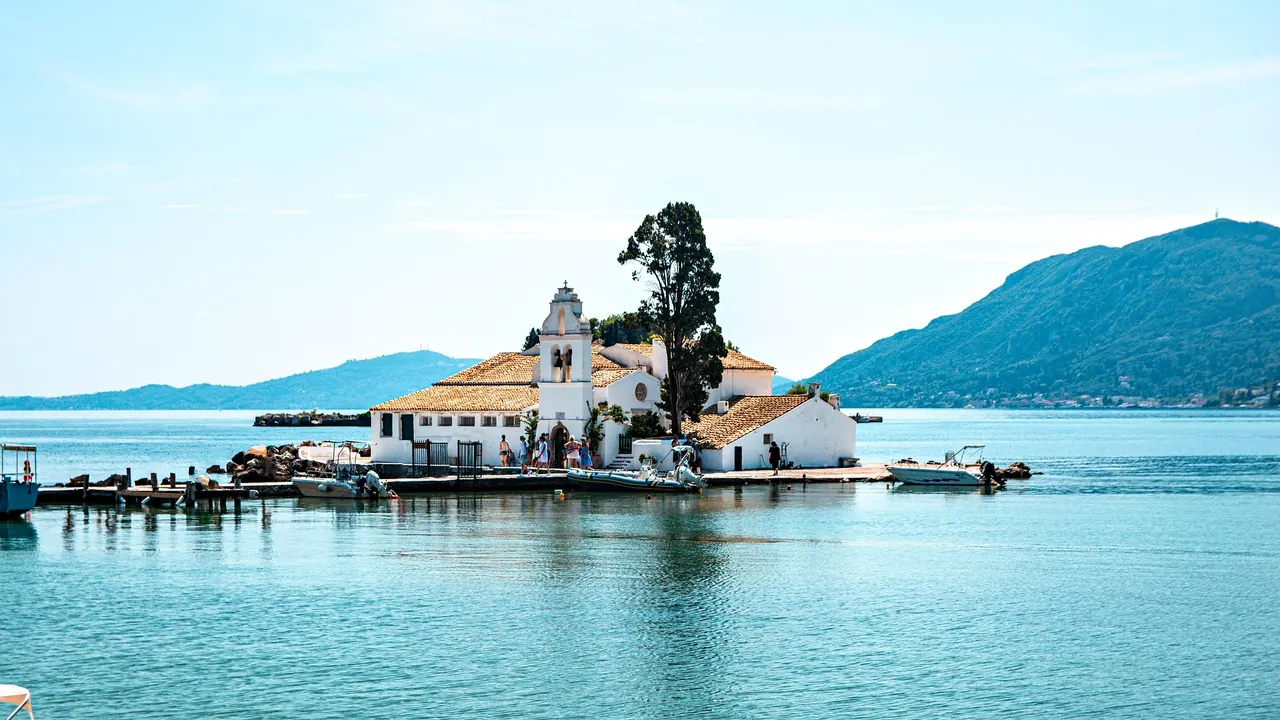
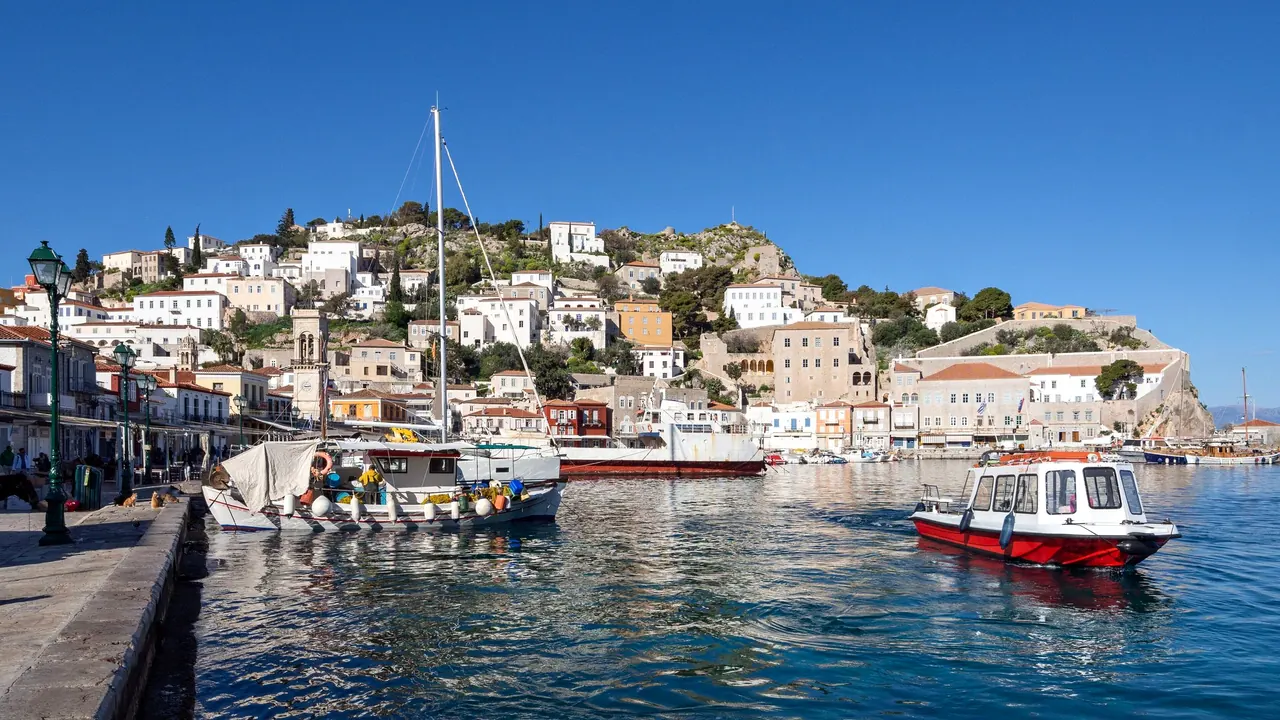
Photos: Corfu by Nico Hartnauer, Pexels License; Hydra by C messier, CC BY-SA 4.0, cropped.
Corfu or Hydra?
Our verdict in twelve categories, each scored against the same fixed benchmark cities, and the climate month by month, so you can choose for your trip.
Choose Corfu for
- families
- nightlife
- live music and the arts
Corfu is the island to choose for a full beach vacation with variety. It has long sandy beaches on the west coast, shallow water in the north for children, a real old town in Corfu Town, distinctive Venetian-influenced cooking and nightlife from quiet to all-night. It is large enough to fill two weeks, though you will want a car to see much of it.
Choose Hydra for
- wellness
- getting around
Hydra is a much smaller and quieter place, best for a few days of stillness. There are no cars and no resort strips. You walk the mule paths, swim off the rocks into deep clear water and spend the evening with a drink on the harbour. It costs more and offers less to do. What you get is one intact stone town and a calm Corfu can only match if you pick your base with care.
Scoreboard
Twelve categories on one fixed scale from 0 to 100. The shaded stretch is the gap between the two.
Your match
Pick a travel style or drag the sliders, and both match scores follow your weighting.
Wins on families and nightlife with your weighting.
Wins on wellness and getting around with your weighting.
What matters to you?
Category by category
What the scores mean for a trip.
Beaches & swimming
Corfu offers a much bigger range of beaches. The west coast has wide stretches of sand at Glyfada, Issos and Halikounas, with sunsets. Paleokastritsa has small clear coves under the cliffs, the north has shallow sandy bays, and the northeast has calm pebble coves. You can also take boat trips to the turquoise water of Antipaxos.
Hydra has almost no sand. Near the harbour you swim from rocks and concrete platforms, Kamini and Vlychos have small pebble coves, and you need a water taxi to reach the pine-backed bays such as Bisti. The water is superb, but this is a place for swimming rather than for long days on a beach.
Food & drink
Corfu has a cuisine of its own, shaped by Venice. Look for pastitsada, veal sofrito and the fiery fish stew bourdeto, along with kumquat liqueur and the ginger beer left over from British rule. The best of it is in Corfu Town and the inland villages, away from the resort menus.
Hydra serves good, simple taverna food, such as grilled fish and octopus eaten beside the water at Kamini or Vlychos. It has its almond amygdalota, but there is little variety beyond that, and the choice soon runs out on a longer stay.
Culture & sights
Corfu has much more to see. Its UNESCO-listed old town has the Liston, two fortresses, Agios Spyridon and museums of Asian art and archaeology. Beyond the town are the Achilleion palace and the cliff-top ruin of Angelokastro.
Hydra's sight is the town itself. Shipowners' stone mansions rise around the horseshoe harbour, with the Monastery of the Dormition and the naval archives museum below them. It is beautifully preserved and complete, and you can see all of it in two days.
Nightlife
Corfu has far more choice after dark. Kavos is a full party resort that goes on until dawn, Ipsos and Dassia have beach bars, and Corfu Town has grown-up cocktail bars and a few clubs.
Hydra has a single kind of night out: a long drink on the waterfront among Athenians and yachting visitors, with some music late on. There are no clubs, and the island goes quiet early in winter.
Nature & outdoors
Green against bare is the first difference. Wetter winters cover Corfu in old olive groves, cypresses and spring wildflowers. Mount Pantokrator rises to about 900m above abandoned stone villages, the Corfu Trail crosses the island from end to end, the Korission lagoon draws birdwatchers and the sea caves at Paleokastritsa suit snorkelling and diving.
Hydra is a bare limestone ridge with little shade. Its mule paths climb to the hilltop monasteries and Mount Eros, often without meeting anyone, and its cliffs are good for kayaking and snorkelling. The landscape is smaller and offers less variety than Corfu's, but the walking in spring and autumn is excellent.
Day trips
The real difference is how far the boats take you. From Corfu they cross into another country as well as to other islands. A short ferry to Saranda leads to the ruins of Butrint in Albania, and other boats go to Paxos and Antipaxos, or to Parga and Sivota on the Greek mainland.
Hydra's easy outings stay within the Saronic Gulf, with Spetses and Poros each under an hour away. Getting to Epidaurus or Nafplio means a boat to Metochi and then a car or a tour, which takes some arranging, so most visitors stay on the island.
Good for families
Corfu is a natural choice for families. The sandy beaches at Roda, Acharavi and Issos slope gently into calm water, many resorts have pools and kids' clubs, and the water park and pirate boat trips fill the gaps.
On Hydra there is nothing built for children. The steps rule out pushchairs, and most swimming is into deep water. The lanes are traffic-free and the donkeys are fun, but the island works only for older children who swim well.
Getting around
Both islands take some effort to get around, in opposite ways. Corfu is about 60km long, buses are infrequent and the roads are twisting, so most visitors hire a car or scooter to reach the western beaches.
Hydra has no cars at all. You walk up and down stone steps, use a donkey for luggage and take a water taxi to the far coves. It is simple once you are there, but the island is reached only by ferry, and strong winds can cancel the boats.
Shopping & style
Neither island is a place to shop seriously. Corfu has a little more range, with olive-wood bowls, kumquat sweets and olive oil along Nikiforou Theotoki and a few ordinary clothing chains. Hydra's few lanes have fewer shops, but the quality of its jewellery workshops and artists' galleries is higher.
Affordability
Corfu is clearly the cheaper of the two. Package resorts on the north and east coasts have reasonable rooms and taverna meals are fairly priced, though Kassiopi and Corfu Town in high summer cost more, and car hire adds up.
On Hydra the room is the main expense. There are only a few boutique guesthouses and converted mansions, and the harbour cafés charge for the view. Back-lane taverna meals and free swimming from the rocks soften the cost, especially in May, June and late September.
Live music & performing arts
Corfu has a real musical tradition. Its old philharmonic bands play in the Spianada and the village squares, and they are at their most impressive in the Easter processions. Kantades serenades are still sung, and there are summer concerts at the Old Fortress.
Hydra has hardly any performance beyond the occasional recital and the Miaoulia festival in June, when a fireship is burned in the harbour.
Wellness & relaxation
Neither island has a spa culture. Corfu has resort hotel spas and yoga retreats among the olive groves. Hydra has a few treatment rooms in boutique hotels. On both, the real draw is the slow pace.
The kind of quiet is different. On Corfu you have to look for it in a hill village or on the northeast coast, away from the resort strips. On Hydra the whole island is car-free, and once the excursion boats leave each evening there is little to hear but bells, donkeys and the sea.
When should you go?
Pick your month. The climate figures are measured averages, not a forecast.
Corfu in July
Hydra in July
Daytime high, °C
Rainfall in the month, mm
Where the figures come from
Hydra's temperatures are measured 66 km from the centre, at Athinai Airport.
Hydra has no rain gauge within 25 km of the centre, so its rainfall comes from a gridded climate dataset read at the destination rather than from a gauge further away.
Temperature and rainfall are climate normals, averaged over the years shown. Corfu: 1991-2020 normals, Kerkyra Airport (0.9 km from centre). Hydra: 1991-2020 normals, Athinai Airport (65.5 km from centre).
The two islands are equally warm. Both reach about 32°C or a little more in July and August, which is too hot for walking anywhere but early in the day. The sea in both is warm enough to swim from June to early October, at about 26°C in August. May, June and September are the comfortable months on either island for a mix of swimming and walking.
The difference is rain. Corfu is wet in winter. Showers come back in September, October is properly rainy, and November is the wettest month at about 188mm. Hydra is much drier and sunnier. It stays mostly dry well into October and gets about half Corfu's rain even in winter, so autumn there is more dependable. Corfu's wetter climate is also the reason it stays so green, and the spring wildflowers are at their best there.
Which traveller are you?
On a family trip with young children, Corfu lets the days look after themselves. You settle in one resort, the sand is a short walk away and small children can paddle safely for hours. Hydra only starts to work once the children swim strongly and are happy to walk everywhere.
For a food and nightlife trip, Corfu gives you a different evening every night: a Venetian-style stew in an old-town lane, a village taverna inland, then dancing as late as you like. On Hydra the same harbour routine comes round each night, pleasant but soon familiar.
On a relaxing and wellness trip, Hydra makes quiet the default rather than something you have to plan for. A morning swim, a long lunch and a nap through the heat fill the days, with little to pull you away. Corfu gets there only from a carefully chosen base.
Before you go
| Measure | Corfu | Hydra |
|---|---|---|
| Official language | Greek | Greek |
| Currency | Euro (EUR) | Euro (EUR) |
| Sockets | CF230 V, 50 Hz | CF230 V, 50 Hz |
| Driving side | Right | Right |
| Time zone | UTC+2, UTC+3 in summer | UTC+2, UTC+3 in summer |
| Emergency number | 112 | 112 |
| Main airport | Corfu Ioannis Kapodistrias International Airport (CFU)88 non-stop destinations | Athens Eleftherios Venizelos International Airport (ATH)176 non-stop destinations |
| Public holidays this year | 15 days | 15 days |
By the numbers
| Measure | Corfu | Hydra |
|---|---|---|
| Population | 100,854 | 1,966 |
| People per km² | 161 | 40 |
| Swim season, months above 21 °C | 5 months | 5 months |
Where else could you go?
Every comparison below shares a destination with this one, so you can follow Corfu or Hydra somewhere new.