Greece
Corfu
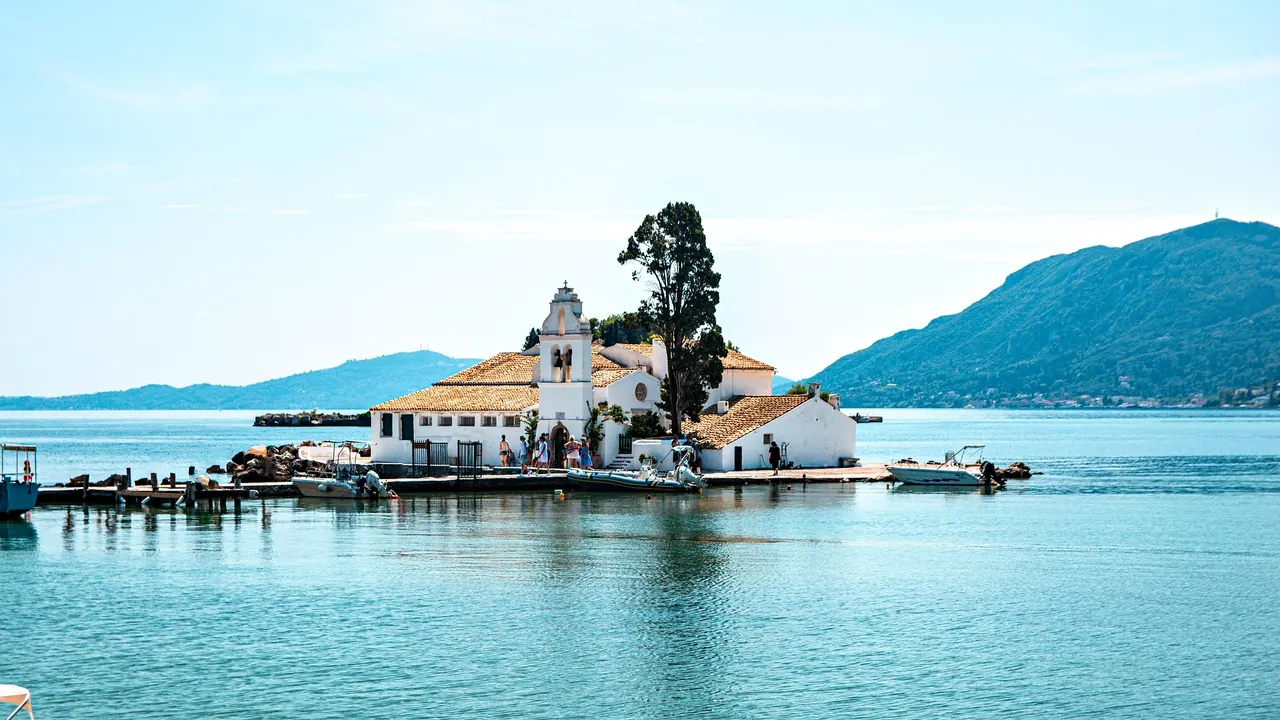
Vlacherna Monastery on its islet
- Beaches82
- Families70
- Culture & sights66
Photo: Nico Hartnauer, Pexels License
Match
56
Every category weighted equally
- Beach & sun59
- Culture & arts53
- Food & nightlife53
- Family trip59
- Outdoors58
- Relax & unwind56
- Shopping & style51
- On a budget55
Corfu in twelve categories
Our verdict on each, scored 0 to 100 against the same fixed benchmark cities, so a score means the same thing on every page.
Beaches & swimming. Scores 82 out of 100.
Food & drink. Scores 58 out of 100.
Culture & sights. Scores 66 out of 100.
Nightlife. Scores 60 out of 100.
Nature & outdoors. Scores 58 out of 100.
Day trips. Scores 60 out of 100.
Good for families. Scores 70 out of 100.
Getting around. Scores 42 out of 100.
Shopping & style. Scores 35 out of 100.
Affordability. Scores 55 out of 100.
Live music & performing arts. Scores 38 out of 100.
Wellness & relaxation. Scores 42 out of 100.
Corfu category by category
Beaches & swimming
82Most visitors build their Corfu stay around the beach, and the island gives real choice. The west coast has the long sandy beaches and the best sunsets: Glyfada, Agios Gordios, Myrtiotissa and the wide, dune-backed sands of Issos and Halikounas in the south, with some surf on windy afternoons. Around Paleokastritsa the coast breaks into small coves of very clear, cold-edged water under green cliffs. The north coast at Sidari, Roda and Acharavi is shallow and sandy, while the northeast facing Albania has calm pebble bays around Kassiopi and Agios Stefanos.
The sea is warm enough to swim from June to early October, reaching about 26°C in August. Boat trips to Antipaxos reach turquoise bays that are among the clearest in the Ionian. The beaches near the busiest resorts get crowded in high summer.
Food & drink
58Corfu cooks differently from the rest of Greece, and that is the reason to eat with care here. Centuries under Venice left dishes such as pastitsada, a spiced beef or rooster stew over pasta, veal sofrito in garlic and vinegar, and bourdeto, a fiery fish stew with red pepper. Kumquats grow in the north and turn up as liqueur and preserves, and the island still drinks its own ginger beer, a legacy of British rule.
The best eating is in Corfu Town's back lanes and in village tavernas inland and on the quieter coasts, where fish is grilled simply and olive oil comes from the surrounding groves. The main resorts lean heavily on menus aimed at package visitors, so a little effort goes a long way.
Culture & sights
66The heart of it is Corfu Town, a UNESCO-listed old town that looks more Italian than Greek: tall Venetian houses, narrow lanes called kantounia, and the arcaded Liston beside the Spianada, one of the largest squares in Greece. The Old Fortress on its rocky headland and the New Fortress above the port frame the town, and the Church of Agios Spyridon holds the island's patron saint. The Palace of St Michael and St George houses a museum of Asian art, the Archaeological Museum keeps the archaic Gorgon pediment, and Mon Repos stands in wooded grounds just south of town.
Beyond the town, the Achilleion palace built for Empress Elisabeth of Austria looks down over the east coast, and the ruined Byzantine castle of Angelokastro clings to a cliff above Paleokastritsa, near a working hilltop monastery.
Nightlife
60Corfu's nightlife splits sharply by place. At the southern tip, Kavos is a full party resort for young visitors, a strip of bars and clubs that runs until dawn from late spring to early autumn. Ipsos and Dassia on the east coast have a smaller, more mixed run of beach bars and late venues. Corfu Town offers the more grown-up evening: cocktails under the Liston arcades, bars in the old town lanes and a handful of clubs along the coast road north of the port.
Away from these places, evenings in the villages and quieter resorts end with a long taverna dinner. In winter almost everything outside Corfu Town closes.
Nature & outdoors
58Corfu is the greenest of the Greek islands, covered in old olive groves, cypresses and wildflowers in spring, thanks to wetter winters than the Aegean. The north rises to Mount Pantokrator at about 900m, with walks through abandoned stone villages and views across to the Albanian mountains. The long-distance Corfu Trail crosses the whole island from south to north, best walked in spring or autumn.
On the west coast, cliffs and sea caves around Paleokastritsa are good for boat trips, snorkelling and diving, and the Korission lagoon in the south draws birdwatchers. The sheltered channel off the east coast suits sailing and kayaking. Summer heat makes serious walking hard in July and August.
Day trips
60Day trips from Corfu go by sea. The most popular is Paxos, a small island of olive groves and harbour villages such as Gaios and Lakka, usually combined with the swimming bays of Antipaxos. A short ferry across the strait reaches Saranda in Albania, the base for the ruins of Butrint, a UNESCO site layered with Greek, Roman and Venetian remains in a lagoon forest.
On the Greek mainland, boat excursions reach Parga, a colourful town under a Venetian castle, and the islets and coves of Sivota. The small Diapontia islands off the northwest make a quieter outing. Most of these run only in the main season.
Good for families
70Corfu works well for a family beach vacation. The north coast around Roda, Acharavi and Sidari and the long sands of Issos and Agios Georgios in the south shelve gently into calm water, and many resorts are built around pools and kids' clubs. Greek tavernas welcome children at any hour, and the island feels safe and easy-going.
Attractions made for children are few: a large water park inland near Agios Ioannis, glass-bottom and pirate-style boat trips, and the fortresses of Corfu Town for older children. Families who want calm should avoid Kavos and Ipsos, and July and August heat calls for a beach-and-pool rhythm.
Getting around
42Corfu Town is easy on foot, and its old town is best seen that way. Beyond it, the island is about 60km long, and the green intercity buses link the town to the main resorts but run too rarely to build a varied stay around. Most visitors hire a car or scooter, which pays off for reaching western beaches and hill villages.
The roads are narrow and twisting, especially in the north and west, and traffic around Corfu Town and the airport is heavy in summer. Staying in one resort and adding boat trips works fine for a beach stay without a car.
Shopping & style
35Shopping centres on Corfu Town's old lanes, where small shops sell olive-wood bowls and boards, kumquat liqueur and sweets, olive oil, local soaps and handmade jewellery among plenty of souvenirs. Nikiforou Theotoki and the streets behind the Liston are the main run, with ordinary Greek clothing chains in the newer part of town. The resorts offer little beyond beachwear and gifts.
Affordability
55Corfu sits in the middle for a Mediterranean island. Taverna meals, local wine and buses are fairly priced, and the big package resorts on the north and east coasts offer reasonable rooms. The northeast coast around Kassiopi, with its villas and quiet bays, is markedly more expensive, as are rooms in Corfu Town in July and August. Car hire adds up for anyone wanting to explore. Spring and autumn are noticeably cheaper than high summer.
Live music & performing arts
38Corfu has a musical tradition unusual in Greece, rooted in its Venetian past. The island has many historic philharmonic bands, the oldest founded in the nineteenth century, and they play in the Spianada and in village squares through the summer. Easter is the high point, when bands accompany the processions through Corfu Town. Kantades, serenades sung with guitar and mandolin, survive in tavernas and at local festivals.
Beyond that, the formal programme is modest: concerts in summer, some classical evenings in the Old Fortress and municipal venues, and Greek dance shows put on in resorts.
Wellness & relaxation
42Corfu has no bathing tradition of its own, so wellness means the spas of the larger resort hotels and a scattering of yoga retreats in the olive groves of the west and north. Its real strength is pace: a stay in a hill village or on the quiet northeast coast, with long lunches and empty afternoons, is deeply restful. The busy resort strips in high summer are the opposite, so choose the base with care.
Where to stay in Corfu
Corfu Town suits a short stay, a first visit or anyone more drawn to history and food than to beaches. The old town is best on foot, the better tavernas hide in its back lanes and evenings under the Liston are the island's most grown-up. Rooms cost more in high summer, and the good beaches need a drive.
For a family beach vacation, the north coast around Roda, Acharavi and Sidari has shallow sandy water, pool-based resorts and fair prices. Issos and Agios Georgios in the south offer the same gentle sand with more space. The northeast around Kassiopi and Agios Stefanos is calmer and pricier, with pebble bays, villas and walks on Mount Pantokrator behind. On the west coast, Paleokastritsa suits snorkelling, boat trips and quiet evenings among cliffs, while Glyfada and Agios Gordios give long sand and sunsets. Kavos, at the southern tip, is for young visitors who want to dance until dawn, and families should avoid it.
The island is about 60km long, so one base is enough for most trips. A first visit often pairs a few nights in Corfu Town with a week on the coast. A second might swap the resorts for a hill village or the quiet northeast. A car opens up the west and the inland villages from any base.
When should you go?
Pick a month to see what it is like. The climate figures are measured averages, not a forecast.
Corfu in July
Daytime high, °C
Rainfall in the month, mm
The whole year
Shaded against this city’s own year: the deepest cell is its best month for that figure and the palest its weakest.
Temperature and rainfall are climate normals, averaged over the years shown. Corfu: 1991-2020 normals, Kerkyra Airport (0.9 km from centre).
Before you go
| Measure | Corfu |
|---|---|
| Official language | Greek |
| Currency | Euro (EUR) |
| Sockets | CF230 V, 50 Hz |
| Driving side | Right |
| Time zone | UTC+2, UTC+3 in summer |
| Emergency number | 112 |
| Main airport | Corfu Ioannis Kapodistrias International Airport (CFU)88 non-stop destinations |
| Public holidays this year | 15 days |
By the numbers
| Measure | Corfu |
|---|---|
| Population | 100,854 |
| People per km² | 161 |
| Swim season, months above 21 °C | 5 months |
Compare Corfu with
Every comparison with a written verdict behind it.