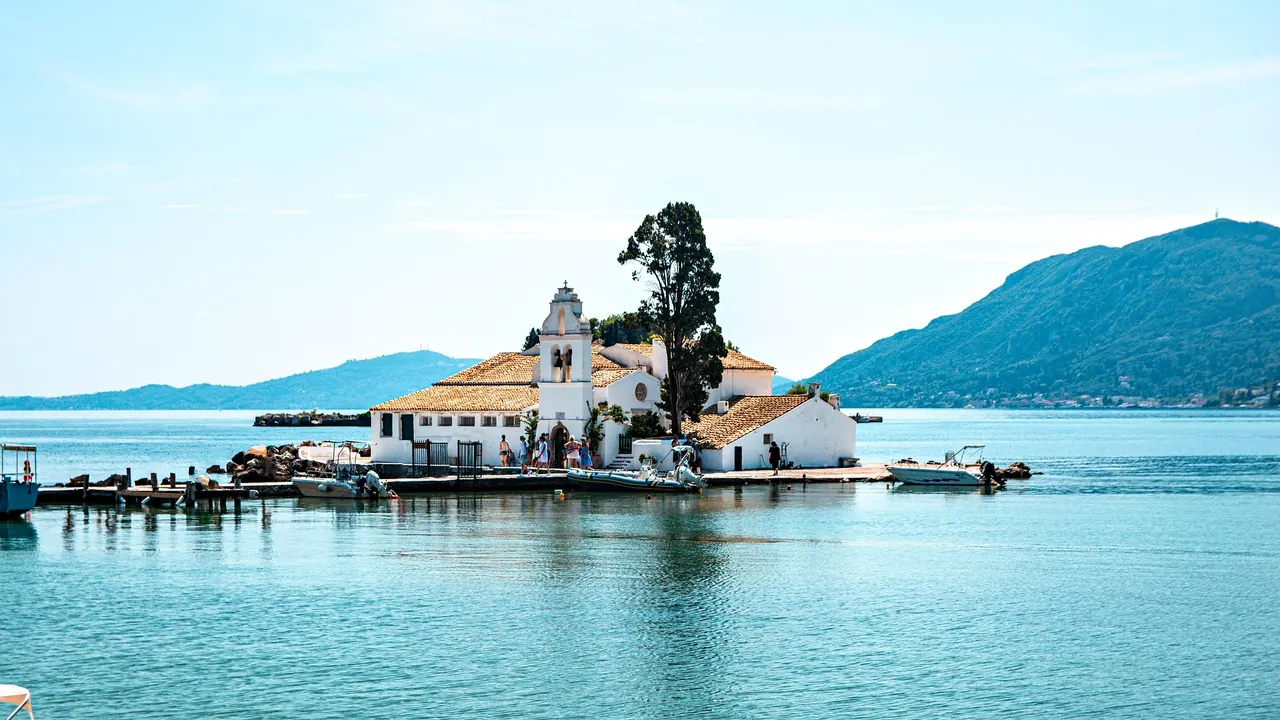
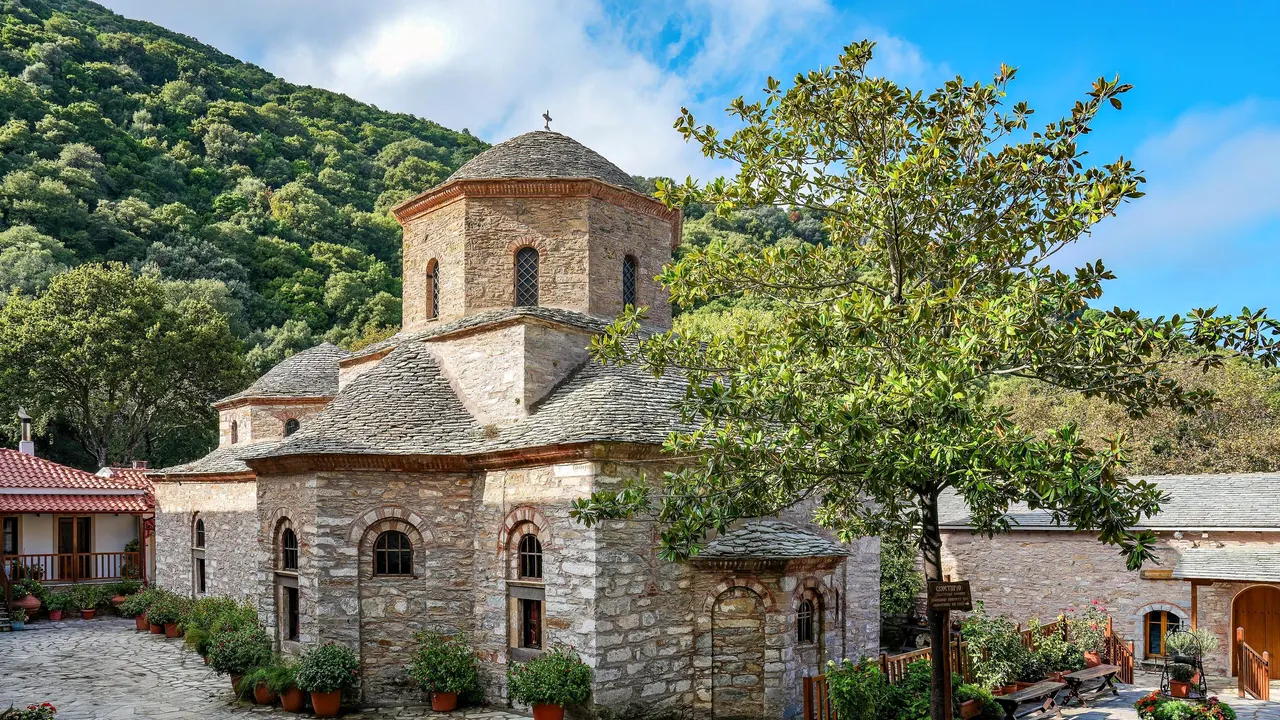
Photos: Corfu by Nico Hartnauer, Pexels License; Skiathos by Giles Laurent, CC BY-SA 4.0, cropped.
Corfu or Skiathos?
Our verdict in twelve categories, each scored against the same fixed benchmark cities, and the climate month by month, so you can choose for your trip.
Choose Corfu for
- culture and sights
- live music and the arts
- food and drink
Corfu suits travellers who want beach days with plenty besides. Corfu Town's Venetian old town, its two fortresses and museums give real substance to rest days. The island has a cooking style of its own, and boats run to Paxos, to the Greek mainland and across to Albania. Families also get more to fill the week. The trade-off is size: it is a large island, and seeing it properly usually means hiring a car and driving winding roads.
Choose Skiathos for
- getting around
- beaches
If the beach is the whole point, Skiathos is the easier choice. Its pine-backed sands line one short coast road out of town, the airport is minutes away, and a bus or water taxi reaches most beaches, so a week works almost without a car. In return there is little to see on land, the food is plainer, and evenings are either the town's bar street or very quiet.
Scoreboard
Twelve categories on one fixed scale from 0 to 100. The shaded stretch is the gap between the two.
Your match
Pick a travel style or drag the sliders, and both match scores follow your weighting.
Wins on culture and sights and live music and the arts with your weighting.
Wins on getting around and beaches with your weighting.
What matters to you?
Category by category
What the scores mean for a trip.
Beaches & swimming
Both islands are first-rate for beaches, and the difference is in their shape. Corfu spreads its beaches over three coasts that feel quite different from each other. The west has long sands with sunset views and some surf at Glyfada and Issos, Paleokastritsa has small cold-edged coves, the north has shallow sandy shores and the northeast has calm pebble bays, with Antipaxos a boat ride away.
Skiathos packs its beaches into a small space. Pale sand or fine shingle under pines runs along the calm south coast to Koukounaries and Banana Beach, while the north-coast beaches catch the meltemi and Lalaria's white pebbles are reached by boat. You get less variety than on Corfu, but a quieter cove is always close by.
Food & drink
Corfu gives you more reasons to seek out a good table. Its Venetian past shows in pastitsada, veal sofrito and the peppery fish stew bourdeto, and kumquat liqueur and local ginger beer add touches you will not find elsewhere in Greece. The best meals are in the back lanes of Corfu Town and in village tavernas inland.
Skiathos serves solid Greek island food: grilled octopus and fish, slow-cooked meat and Sporades-style pies. It is best eaten in the stepped lanes of the old quarter or at a beach taverna under the pines. The range is narrow, and on both islands the resort menus written for package visitors are the ones to avoid.
Culture & sights
This is where the two islands differ most. Corfu Town gives you days of sightseeing: Italianate kantounia lanes, the Liston arcades on the Spianada, the Old and New Fortresses, the Gorgon pediment in the Archaeological Museum and the Asian art collection in the Palace of St Michael and St George. Outside town, the Achilleion and the clifftop ruin of Angelokastro make good excursions.
Skiathos has a short list. There is the Papadiamantis house museum, the Evangelistria Monastery in the woods and the Kastro ruins on the northern cliffs, which are the most atmospheric. On Skiathos these make a pleasant break from the beach for a day or two, while Corfu can fill several days of sightseeing without repeating itself.
Nightlife
Both islands have plenty going on after dark in summer, but it is spread out differently. Corfu's nightlife depends on where you stay. Kavos at the southern tip is an all-night party resort, Ipsos and Dassia are a milder mix, and Corfu Town offers cocktails under the Liston and old-town bars, some of it lasting through winter.
Skiathos puts almost everything into one place: the bar street climbing from the harbour, with waterfront clubs open late in July and August and sunset parties at Banana Beach. Its scene is easier to find but shorter, running from about June to September, with the rest of the island quiet.
Nature & outdoors
Corfu has a little more for walkers and nature lovers. Mount Pantokrator rises to about 900m, with abandoned stone villages and views to Albania, and the Corfu Trail crosses the whole island. The sea caves at Paleokastritsa are good for diving, and the Korission lagoon draws birdwatchers.
Skiathos is gentler and smaller in scale. Old footpaths run through pine and oak forest between monasteries and chapels, the Strofilia wetland lies behind Koukounaries, and boat trips into the Alonissos marine park sometimes find dolphins. It has no high ground, but the walks are short and shady.
Day trips
Corfu's boat trips cover more ground. Paxos and the bays of Antipaxos make a classic sea day, a short crossing to Saranda leads to the Roman and Venetian ruins of Butrint in Albania, and excursions reach Parga and Sivota on the Greek mainland.
From Skiathos, the outings stay within the Sporades. Skopelos, about an hour away, has its steep harbour town, Glossa and the famous clifftop chapel, and Alonissos makes a longer day. Pelion and Volos are better as an overnight stay than a return trip.
Good for families
Both have gently shelving sand and tavernas that welcome children. Corfu adds more to do between swims: resorts built around pools and kids' clubs, a large water park near Agios Ioannis, pirate-style boat trips and fortresses for older children. Families should choose Roda, Acharavi or Issos rather than Kavos.
Skiathos is simpler, which has its advantages. The airport transfer takes minutes, and Koukounaries is an easy beach for small children. There is nothing built for children, though, and the busy coast road has few pavements, so the days centre on the sea and the occasional low-flying plane.
Getting around
Skiathos is much easier to get around. One road of about 12km joins town to Koukounaries, with a summer bus stopping at numbered beach stops, water taxis serve many coves, and the airport and ferry harbour are both at the edge of town. Only the north coast, the Kastro and the monasteries need a scooter, a jeep or a boat.
Corfu is about 60km long, and its buses run too rarely to build a varied stay around. Most visitors hire a car for the western beaches and hill villages and face narrow, twisting roads and heavy summer traffic near town. Staying in one resort and adding boat trips works without a car.
Shopping & style
Neither island is a shopping destination, but Corfu Town gives you more to browse. Along Nikiforou Theotoki and the lanes behind the Liston there are olive-wood bowls, kumquat sweets and liqueur, local soaps and handmade jewellery, and the newer town has ordinary chain stores. Skiathos's main street is resort shopping, with sandals, ceramics, honey and souvenirs for an evening walk, and most shops close in winter.
Affordability
Corfu is the somewhat cheaper choice. Its big package resorts on the north and east coasts offer reasonable rooms, and taverna meals and buses are fair. Costs climb around Kassiopi's villas and in Corfu Town in high summer, and the car hire most visitors need adds up.
On Skiathos, peak-season rooms near the popular beaches are expensive, and sunbeds and boat trips add to the bill, though plentiful studios and family-run rooms help. Its compactness saves on car hire. On both islands, June or September brings prices down while the sea is still warm.
Live music & performing arts
Corfu has a living musical tradition unusual in Greece. Philharmonic bands dating from the nineteenth century play in the Spianada and village squares, Easter processions march to brass, and kantades serenades with guitar and mandolin survive in tavernas. Some classical evenings take place in the Old Fortress.
Skiathos offers summer concerts at the open-air theatre on the Bourtzi, saints'-day festivals with traditional dancing and live sets in some bars. Nobody plans a trip around it.
Wellness & relaxation
Neither island has a bathing tradition, so on both the spas belong to the larger resort hotels. Corfu has a little more: yoga retreats in the olive groves of the west and north, and hill villages or the northeast coast where long lunches set a slow pace.
Skiathos's calm comes from cool pine shade and quiet mornings, best on the north coast or early and late in the summer. On both islands, the choice of base matters more than any spa: avoid the resort strips on Corfu and the town itself on Skiathos.
When should you go?
Pick your month. The climate figures are measured averages, not a forecast.
Corfu in July
Skiathos in July
Daytime high, °C
Rainfall in the month, mm
Where the figures come from
Skiathos's temperatures are measured 60 km from the centre, at Anchialos Airport.
Skiathos has no rain gauge within 25 km of the centre, so its rainfall comes from a gridded climate dataset read at the destination rather than from a gauge further away.
Temperature and rainfall are climate normals, averaged over the years shown. Corfu: 1991-2020 normals, Kerkyra Airport (0.9 km from centre). Skiathos: 1998-2020 (rainfall 1991-2020) normals, Anchialos Airport (59.8 km from centre).
The two islands share a summer. Both reach about 32°C in July and August, which is fine on the sand but tiring for walking. On both, the sea is warm enough to swim from June to early October and peaks at about 26°C in August. Corfu has its sunniest weeks in July. May and late September are the gentler months for combining swimming with walks, sightseeing or the island trails.
They split in autumn and winter. Corfu's wet season starts early and arrives hard: September already brings real rain, and November is the wettest month at around 188mm, which keeps the island green but makes a late-season trip a gamble. Skiathos stays much drier, with only about 59mm in November, though its winter days are a little cooler. Neither island is a winter beach destination.
Which traveller are you?
On a beach and sun trip, Skiathos has the edge. Dozens of sandy, pine-shaded beaches, Koukounaries among them, lie along a single short road served by bus and water taxi, so you spend the day swimming rather than driving.
For a culture and arts trip, Corfu is the clear choice. Corfu Town's UNESCO-listed Venetian lanes, two fortresses, Asian art museum and the Achilleion give days of sightseeing, and its philharmonic bands play in the squares. Skiathos has a few modest sights.
On a family trip with children, Corfu offers more. Its northern and southern sands are just as gentle, and it adds resorts with pools and kids' clubs, a large water park and fortresses to explore. Skiathos has no attractions built for children.
Before you go
| Measure | Corfu | Skiathos |
|---|---|---|
| Official language | Greek | Greek |
| Currency | Euro (EUR) | Euro (EUR) |
| Sockets | CF230 V, 50 Hz | CF230 V, 50 Hz |
| Driving side | Right | Right |
| Time zone | UTC+2, UTC+3 in summer | UTC+2, UTC+3 in summer |
| Emergency number | 112 | 112 |
| Main airport | Corfu Ioannis Kapodistrias International Airport (CFU)88 non-stop destinations | Skiathos Island National Airport (JSI)37 non-stop destinations |
| Public holidays this year | 15 days | 15 days |
By the numbers
| Measure | Corfu | Skiathos |
|---|---|---|
| Population | 100,854 | - |
| People per km² | 161 | - |
| Swim season, months above 21 °C | 5 months | 5 months |
Where else could you go?
Every comparison below shares a destination with this one, so you can follow Corfu or Skiathos somewhere new.
- Skopelosvs Skiathos
- Paxosvs Corfu
- Halkidikivs Skiathos
- Lefkadavs Corfu
- Aeginavs Skiathos
- Kefaloniavs Corfu