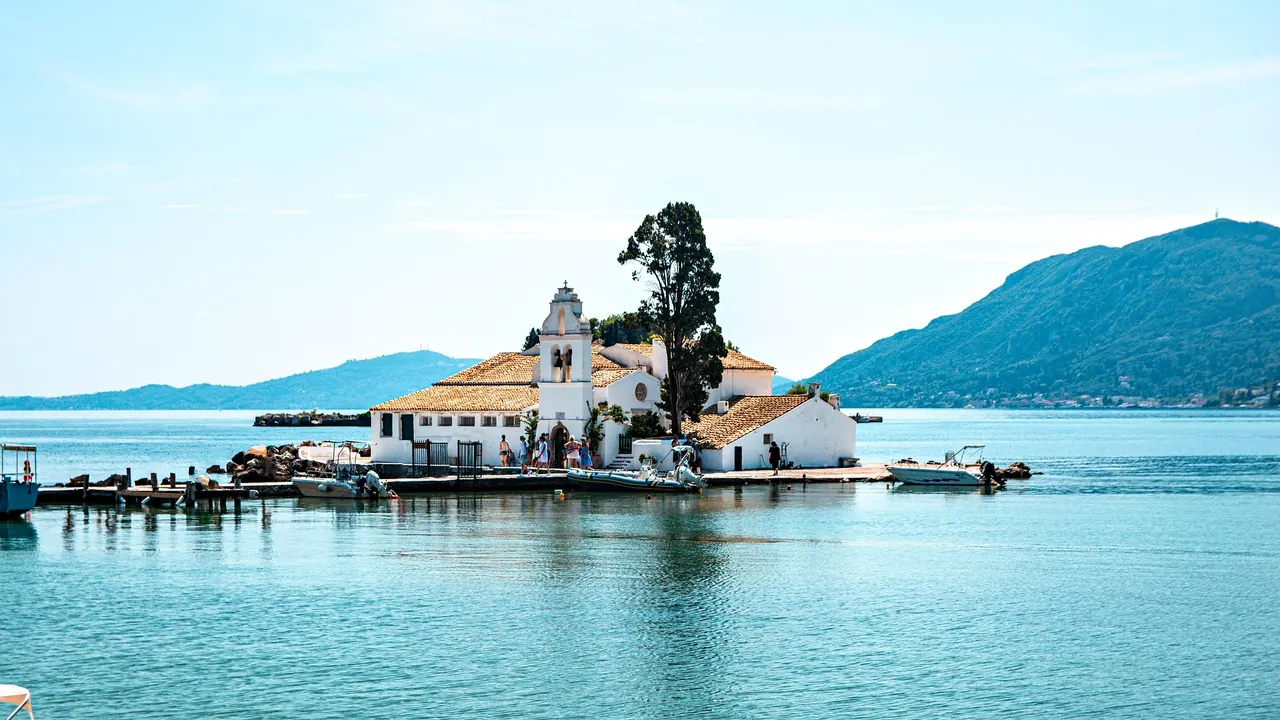
Photos: Corfu by Nico Hartnauer, Pexels License.
Corfu or Kefalonia?
Our verdict in twelve categories, each scored against the same fixed benchmark cities, and the climate month by month, so you can choose for your trip.
Choose Corfu for
- nightlife
- culture and sights
- live music and the arts
Corfu suits travellers who want more than a beach from their island. Corfu Town gives it a real historic centre to walk, with Venetian lanes, two fortresses and the Liston for the evening. Around that you get sandy family beaches, a choice of party or quiet resorts, and boat trips to Paxos, Albania and the mainland. It is the easier pick for families, first-timers and anyone who wants to mix sightseeing and nights out with swimming.
Choose Kefalonia for
- nature and the outdoors
- beaches
Kefalonia is for people who come for the landscape and the sea and are happy to drive. The beaches there sit below white cliffs with remarkably clear water, Mount Ainos rises behind them with its fir forest, and the caves of Melissani and Drogarati lie underground. Evenings are quiet harbour dinners rather than late nights. It suits couples and walkers, and anyone who would rather spend a day driving between coves than visiting a museum.
Scoreboard
Twelve categories on one fixed scale from 0 to 100. The shaded stretch is the gap between the two.
Your match
Pick a travel style or drag the sliders, and both match scores follow your weighting.
Wins on nightlife and culture and sights with your weighting.
Wins on nature and the outdoors and beaches with your weighting.
What matters to you?
Category by category
What the scores mean for a trip.
Beaches & swimming
Both islands are built around their beaches. The difference is in how they are spread out. Corfu has whole coasts of one kind. The west has long sands such as Glyfada and dune-backed Issos, with sunsets over open sea and surf on windy afternoons. The north is shallow and sandy, and the northeast has calm pebble bays facing Albania. Choose the coast that suits you and you can walk to the same kind of beach every day, adding a boat trip to the clear bays of Antipaxos.
Kefalonia's beaches are more striking, but they are scattered one by one around the island. You get white pebble at Myrtos below its cliffs, quieter Petani across the gulf on Paliki, red sand at Xi and long sandy stretches at Skala and Lourdas in the south, all in unusually clear water. They lie on different coasts, though, so a beach week there means picking a base and then driving to the rest.
Food & drink
Neither island is a reason to travel for food alone, but each cooks dishes of its own. Corfu's are Venetian in origin: pastitsada, veal sofrito and fiery bourdeto, followed by kumquat liqueur or a glass of local ginger beer. The best of it is found in Corfu Town's back lanes and the inland villages.
Kefalonia counters with its spiced meat pie, aliada with salt cod, thyme honey and red mandoles. It also has an outing Corfu cannot match: Robola tastings at the wineries of the Omala valley.
Culture & sights
Here Corfu is well ahead. Corfu Town is a UNESCO-listed Venetian old town with the arcaded Liston, two fortresses, the Gorgon pediment in the Archaeological Museum and Asian art in the Palace of St Michael and St George. Outside town are the Achilleion and the clifftop ruin of Angelokastro, so you could fill several days with sightseeing.
Kefalonia lost most of its old buildings in the 1953 earthquake, so Argostoli is plain postwar. Pastel Fiskardo, the Venetian fortress at Assos and the Agios Gerasimos monastery make pleasant half-days rather than a programme.
Nightlife
Corfu offers a real choice of evenings. Kavos runs until dawn for young party crowds, Ipsos and Dassia offer a more mixed run of late bars, and Corfu Town gives a grown-up night of cocktails under the Liston and drinks in the old lanes.
Kefalonia's evenings are a long dinner and a drink by the water. You might stroll Argostoli's Lithostroto, try the bars at Lassi or linger in the harbours at Skala and Fiskardo. Clubs are few and small, and most places close early outside high summer.
Nature & outdoors
Kefalonia has the bigger landscapes. Mount Ainos climbs to over 1,600m inside a national park of dark Greek fir with semi-wild horses. Below ground are the lake cave of Melissani and the stalactites of Drogarati, and loggerhead turtles feed in Argostoli harbour.
Corfu is softer and greener, with old olive groves and spring flowers. Its walking runs along the Corfu Trail and up the lower slopes of Pantokrator, and the sea caves at Paleokastritsa and the Korission lagoon round it out. It is lovely countryside, but less dramatic.
Day trips
Corfu has more places to reach by boat. You can sail to Paxos and the turquoise bays of Antipaxos, cross to Albania for the ruins of Butrint, or go over to the mainland for Parga's Venetian castle and the coves of Sivota. That makes it easy to break up a beach week with a different country or island.
From Kefalonia the standout is Ithaca, a short ferry from Sami, with Vathy, Kioni and the Odyssean sites. Summer boats also reach Zakynthos and Lefkada, but after that the list runs short.
Good for families
Corfu is the easier family island. The gently shelving sands of Roda, Acharavi and Issos are good for small children, and many resorts come with pools and kids' clubs. There is also a large water park inland and pirate-style boat trips. The one thing to get right is the base: steer clear of Kavos and Ipsos.
Kefalonia works for a calm beach stay at Skala, Lourdas or Xi, and children usually love the Melissani boat ride and spotting turtles. But it has no theme parks, and the sights mean long, winding drives in the heat.
Getting around
Both islands really call for a hire car, but Corfu asks a little less of you. Its old town is a pleasure on foot, buses link the main resorts, and staying in one resort with a few boat trips works fine without wheels.
Kefalonia is larger and more mountainous, and its beaches, caves and harbour villages are on different coasts, so a car is close to essential. Argostoli to Fiskardo alone takes about an hour and a half, though the ferry across the bay to Lixouri saves one long drive.
Shopping & style
Corfu offers more of a shopping stroll. The old lanes around Nikiforou Theotoki and behind the Liston sell olive-wood bowls, kumquat sweets, soaps and handmade jewellery. Kefalonia has the Lithostroto in Argostoli and a few boutiques around Fiskardo's harbour, and its best souvenirs are things to eat and drink: Robola, thyme honey and mandoles.
Affordability
Corfu is a little kinder to the budget. The big resorts on the north and east coasts offer reasonable rooms, and you can manage without a car if you stay put. Only Kassiopi's villa coast and Corfu Town in high summer push prices up.
On Kefalonia, Skala, Lourdas and Lassi offer fair value, while Fiskardo and Assos cost noticeably more. Nearly every visitor also pays for car hire. On both islands June and September are cheaper than high summer.
Live music & performing arts
Both islands keep the Venetian kantades and a philharmonic band tradition, but Corfu has far more of it. Its many historic bands play on the Spianada and in village squares all summer and lead the Easter processions through town, and the Old Fortress hosts classical evenings. On Kefalonia you are most likely to hear music at a village festival or an open-air concert in Argostoli, with no regular stage beyond that.
Wellness & relaxation
Neither island has a spa tradition, so both offer resort-hotel spas and, more importantly, a slow pace. On Corfu that means a hill village, the quiet northeast coast or a yoga retreat among the olive groves, as long as you keep away from the busy resort strips. On Kefalonia, the Paliki peninsula and the harbour evenings at Assos are the places to unwind, especially once the crowds thin in June and September.
When should you go?
Pick your month. The climate figures are measured averages, not a forecast.
Corfu in July
Kefalonia in July
Daytime high, °C
Rainfall in the month, mm
Where the figures come from
Kefalonia's temperatures are measured 59 km from the centre, at Zakinthos / Agrilia.
Kefalonia has no rain gauge within 25 km of the centre, so its rainfall comes from a gridded climate dataset read at the destination rather than from a gauge further away.
Temperature and rainfall are climate normals, averaged over the years shown. Corfu: 1991-2020 normals, Kerkyra Airport (0.9 km from centre). Kefalonia: 1991-2020 normals, Zakinthos / Agrilia (58.6 km from centre).
The two islands share almost the same summer. The sea is warm enough to swim from June, at about 22°C, and reaches 26°C in August around both. July and August bring afternoons of about 32°C, which suits a beach-and-pool rhythm but makes long walks and steep village lanes hard work. May, June and September are the best balance, warm enough to swim by the end of May and still comfortable for exploring.
Where they differ is the rain. Corfu is the wetter of the two, which is why it is so green. The showers return there earlier in September and grow heavy through late autumn, peaking at around 188mm in November. Kefalonia stays drier and a little sunnier through spring and autumn, so it has slightly better odds for an October trip. Both islands are mild but rainy in winter, too cool for the beach and quiet off season.
Which traveller are you?
On a culture and arts trip, choose Corfu. You can stay in a historic town and spend whole days on foot among its sights, with band music in the squares on summer evenings. Kefalonia's history comes as scattered half-day outings, each needing a drive.
For a food and nightlife trip, Corfu wins on the evenings rather than the plates. Both islands cook dishes of their own, but Corfu lets you pick the kind of night you want, from a grown-up town evening to dancing until dawn. Kefalonia winds down after dinner.
On an outdoors trip, pick Kefalonia. Its mountain is higher and wilder, its cliffs steeper, and walking, cave visits, kayaking and sailing are all on one island, so a hire car gives you a different landscape each day. Corfu's countryside is gentler and better for easy spring walks.
Before you go
| Measure | Corfu | Kefalonia |
|---|---|---|
| Official language | Greek | Greek |
| Currency | Euro (EUR) | Euro (EUR) |
| Sockets | CF230 V, 50 Hz | CF230 V, 50 Hz |
| Driving side | Right | Right |
| Time zone | UTC+2, UTC+3 in summer | UTC+2, UTC+3 in summer |
| Emergency number | 112 | 112 |
| Main airport | Corfu Ioannis Kapodistrias International Airport (CFU)88 non-stop destinations | Kefalonia International Airport "Anna Pollatou" (EFL)41 non-stop destinations |
| Public holidays this year | 15 days | 15 days |
By the numbers
| Measure | Corfu | Kefalonia |
|---|---|---|
| Population | 100,854 | 36,064 |
| People per km² | 161 | 49 |
| Swim season, months above 21 °C | 5 months | 5 months |
Where else could you go?
Every comparison below shares a destination with this one, so you can follow Corfu or Kefalonia somewhere new.
- Zakynthosvs Kefalonia
- Lefkadavs Kefalonia
- Lefkadavs Corfu
- Peloponnesevs Kefalonia
- Zakynthosvs Corfu
- Pugliavs Corfu