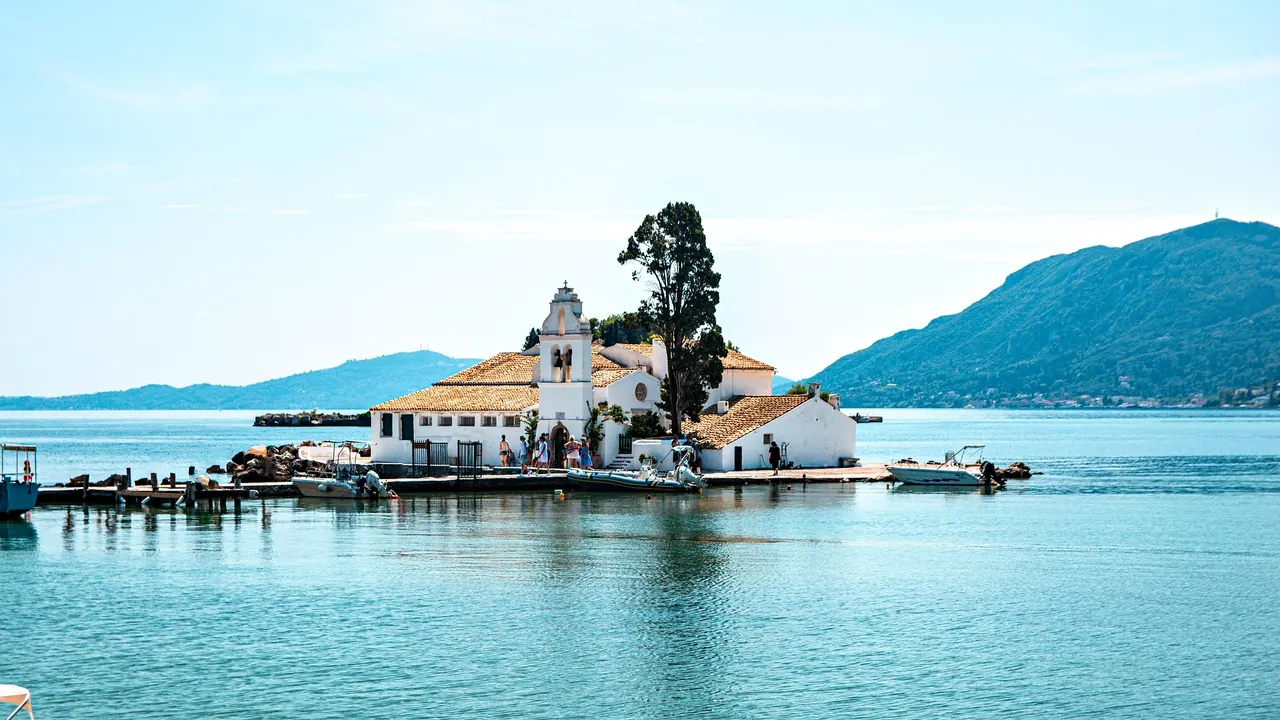
Photos: Corfu by Nico Hartnauer, Pexels License.
Corfu or Korčula?
Our verdict in twelve categories, each scored against the same fixed benchmark cities, and the climate month by month, so you can choose for your trip.
Choose Corfu for
- nightlife
- families
- live music and the arts
Corfu is the bigger, broader island and the safer choice for most kinds of trip. Long sandy beaches on the west coast, a Venetian old town with real depth to its sights, a kitchen unlike the rest of Greece and evenings that range from the Liston arcades to the clubs of Kavos give families, groups and first-timers more to work with, and it costs a little less.
Choose Korčula for
- getting around
Choose Korčula if you want a smaller, quieter island and are happy with less to do. Its walled town takes an afternoon to see, the nights end with a drink on the walls, and the swimming is in clear pebble coves rather than on long sands. What you get in return is calm, white wines you will hardly find elsewhere, and Pelješac and Mljet a short boat ride away. It suits couples and slow travellers more than anyone who needs entertainment.
Scoreboard
Twelve categories on one fixed scale from 0 to 100. The shaded stretch is the gap between the two.
Your match
Pick a travel style or drag the sliders, and both match scores follow your weighting.
Wins on nightlife and families with your weighting.
Wins on getting around with your weighting.
What matters to you?
Category by category
What the scores mean for a trip.
Beaches & swimming
Both islands are built around swimming, and the difference is mainly sand against stone. Corfu's west coast has long sandy beaches, from Glyfada to the dune-backed Issos and Halikounas, with shallow sand in the north and calm pebble bays in the northeast, so you can pick a beach to suit the day. The sea there also stays warm a little later in the year.
Korčula is mostly small rocky and pebbly coves under pine, and Lumbarda's Pržina and Bilin Žal are its only real sand. The water is very clear, and Pupnatska Luka and the flat rocks of Badija are lovely, but the coves are small and the well-known ones fill early in high summer.
Food & drink
Corfu gives you more to discover at the table. Its Venetian past survives in pastitsada, veal sofrito and fiery bourdeto, and kumquat liqueur and the island's own ginger beer are local too. To eat well you need to leave the resort menus behind for Corfu Town's back lanes and the village tavernas.
On Korčula the cooking is sound Dalmatian food, such as grilled fish, black risotto and dishes cooked under the iron bell, but the menus look much alike from place to place. The wine is the reason to come: Grk from Lumbarda, Pošip from Čara and Smokvica, Plavac Mali on Pelješac, and oysters at Ston.
Culture & sights
Corfu has the deeper set of sights. Its UNESCO-listed old town has two fortresses, the Liston and Agios Spyridon, as well as museums holding Asian art and the archaic Gorgon pediment. Beyond the town are the Achilleion and the clifftop ruin of Angelokastro, enough to fill several days.
Korčula Town is a handsome walled peninsula with a herringbone street plan, St Mark's Cathedral with its Tintoretto, and the house said to be Marco Polo's birthplace. You can walk all of it in an hour, and with the Vela Spila cave added, most visitors have seen it all in a day or two.
Nightlife
The two are far apart here. Corfu has every kind of night: Kavos for young party crowds until dawn, beach bars and late venues at Ipsos and Dassia, and cocktails under the Liston arcades and bars in the lanes of Corfu Town.
Korčula's evenings are a long dinner and a sunset drink on the town walls, with a few harbour bars open late in July and August. There are hardly any clubs, so anyone who wants to party takes a boat to another island.
Nature & outdoors
These are two green islands with roughly equal appeal, but the terrain is different. Corfu is better on foot: Mount Pantokrator has walks through abandoned villages, and the Corfu Trail runs the length of the island. Add the sea caves at Paleokastritsa for diving and the Korission lagoon for birds.
Korčula's own ridge is gentle country for cycling between vineyards. Its drama lies across the channel, with the climb up Sveti Ilija, the windsurfing at Viganj and the forested lakes of Mljet.
Day trips
Both islands have a similar number of good outings, almost all of them by sea. From Corfu they reach further afield: Paxos and Antipaxos, Parga and Sivota on the Greek mainland, and a ferry to Albania for the Roman and Venetian layers of Butrint. Most of these boats run only in the main season.
From Korčula, the short crossing to Orebić opens up Pelješac, with its wineries, Franciscan monasteries and the walls of Ston, which you can explore by car at your own pace. Mljet's lake monastery and Hvar Town make full days out, while Dubrovnik and Split are long ones.
Good for families
Corfu is much the stronger family island. Its north coast and southern sands shelve gently into calm water, many resorts have pools and kids' clubs, and there is a water park and pirate-style boat trips. Families just need to avoid Kavos and Ipsos.
Korčula is safe and welcoming, and Lumbarda's shallow sandy bays are good for small children. There is nothing built for them, though, and the stepped streets of the old town and the ferry journeys there take planning.
Getting around
The two are much alike: a walkable main town, infrequent buses and a strong case for hiring a car or scooter. On Corfu, the problem is twisting roads in the north and west and heavy summer traffic around the town and airport. On Korčula, it is the steep side roads down to the coves off its single main road, though taxi boats to Lumbarda, the islets and Orebić make up for some of that. Korčula also means ferries just to get there.
Shopping & style
Neither island is a shopping trip, but Corfu has more to browse. Along Nikiforou Theotoki and behind the Liston you will find olive-wood bowls, kumquat sweets, soaps and jewellery, with ordinary clothing chains in the newer part of town. Korčula has souvenir shops, a few craft studios and small galleries, and its best buys are things to eat and drink, such as Grk, Pošip and cukarini biscuits.
Affordability
Corfu is the cheaper island. Taverna meals and buses are fairly priced and the package resorts on the north and east coasts have reasonable rooms, though Kassiopi's villas and Corfu Town in high summer cost more.
Korčula charges popular-Dalmatian-island prices in and around the old town, and boat trips and drinks on the walls add up. You can keep costs down with an apartment in Lumbarda or Vela Luka and wine bought at the cellar door. On both islands, the months either side of high summer are noticeably cheaper.
Live music & performing arts
Corfu has more live music. Its historic philharmonic bands play in the Spianada and village squares all summer, kantades are still sung in tavernas, Easter brings bands to the processions, and there are classical evenings in the Old Fortress.
Korčula has one real spectacle, the Moreška sword dance performed in town through the summer, plus klapa singing in churches and squares. Beyond that there is no theatre or regular concert life.
Wellness & relaxation
Neither island has a bathing tradition, and on both the real wellness is the slow pace. Corfu has a little more on offer, with spas in the larger resort hotels and yoga retreats in the western and northern olive groves, and its hill villages and quiet northeast coast are very restful if you avoid the resort strips. Korčula's spa options are mostly hotel wellness areas near the town. Its calm is in the vineyard villages, especially in June or September.
When should you go?
Pick your month. The climate figures are measured averages, not a forecast.
Corfu in July
Korčula in July
Daytime high, °C
Rainfall in the month, mm
Where the figures come from
Korčula's temperatures are measured 69 km from the centre, at Mostar.
Korčula has no rain gauge within 25 km of the centre, so its rainfall comes from a gridded climate dataset read at the destination rather than from a gauge further away.
Temperature and rainfall are climate normals, averaged over the years shown. Corfu: 1991-2020 normals, Kerkyra Airport (0.9 km from centre). Korčula: 1991-2020 normals, Mostar (69.2 km from centre).
Through the summer the two islands follow much the same pattern. May and June are warm and dry, and in July and August both reach the low thirties, too hot for walking in the middle of the day. The sea is warm enough to swim from June on both. Corfu's water holds its warmth a little longer, around 26°C in August and still pleasant into early October, while Korčula's runs a degree or so cooler and its swimming season ends in late September. Corfu also gets slightly more sunshine through the summer.
The rest of the year is where they part. Corfu's winters are mild, around 14°C by day, but very wet: heavy rain sets in from October and peaks near 188mm in November. Korčula is drier but noticeably colder, near 9°C in January. For walking and sightseeing, April to May and late September suit both, though October on Corfu often brings rain.
Which traveller are you?
On a family trip with young children, Corfu is the easier choice. The north coast and Issos have gently shelving sand, many resorts have pools and kids' clubs, and there is a water park. Korčula has sandy bays only at Lumbarda, nothing built for children, and stepped streets.
For a food and nightlife trip, Corfu wins clearly. Its Venetian-influenced dishes are worth seeking out, and the evenings range from cocktails in Corfu Town to all-night clubs at Kavos. On Korčula the night ends after dinner and a glass of Grk, and there are almost no clubs.
On an outdoors trip, the two are close, but Korčula suits anyone who wants to be on the water. Viganj, across the channel, has steady afternoon wind for windsurfing and kitesurfing, you can paddle round the islets, and Mljet's saltwater lakes are a boat ride away. Corfu is better for long-distance walking.
Before you go
| Measure | Corfu | Korčula |
|---|---|---|
| Official language | Greek | Croatian |
| Currency | Euro (EUR) | Euro (EUR) |
| Sockets | CF230 V, 50 Hz | CF230 V, 50 Hz |
| Driving side | Right | Right |
| Time zone | UTC+2, UTC+3 in summer | UTC+1, UTC+2 in summer |
| Emergency number | 112 | 112 |
| Main airport | Corfu Ioannis Kapodistrias International Airport (CFU)88 non-stop destinations | Dubrovnik Ruđer Bošković Airport (DBV)76 non-stop destinations |
| Public holidays this year | 15 days | 14 days |
By the numbers
| Measure | Corfu | Korčula |
|---|---|---|
| Population | 100,854 | - |
| People per km² | 161 | - |
| Swim season, months above 21 °C | 5 months | 5 months |
Where else could you go?
Every comparison below shares a destination with this one, so you can follow Corfu or Korčula somewhere new.