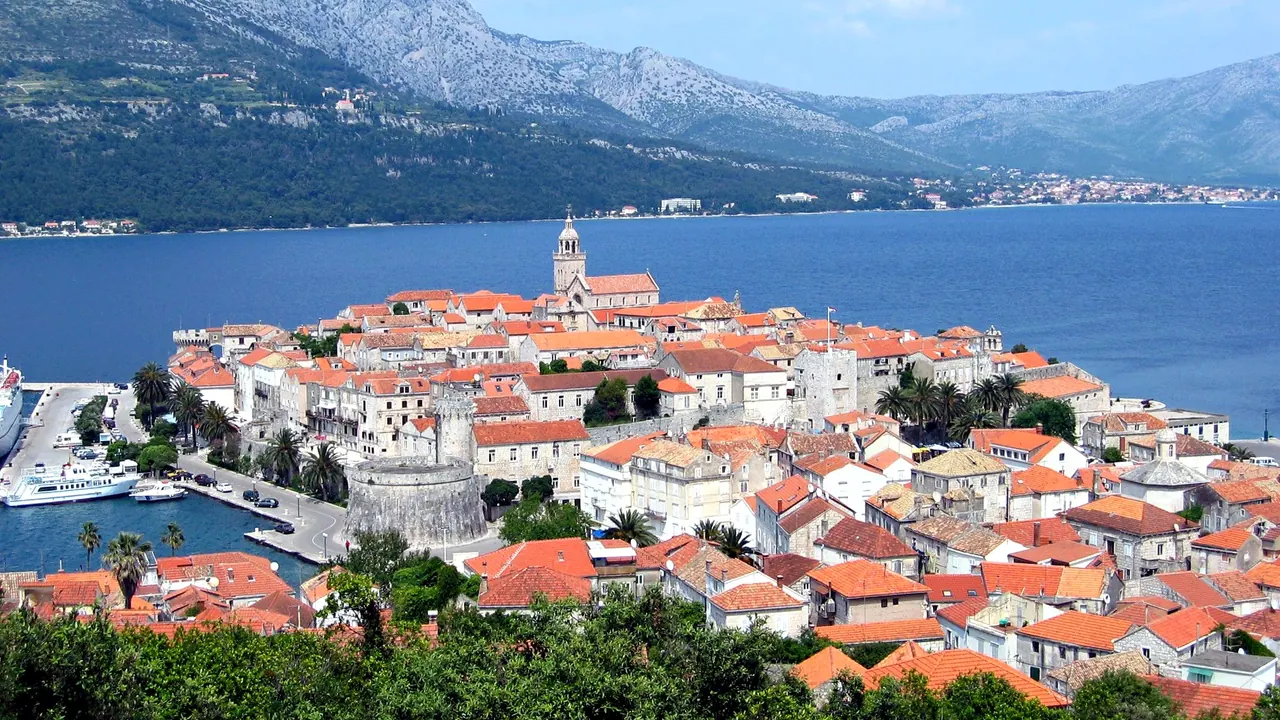
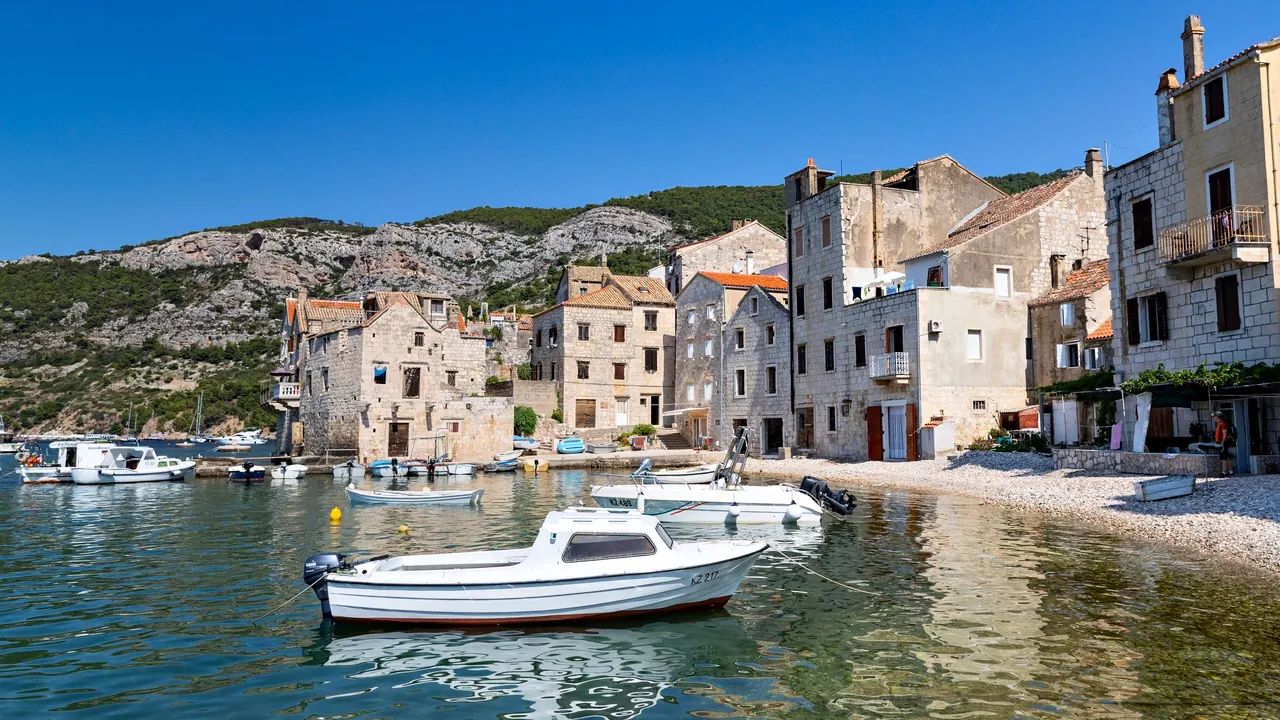
Photos: Korčula by Εὐθυμένης, CC BY-SA 3.0, cropped; Vis by dronepicr, CC BY 2.0, cropped.
Korčula or Vis?
Our verdict in twelve categories, each scored against the same fixed benchmark cities, and the climate month by month, so you can choose for your trip.
Choose Korčula for
- day trips
- culture and sights
- shopping
Korčula is the better choice if you want an island with a proper town at its centre. The walled old town gives you a cathedral, a museum and evening drinks on the towers, and the sandy bays at Lumbarda suit young children. The short ferry to Pelješac opens up wineries, Ston's walls and oysters, and boat trips to Mljet. It is the easier and more varied base for a week of swimming mixed with sightseeing.
Choose Vis for
- nature and the outdoors
- beaches
Vis suits travellers who mainly want the sea and are happy to leave the rest behind. It sits further out, so the crossing is longer, there are fewer day trips and there is less to do in the evenings. In return you get a slower pace and some of the clearest water in the Adriatic. The coves under the southern cliffs, the sea caves of the geopark and the diving on wrecks and walls are its strongest draws, along with an odd military past to explore underground.
Scoreboard
Twelve categories on one fixed scale from 0 to 100. The shaded stretch is the gap between the two.
Your match
Pick a travel style or drag the sliders, and both match scores follow your weighting.
Wins on day trips and culture and sights with your weighting.
Wins on nature and the outdoors and beaches with your weighting.
What matters to you?
Category by category
What the scores mean for a trip.
Beaches & swimming
The swimming is equally good on both islands, but the shoreline differs. Korčula has something rare on this coast: real sand and shallow water at Pržina and Bilin Žal near Lumbarda. It also has the deep pebble bay of Pupnatska Luka on the south coast, and taxi boats take you to the flat rocks of Badija.
Vis is almost all pebble and rock, with little shade. Its coves are more dramatic, above all Stiniva, closed off between two cliffs. The emptiest water lies around the outer islets, which you reach by boat, so a beach day there takes more planning than on Korčula.
Food & drink
At the table the two are much alike: family konobas, grilled fish and dishes slow-cooked under the peka bell, with many kitchens closing once summer ends. On Korčula, wine is what stands out. You can drink Grk in Lumbarda and Pošip from Čara and Smokvica, and Pelješac's Dingač reds and the Ston oysters are a short crossing away.
Vis is better for lobster straight off the boats and the anchovy-filled pogaca of Komiza. Its own Vugava white is poured by growers in the inland fields. Komiza has the harbour tables, and Vis town has a few more ambitious restaurants along its waterfront.
Culture & sights
Korčula has much more to show. Its walled old town, with herringbone streets laid out to break the wind, is intact and easy to read. St Mark's Cathedral, the treasury, the town museum and the house claimed as Marco Polo's birthplace all sit within a short walk. Further west, the prehistoric cave of Vela Spila adds real depth.
The history on Vis is spread more thinly but is unusual. There are the Greek remains of Issa, an archaeological museum in an Austrian fortress with a bronze Greek head, British forts from the Napoleonic wars, and Tito's wartime cave. Guided visits through tunnels and submarine pens from the island's decades as a military zone are its most memorable sight.
Nightlife
Neither island is for clubbing, but Korčula has a bit more going on. Cocktail bars sit on the old walls and towers above the channel, and a few harbour bars stay open late in high summer. On Vis, a night out means harbour tables in Vis town or Komiza and perhaps a beach bar party on a summer weekend, and the island is asleep long before dawn.
Nature & outdoors
The scenery is good on both but quite different. Korčula is green and gentle, with pine, holm oak and terraced vineyards along a walkable central ridge. Across the channel are bigger landscapes: the steep climb up Sveti Ilija, the windsurfing strait at Viganj, and the forested lakes of Mljet.
Vis is drier and wilder. It has a high plateau, sheer southern cliffs and Hum looking out over open sea. The island and its islets form a geopark of volcanic rock and sea caves, and diving on wrecks and walls is its outstanding outdoor activity.
Day trips
Korčula wins here easily. A short ferry to Orebić puts all of Pelješac within reach: the Dingač wineries, the Franciscan monasteries and the medieval walls of Ston above its salt pans. Boats go to Mljet's lake monastery and Roman ruins, and the catamaran reaches Hvar Town in under a couple of hours.
From Vis, outings mostly mean boat trips around its own waters: the Blue Cave on Bisevo, Ravnik and Budikovac, and on calm days distant Svetac or Jabuka. The mainland and the other islands are too far for a day, so any town sightseeing belongs before or after your stay.
Good for families
Both islands are safe and relaxed, and neither has anything built for children. Korčula's advantage is the sandy, shallow water around Lumbarda, the gentlest swimming for toddlers on either island, though the stepped lanes of Korčula Town are hard going with a pushchair.
On Vis, Stoncica and a few bays near Komiza have shallow water. Many of the best coves, though, are down steep paths or reached only by boat, and the pebble shores have little shade.
Getting around
Korčula is the easier island to reach and to get around. The ferry hop from Orebić is short, taxi boats link Korčula Town with Lumbarda and the islets, and buses run along the single main road to Vela Luka. Even so, a car or scooter helps for the coves down steep side roads.
Vis takes more effort from the start. The car ferry from Split takes over two hours and there are few sailings a day. Once there, the bus covers the 10km between Vis town and Komiza, but Stiniva and the southern bays mean a scooter on winding roads or a taxi boat.
Shopping & style
Neither island is a place to shop, but Korčula Town at least has jewellery and craft studios and small galleries among its souvenir shops. Vis has little beyond grocery stores and producers selling wine, olive oil, carob and herbal brandies. On both, the best things to take home are bottles, and on Vis anything else should be bought before the ferry.
Affordability
Both islands cost what a popular Croatian island costs in summer, and on both June and September are noticeably easier on the budget. On Korčula, the savings come from staying away from the old town, in Lumbarda, Vela Luka or the inland villages, and from buying wine at the cellar door.
On Vis, the private apartments and guesthouses keep rooms reasonable. Fish sold by weight, the ferry, taxi boats and island shop prices are what push the bill up.
Live music & performing arts
Korčula has one genuine reason to plan an evening around a performance: the Moreška, a centuries-old sword dance staged in Korčula Town through the summer. Klapa concerts are held in its churches and squares. Vis offers only what you happen to come across, such as klapa singing in the harbours, occasional open-air concerts and the fishermen's feast days in Komiza.
Wellness & relaxation
Neither island has a spa or bathing tradition, so on both relaxation comes from slowness rather than treatments. If you want a massage or a pool, Korčula's larger hotels around the old town have wellness areas. Vis has only a few massage rooms, but its distance from the mainland and its empty evenings make switching off even easier.
When should you go?
Pick your month. The climate figures are measured averages, not a forecast.
Korčula in July
Vis in July
Daytime high, °C
Rainfall in the month, mm
Where the figures come from
Korčula's temperatures are measured 69 km from the centre, at Mostar.
Korčula has no rain gauge within 25 km of the centre, so its rainfall comes from a gridded climate dataset read at the destination rather than from a gauge further away.
Vis's temperatures are measured 55 km from the centre, at Split / Marjan.
Vis has no rain gauge within 25 km of the centre, so its rainfall comes from a gridded climate dataset read at the destination rather than from a gauge further away.
Vis's sunshine is measured 55 km from the centre, at Split / Marjan.
Temperature and rainfall are climate normals, averaged over the years shown. Korčula: 1991-2020 normals, Mostar (69.2 km from centre). Vis: 1991-2020 (sunshine 1971-2000) normals, Split / Marjan (54.8 km from centre).
Both islands follow the same sea. The water warms enough to swim from June, peaks around 25°C in August and stays pleasant through September. The air is where they differ. Around Korčula Town, July and August highs reach about 33°C, which makes midday walks through the old town and over the vineyard ridge hard work. Vis is a couple of degrees cooler, at about 31°C, and gets a little more sunshine in every month.
June and September are the best months on both islands: the sea is warm and the heat is easier to bear. From October the rain sets in, and Korčula is clearly the wetter of the two, with about 121mm in November against about 94mm on Vis. Winter is mild on both, but the swimming is over and the islands are quiet.
Which traveller are you?
On a culture and arts trip, Korčula is the clear pick. Its walled town has St Mark's Cathedral with a Tintoretto altarpiece, and the Moreška sword dance is performed through the summer. Ston and the monasteries of Pelješac are a short crossing away.
For a relaxing and wellness trip, Vis has the edge in feel, though neither island has spa culture. It is further out, has less traffic and fewer outings to tempt you, so the days settle into a rhythm of swims, long lunches and early nights.
Divers should choose Vis. Wrecks, underwater walls and the sea caves of the geopark around Ravnik and Bisevo make it one of the Adriatic's better dive spots. Korčula's water is just as clear, but its outdoor appeal lies in kayaking, walking and the windsurfing at Viganj across the channel.
Before you go
| Measure | Korčula | Vis |
|---|---|---|
| Official language | Croatian | Croatian |
| Currency | Euro (EUR) | Euro (EUR) |
| Sockets | CF230 V, 50 Hz | CF230 V, 50 Hz |
| Driving side | Right | Right |
| Time zone | UTC+1, UTC+2 in summer | UTC+1, UTC+2 in summer |
| Emergency number | 112 | 112 |
| Main airport | Dubrovnik Ruđer Bošković Airport (DBV)76 non-stop destinations | Split Saint Jerome Airport (SPU)69 non-stop destinations |
| Public holidays this year | 14 days | 14 days |
By the numbers
| Measure | Korčula | Vis |
|---|---|---|
| Swim season, months above 21 °C | 5 months | 4 months |
Where else could you go?
Every comparison below shares a destination with this one, so you can follow Korčula or Vis somewhere new.