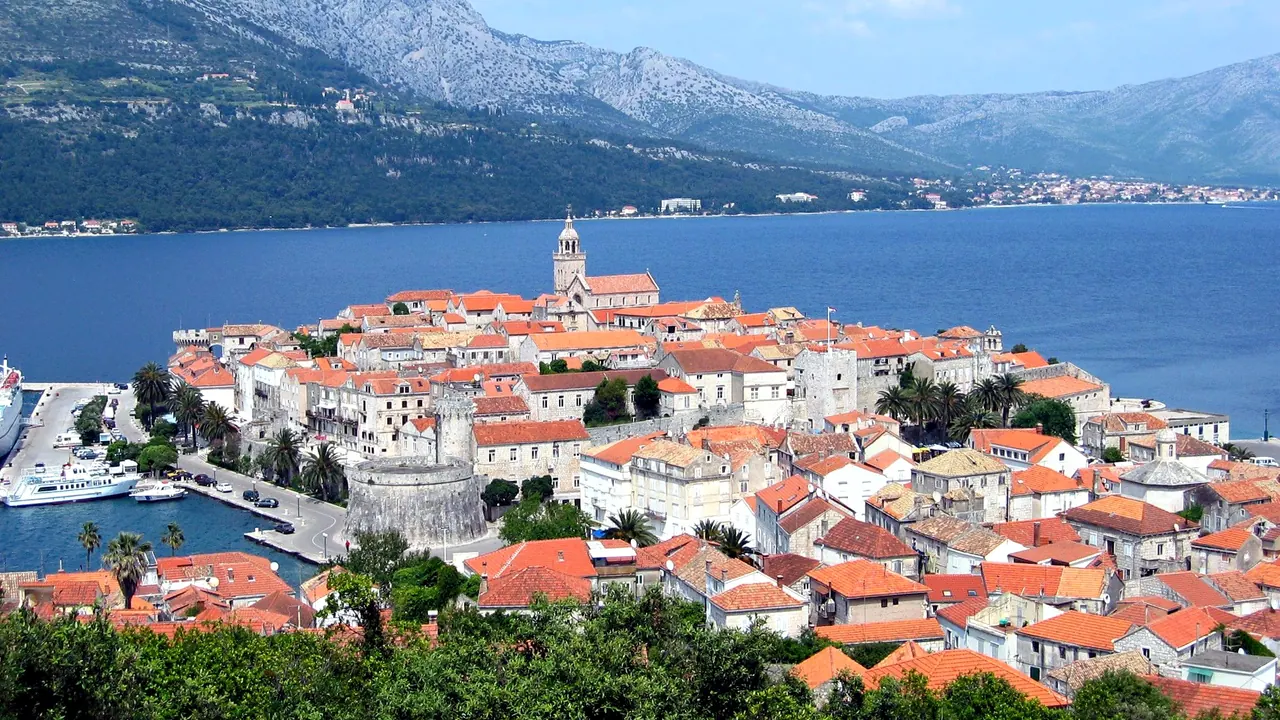
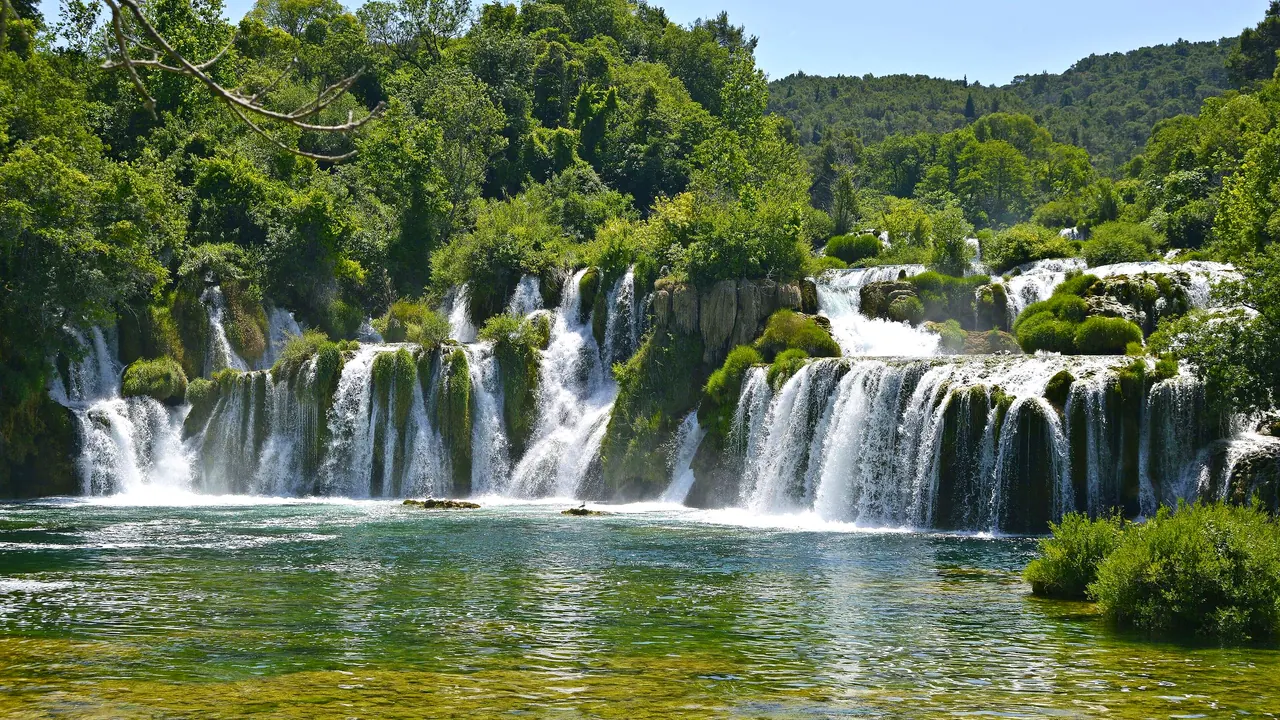
Photos: Korčula by Εὐθυμένης, CC BY-SA 3.0, cropped; Krka by Alberto-g-rovi, CC BY 4.0, cropped.
Korčula or Krka?
Our verdict in twelve categories, each scored against the same fixed benchmark cities, and the climate month by month, so you can choose for your trip.
Choose Korčula for
- beaches
- nightlife
- shopping
Korčula is the better pick for a summer by the sea. Its clear water, sandy bays at Lumbarda, pebble coves under the pines and taxi boats out to the islets make swimming the centre of each day. The walled old town, the island wines and a drink on the towers at sunset fill the rest. It suits travellers who want to unpack once and slow down on an island, and who don't mind ferries and a hired scooter.
Choose Krka for
- nature and the outdoors
- day trips
- prices
Krka is for travellers who care more about landscape than the beach. The trip is built around the river itself: boardwalks through the spray at Skradinski Buk, boats to the monastery on Visovac and walks along the canyon rim. Šibenik's cathedral and Trogir, Zadar and Split are all within reach for day trips. It also costs a little less, but it works best with a car, and the sea is something you drive to.
Scoreboard
Twelve categories on one fixed scale from 0 to 100. The shaded stretch is the gap between the two.
Your match
Pick a travel style or drag the sliders, and both match scores follow your weighting.
Too close to call, level with your weighting
Wins on beaches and nightlife with your weighting.
Wins on nature and the outdoors and day trips with your weighting.
What matters to you?
Category by category
What the scores mean for a trip.
Beaches & swimming
Korčula is much the stronger choice for swimming. The sea is right on the doorstep: sandy, shallow bays at Pržina and Bilin Žal, Pupnatska Luka's bright pebble bay below Pupnat, and rocky islets such as Badija a short taxi-boat ride from Korčula Town.
On a Krka trip the swimming happens away from the river, because bathing below Skradinski Buk is not allowed. For the sea you head down to Šibenik's coves at Banj and Solaris, to Primošten, or across to the rocky shores of Zlarin and Prvić. It is good water, but it means a short trip for an afternoon.
Food & drink
The food is much the same: Dalmatian grilled fish and dishes slow-cooked under the iron bell, served in family konobas. What sets each apart is local. Korčula has its own wines, Grk from Lumbarda and Pošip from Čara and Smokvica, with Pelješac reds and Ston oysters across the channel.
Krka's speciality is Skradin's slow-cooked veal risotto, with estuary mussels and the dark Babić red from the hills. Šibenik's old town also gives it a better choice of restaurants than anywhere on Korčula.
Culture & sights
The sights are about even, but they are spread out differently. Korčula's history is gathered in one compact walled town: the herringbone streets, St Mark's Cathedral with its Tintoretto, and the house said to be Marco Polo's birthplace. Most visitors see it all in a day or two, with the Vela Spila cave as a separate outing.
Krka's sights are strung along the river: the island monastery on Visovac, the catacombs under the Orthodox Krka Monastery and the arches of the Roman camp at Burnum. At the river mouth, Šibenik adds two UNESCO-listed sights, the Cathedral of St James and the sea fortress of St Nicholas.
Nightlife
Neither is a place to go out, but Korčula has a little more going on after dinner. In summer there are cocktails on the old walls and towers above the channel, and a few harbour bars stay open late. On Krka, evenings mostly mean dinner on Skradin's harbour among the moored yachts, plus a handful of bars in Šibenik's old town.
Nature & outdoors
Krka has the more remarkable landscape. A limestone canyon cuts through the dry karst, with travertine falls at Skradinski Buk and the many small cascades of Roški Slap. Add canyon-rim trails, kayaking on the upper river and birdlife in the estuary reed beds, and the whole trip revolves around nature.
Korčula is gentler and greener, with pine, holm oak and terraced vineyards along a low central ridge, and sea kayaking among the islets. For more dramatic scenery from Korčula, cross the channel to climb Sveti Ilija or go windsurfing at Viganj.
Day trips
Krka makes the better base for day trips, because the mainland roads put half of central Dalmatia within about an hour. Trogir, Split and Zadar are all comfortable days out, and Primošten and the ferries to Zlarin and Prvić are closer still.
From Korčula, every outing starts with a boat. Pelješac's wineries and Ston's walls are easy, Mljet takes a full day, and Hvar is a short catamaran ride away. Dubrovnik and Split, though, mean about three hours each way.
Good for families
Both work for families, but with different kinds of days out. Korčula is a beach trip: Lumbarda's sandy, shallow bays are some of the gentlest swimming on the coast, and short boat hops to the islets please older children. The stepped lanes of Korčula Town are hard going with a pushchair.
At Krka the highlight is the boardwalks over rushing water and pools full of fish, plus the boat rides to Visovac. Most families stay at a resort hotel with a pool near Šibenik and drive in for the falls.
Getting around
Krka is slightly easier to get around, as long as you have a car. The motorway runs close to Lozovac, distances are short, and park buses and boats link the falls. Without a car, the upper river and the monasteries need a tour.
Korčula is long and narrow, with one main road and infrequent buses, and the best coves lie down steep side roads. Taxi boats help around Korčula Town, but arriving and leaving always depends on ferry timetables.
Shopping & style
Korčula has a little more to browse, with craft and jewellery studios and small galleries in the old town lanes. Even so, the best buys are Grk, Pošip and the island's cukarini biscuits. Around Krka, shopping mostly means farm produce such as honey, dried figs and lavender from roadside stalls, plus a few shops in Šibenik's old town. Zlarin's coral work is its one local craft.
Affordability
Krka is the slightly cheaper trip. Village apartments inland from Lozovac and generous konoba meals keep costs down, and the park entrance fee is the main expense. It is lower outside July and August.
Korčula's old town and its surroundings charge popular-island prices, and boat trips, car hire and drinks on the walls add up. Staying in Vela Luka or the villages brings the cost down.
Live music & performing arts
Neither has much of a stage, but each has its own summer tradition. Korčula has the Moreška, a centuries-old sword dance that local troupes perform in town, and village sword dances on feast days. Around Krka, performance means fortress concerts and the long-running children's festival in Šibenik. Both have klapa singing on summer evenings.
Wellness & relaxation
Neither suits a spa trip. There is no bathing tradition in either place, and treatments come down to the wellness rooms of a few larger hotels, around Korčula Town on the island and along the coast near Šibenik for Krka. What differs is the kind of calm each gives you.
On Korčula the whole island slows down. A week of swims, unhurried meals and early nights in a stone village is the trip itself, and it is most peaceful in June and September. At Krka the calm comes from where you stay rather than how you spend the day. The park boardwalks fill with visitors, but an inland village house or Skradin's waterfront gives you still, silent evenings to come back to.
When should you go?
Pick your month. The climate figures are measured averages, not a forecast.
Korčula in July
Krka in July
Daytime high, °C
Rainfall in the month, mm
Where the figures come from
Korčula's temperatures are measured 69 km from the centre, at Mostar.
Korčula has no rain gauge within 25 km of the centre, so its rainfall comes from a gridded climate dataset read at the destination rather than from a gauge further away.
Krka's temperatures are measured 53 km from the centre, at Split / Marjan.
Krka has no rain gauge within 25 km of the centre, so its rainfall comes from a gridded climate dataset read at the destination rather than from a gauge further away.
Krka's sunshine is measured 53 km from the centre, at Split / Marjan.
Temperature and rainfall are climate normals, averaged over the years shown. Korčula: 1991-2020 normals, Mostar (69.2 km from centre). Krka: 1991-2020 (sunshine 1971-2000) normals, Split / Marjan (52.9 km from centre).
The two have much the same climate, but Korčula runs a little hotter in high summer. Around Korčula Town the days reach 33°C in July and August and the sea warms to 25°C. That is ideal for swimming, but the middle of the day is too hot for walking. Krka peaks a couple of degrees cooler, at about 31°C, so midsummer days at the falls are a little easier. The boardwalks still get hot and crowded, though.
Both are at their best in late May, June and September, when the sea is warm enough to swim and walking is comfortable. Spring suits Krka especially, because the waterfalls carry the most water then. From October the rain sets in on both, and November is the wettest month, with about 121mm on Korčula. Winter is mild but grey and quiet, so neither place is a winter destination.
Which traveller are you?
On a beach and sun trip, Korčula is the clear choice. The sea sets the pace of every day, with a swim before breakfast and a boat to another cove after lunch. At Krka the beach is an afternoon outing, not the point.
For an outdoors trip, Krka is the stronger base. Your days are spent on foot, on boats and in kayaks inside a river canyon, and the landscape is the main event. On Korčula the outdoors is a gentler backdrop to swimming and long lunches.
On a trip on a tight budget, Krka makes the money go a little further, especially outside high summer, when staying inland and eating simply keeps a week modest. Korčula costs what a popular island costs, and almost every outing there means paying for transport.
Before you go
| Measure | Korčula | Krka |
|---|---|---|
| Official language | Croatian | Croatian |
| Currency | Euro (EUR) | Euro (EUR) |
| Sockets | CF230 V, 50 Hz | CF230 V, 50 Hz |
| Driving side | Right | Right |
| Time zone | UTC+1, UTC+2 in summer | UTC+1, UTC+2 in summer |
| Emergency number | 112 | 112 |
| Main airport | Dubrovnik Ruđer Bošković Airport (DBV)76 non-stop destinations | Split Saint Jerome Airport (SPU)69 non-stop destinations |
| Public holidays this year | 14 days | 14 days |
By the numbers
| Measure | Korčula | Krka |
|---|---|---|
| Swim season, months above 21 °C | 5 months | 4 months |
Where else could you go?
Every comparison below shares a destination with this one, so you can follow Korčula or Krka somewhere new.