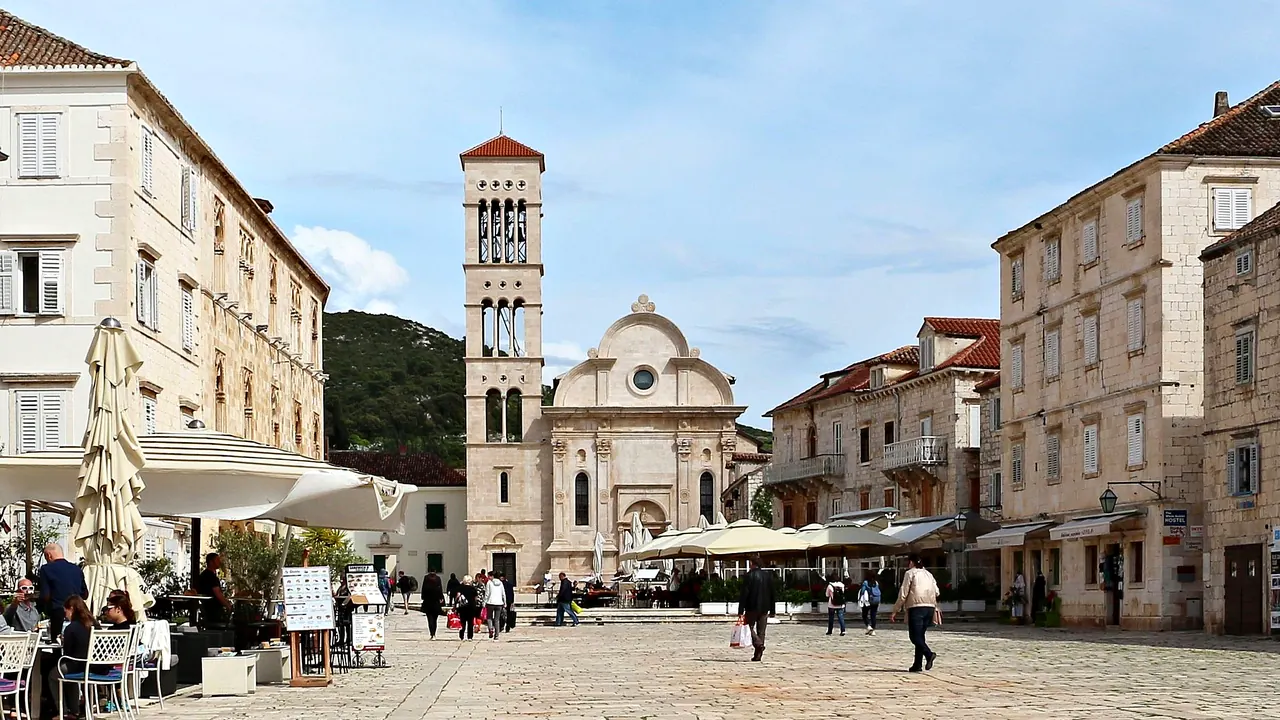
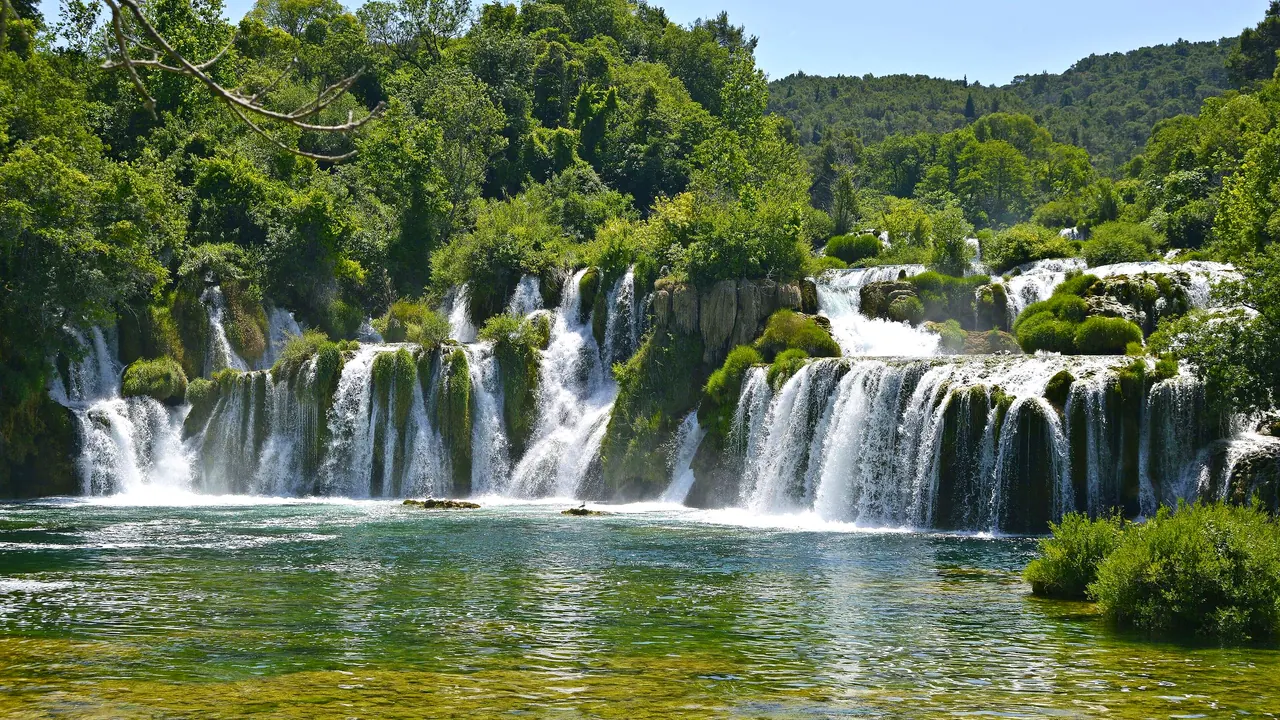
Photos: Hvar by Bernard Gagnon, CC BY-SA 4.0, cropped; Krka by Alberto-g-rovi, CC BY 4.0, cropped.
Hvar or Krka?
Our verdict in twelve categories, each scored against the same fixed benchmark cities, and the climate month by month, so you can choose for your trip.
Choose Hvar for
- nightlife
- beaches
- food and drink
Hvar is the choice for a summer by the sea. You stay on the island, swim off rocks and pebbles in very clear water, take taxi boats to the Pakleni Islands and spend the evenings in Hvar Town's harbour bars, or in the calmer north-side towns if you would rather not party. It also has the better wine and the more varied cooking. The cost of all this is high-season prices, and the boat timetables shape every trip off the island.
Choose Krka for
- nature and the outdoors
- culture and sights
- day trips
Krka is better for travellers who want landscape and sights more than lazy beach days. The travertine falls, the canyon boardwalks and the boat to Visovac are the heart of the trip. Šibenik's cathedral and fortress are close by, and Trogir, Split and Zadar are easy drives. Evenings are quiet and it costs a little less, but you will want a car, and swimming means a trip down to the coast.
Scoreboard
Twelve categories on one fixed scale from 0 to 100. The shaded stretch is the gap between the two.
Your match
Pick a travel style or drag the sliders, and both match scores follow your weighting.
Wins on nightlife and beaches with your weighting.
Wins on nature and the outdoors and culture and sights with your weighting.
What matters to you?
Category by category
What the scores mean for a trip.
Beaches & swimming
Hvar is built around swimming. Taxi boats from Hvar Town run to the Pakleni Islands, steep tracks lead down to wild coves on the south coast, and the north side around Jelsa and Vrboska has shallow, calm bays. Almost all of it is pebble and rock, so you swim from stone ledges and coves rather than sand.
Krka's main attraction is off-limits for swimmers, because bathing below the falls is not allowed. For the sea you head down the estuary to Šibenik's coves at Banj, south to Primošten, or by ferry to the quiet rocky shores of Zlarin and Prvić. The water is just as clear, but at Krka the beach is an afternoon outing, not the reason for the trip.
Food & drink
Both serve Dalmatian cooking: grilled fish, and lamb slow-cooked under a peka bell. Hvar has the edge because of its wine. Plavac Mali grows on the steep slopes around Ivan Dolac and Bogdanjuša on the Stari Grad plain, and family cellars will pour a tasting. The konobas in Pitve and Velo Grablje serve lamb and vegetables from their own land.
Krka has a narrower range, though with some specialities of its own: Skradin's slow-cooked veal risotto, mussels and oysters from the estuary, and dark Babić from the hills. Its best restaurants are in Šibenik's old town, and away from there you are choosing between a few family taverns.
Culture & sights
Krka has the weightier heritage. At the river mouth, Šibenik's Cathedral of St James, with its frieze of carved faces, and the sea fortress of St Nicholas are both UNESCO-listed. Along the river there are more sights: the island monastery on Visovac, the catacombs under the Orthodox Krka Monastery and the Roman arches of Burnum above the canyon.
Hvar's sights are fewer but very attractive. Hvar Town has a white-stone Venetian square, its cathedral and the Fortica fortress. Stari Grad has its Greek origins and the Tvrdalj, and the ancient field pattern of the Stari Grad Plain lies behind it. Two or three days cover all of it.
Nightlife
There is no real contest here. In summer, Hvar Town fills its harbour front and stepped lanes with cocktail bars full of yacht crews and young travellers, and the beach clubs on the Pakleni Islands keep going after dark, with taxi boats ferrying people back and forth. It is crowded and expensive, and it runs only from June to early September.
At Krka the evening means dinner by the water and a drink on Skradin's harbour. Šibenik has a few lively bars on summer nights but no clubs worth seeking out, so night owls will be disappointed.
Nature & outdoors
Krka is the place for scenery. The river has cut a deep canyon through the karst and drops over travertine falls. Boardwalks at Skradinski Buk take you through the spray, Roški Slap spreads into dozens of small cascades, and boats cross the lake around Visovac. There are also rim trails, plateau cycling, kayaking on the upper river and birdlife in the estuary reed beds.
Hvar's landscape is quieter: a limestone ridge of dry-stone terraces, pine, abandoned villages and lavender fields. The walk up Sveti Nikola gives wide sea views, and the Pakleni Islands are good for sea kayaking and snorkelling. It is a pleasant setting rather than a dramatic one.
Day trips
Krka is the better base for touring. With a car you can reach Trogir and Primošten easily, and Zadar or Split in a little over an hour. Knin's fortress is inland, and small ferries from Šibenik run to Zlarin and Prvić. Murter opens the way to the Kornati.
From Hvar, catamarans reach Split, Korčula's walled town and Vis, and the island's own towns make good outings from one another. Still, every trip off the island depends on boat timetables, and there are fewer sailings outside summer.
Good for families
Neither has attractions built for children, and they suit families in different ways. On Hvar the trip is a string of easy seaside days from Jelsa, Stari Grad or Vrboska, with shallow bays, some fine gravel and boat rides to the coves. Hvar Town, with its steps and party nights, is best avoided.
Krka gives children one memorable day: boardwalks right over rushing water and fish-filled pools, and boat rides to Visovac. For the rest of the stay, families usually base themselves in a coastal resort near Šibenik with pools and shallow pebble shores.
Getting around
Both are a little awkward, in different ways. Hvar starts with a ferry or catamaran. Its towns are small and walkable, taxi boats serve the nearby islands, and the buses are infrequent. You need a car or scooter for the south coast and the hill villages, on narrow, winding roads.
Krka is really a driving trip. The motorway runs close to the park entrance, and inside the park, buses and boats link the falls and the monastery. Without a car you can get to Skradin and Šibenik by bus, but the upper falls require a tour.
Shopping & style
Neither is a place to shop, but Hvar has a little more to look at. You can buy lace made by Benedictine nuns, lavender oil from the harbour stalls and wine straight from family cellars, and Hvar Town's lanes have linen and swimwear boutiques. At Krka it comes down to farm produce, souvenirs at the park gates, a few craft shops in Šibenik and Zlarin's coral work.
Affordability
Krka is easier on the budget. Rooms and meals cost about what they do in the middle of Western Europe, inland apartments near Lozovac undercut the waterfront, and the park entrance fee is the main extra cost.
In high summer, Hvar Town is among the costliest stops on the Croatian coast, from harbour rooms to beach-club loungers and taxi boats. Staying in Jelsa or Vrboska and eating at village konobas helps, and both destinations cost much less in spring and autumn.
Live music & performing arts
Both offer only summer performances, and neither is worth a trip for its stage. Hvar's concerts are classical and chamber music in churches, the Franciscan cloister and the squares. Krka's are centred on Šibenik, with concerts in the hilltop fortresses, a small nineteenth-century theatre and the long-running International Children's Festival. Klapa singing turns up at village feasts in both.
Wellness & relaxation
Hvar is slightly better for a restful stay. The larger hotels in Hvar Town and Jelsa have spas, massage and yoga are offered in season, and Vrboska and the hill villages settle into long lunches and evening strolls, with pine and lavender in the air.
Krka's calm is in its quiet: Skradin's harbour at dusk, the river early in the morning before the coaches arrive, and silent evenings in stone houses inland. The only spa facilities are in a few resort hotels near Šibenik.
When should you go?
Pick your month. The climate figures are measured averages, not a forecast.
Hvar in July
Krka in July
Daytime high, °C
Rainfall in the month, mm
Where the figures come from
Hvar's temperatures are measured 38 km from the centre, at Split / Marjan.
Hvar has no rain gauge within 25 km of the centre, so its rainfall comes from a gridded climate dataset read at the destination rather than from a gauge further away.
Hvar's sunshine is measured 38 km from the centre, at Split / Marjan.
Krka's temperatures are measured 53 km from the centre, at Split / Marjan.
Krka has no rain gauge within 25 km of the centre, so its rainfall comes from a gridded climate dataset read at the destination rather than from a gauge further away.
Krka's sunshine is measured 53 km from the centre, at Split / Marjan.
Temperature and rainfall are climate normals, averaged over the years shown. Hvar: 1991-2020 (sunshine 1971-2000) normals, Split / Marjan (38.2 km from centre). Krka: 1991-2020 (sunshine 1971-2000) normals, Split / Marjan (52.9 km from centre).
The two have almost the same weather, so the choice of month depends on what you plan to do. Daytime highs reach 28°C in June and 31°C in July and August, which suits swimming and is too hot for walking in the middle of the day. Around Hvar Town the sea is warm enough from June to late September and reaches 25°C in August. The water off the Krka coast is a degree or so cooler at its peak. Midsummer is also the driest and sunniest part of the year in both places.
For walking, cycling and sightseeing, May and late September are the kindest months. Krka is also worth seeing in spring, when the falls carry the most water. The rain comes in from September, and November is the wettest month, with about 116mm on Hvar. From then until March the days are cool and grey in both places, which makes this a poor season for either trip.
Which traveller are you?
On a beach and sun trip, choose Hvar. Swimming is the whole point of a summer there. There are pine-backed bays on the Pakleni Islands, wild coves along the south coast and shallow water around Jelsa. At Krka you cannot swim at the falls, so a beach day means driving to the coast.
On a food and nightlife trip, Hvar is also the better choice. Hvar Town is one of the Adriatic's best-known party ports, with harbour cocktail bars and day parties on the Pakleni Islands. The island also has cellar tastings and village konobas. Krka's evenings rarely go beyond a long dinner in Skradin.
On an outdoors trip, Krka wins clearly. You can follow boardwalks over the falls at Skradinski Buk, take boats through the canyon, walk rim trails, kayak on the upper river and sail out to the Kornati. Hvar offers pleasant ridge walks and sea kayaking, but its scenery is gentler.
Before you go
| Measure | Hvar | Krka |
|---|---|---|
| Official language | Croatian | Croatian |
| Currency | Euro (EUR) | Euro (EUR) |
| Sockets | CF230 V, 50 Hz | CF230 V, 50 Hz |
| Driving side | Right | Right |
| Time zone | UTC+1, UTC+2 in summer | UTC+1, UTC+2 in summer |
| Emergency number | 112 | 112 |
| Main airport | Split Saint Jerome Airport (SPU)69 non-stop destinations | Split Saint Jerome Airport (SPU)69 non-stop destinations |
| Public holidays this year | 14 days | 14 days |
By the numbers
| Measure | Hvar | Krka |
|---|---|---|
| Swim season, months above 21 °C | 4 months | 4 months |
Where else could you go?
Every comparison below shares a destination with this one, so you can follow Hvar or Krka somewhere new.