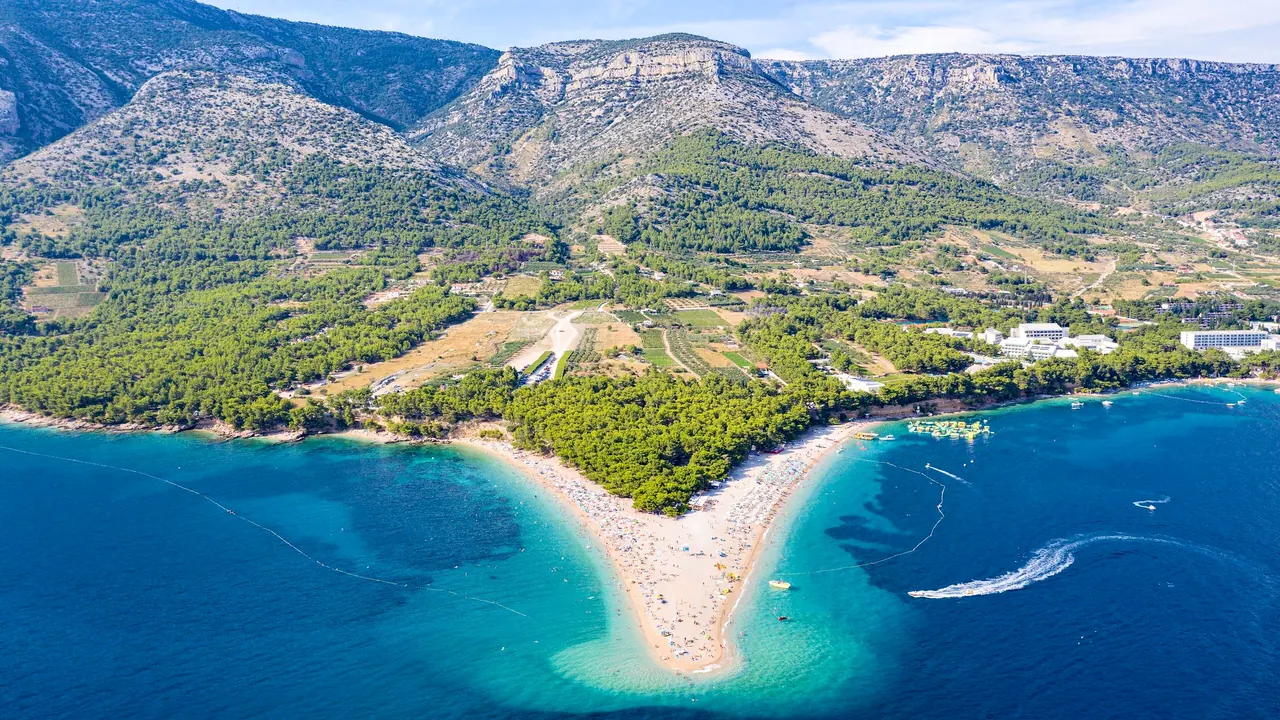
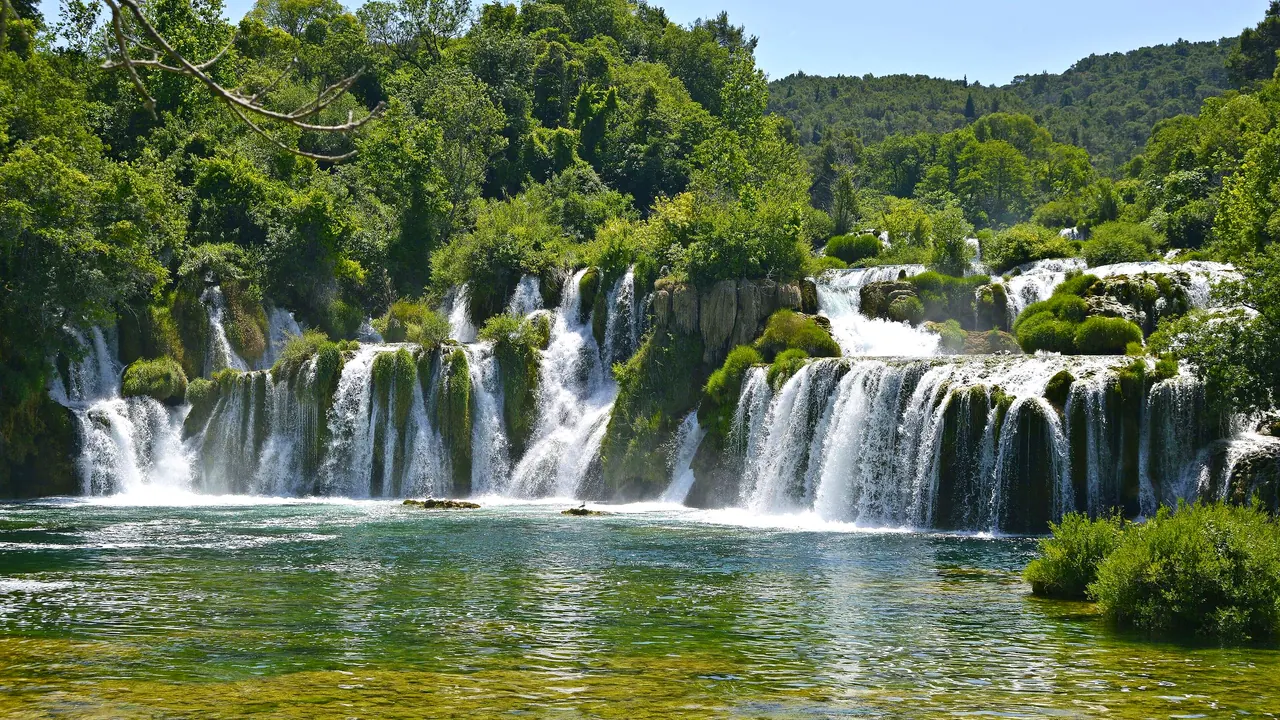
Photos: Brač by dronepicr, CC BY 2.0, cropped; Krka by Alberto-g-rovi, CC BY 4.0, cropped.
Brač or Krka?
Our verdict in twelve categories, each scored against the same fixed benchmark cities, and the climate month by month, so you can choose for your trip.
Choose Brač for
- beaches
- nightlife
- wellness
Choose Brač when the sea is the point of the trip. Zlatni Rat at Bol, the coves running west towards Murvica and the shallow town beaches of the north coast give you a week of swimming, with long evenings on a harbour front and a slower pace in the quieter stone ports. Bol also has a little life after dark in summer. The cost is that the sights are modest and every outing starts with a ferry.
Choose Krka for
- culture and sights
- nature and the outdoors
- day trips
Krka suits a touring vacation better than a beach one. The canyon and travertine falls, the monastery islets and Šibenik's cathedral and fortress give it more to see. A mainland base puts Trogir, Split and Zadar within reach by road, and costs and eating out are slightly kinder. Swimming in the sea is something you drive to for an afternoon, not the reason to come.
Scoreboard
Twelve categories on one fixed scale from 0 to 100. The shaded stretch is the gap between the two.
Your match
Pick a travel style or drag the sliders, and both match scores follow your weighting.
Too close to call, 2 points apart
Wins on beaches and nightlife with your weighting.
Wins on culture and sights and nature and the outdoors with your weighting.
What matters to you?
Category by category
What the scores mean for a trip.
Beaches & swimming
Brač is the beach destination of the two. Zlatni Rat at Bol, a long pebble spit with pine shade and very clear water, is the showpiece, and the north coast from Supetar to Postira adds shallow town beaches, with sandy Lovrečina a rare exception to the pebble and rock.
At Krka you cannot swim in the water you came to see, because bathing below Skradinski Buk is not allowed. For the sea you head down to Šibenik's coves at Banj and Solaris, the bays near Primošten or the rocky shores of Zlarin and Prvić. They are pleasant for an afternoon, but they are not the centre of the trip.
Food & drink
Both serve the same plain Dalmatian cooking of grilled fish and meat slow-cooked under an iron lid, and neither has much range. Krka edges ahead because Šibenik's old town holds the best restaurants in either region, and Skradin adds estuary mussels, oysters and its long-cooked veal risotto.
Brač's appeal lies in particular dishes: spit-roasted vitalac, Dol's walnut hrapoćuša, its prized olive oil and the red wine from above Bol. The more authentic tables are in inland villages, while the waterfronts of Bol and Supetar lean towards visitor menus and many places shut out of season.
Culture & sights
Krka has the weightier sights. Šibenik's Cathedral of St James and the sea fortress of St Nicholas are both UNESCO-listed, and along the river you find the Franciscan monastery on its lake islet at Visovac, the Orthodox Krka Monastery with its catacombs and the Roman arches of Burnum.
Brač's heritage is quieter and built of its own white stone: the cliff hermitage of Pustinja Blaca, reached only on foot, the Illyrian walls of Škrip, the stonemasons' harbour at Pučišća and a Tintoretto in Bol's Dominican monastery. It rewards a few slow days of exploring rather than a list of sights.
Nightlife
Neither is a place to go out, but Brač has more of a summer night. In July and August, beach bars on the path to Zlatni Rat and a few open-air dance venues in Bol run late, Supetar has its strip of waterfront bars, and Hvar town's party scene is a catamaran ride away. Krka's evenings are dinner and a drink on Skradin's harbour among the moored yachts, with a few bars in Šibenik's old town and no clubs of note.
Nature & outdoors
Krka's landscape is the reason to go: a deep limestone canyon with travertine falls, boardwalks through the spray at Skradinski Buk, the scattered cascades of Roški Slap, trails on the canyon rim, kayaking on the upper river and birdlife in the estuary reeds. Most of it is gentle walking rather than climbing.
Brač offers height and wind instead. Vidova Gora, at 778m the highest peak on any Adriatic island, is a steep morning's hike up from Bol, and the channel below is a serious windsurfing and kitesurfing spot. The bare plateau is fierce in summer heat, so its walks belong to spring and autumn.
Day trips
Krka's position on the mainland is its advantage. Trogir and Zadar are each about an hour away by road, Split a little further and Primošten closer still, while small ferries from Šibenik reach Zlarin and Prvić and Murter opens the way to the Kornati.
Every outing from Brač starts with a boat. Split is a fifty-minute car ferry from Supetar, with Trogir beyond it, and from Bol or Sumartin you can cross to Hvar or Makarska. Those links thin out quickly once summer ends.
Good for families
Brač is the easier base for a seaside week with children. Supetar, Sutivan and Postira have shallow, sheltered beaches, short promenades and apartments with kitchens, though Zlatni Rat drops off fairly quickly.
Krka's draw for children is the day out itself: boardwalks over rushing water and fish-filled pools, and boat rides to Visovac. The loop gets hot and crowded in midsummer, so families usually sleep on the coast near Šibenik and drive in. Neither has a zoo, aquarium or theme park.
Getting around
You will want a car in both, but Krka is the simpler of the two. The motorway runs close to the Lozovac entrance, Skradin is a short drive from Šibenik, and park buses and boats link the falls, Visovac and Roški Slap. Without a car, though, the upper river needs a tour.
Brač begins and ends with a ferry or catamaran, and summer weekend queues back to the mainland are long. On the island the road over the plateau to Bol is slow and winding and the local buses are too sparse to rely on, though Bol and Supetar themselves are compact enough to walk.
Shopping & style
Neither is a place to shop, and both send you home with olive oil, honey, wine and lavender. The difference is the one local craft: on Brač it is carved stone from the workshops of Pučišća, around Krka the coral work of Zlarin, with Šibenik's old town adding a few craft and jewellery shops. For anything more, Brač sends you across to Split.
Affordability
Krka is a little easier on the budget. Rooms and meals sit around the middle of Western European levels, apartments in the villages around Lozovac cost less than the Šibenik waterfront, and the park entrance is the biggest single expense.
On Brač in July and August you pay about what you would in Western Europe, from hotel rooms in Bol to sunbeds at the main beaches, and car ferry fares add up. In both places private apartments, inland stays and the months either side of high summer save the most.
Live music & performing arts
Live performance is thin in both, but Krka has more of it through Šibenik, with summer concerts in the fortresses above the town, the long-running International Children's Festival and a small nineteenth-century theatre. Brač has no theatre or concert hall at all, only open-air concerts on the squares of Bol and Supetar and klapa singing on festival evenings, so for a real programme you take the crossing to Split's summer festival.
Wellness & relaxation
Neither has a bathing tradition, and in both the spas are inside resort hotels. Brač is the more restful stay, because the quiet harbours of Milna, Povlja and Sumartin and the inland stone villages slow a whole week down, especially in June and September. Krka's calm comes in moments, such as Skradin's harbour at dusk or the river before the coaches arrive, because by day the park fills with visitors.
When should you go?
Pick your month. The climate figures are measured averages, not a forecast.
Brač in July
Krka in July
Daytime high, °C
Rainfall in the month, mm
Where the figures come from
Brač's temperatures are measured 34 km from the centre, at Split / Marjan.
Brač has no rain gauge within 25 km of the centre, so its rainfall comes from a gridded climate dataset read at the destination rather than from a gauge further away.
Brač's sunshine is measured 34 km from the centre, at Split / Marjan.
Krka's temperatures are measured 53 km from the centre, at Split / Marjan.
Krka has no rain gauge within 25 km of the centre, so its rainfall comes from a gridded climate dataset read at the destination rather than from a gauge further away.
Krka's sunshine is measured 53 km from the centre, at Split / Marjan.
Temperature and rainfall are climate normals, averaged over the years shown. Brač: 1991-2020 (sunshine 1971-2000) normals, Split / Marjan (33.5 km from centre). Krka: 1991-2020 (sunshine 1971-2000) normals, Split / Marjan (52.9 km from centre).
The two share almost the same weather, so the season is the same for both. The sea is warm enough to swim from June into September, and on Brač into early October, peaking at about 25°C off the island in August, a degree warmer than off Šibenik. July and August bring highs of 31°C, which is hard work on Brač's bare plateau and on Krka's crowded boardwalks around midday. May, June and September are the comfortable months for walking.
The rain arrives in September and builds through the autumn. Brač is the wetter of the two in late autumn, with about 125mm in November. Winter highs of around 11°C make both a quiet off-season visit rather than a seaside one, though spring, with highs near 18°C in April, is a good time to see Krka's falls at their fullest.
Which traveller are you?
On a beach and sun trip, Brač is the clear choice. Zlatni Rat, the quieter coves west of Bol and the shallow north coast beaches give a different swim each day, while at Krka the falls are off limits and the sea is a drive away.
For a culture and arts trip, Krka goes further. Šibenik's UNESCO-listed cathedral and sea fortress, the monasteries of Visovac and Krka, Roman Burnum and summer fortress concerts add up to more than Brač's stone villages and cliff hermitage.
On an outdoors trip, Krka's canyon, falls, rim trails and upper-river kayaking give the richer landscape. Brač answers with height and wind: a spring or autumn climb to Vidova Gora, and the summer westerly that brings windsurfers and kitesurfers to the channel off Bol.
Before you go
| Measure | Brač | Krka |
|---|---|---|
| Official language | Croatian | Croatian |
| Currency | Euro (EUR) | Euro (EUR) |
| Sockets | CF230 V, 50 Hz | CF230 V, 50 Hz |
| Driving side | Right | Right |
| Time zone | UTC+1, UTC+2 in summer | UTC+1, UTC+2 in summer |
| Emergency number | 112 | 112 |
| Main airport | Split Saint Jerome Airport (SPU)69 non-stop destinations | Split Saint Jerome Airport (SPU)69 non-stop destinations |
| Public holidays this year | 14 days | 14 days |
By the numbers
| Measure | Brač | Krka |
|---|---|---|
| Population | 14,434 | - |
| People per km² | 36 | - |
| Swim season, months above 21 °C | 4 months | 4 months |
Where else could you go?
Every comparison below shares a destination with this one, so you can follow Brač or Krka somewhere new.