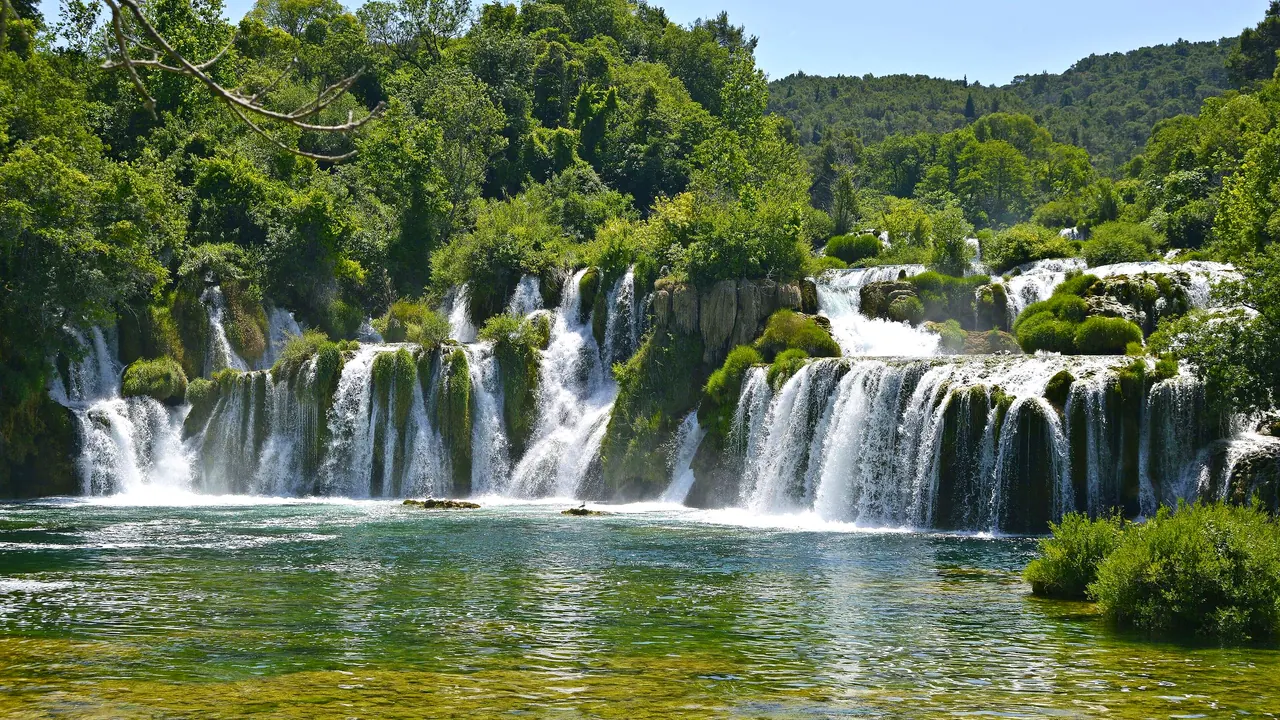
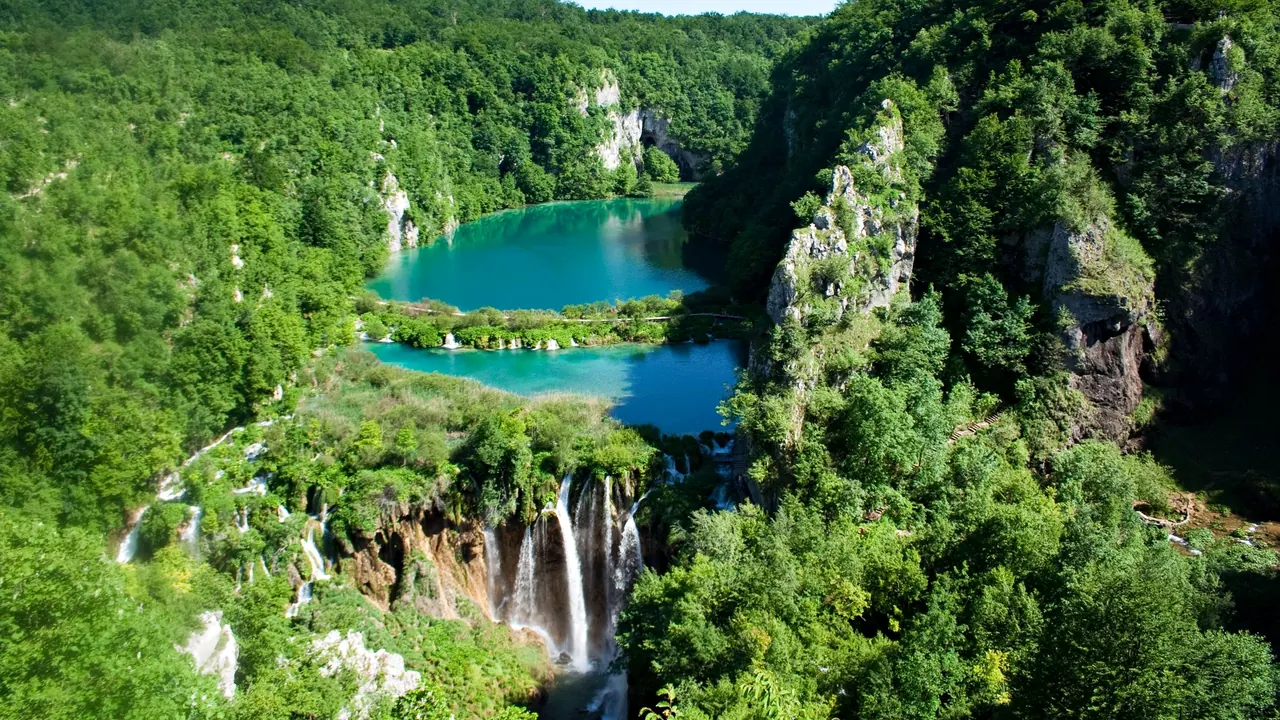
Photos: Krka by Alberto-g-rovi, CC BY 4.0, cropped; Plitvice Lakes by Pablo BM from London, England, CC BY 2.0, cropped.
Krka or Plitvice Lakes?
Our verdict in twelve categories, each scored against the same fixed benchmark cities, and the climate month by month, so you can choose for your trip.
Choose Krka for
- culture and sights
- beaches
- day trips
Krka suits a trip that mixes waterfalls with the rest of Dalmatia. Skradinski Buk and Roški Slap make a fine day or two, but much of the appeal is the base around them. Šibenik has its cathedral and old town lanes, there are pebble coves and car-free islands to swim from, and Skradin serves fish suppers by the harbour. Trogir and Zadar are within easy reach. Choose it if you want sea, sights and scenery in a single stay.
Choose Plitvice Lakes for
- nature and the outdoors
- prices
If the landscape is the main reason for going, Plitvice Lakes is the better pick. Its terraced lakes in beech and fir forest are grander and more varied than the Krka falls, and the trails, caves and rivers around them reward walkers who start early. What you give up is everything else: no swimming in the park, no sea nearby, plain country food and silent evenings. It works best as a few days of walking or as a stop between Zagreb and the coast.
Scoreboard
Twelve categories on one fixed scale from 0 to 100. The shaded stretch is the gap between the two.
Your match
Pick a travel style or drag the sliders, and both match scores follow your weighting.
Wins on culture and sights and beaches with your weighting.
Wins on nature and the outdoors and prices with your weighting.
What matters to you?
Category by category
What the scores mean for a trip.
Beaches & swimming
You can't swim at the falls in either park, so the difference is what lies nearby. From Krka, the Adriatic is a short drive or boat ride down the estuary. There are pebble coves at Banj and on the Solaris peninsula, bays around Primošten and quiet rocky shores on Zlarin and Prvić.
Plitvice has only the cool, clear Korana river below the park, at Korana village and Slunj. It is lovely on a hot day but no substitute for the sea, which is two hours away over the mountains.
Food & drink
Krka eats better, mainly because Šibenik at the river's mouth has proper restaurants in its old town. The estuary also supplies mussels and oysters to Skradin's riverside konobas, alongside the town's slow-cooked veal risotto and the local Babić red.
At Plitvice, the food is heavier mountain fare: spit-roast lamb and suckling pig, river trout, cabbage and beans in roadside inns, much of it cooked for tour groups. Both places do iron-bell cooking and both have a narrow range, but only Krka has a town to fall back on.
Culture & sights
This is where the two differ most. History lines the Krka: a Franciscan monastery on the islet of Visovac, the catacombs under the Orthodox Krka Monastery and the Roman camp at Burnum. At the river's mouth stand Šibenik's Cathedral of St James and the fortress of St Nicholas, both UNESCO-listed.
Plitvice is protected for its landscape, not its buildings. Rastoke's mill village and the ruins of Drežnik make a pleasant afternoon, and the 1991 memorials near the entrances carry real weight, but there is little else.
Nightlife
Neither is a place to go out, but Krka at least has drinks on Skradin's yacht harbour and a few bars in Šibenik's old town and on its waterfront that stay busy on summer nights. Around Plitvice, the evening ends with dinner and a brandy at the guesthouse, and the villages go quiet soon after dark. That suits visitors who want to be on the trails when the park opens.
Nature & outdoors
Both are limestone landscapes with travertine falls seen from boardwalks, but Plitvice is the bigger spectacle. Its terraced lakes step down through beech and fir forest to the Veliki slap at the foot of the Lower Lakes canyon, and the colours change from spring floods to autumn gold and winter ice. The surrounding area offers more exercise too: forest trails, the Barać caves, rafting on the Korana and Una, and hikes on Velebit.
Krka's canyon runs through drier, barer karst. The highlights are Skradinski Buk, the spread of cascades at Roški Slap and the boat trip to Visovac. It adds estuary birdlife, walks on the canyon rim and boat trips to the Kornati, though most of it is gentle walking rather than hiking.
Day trips
Krka makes much the better base. Trogir and Zadar are each about an hour away, Split is a little further and Primošten is closer still. Ferries from Šibenik reach Zlarin and Prvić, and Murter is the gateway to the Kornati.
From Plitvice, the nearby outings are Rastoke, Bihać and Una National Park across the Bosnian border, and Tesla's birthplace at Smiljan. Zadar and Zagreb are each about two hours away, so most people treat the lakes as a stop on a longer route rather than a place to tour from.
Good for families
Both win children over in the same way, with boardwalks above rushing water, fish in the pools and boat rides, and both get hot and crowded in high summer. The difference is what surrounds each park. Families visiting Krka usually stay in coastal hotels near Šibenik, which have pools and shallow pebble shores, and drive in for the day.
Around Plitvice there is no swimming. Instead, farmstay guesthouses with animals, the electric boat and the panoramic train give children some variety, and the area is calm. Its narrow, wet boardwalks mostly lack railings, so toddlers need a hand at all times.
Getting around
Both are easiest with a car, and inside each park boats and park transport link the sights: buses and boats between the Krka falls, Visovac and Roški Slap, and electric boats and panoramic trains at Plitvice. The difference is outside the gates. At Krka, regional buses and excursion boats connect Šibenik and Skradin, so the lower falls are reachable without a car.
At Plitvice, many guesthouses are within walking distance of an entrance and intercity buses stop at the gates. Beyond that there is little transport, and the roads into Lika are slow.
Shopping & style
Zlarin's coral work is the one real local craft in either area, and with Šibenik's old town close by, it gives Krka the edge. Šibenik's stone lanes have a scattering of craft and jewellery shops. Stalls around Skradin and the park entrances sell olive oil, honey, dried figs and local wine.
At Plitvice the choice is smaller still: souvenir kiosks at the gates and roadside farm stalls selling cheese, honey, jams and fruit brandies. There is no nearby town worth a detour for its shops.
Affordability
Costs are much alike. At both, the park entrance is the biggest single expense, and it is far lower outside July and August.
The savings lie in different places. Around Krka, apartments inland near Lozovac are cheaper than the Šibenik and Skradin waterfronts. At Plitvice, village guesthouses a little away from the gates and generous country portions keep costs down, while hotels by the entrances and meals near the park are priced for passing visitors.
Live music & performing arts
Krka has a modest summer programme, mostly in Šibenik: concerts in the fortresses above the town, the International Children's Festival and a small nineteenth-century theatre, plus klapa singing on summer evenings. Plitvice has almost nothing beyond the odd Lika folk tune at a village festival, so concerts mean a drive to Zagreb or Zadar.
Wellness & relaxation
Neither has a spa culture, and both offer quiet rather than treatments. At Krka the calm is by the water, in Skradin's harbour at dusk and on the river early in the morning, and there are a few resort spas on the coast near Šibenik.
Plitvice offers mountain stillness instead: farmhouses among meadows and fir forest, clean air and silent nights, with only small hotel saunas. Both parks are crowded at midday in summer, so early starts matter at either.
When should you go?
Pick your month. The climate figures are measured averages, not a forecast.
Krka in July
Plitvice Lakes in July
Daytime high, °C
Rainfall in the month, mm
Where the figures come from
Krka's temperatures are measured 53 km from the centre, at Split / Marjan.
Krka has no rain gauge within 25 km of the centre, so its rainfall comes from a gridded climate dataset read at the destination rather than from a gauge further away.
Krka's sunshine is measured 53 km from the centre, at Split / Marjan.
Plitvice Lakes has no weather station within reach, so its figures come from a gridded climate model rather than a measured record, and read a broad area rather than one spot.
Temperature and rainfall are climate normals, averaged over the years shown. Krka: 1991-2020 (sunshine 1971-2000) normals, Split / Marjan (52.9 km from centre). Plitvice Lakes: 2001-2020 normals, NASA POWER reanalysis grid, no weather station within 90 km.
Krka's weather, measured on the lower river near the coast, follows the Adriatic calendar. June to September is swimming season, with the sea at about 24°C in high summer, and July and August are dry and very sunny. Daytime highs near 31°C make midday on the boardwalks hard going, though. May and late September are the best months for walking the falls. Rain comes with autumn and peaks in November, and winters are mild but grey.
Plitvice is higher and inland, and it stays several degrees cooler all year. Summer highs around 27°C make July and August comfortable for walking, while January barely gets above 3°C and the falls can freeze under snow. It is wetter than Krka in every month. Autumn is the rainiest season, with around 140mm in both September and November, but it is also when the forests turn red and gold. Late spring, when the water is fullest, is a good time for either.
Which traveller are you?
On a beach and sun trip, Krka wins easily. Swimming is banned at both sets of falls, but from Krka the pebble coves of Šibenik, the bays near Primošten and the islands of Zlarin and Prvić are close by. Plitvice is two hours from the sea.
For a culture and arts trip, choose Krka. It has Šibenik's UNESCO-listed cathedral and fortress, the island monastery at Visovac, Roman Burnum, and summer concerts and klapa singing. Around Plitvice, the built heritage amounts to Rastoke's mills and a ruined fortress.
On an outdoors trip, Plitvice Lakes is the pick. Its terraced lakes and forest trails are the finer landscape, and nearby there are the Barać caves, rafting on the Korana and Una, and longer hikes on Velebit. Krka mostly offers gentle walking.
Before you go
| Measure | Krka | Plitvice Lakes |
|---|---|---|
| Official language | Croatian | Croatian |
| Currency | Euro (EUR) | Euro (EUR) |
| Sockets | CF230 V, 50 Hz | CF230 V, 50 Hz |
| Driving side | Right | Right |
| Time zone | UTC+1, UTC+2 in summer | UTC+1, UTC+2 in summer |
| Emergency number | 112 | 112 |
| Main airport | Split Saint Jerome Airport (SPU)69 non-stop destinations | Zagreb Franjo Tuđman International Airport (ZAG)66 non-stop destinations |
| Public holidays this year | 14 days | 14 days |
By the numbers
| Measure | Krka | Plitvice Lakes |
|---|---|---|
| Swim season, months above 21 °C | 4 months | - |
Where else could you go?
Every comparison below shares a destination with this one, so you can follow Krka or Plitvice Lakes somewhere new.
- Hvarvs Krka
- Bračvs Krka
- Korčulavs Krka
- Bračvs Plitvice Lakes
- Hvarvs Plitvice Lakes
- Korčulavs Plitvice Lakes