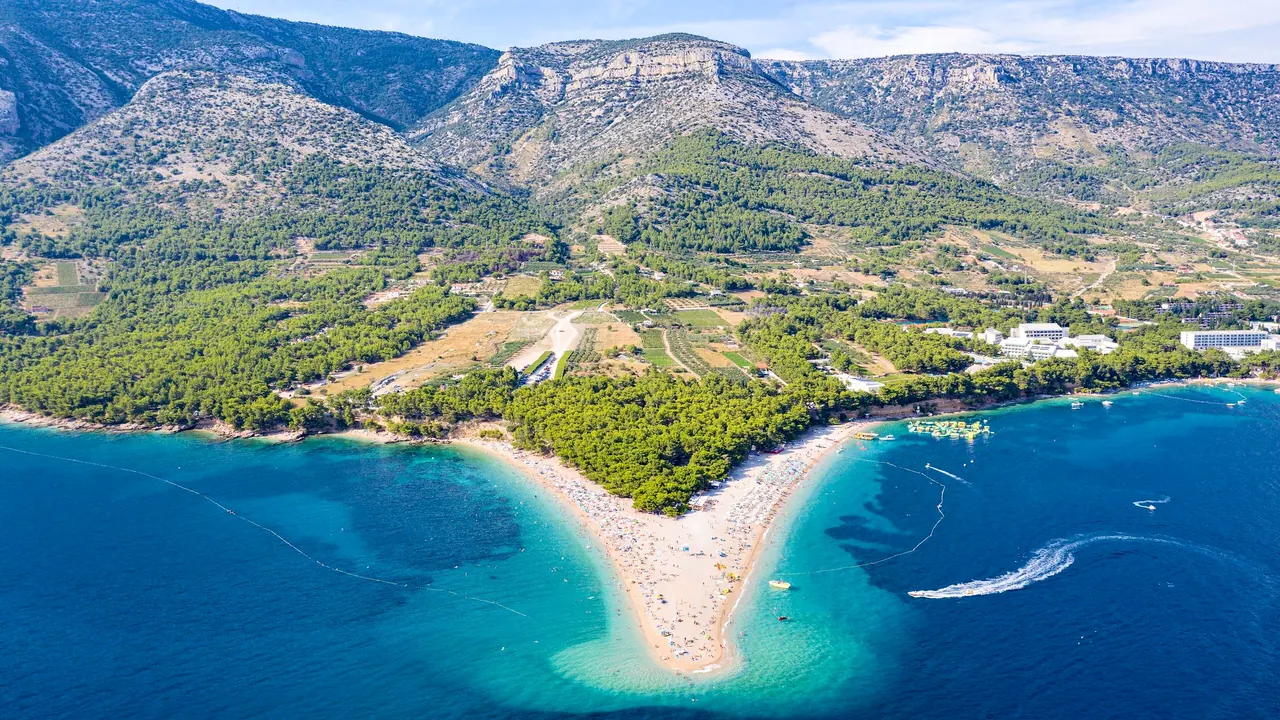
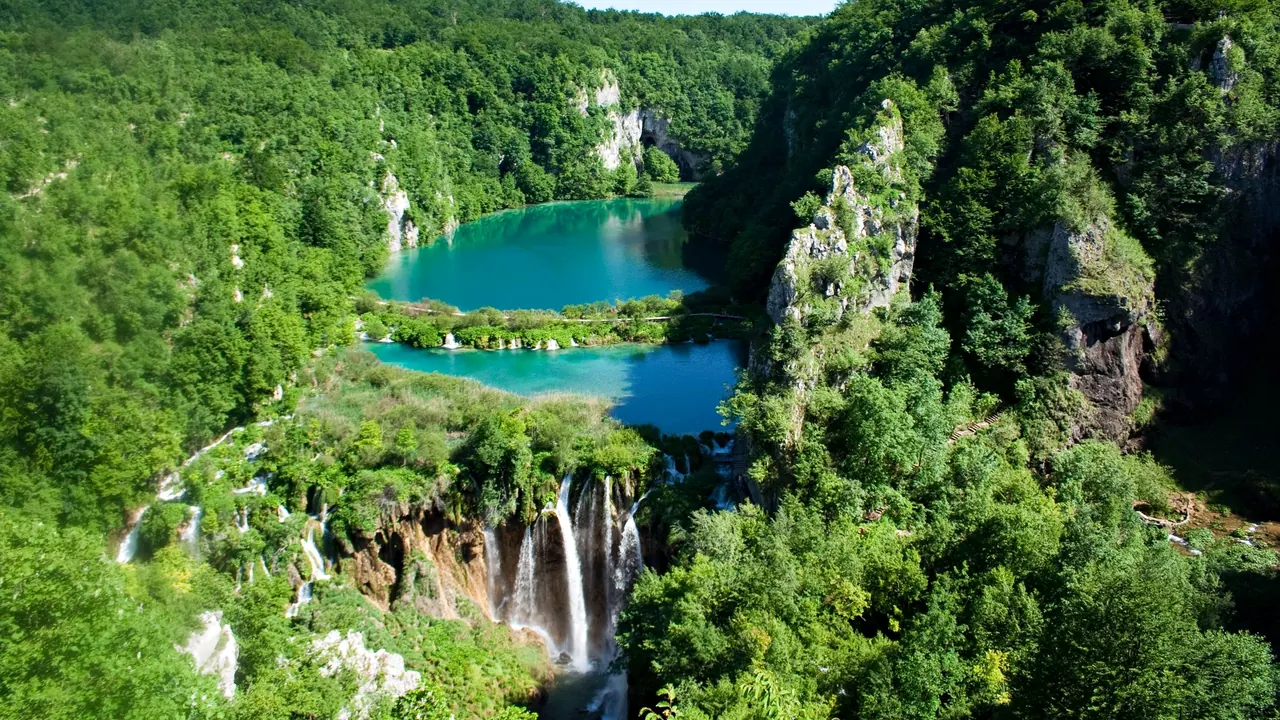
Photos: Brač by dronepicr, CC BY 2.0, cropped; Plitvice Lakes by Pablo BM from London, England, CC BY 2.0, cropped.
Brač or Plitvice Lakes?
Our verdict in twelve categories, each scored against the same fixed benchmark cities, and the climate month by month, so you can choose for your trip.
Choose Brač for
- beaches
- nightlife
- culture and sights
Brač is the choice for a summer seaside vacation. It has Zlatni Rat and a long coastline of clear water, harbour towns where an evening is a slow dinner by the boats, and a short ferry across to Split when you want a city. The island lets you settle in one place for a week, swim every day and wander out to stone villages and the Blaca hermitage between swims. It suits couples and families who want sea, sun and an easy pace.
Choose Plitvice Lakes for
- nature and the outdoors
- prices
- getting around
Plitvice Lakes is a trip for the landscape itself. The terraced lakes, travertine falls and beech forest are the draw, and there is little else: no swimming in the park, no nightlife and only a few sights in the surrounding villages. It works best as two or three days of early walks on the boardwalks and trails, ideally in spring or autumn, often as a stop between Zagreb and the coast rather than a whole vacation.
Scoreboard
Twelve categories on one fixed scale from 0 to 100. The shaded stretch is the gap between the two.
Your match
Pick a travel style or drag the sliders, and both match scores follow your weighting.
Wins on beaches and nightlife with your weighting.
Wins on nature and the outdoors and prices with your weighting.
What matters to you?
Category by category
What the scores mean for a trip.
Beaches & swimming
This is the clearest gap between the two. Brač is built around the sea: Zlatni Rat at Bol curves into the channel towards Hvar, quieter coves run west to Murvica, and the north coast towns have shallow bays, with Lovrečina one of the rare sandy ones. Almost all of it is pebble or rock, so water shoes help.
Plitvice has no swimming at all inside the park, however tempting the turquoise lakes look. The only option is the cool, green Korana river around Korana village and Slunj, and the nearest sea is a long drive away.
Food & drink
Neither is a food destination, but Brač has more to offer. Its konobas serve grilled fish, octopus under the iron lid, island lamb and specialities such as vitalac and the walnut cake hrapoćuša from Dol, with good olive oil and red wine from the slopes above Bol.
Around Plitvice the cooking is Lika country food: spit-roasted lamb and suckling pig, river trout, cabbage, beans and local cheeses and brandies. It is filling and honest, but narrower, and much of it is cooked for tour groups along the main road.
Culture & sights
Brač has more history to explore, mostly in stone. There is the cliff hermitage of Pustinja Blaca, the Illyrian walls and Venetian tower at Škrip, the pale harbour of Pučišća with its stonemasonry school and a Tintoretto in the Dominican monastery at Bol. That fills a few unhurried days.
Plitvice's World Heritage listing is for its nature, so built heritage is thin: the mill village of Rastoke, the ruined Drežnik fortress above the Korana and memorials to the first deaths of the 1991 war. That is barely an afternoon.
Nightlife
Brač at least has summer evenings out: beach bars on the path to Zlatni Rat, a few open-air dance venues in Bol that run late in July and August, and waterfront bars in Supetar. For a real party, Hvar town is a catamaran ride away. At Plitvice the villages fall silent soon after dark, and the evening ends with dinner and perhaps a glass of brandy before an early start on the trails.
Nature & outdoors
Plitvice is the natural spectacle here. Sixteen lakes step down a forested valley over travertine barriers and waterfalls, with boardwalks over the cascades, the Veliki slap at the bottom and beech and fir forest that changes dramatically through the seasons. The surrounding area adds caves, river rafting on the Korana and Una and longer hikes on Velebit.
Brač's outdoors is drier and more open: a karst plateau of stone walls and olive groves rising to Vidova Gora, with views straight down on Zlatni Rat. Its real strength is on the water, with a reliable summer wind for windsurfing and kitesurfing off Bol, plus kayaking and diving.
Day trips
Brač has the better outings, as long as the ferries are running. Split and Diocletian's Palace are under an hour across the channel, with Trogir close behind, and summer boats reach Hvar from Bol and Makarska from Sumartin.
From Plitvice, the easy trips are Rastoke and Bihać with the Una falls across the Bosnian border, plus the Tesla birthplace at Smiljan. Zadar, Senj and Zagreb are possible but sit at the edge of a day out, which is why most visitors pass through rather than base themselves here.
Good for families
Brač gives families the simpler week. Supetar, Sutivan and Postira have shallow, sheltered beaches, apartments with kitchens and harbour fronts where children stay up late, though there is little built for children beyond the sea.
Plitvice is magical for school-age children for a day or two, with fish in the clear water, the electric boat and the panoramic train. It is harder with toddlers, since the narrow, wet boardwalks mostly lack railings, pushchairs are awkward and there is no swimming to fall back on.
Getting around
Plitvice is slightly easier to manage. Intercity buses between Zagreb and the coast stop at the park entrances, many guesthouses are within walking distance of the gates, and inside the park boats and trains link the circuits. Beyond that you need a car.
Brač adds a sea crossing to everything: ferry or catamaran from Split, long queues on summer weekends and sparse island buses. A car or scooter is close to essential, and the road over the plateau to Bol is slow, though each harbour town is easy on foot.
Shopping & style
Neither is a place to shop. Brač has a little more to take home: carved stone from the Pučišća workshops, olive oil, wine, honey and lavender, with Split close by for anything else. At Plitvice the farm stalls selling cheese, honey, jams and brandy are the only things worth buying, and the entrance kiosks hold little beyond souvenirs.
Affordability
Plitvice is the cheaper stay. Village guesthouses and country inns are reasonably priced, especially away from the gates, though the summer park fee and the hotels right by the entrances push costs up.
Brač in July and August costs about as much as Western Europe, between Bol hotels, waterfront meals, sunbeds and car ferry fares. Private apartments in north coast or inland villages and June or September dates soften that considerably.
Live music & performing arts
Summer evenings on Brač can bring open-air concerts on the squares of Bol and Supetar, and on festival nights klapa groups singing the unaccompanied harmonies of Dalmatia. The island has no theatre or concert hall, but Split's summer festival of opera and theatre in the old town is a ferry ride away. Around Plitvice the most you might catch is Lika folk music at a village festival or over dinner, and any real concert or play means the long drive to Zagreb or Zadar.
Wellness & relaxation
Brač relaxes you more easily. The bigger hotels in Bol and Supetar have spas, and the slow harbours of Milna, Povlja and Sumartin, the olive groves and evenings over the water set an unhurried pace, especially in June and September.
Plitvice offers quiet of a different kind: farmhouse guesthouses among meadows and fir forest and silent evenings once the coaches leave. Spa facilities are minimal, and the park itself is anything but calm at midday in summer.
When should you go?
Pick your month. The climate figures are measured averages, not a forecast.
Brač in July
Plitvice Lakes in July
Daytime high, °C
Rainfall in the month, mm
Where the figures come from
Brač's temperatures are measured 34 km from the centre, at Split / Marjan.
Brač has no rain gauge within 25 km of the centre, so its rainfall comes from a gridded climate dataset read at the destination rather than from a gauge further away.
Brač's sunshine is measured 34 km from the centre, at Split / Marjan.
Plitvice Lakes has no weather station within reach, so its figures come from a gridded climate model rather than a measured record, and read a broad area rather than one spot.
Temperature and rainfall are climate normals, averaged over the years shown. Brač: 1991-2020 (sunshine 1971-2000) normals, Split / Marjan (33.5 km from centre). Plitvice Lakes: 2001-2020 normals, NASA POWER reanalysis grid, no weather station within 90 km.
Brač is a summer island. From June to early October the sea is warm enough for swimming, reaching about 25°C in August, and July and August are hot, sunny and nearly dry, with highs around 31°C that make the bare interior hard work by midday. Late spring and September are kinder for walking and still give long sunny days. The rain arrives in autumn and peaks in November at about 125mm, and winters are mild but grey and quiet.
Plitvice sits high in the Lika hills and is cooler and wetter all year. Summer highs of about 27°C are pleasant on the forest trails, while winter is properly cold, around 3°C in January, with snow and frozen falls. Rain is spread through every month and heaviest in autumn, but that is part of the appeal, since spring brings the fullest waterfalls and autumn the red and gold forest. For walking, late spring and early autumn are the sweet spot at the lakes, while high summer is Brač's moment.
Which traveller are you?
On a beach and sun trip, Brač wins easily. Zlatni Rat, the quieter coves west of Bol and the shallow north coast bays give months of warm sea, while Plitvice bans swimming and the Adriatic is two hours away over the mountains.
For an outdoors trip, Plitvice is the stronger pick. The lakes, waterfalls and beech forest trails, the Barać caves, rafting on the Korana and the Velebit ridges outweigh Brač's climb up Vidova Gora and its windsurfing channel off Bol.
On a trip with a tight budget, Plitvice goes a little further. Village guesthouses and big portions at country inns cost less than midsummer Brač, where Bol hotels, sunbeds and car ferry fares add up, though the park entry fee is steep in summer.
Before you go
| Measure | Brač | Plitvice Lakes |
|---|---|---|
| Official language | Croatian | Croatian |
| Currency | Euro (EUR) | Euro (EUR) |
| Sockets | CF230 V, 50 Hz | CF230 V, 50 Hz |
| Driving side | Right | Right |
| Time zone | UTC+1, UTC+2 in summer | UTC+1, UTC+2 in summer |
| Emergency number | 112 | 112 |
| Main airport | Split Saint Jerome Airport (SPU)69 non-stop destinations | Zagreb Franjo Tuđman International Airport (ZAG)66 non-stop destinations |
| Public holidays this year | 14 days | 14 days |
By the numbers
| Measure | Brač | Plitvice Lakes |
|---|---|---|
| Population | 14,434 | - |
| People per km² | 36 | - |
| Swim season, months above 21 °C | 4 months | - |
Where else could you go?
Every comparison below shares a destination with this one, so you can follow Brač or Plitvice Lakes somewhere new.
- Hvarvs Brač
- Korčulavs Brač
- Krkavs Brač
- Krkavs Plitvice Lakes
- Hvarvs Plitvice Lakes
- Korčulavs Plitvice Lakes