Croatia
Krka
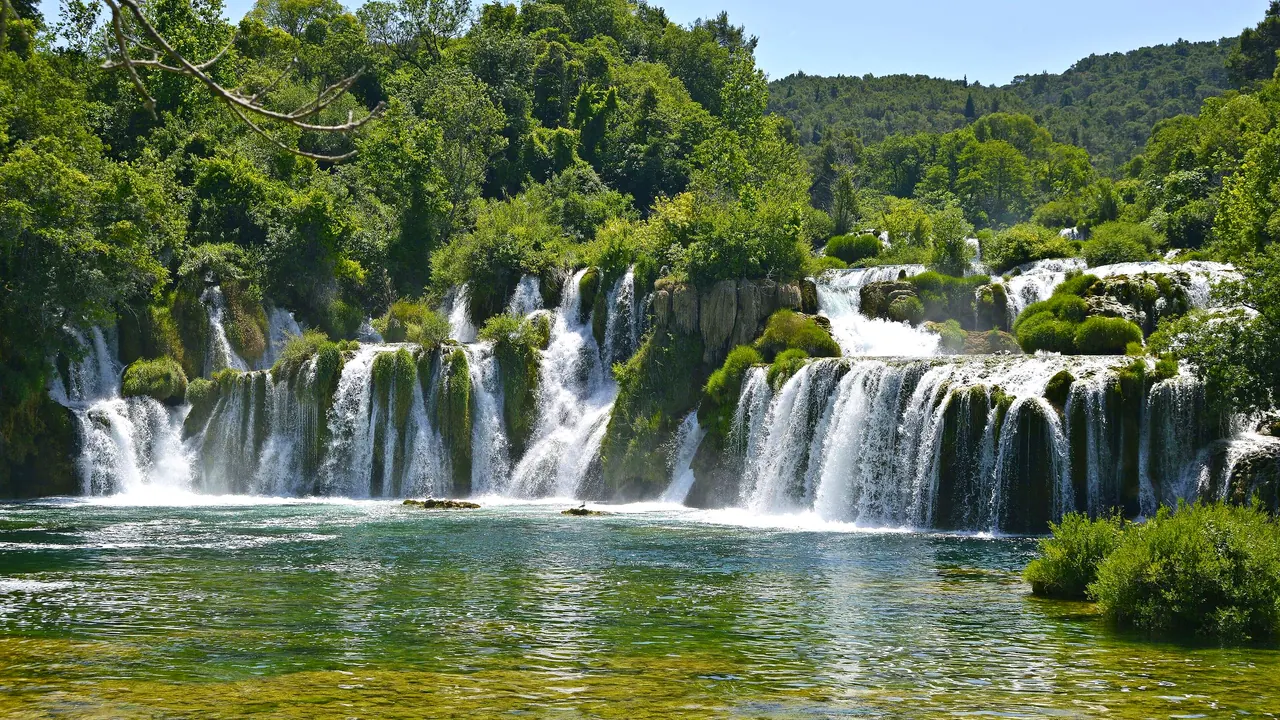
The cascades of Skradinski Buk
- Nature & outdoors72
- Day trips70
- Culture & sights58
Photo: Alberto-g-rovi, CC BY 4.0, cropped
Match
44
Every category weighted equally
- Beach & sun46
- Culture & arts44
- Food & nightlife39
- Family trip51
- Outdoors53
- Relax & unwind47
- Shopping & style39
- On a budget45
Krka in twelve categories
Our verdict on each, scored 0 to 100 against the same fixed benchmark cities, so a score means the same thing on every page.
Beaches & swimming. Scores 52 out of 100.
Food & drink. Scores 48 out of 100.
Culture & sights. Scores 58 out of 100.
Nightlife. Scores 18 out of 100.
Nature & outdoors. Scores 72 out of 100.
Day trips. Scores 70 out of 100.
Good for families. Scores 50 out of 100.
Getting around. Scores 50 out of 100.
Shopping & style. Scores 15 out of 100.
Affordability. Scores 47 out of 100.
Live music & performing arts. Scores 20 out of 100.
Wellness & relaxation. Scores 33 out of 100.
Krka category by category
Beaches & swimming
52The waterfalls themselves are for looking at, not for bathing: swimming below Skradinski Buk is not allowed, and the river is walked and boated rather than swum. For the sea, a visitor drives or takes a boat down the estuary to Šibenik, whose pebble coves at Banj and the Solaris peninsula sit on clear Adriatic water, or heads south to the bays around Primošten, about half an hour away.
The sea is warm enough to swim from June to September, reaching about 24°C in high summer, and the small car-free islands of Zlarin and Prvić have quiet rocky shores a short ferry ride from Šibenik. It is pleasant swimming, but on a Krka trip the beach is an afternoon, not the reason to come.
Food & drink
48Eating here is plain Dalmatian cooking done in small places: grilled fish and squid, lamb and veal slow-cooked under an iron bell, prosciutto and sheep's cheese from the hinterland, and Skradin's own risotto, a veal dish cooked for hours that the town treats as a point of pride. Riverside konobas in Skradin serve mussels and oysters from the estuary, where fresh and sea water meet.
Šibenik, at the river's mouth, adds the region's best restaurants in the stone lanes of its old town, and the surrounding hills grow Babić, a dark local red worth seeking out. The range is narrow, and away from Šibenik the choice comes down to a handful of family taverns.
Culture & sights
58The river's heritage is strung along its length. On the islet of Visovac a Franciscan monastery sits in the middle of a lake, reached by boat; further upstream the Serbian Orthodox Krka Monastery hides catacombs beneath it, and the arches of the Roman legionary camp of Burnum stand on the plateau above the canyon. Old stone water mills at Skradinski Buk have been kept as a small working ethnographic display, and medieval fortress ruins cling to the canyon walls.
The weightiest sights are at the estuary in Šibenik: the Cathedral of St James, a Renaissance stone building with a frieze of carved faces, and the sea fortress of St Nicholas, both UNESCO-listed. Skradin itself is a small, pretty harbour town rather than a sight.
Nightlife
18Evenings along the Krka are for a long dinner by the water and a drink on Skradin's harbour, where the moored yachts provide most of the noise. Šibenik has a few bars in the old town lanes and on the waterfront that stay lively on summer nights, but there are no clubs of note and the region is not a place to go out.
Nature & outdoors
72The river cuts a deep limestone canyon through dry Dalmatian karst and drops over a series of travertine falls, the largest at Skradinski Buk, where boardwalks loop through spray, pools and willow thickets. Further upstream Roški Slap spreads into dozens of small cascades, and the gorge between, around Visovac lake, is best seen from the park boats. Spring brings the fullest water; by late summer the falls are gentler and the paths far busier.
Beyond the boardwalks there are marked walking trails on the canyon rim, cycling routes on quiet plateau roads, kayaking on the calmer upper river and birdlife in the reed beds of the estuary. Boats from the coast reach the bare island maze of the Kornati. There are no mountains, and much of the visit is gentle walking rather than real hiking.
Day trips
70A base on the Krka puts much of central Dalmatia within easy reach. Trogir, a walled medieval town on its own islet, is about an hour south, and Split with Diocletian's Palace a little beyond. Zadar, with its Roman forum and seafront, is about an hour north, and the hilltop village of Primošten is closer still.
From Šibenik, small ferries run to the car-free islands of Zlarin, known for coral craft, and Prvić, while the fishing town of Murter is the gateway to the Kornati. Inland, the great fortress above Knin looks over the upper river. Plitvice lies a little too far for a comfortable return in a day.
Good for families
50Children tend to love the Krka boardwalks, which bring them right over rushing water and fish-filled pools, and the boat rides from Skradin and to Visovac turn a day out into a small adventure. The loop at Skradinski Buk is flat enough for most small legs, though it gets crowded and hot in July and August and is not built for buggies everywhere.
Otherwise there is little made for children. Families usually stay on the coast near Šibenik, where resort hotels have pools, shallow pebble shores and play areas, and drive in for the park. Spring and early autumn are much easier than high summer.
Getting around
50Distances are short and the roads good, but a car makes the trip. The motorway passes close to the main park entrance at Lozovac, Skradin is a short drive from Šibenik, and inside the park visitor buses and boats link the falls, Visovac and Roški Slap. Skradin's harbour has its own park boat to Skradinski Buk.
Without a car, regional buses connect Šibenik and Skradin, and excursion boats run up the estuary, but reaching the upper falls or the monasteries needs a tour or a vehicle. In July and August the car parks and entrance queues fill by mid-morning.
Shopping & style
15Shopping is limited to the essentials and a few things to take home: olive oil, honey, local wine and dried figs from stalls and small producers, lavender sachets and souvenirs in Skradin and at the park entrances. Šibenik's old town adds a scattering of craft and jewellery shops, and Zlarin's coral work is the one local craft of note.
Affordability
47This is coastal Croatia in summer, and prices for rooms and meals sit around the middle of Western Europe. Private apartments in the villages around Lozovac and inland are cheaper than anything on the Šibenik waterfront or in Skradin's harbour, and konoba meals are fair for the portions. The national park entrance is the biggest single cost and is highest in July and August, so spring and autumn visits are noticeably kinder on the budget.
Live music & performing arts
20Live performance is a summer matter and mostly happens in Šibenik: concerts in the fortresses above the town, the long-running International Children's Festival in early summer, and a small nineteenth-century theatre. Klapa, the close-harmony Dalmatian a cappella singing, turns up at village festivities and on summer evenings. Along the river itself there is almost nothing to attend.
Wellness & relaxation
33There is no bathing tradition and spa options are limited to a few resort hotels on the coast near Šibenik. What the region does offer is quiet: Skradin's harbour at dusk, early mornings on the river before the coaches arrive, and stone village houses inland where the evenings are silent. It suits a slow trip, but not a spa one.
Where to stay in Krka
The Krka is compact, so one base covers the whole trip, and the choice comes down to river or sea. Skradin is the obvious one for the park itself: a small harbour town at the head of the estuary, with its own boat up to Skradinski Buk and riverside taverns serving estuary mussels. Evenings are quiet, with dinner by the moored yachts, and early starts let you reach the falls before the coaches. It suits couples, walkers and anyone after a slow stay.
Šibenik, a short drive down the estuary, works better if you want more than the river. You get the cathedral and the old town's best restaurants, a few bars that stay open late in summer, pebble swimming at Banj and ferries to Zlarin and Prvić. It is also the easiest base without a car. Families usually pick the resort coast just outside the town, where pools and shallow shores fill the afternoons, and drive in for the park.
The villages around Lozovac and further inland are the cheapest option and the closest to the main entrance, with stone houses and silent evenings. You will need a car, and they suit independent travellers who want to explore the upper falls, the monasteries and the day trips to Trogir or Zadar.
When should you go?
Pick a month to see what it is like. The climate figures are measured averages, not a forecast.
Krka in July
Daytime high, °C
Rainfall in the month, mm
The whole year
Shaded against this destination’s own year: the deepest cell is its best month for that figure and the palest its weakest.
Where the figures come from
Krka's temperatures are measured 53 km from the centre, at Split / Marjan.
Krka has no rain gauge within 25 km of the centre, so its rainfall comes from a gridded climate dataset read at the destination rather than from a gauge further away.
Krka's sunshine is measured 53 km from the centre, at Split / Marjan.
Temperature and rainfall are climate normals, averaged over the years shown. Krka: 1991-2020 (sunshine 1971-2000) normals, Split / Marjan (52.9 km from centre).
Before you go
| Measure | Krka |
|---|---|
| Official language | Croatian |
| Currency | Euro (EUR) |
| Sockets | CF230 V, 50 Hz |
| Driving side | Right |
| Time zone | UTC+1, UTC+2 in summer |
| Emergency number | 112 |
| Main airport | Split Saint Jerome Airport (SPU)69 non-stop destinations |
| Public holidays this year | 14 days |
By the numbers
| Measure | Krka |
|---|---|
| Swim season, months above 21 °C | 4 months |
Compare Krka with
Every comparison with a written verdict behind it.
- Amalfi Coast
- Brač
- Capri
- Dolomites
- Elba
- Hvar
- Ischia
- Korčula
- Lake Garda
- Plitvice Lakes
- Procida
- Puglia
- Tuscany
- Umbria