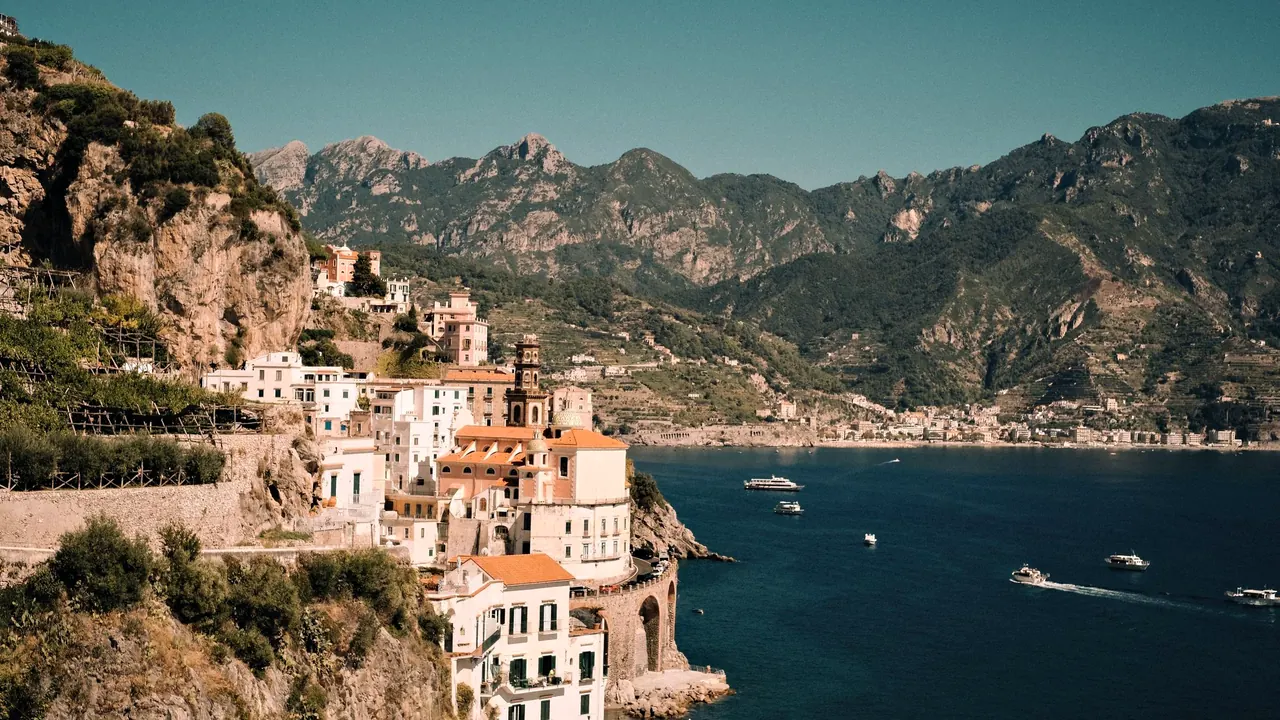
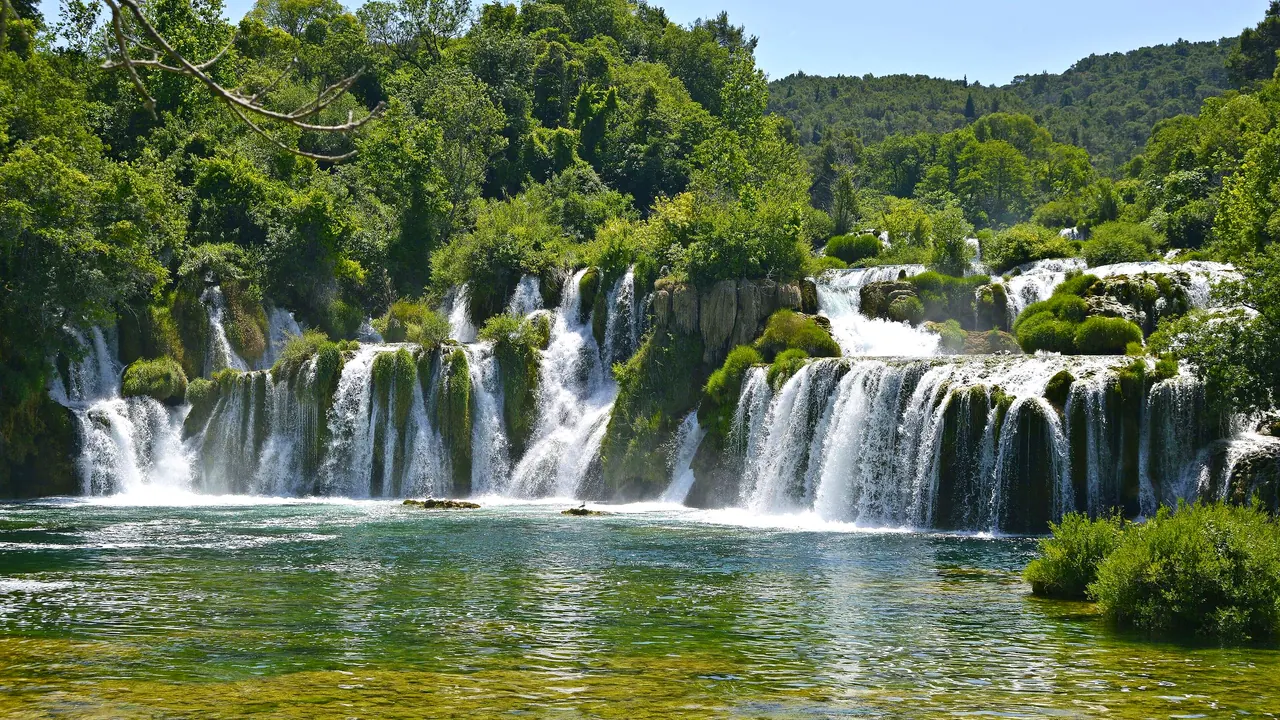
Photos: Amalfi Coast by Alina Chernii, Pexels License; Krka by Alberto-g-rovi, CC BY 4.0, cropped.
Amalfi Coast or Krka?
Our verdict in twelve categories, each scored against the same fixed benchmark cities, and the climate month by month, so you can choose for your trip.
Choose Amalfi Coast for
- shopping
- food and drink
- beaches
The Amalfi Coast is the choice for a trip built around the sea and the view. You get deep-water swimming from boats below the cliffs, the Path of the Gods, long terrace dinners of seafood and lemons, and Pompeii, Capri and Naples all within a day's reach. It suits couples with a generous budget who don't mind climbing stairs and are happy to leave the car behind.
Choose Krka for
- prices
- getting around
- families
Krka works better for a gentler, cheaper trip centred on a river rather than a coastline. The falls at Skradinski Buk, the boat to Visovac and Šibenik's cathedral fill a few days easily, the roads are good, and it is far kinder to families with young children. What you give up is the food, the shopping and the swimming that make the Italian coast famous.
Scoreboard
Twelve categories on one fixed scale from 0 to 100. The shaded stretch is the gap between the two.
Your match
Pick a travel style or drag the sliders, and both match scores follow your weighting.
Wins on shopping and food and drink with your weighting.
Wins on prices and getting around with your weighting.
What matters to you?
Category by category
What the scores mean for a trip.
Beaches & swimming
On the Amalfi Coast the sea is a main reason to come. It offers deep, clear water at the foot of the cliffs, pebble coves at Positano, Atrani and the Furore fjord, and a longer, sandier beach at Maiori. The best spots are often reached by boat, and in summer hired sunbeds take up most of the space.
At Krka the water is for looking at, because swimming below Skradinski Buk is not allowed. Swimming means a drive or a boat down to Šibenik's coves at Banj and Solaris, the rocky shores of Zlarin and Prvić, or the bays near Primošten. It is pleasant, but it fills an afternoon rather than a vacation.
Food & drink
The Amalfi Coast sets the richer table. There is seafood pasta, scialatielli with clams, Cetara's anchovies and colatura, and Sfusato lemons in everything, served anywhere from family trattorias in Agerola to grand terrace dining in Ravello. The catch is the tired menus along the waterfronts of Positano and Amalfi.
Krka's cooking is plainer and the choice narrower: grilled fish, lamb cooked under the iron bell, Skradin's slow veal risotto and oysters from the estuary. The better restaurants are in Šibenik's old town, and the hills supply a dark Babić red. The meals are honest, but there are far fewer to choose from.
Culture & sights
The two are evenly matched and neither has big museums, but their heritage takes a different shape. Amalfi's is concentrated and theatrical: the striped cathedral and its Cloister of Paradise, Ravello's villas and gardens, and a UNESCO-listed landscape of pastel towns that is itself the main sight.
Krka's is spread along a river, and you need boats or a car to see it all. There is the island monastery at Visovac, the Orthodox Krka Monastery with its catacombs and the Roman arches of Burnum on the plateau. Its weightiest pieces, the Cathedral of St James and the fortress of St Nicholas, stand down at the estuary in Šibenik.
Nightlife
Neither is a place for a night out, but the Amalfi Coast has a little more going on after dinner. Positano has cocktail bars, one or two of which stay open late in summer, and the café tables on Amalfi's cathedral square fill until around midnight. Krka's evenings end with a drink on Skradin's harbour among the moored yachts or in a few bars in Šibenik's old lanes, and there are no clubs worth the name.
Nature & outdoors
The Amalfi Coast has the more dramatic outdoors. The Lattari mountains fall straight into the sea, the Path of the Gods runs high above Positano, and the Valle delle Ferriere climbs a shaded gorge. Offshore there are sea caves to explore, and snorkelling and diving around Punta Campanella and Li Galli.
Krka's landscape is gentler. A limestone canyon cuts through dry karst, with travertine falls at Skradinski Buk and the spreading cascades of Roški Slap. There are trails along the rim, cycling on the plateau and kayaking on the upper river. There are no mountains, so it suits easy walkers better than hikers.
Day trips
Both make good bases, but the Amalfi Coast has the more famous list: Pompeii and Herculaneum, Capri by ferry, the Greek temples at Paestum, and Naples with its archaeological museum. The roads are slow, so the ferries often do the work.
From Krka you can reach much of central Dalmatia. Medieval Trogir and Diocletian's Palace in Split lie to the south, Roman Zadar to the north, and there are the car-free islands off Šibenik and the Kornati from Murter. It is a strong set, just not quite the roll call that Amalfi offers.
Good for families
Krka is the easier of the two with children. The boardwalks over rushing water and fish-filled pools and the boats from Skradin and to Visovac feel like an adventure to young children. Families can stay in coastal hotels near Šibenik with pools and shallow shores. The heat and crowds of high summer are the drawback.
The Amalfi Coast is built for couples, with hundreds of steps, pebble beaches, a road without pavements and packed buses. Families who go do best in flatter Maiori or Minori, where boat trips and the emerald grotto are the highlights.
Getting around
Krka is simpler to get around, as long as you have a car. Distances are short, the motorway runs close to the main entrance, and park buses and boats link the falls, Visovac and Roški Slap. Without a car, you need a tour to reach the upper falls and the monasteries.
On the Amalfi Coast a car is more burden than help, because the single cliff road jams in summer and parking is scarce. The ferries between Positano, Amalfi, Minori, Maiori and Salerno are the better way to travel, and on land nearly every walk involves stairs.
Shopping & style
The Amalfi Coast is far better for shopping. Positano's lanes sell linen and cotton resort clothing and sandals made while you wait, Amalfi has handmade paper, and Vietri has hand-painted majolica, though the waterfront souvenirs soon start to repeat. Krka offers little beyond olive oil, honey, wine and dried figs from small producers, a few craft shops in Šibenik and Zlarin's coral work.
Affordability
Krka is much easier on the wallet. Rooms and meals cost about the Western European middle, private apartments in the inland villages are cheaper than the waterfront, and the park entrance is the biggest single expense.
The Amalfi Coast in high season is one of Europe's dearest coasts, where sea-view rooms, sunbeds, private boats and taxis on the coast road add up fast. Staying in Maiori, Minori, Atrani or Agerola and travelling by bus and ferry helps, and late September brings both lower rates and a sea that is still warm.
Live music & performing arts
Ravello gives the Amalfi Coast the edge. Its summer festival, rooted in the town's long link with Wagner, puts orchestras on a stage built out over the cliff at Villa Rufolo, and chamber concerts fill its churches and halls through the warm months.
Krka's live music and theatre is mostly in Šibenik: concerts in the fortresses, the long-running International Children's Festival and a small nineteenth-century theatre. Klapa singing turns up at village festivities, but along the river there is almost nothing to attend.
Wellness & relaxation
Neither has a bathing tradition, but the Amalfi Coast offers more polished relaxation. There are spas in the cliffside hotels with seawater pools, as well as gardens and long lunches. Ravello, Atrani, Praiano and Conca dei Marini are calm bases away from the July crowds.
Krka offers quiet rather than pampering: Skradin's harbour at dusk, early mornings on the river and silent stone villages inland. Spas are limited to a few resort hotels on the coast near Šibenik.
When should you go?
Pick your month. The climate figures are measured averages, not a forecast.
Amalfi Coast in July
Krka in July
Daytime high, °C
Rainfall in the month, mm
Where the figures come from
Amalfi Coast's temperatures are measured 65 km from the centre, at Grazzanise.
Amalfi Coast has no rain gauge within 25 km of the centre, so its rainfall comes from a gridded climate dataset read at the destination rather than from a gauge further away.
Krka's temperatures are measured 53 km from the centre, at Split / Marjan.
Krka has no rain gauge within 25 km of the centre, so its rainfall comes from a gridded climate dataset read at the destination rather than from a gauge further away.
Krka's sunshine is measured 53 km from the centre, at Split / Marjan.
Temperature and rainfall are climate normals, averaged over the years shown. Amalfi Coast: 1991-2020 normals, Grazzanise (64.7 km from centre). Krka: 1991-2020 (sunshine 1971-2000) normals, Split / Marjan (52.9 km from centre).
Both are hottest in July and August, when afternoons reach about 31°C and the stairways of the Amalfi towns or the paths on Krka's canyon rim are hard going by midday. On the Amalfi Coast the sea stays warm for longer, reaching 26°C in August and still good for swimming through September. The Adriatic off Šibenik peaks a little cooler at around 24°C, and the swimming there runs from June to September. In both places May, June and September are the comfortable months for walking.
The wet season is where they differ more. The Amalfi Coast turns properly rainy from October, and November is the wettest month with around 143mm. Krka is drier and slightly sunnier through the year, though autumn rain reaches it too. Spring is the best time for the falls, when the river runs fullest.
Which traveller are you?
On a trip on a tight budget, Krka is the sensible pick. Rooms and konoba meals cost about what they do in the middle of Western Europe, and inland apartments are cheaper still. On the Amalfi Coast in season, sea views, sunbeds and lunches are priced for honeymooners.
On a family trip with young children, Krka is the easier of the two. The boardwalks over rushing water and the boat rides to Visovac delight children, and pool hotels near Šibenik make a good base. Amalfi's stairways, pebble coves and road without pavements are hard work with a pushchair.
For a beach and sun trip, the Amalfi Coast wins clearly. It has deep, clear coves below Positano and Amalfi, a sandier beach at Maiori and swimming from hired boats. At Krka, bathing at the falls is banned and the sea means a trip down to Šibenik.
Before you go
| Measure | Amalfi Coast | Krka |
|---|---|---|
| Official language | Italian | Croatian |
| Currency | Euro (EUR) | Euro (EUR) |
| Sockets | CFL230 V, 50 Hz | CF230 V, 50 Hz |
| Driving side | Right | Right |
| Time zone | UTC+1, UTC+2 in summer | UTC+1, UTC+2 in summer |
| Emergency number | 112 | 112 |
| Main airport | Naples International Airport (NAP)131 non-stop destinations | Split Saint Jerome Airport (SPU)69 non-stop destinations |
| Public holidays this year | 13 days | 14 days |
By the numbers
| Measure | Amalfi Coast | Krka |
|---|---|---|
| Swim season, months above 21 °C | 5 months | 4 months |
Where else could you go?
Every comparison below shares a destination with this one, so you can follow Amalfi Coast or Krka somewhere new.
- Caprivs Amalfi Coast
- Naplesvs Amalfi Coast
- Procidavs Amalfi Coast
- Ischiavs Amalfi Coast
- Hvarvs Krka
- Bračvs Krka