Italy
Amalfi
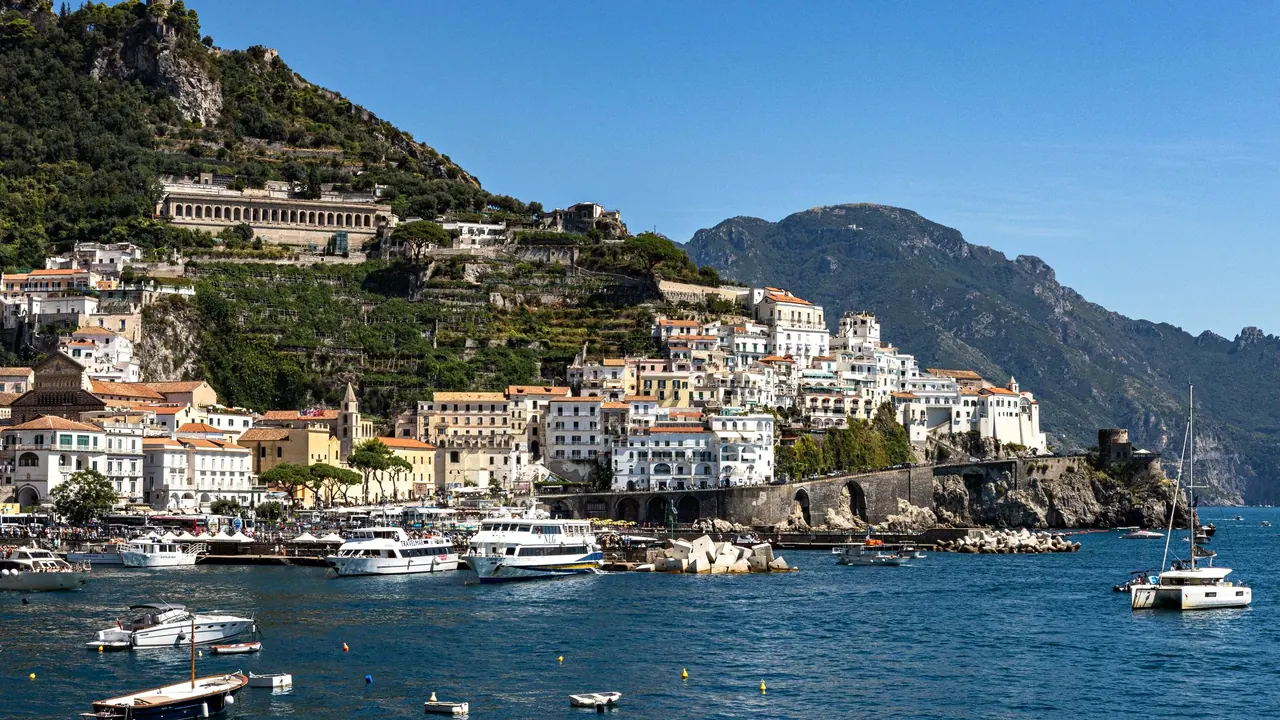
Amalfi and its harbour below the cliff
- Day trips88
- Nature & outdoors82
- Beaches64
Photo: Oleksandra Zelena, Pexels License
Match
43
Every category weighted equally
- Beach & sun45
- Culture & arts41
- Food & nightlife37
- Family trip47
- Outdoors54
- Relax & unwind47
- Shopping & style39
- On a budget40
Amalfi in twelve categories
Our verdict on each, scored 0 to 100 against the same fixed benchmark cities, so a score means the same thing on every page.
Beaches & swimming. Scores 64 out of 100.
Food & drink. Scores 48 out of 100.
Culture & sights. Scores 36 out of 100.
Nightlife. Scores 12 out of 100.
Nature & outdoors. Scores 82 out of 100.
Day trips. Scores 88 out of 100.
Good for families. Scores 28 out of 100.
Getting around. Scores 48 out of 100.
Shopping & style. Scores 34 out of 100.
Affordability. Scores 18 out of 100.
Live music & performing arts. Scores 22 out of 100.
Wellness & relaxation. Scores 32 out of 100.
Amalfi category by category
Beaches & swimming
64Swimming here means a pebble beach. Marina Grande runs along the front of town under the Duomo steps, and in high summer it is packed edge to edge with rows of loungers belonging to beach clubs, with only small free stretches left. The Tyrrhenian is clear and warm, about 25°C in August, and you can swim from May into October.
The better swimming is a short walk or boat ride away. Atrani's little beach is ten minutes on foot, and coves such as Santa Croce and Duoglio are reached by stairs or small shuttle boats. Many visitors hire a boat for the day to reach rocks and grottoes the road never touches. It is a place for dipping into the sea between other plans, not a long sandy shore.
Food & drink
48Amalfi cooks with the coast's own produce: the large, thick-skinned sfusato lemons grown on terraces above town, anchovies, colatura (the anchovy sauce from neighbouring Cetara), and scialatielli pasta served with clams or mixed seafood. Lemon flavours everything from delizia al limone cakes to the limoncello poured after dinner, and local whites and reds from the hillside vineyards of Furore and Tramonti go well with it.
The town is small, though, and the choice is narrow. The cafés on Piazza Duomo and along the seafront serve walk-in crowds, and the cooking is often only average. The more careful trattorias are tucked into the alleys and up the valley. Expect a regional coastal cuisine done well in places, not a deep or varied dining scene.
Culture & sights
36The town's sights come from its medieval maritime republic. The Duomo di Sant'Andrea sits at the top of a broad flight of steps, with a striped Arab-Norman facade, bronze doors cast in Constantinople and a crypt holding the relics of St Andrew. Beside it is the Chiostro del Paradiso, a cloister of interlaced white arches. The old Arsenale, where the republic built its galleys, and the paper museum in a medieval mill up the Valle dei Mulini round out the main heritage.
Wandering the covered passages and stairways of the old town is part of the experience, but there is not much to see beyond that. Most visitors cover it in half a day and spend the rest of their time on the coast.
Nightlife
12Evenings revolve around a long dinner, then a drink or a gelato on Piazza Duomo or along the harbour. In summer a few wine and cocktail bars stay open later, but nightlife goes no further than that, and the town falls quiet once the last buses and ferries have taken the day visitors away. For a real night out you would have to travel to Salerno or Naples.
Nature & outdoors
82The landscape is the main reason to come. The Lattari mountains drop almost straight into the sea, and the slopes are cut into lemon terraces, ravines and cliff villages. The Valle delle Ferriere starts at the back of town, a shaded gorge with waterfalls, old paper mills and rare ferns. A short bus ride up to Agerola brings you to the Sentiero degli Dei, the Path of the Gods. This high balcony trail looks down over Positano and out towards Capri, one of the great coastal walks in Europe.
Old mule stairways link Amalfi with Pontone, Ravello and the hill hamlets, and they make strenuous but rewarding half-day walks. On the water, kayaks and small boats explore sea caves, including the Emerald Grotto at Conca dei Marini. Spring and autumn are the best seasons for walking. In summer the heat on the exposed trails is hard work.
Day trips
88Amalfi is the transport hub of its coast, and some of Italy's best-known places lie within an easy day. Ravello is a short bus ride up the hill, with the gardens and terraces of Villa Rufolo and Villa Cimbrone high above the sea. Positano is about half an hour by ferry. Minori, Atrani, Cetara and Vietri sul Mare, the ceramics town, line the road east towards Salerno.
Going further, ferries cross to Capri in season, and from Salerno trains reach the Greek temples of Paestum. With a little planning, Sorrento, Pompeii and Herculaneum also fit into a full day out. The one drawback is getting there: ferries run mainly from spring to autumn, and the coast road is slow and crowded in summer.
Good for families
28Amalfi is hard work with small children. The town climbs in steep stairways where pushchairs are useless, the beach is a crowded strip of pebbles, and the buses along the cliff road are packed and winding, which can make children carsick. There are no attractions made for children. Older children who swim confidently will enjoy boat trips, the sea caves and walks up the valley, and the town is safe and welcoming. Families with toddlers will find it easier to stay somewhere with more space and sand.
Getting around
48The town itself is tiny and you can walk everywhere, along the main street, through covered alleys and up a lot of steps. It is also the coast's hub. Blue local buses leave from the harbour front for Ravello, Positano and Salerno, and from spring to autumn ferries link the coast with Positano, Salerno and Capri.
In summer the strain shows. Buses fill up and pass waiting queues, the single cliff road becomes a slow line of traffic, and parking is scarce and hard to find. A car is more trouble than it is worth. Stairs are everywhere, so anyone with limited mobility will struggle away from the seafront.
Shopping & style
34Shopping in Amalfi means one main street running up from Piazza Duomo, lined with shops selling limoncello, lemon soaps and painted ceramics. The local speciality worth buying is the town's handmade cotton paper, still made in the valley and sold as notebooks and stationery. Hand-painted majolica tiles and tableware, linen clothing and sandals made to measure are the other good finds. Much of the stock repeats from one shop to the next, and there is no fashion or luxury shopping to speak of.
Affordability
18This is one of the most expensive places to stay in Italy. Rooms with a sea view, especially in summer, cost about as much as the dearest European capitals. Lack of space keeps supply short, and much of what there is sits at the luxury end. Meals on the piazza and seafront are expensive, and so are beach loungers and private boat hire. The local buses are the one real bargain. Staying in the hill villages, eating in back-street trattorias and visiting in spring or autumn bring the cost down noticeably, but it never feels cheap.
Live music & performing arts
22The town has no theatre or concert hall, and for most of the year there is little to attend beyond church concerts and religious festivals. The exception is summer in Ravello, a short ride up the hill. The long-running Ravello Festival stages orchestral and chamber concerts on a terrace in the gardens of Villa Rufolo, set above the sea, and the setting alone makes an evening worth planning around. In Amalfi itself, the feast of Sant'Andrea brings processions and band music.
Wellness & relaxation
32Amalfi has no thermal baths or bathing tradition. Spa treatments are found in the luxury hotels built into the cliffs, which open their pools and treatment rooms mainly to their own guests. What restores people here is the pace: long lunches on a shaded terrace, swims from the rocks and quiet mornings before the day visitors arrive. In July and August the centre gets crowded and noisy, and the calm moves to the hill hamlets and the quieter months of May and October.
When should you go?
Pick a month to see what it is like. The climate figures are measured averages, not a forecast.
Amalfi in July
Daytime high, °C
Rainfall in the month, mm
The whole year
Shaded against this city’s own year: the deepest cell is its best month for that figure and the palest its weakest.
Where the figures come from
Amalfi's temperatures are measured 65 km from the centre, at Grazzanise.
Amalfi has no rain gauge within 25 km of the centre, so its rainfall comes from a gridded climate dataset read at the city rather than from a gauge further away.
Temperature and rainfall are climate normals, averaged over the years shown. Amalfi: 1991-2020 normals, Grazzanise (64.7 km from centre).
Before you go
| Measure | Amalfi |
|---|---|
| Official language | Italian |
| Currency | Euro (EUR) |
| Sockets | CFL230 V, 50 Hz |
| Driving side | Right |
| Time zone | UTC+1, UTC+2 in summer |
| Emergency number | 112 |
| Elevation | 6 m |
| Main airport | Naples International Airport (NAP)38 km from centre131 non-stop destinations |
| Public holidays this year | 13 days |
By the numbers
| Measure | Amalfi |
|---|---|
| City population | 4,729 |
| People per km² | 830 |
| Museums within 10 km | 8 |
| UNESCO World Heritage sites within 50 km | 5 |
| Swim season, months above 21 °C | 5 months |
Compare Amalfi with
Every comparison with a written verdict behind it.
- Bologna
- Catania
- Como
- Dubrovnik
- Florence
- Genoa
- Kotor
- La Spezia
- Milan
- Mostar
- Naples
- Palermo
- Pisa
- Portofino
- Positano
- Rome
- Salerno
- Sarajevo
- Siena
- Sorrento
- Split
- Tirana
- Turin
- Venice
- Verona
- Zadar