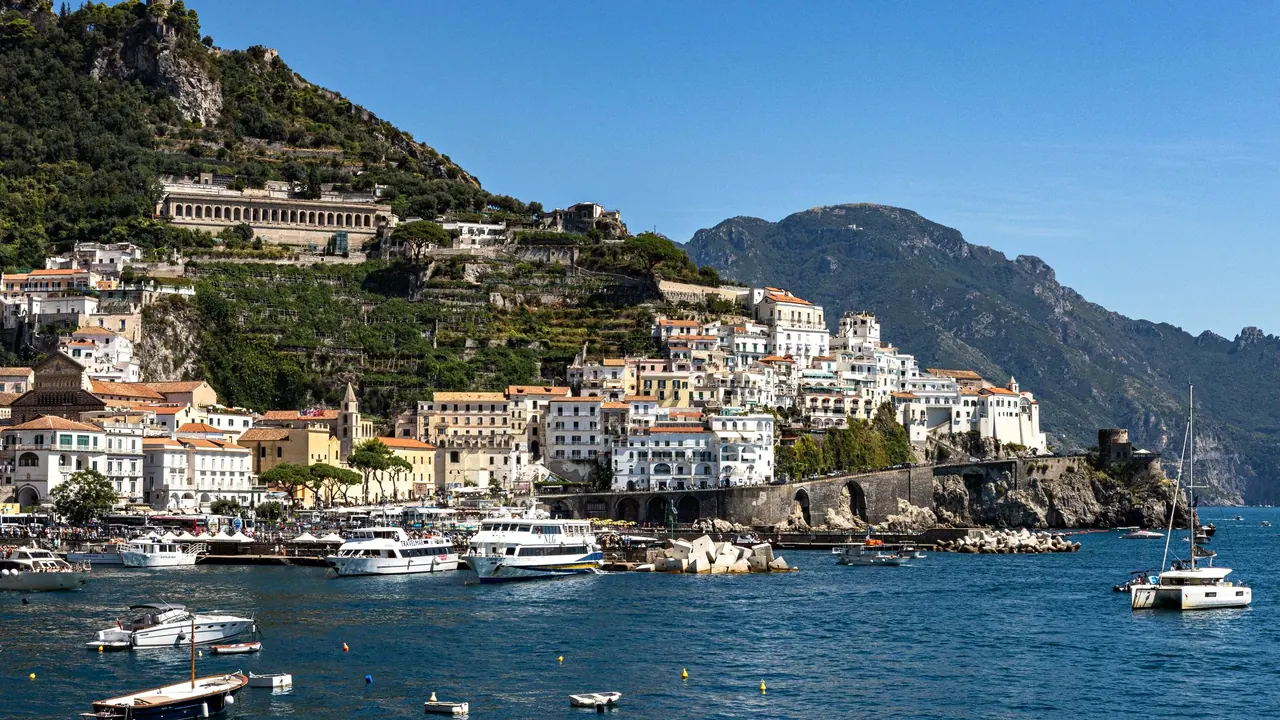
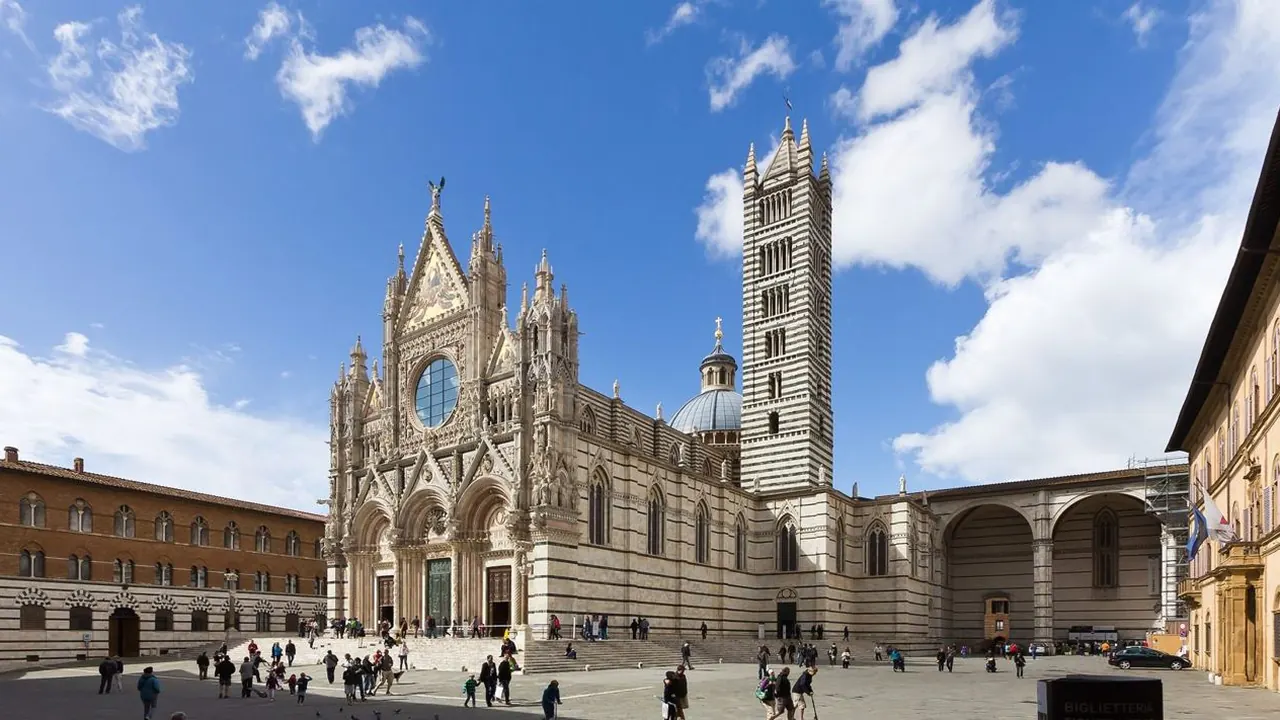
Photos: Amalfi by Oleksandra Zelena, Pexels License; Siena by Raimond Spekking, CC BY-SA 4.0, cropped.
Amalfi or Siena?
Our verdict in twelve categories, each scored against the same fixed benchmark cities, and the climate month by month, so you can choose for your trip.
Choose Amalfi for
- beaches
- nature and the outdoors
Amalfi is the choice for a trip built around the sea and the cliffs. You swim from pebbles and rocks, take boats into grottoes, walk the Path of the Gods and hop by ferry to Positano or Capri. In return, you accept a town that is expensive, steep and quiet after dinner, with little to see beyond the Duomo and its cloister.
Choose Siena for
- culture and sights
- prices
- wellness
Travellers who want art, history and Tuscan cooking will be happier in Siena, with the countryside as a backdrop rather than the main event. The Campo, the Duomo and the Sienese painters fill two or three days. The hill towns, wine villages and hot springs fill the rest, and the stay costs noticeably less than on the Amalfi Coast. The one thing missing is a sea within easy reach.
Scoreboard
Twelve categories on one fixed scale from 0 to 100. The shaded stretch is the gap between the two.
Your match
Pick a travel style or drag the sliders, and both match scores follow your weighting.
Wins on beaches and nature and the outdoors with your weighting.
Wins on culture and sights and prices with your weighting.
What matters to you?
Category by category
What the scores mean for a trip.
Beaches & swimming
Amalfi has the sea on its doorstep. There is a pebble town beach under the Duomo steps, Atrani's small beach a short walk away, and coves and grottoes reached by stairs or by boat. In high summer it is crowded and lined with loungers, but from May to October you can fit a swim in between other plans.
Siena has no beach at all. A trip to the Maremma coast takes a full day, so swimming there usually means the pool at your hotel or agriturismo.
Food & drink
Both have a strong regional kitchen, but Siena's goes deeper. You get hand-rolled pici, cinta senese pork, wild boar and the bakeries' panforte and ricciarelli, with Chianti Classico, Brunello and Vino Nobile poured by the glass. The family osterie in the contrade make good meals easy to find.
Amalfi's table is lemons, anchovies, colatura and scialatielli with seafood. It is lovely when done well, but the small town offers a narrow choice, and the places on the piazza and seafront often cook for passing crowds.
Culture & sights
Here Siena is in another league. Its whole walled centre survives as a medieval city, with the Campo, the Palazzo Pubblico's frescoes of Good and Bad Government, the Duomo's inlaid floor and Duccio's Maestà, along with Santa Maria della Scala and the Pinacoteca. It rewards two or three full days.
Amalfi's heritage comes from its maritime republic: the Arab-Norman Duomo, the Chiostro del Paradiso, the old Arsenale and the paper museum. They are fine sights, but a morning or an afternoon covers them.
Nightlife
Neither is a place for a big night out, but Siena has a little more going on after dinner. Students keep a few pubs and wine bars busy, the Campo stays sociable over a glass of wine, and on the nights around the Palio the streets stay full until late. Amalfi empties once the last buses and ferries leave, and evenings end with a drink or a gelato by the harbour.
Nature & outdoors
Amalfi's setting is the more dramatic. Mountains drop straight into the sea, and from town you can walk up the Valle delle Ferriere, climb the mule stairways to Ravello or take the bus to the Path of the Gods, then spend the next day kayaking into sea caves.
Siena's countryside is gentler: the clay hills of the Crete Senesi and the Val d'Orcia, best seen by bike on the strade bianche or on foot along the Via Francigena. It is beautiful rolling farmland, but it has no coastline and no steep mountain trails.
Day trips
Both are excellent bases, and Siena edges ahead on range. Florence, San Gimignano, the Chianti villages, Volterra, Pienza, Montalcino and the abbeys of Sant'Antimo and San Galgano give you weeks of choice, though the hill towns are much easier with a car.
Amalfi's outings follow the coast and the water. Ravello is up the hill, Positano and Capri are reached by ferry, and Paestum, Pompeii and Herculaneum fit in with some planning. Ferries run mainly from spring to autumn, and the summer road is slow.
Good for families
Neither is easy with small children, but Siena is the gentler of the two. It is compact and mostly free of cars, older children enjoy climbing the Torre del Mangia and watching the contrada drummers, and a farmhouse with a pool in the countryside makes a good base.
Amalfi asks more of families. There are stairs everywhere, the pebble beach is packed, and the winding cliff buses can make children carsick. It works best with older children who swim well and enjoy boats.
Getting around
Siena is the easier place to get about. The centre is largely closed to traffic, escalators carry you up from the station, and buses run to Florence, though you will want a hired car for the wine country.
Amalfi is also tiny and walkable, and its buses and seasonal ferries cover the whole coast. In summer, though, full buses drive past waiting queues, the single cliff road clogs and parking is scarce. The steps also make it hard going for anyone with limited mobility.
Shopping & style
Shopping is a sideline in both, and both sell hand-painted majolica. In Amalfi the best buys are the handmade cotton paper from its valley and made-to-measure sandals and linen, all on one main street where much of the stock repeats.
Siena has more everyday shopping, with Italian clothing, shoes and leather on Banchi di Sopra, a large weekly market by the Fortezza, and food to take home such as panforte and pecorino.
Affordability
Siena is the cheaper stay by a clear margin. Rooms inside the walls are in demand, especially around the Palio, but an osteria lunch with house wine is good value, and an agriturismo outside town costs less again.
Amalfi is among the dearest places to sleep in Italy. Sea-view rooms, seafront meals, loungers and boat hire all cost a lot. Staying in a hill village and coming in spring or autumn helps, but only up to a point.
Live music & performing arts
Siena has a modest musical life of its own through the year. In summer the Accademia Chigiana holds concerts in palaces and churches and Siena Jazz adds its own, and in winter the Teatro dei Rinnovati and Teatro dei Rozzi stage drama and music.
Amalfi has no theatre, so it relies on church concerts and the feast of Sant'Andrea. In summer it also has the Ravello Festival up the hill, with concerts on the Villa Rufolo terrace high above the sea, a setting worth planning an evening around.
Wellness & relaxation
Siena wins for real restoration because of the hot springs around it. Rapolano Terme is about half an hour away, and Bagno Vignoni, the free limestone pools of Bagni San Filippo and Petriolo's sulphur river are all within reach of a spa hotel in the countryside.
Amalfi has no bathing tradition, and its spas are mostly for guests of the cliff hotels. Rest there comes from long lunches in the shade, swims from the rocks and visits in quieter months such as May and October.
When should you go?
Pick your month. The climate figures are measured averages, not a forecast.
Amalfi in July
Siena in July
Daytime high, °C
Rainfall in the month, mm
Where the figures come from
Amalfi's temperatures are measured 65 km from the centre, at Grazzanise.
Amalfi has no rain gauge within 25 km of the centre, so its rainfall comes from a gridded climate dataset read at the city rather than from a gauge further away.
Siena's temperatures are measured 45 km from the centre, at Arezzo.
Siena has no rain gauge within 25 km of the centre, so its rainfall comes from a gridded climate dataset read at the city rather than from a gauge further away.
Temperature and rainfall are climate normals, averaged over the years shown. Amalfi: 1991-2020 normals, Grazzanise (64.7 km from centre). Siena: 2006-2017 (rainfall 1991-2020) normals, Arezzo (45 km from centre).
Amalfi is a summer coast. From June to September the sea is warm enough for long swims, reaching about 26°C in August, and July and August bring hot, dry days with long hours of sunshine. May and October are milder and better for the trails, and the water is still swimmable. The rain comes in earnest from autumn, with November the wettest month at 143mm, so winter is grey and damp, though mild.
Siena swings further between hot and cold. July and August reach about 31°C, which makes the climbs between its ridges tiring at midday, and winter is chilly, with January highs near 9°C. April, May and late September are the best times for walking the town and the Crete Senesi. Autumn is wet here too, with October and November the rainiest months, but from December to March Siena gets far less rain than Amalfi.
Which traveller are you?
For a beach and sun trip, Amalfi wins outright. The sea is part of every day, with a swim before lunch and a boat out in the afternoon. From Siena the coast is a full day's outing, so sunbathing usually means a pool.
On a culture and arts trip, Siena is the clear choice. Amalfi gives you a morning of sights before the coast takes over. In Siena the art fills whole days spent between palace, cathedral and museums, with summer concerts after dinner.
For a relaxing and wellness trip, Siena suits better. Amalfi's calm depends on timing: it is peaceful in May or October but noisy in high summer. Around Siena you soak in warm thermal pools and sleep in a farmhouse among quiet hills.
Before you go
| Measure | Amalfi | Siena |
|---|---|---|
| Official language | Italian | Italian |
| Currency | Euro (EUR) | Euro (EUR) |
| Sockets | CFL230 V, 50 Hz | CFL230 V, 50 Hz |
| Driving side | Right | Right |
| Time zone | UTC+1, UTC+2 in summer | UTC+1, UTC+2 in summer |
| Emergency number | 112 | 112 |
| Elevation | 6 m | 322 m |
| Main airport | Naples International Airport (NAP)38 km from centre131 non-stop destinations | Florence Airport, Peretola (FLR)55 km from centre46 non-stop destinations |
| Public holidays this year | 13 days | 13 days |
By the numbers
| Measure | Amalfi | Siena |
|---|---|---|
| City population | 4,729 | 52,812 |
| People per km² | 830 | 446 |
| Museums within 10 km | 8 | 30 |
| UNESCO World Heritage sites within 50 km | 5 | 5 |
| Swim season, months above 21 °C | 5 months | - |
Where else could you go?
Every comparison below shares a destination with this one, so you can follow Amalfi or Siena somewhere new.