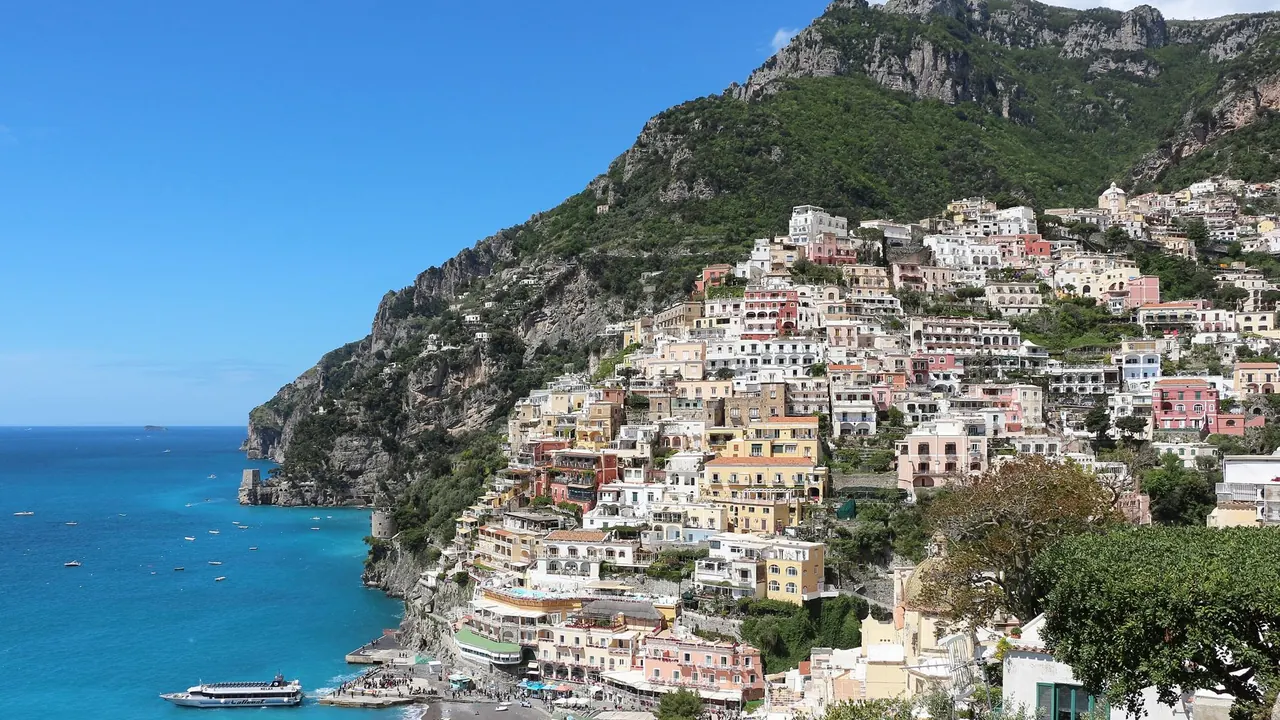
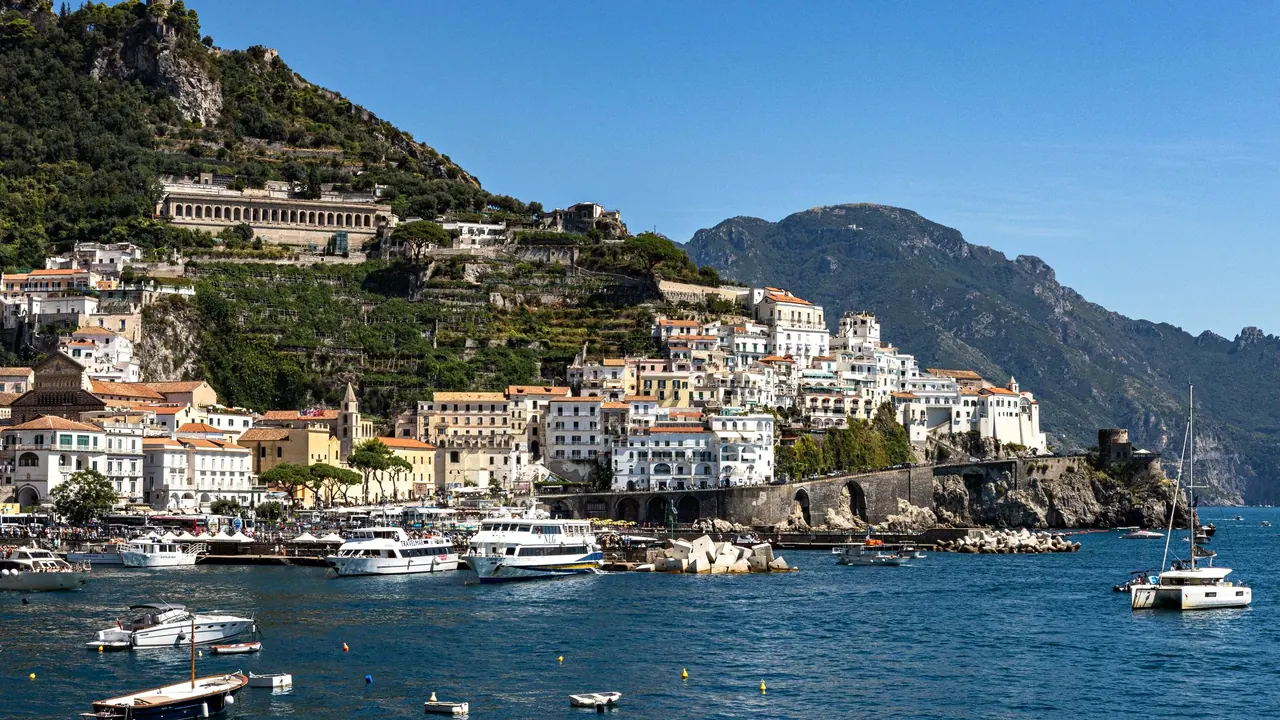
Photos: Positano by Bernard Gagnon, CC BY 4.0, cropped; Amalfi by Oleksandra Zelena, Pexels License.
Positano or Amalfi?
Our verdict in twelve categories, each scored against the same fixed benchmark cities, and the climate month by month, so you can choose for your trip.
Choose Positano for
- beaches
- wellness
- shopping
For a vacation built around the beach, the view and a certain style, Positano is the one. Its main beaches lie right below the town, its lanes are full of linen boutiques and sandal makers, its cliff hotels do spa days better, and summer evenings run a little later. Expect to pay even more, and to climb more steps, for all of it.
Choose Amalfi for
- culture and sights
- getting around
- food and drink
Amalfi suits travellers who want the coast with something to do between swims. It has the history of a medieval maritime republic in its Duomo and cloister, a slightly better table in its back-street trattorias, and buses leaving the harbour for Ravello, Positano and Salerno. Its prices are still high, but a little less steep. Walkers can set off into the Valle delle Ferriere straight from town.
Scoreboard
Twelve categories on one fixed scale from 0 to 100. The shaded stretch is the gap between the two.
Your match
Pick a travel style or drag the sliders, and both match scores follow your weighting.
Too close to call, 1 point apart
Wins on beaches and wellness with your weighting.
Wins on culture and sights and getting around with your weighting.
What matters to you?
Category by category
What the scores mean for a trip.
Beaches & swimming
Positano is the stronger choice for a trip built around swimming. Spiaggia Grande is a broader curve than Amalfi's Marina Grande. Fornillo is a cliff-path walk away, with Arienzo and Laurito further on, so there is more shore to choose from, though it is coarse grey sand and pebble that shelves steeply.
Amalfi's town beach is a narrower pebble strip, mostly taken up by beach clubs. The better swimming means walking to Atrani or taking stairs and shuttle boats to Santa Croce and Duoglio. The water is just as clear and warm off both towns. The difference is how much beach is right on your doorstep.
Food & drink
Both towns cook from the same coastal larder: scialatielli with seafood, thick-skinned lemons and limoncello. Amalfi has rather more to it, though. More careful trattorias hide in its alleys and up the valley, Cetara's anchovies and colatura are close by, and the wines of Furore and Tramonti come from the hills above.
In Positano the setting matters more than the cooking: long terrace lunches over the sea and a few hotel dining rooms aiming high. The menus repeat one another, there is little everyday or market food, and many kitchens close between November and Easter.
Culture & sights
Amalfi still shows the heritage of its medieval maritime republic. There is the Arab-Norman Duomo, with bronze doors cast in Constantinople and the crypt of St Andrew, along with the Chiostro del Paradiso, the old Arsenale and the paper museum up the Valle dei Mulini. Together they fill a good half-day.
Positano has less to see: the majolica dome of Santa Maria Assunta and, beneath it, the painted rooms of a Roman villa buried by Vesuvius. A couple of hours covers both. Here the stacked pastel town is itself the sight, and anyone wanting monuments ends up taking the ferry to Amalfi.
Nightlife
Neither town suits a big night out, but Positano has a little more going on after dinner. In summer its bars near the beach stay busy, and a club in a cave at the end of Spiaggia Grande keeps a dressed-up crowd out late.
Amalfi winds down earlier. After dinner there is a drink or a gelato on Piazza Duomo or by the harbour, and the town goes quiet once the last buses and ferries leave. For anything more you have to go to Salerno or Naples.
Nature & outdoors
Both towns sit where the Lattari mountains drop into the sea, and both have the Path of the Gods within reach, so the scenery is equally strong. The difference is what starts at your door. From Amalfi you can walk straight into the Valle delle Ferriere, a shaded gorge of waterfalls and ferns, or climb the old mule stairways to Pontone and Ravello.
Positano sits below Nocelle, where the Path of the Gods ends, and its steeper trails climb through chestnut woods to Montepertuso and ridges above 1,000m. Out on the water, boats from Positano head for the Li Galli islets, while those from Amalfi go to the Emerald Grotto.
Day trips
Both make excellent bases for the coast, and the difference is which way the trips point. Amalfi looks east and up the hill. Ravello is a short bus ride away, the villages run on towards Vietri sul Mare and Salerno, and trains from Salerno reach Paestum.
Positano looks west. Sorrento is a short ferry or bus ride away, which makes Positano the easier start for Pompeii and Herculaneum, and Capri is about half an hour by boat. From either town, most ferries stop in winter and the coast road is slow in summer.
Good for families
Stairs rule out pushchairs in both towns, and neither has anything built for children. Amalfi's beach is a crowded pebble strip and the winding buses can upset small stomachs, but older children enjoy the walk up the valley past the old paper mills and boat trips to the sea caves.
Positano's beach shelves steeply, though the water is usually calm and warm in summer. Beyond swimming and boat trips there is little to keep children busy, so toddlers are better off on a flatter stretch of coast.
Getting around
Amalfi is the easier town to move around from. It is the hub of the coast, with buses for Ravello, Positano and Salerno leaving from the harbour front, and the seafront is manageable on foot before the stairs begin.
Positano is harder going. Almost every walk means hundreds of steps, a single bus loop serves the upper town, and coastal buses fill up and crawl in summer. Ferries from the main beach are the easy option, mostly in season. In both towns a car is more trouble than it is worth.
Shopping & style
Positano is the town to shop in. The lanes down to the beach are lined with boutiques selling moda Positano, the loose white linen and printed resort wear the town is known for, and sandal makers cut pairs to fit. It is one look only, but it is its own.
Amalfi's shopping is a single main street of limoncello, lemon soap and ceramics, much of it the same from shop to shop. The one real speciality is the handmade cotton paper from the valley mills, worth taking home as notebooks.
Affordability
Both are among the most expensive places to stay in Italy, but Amalfi is a little easier on the wallet. Its local buses are a genuine bargain, and staying in the hill villages and eating in back-street trattorias takes the edge off the cost.
Positano charges more for almost everything, from sea-view rooms and loungers to terrace meals and boat transfers. The usual way to save is to sleep in Praiano or Sorrento and come in by bus or ferry.
Live music & performing arts
Neither town has a theatre or concert hall, and both rely on the Ravello Festival for serious music. Amalfi has the edge because Ravello is a short bus ride up the hill, which makes a concert on the Villa Rufolo terrace an easy evening. Its feast of Sant'Andrea also brings processions and band music.
From Positano, Ravello is a longer trip along the coast for an evening out. The town itself offers only occasional summer concerts in churches and squares, and for opera or theatre you need to go to Naples.
Wellness & relaxation
Spas on this coast belong to the cliff hotels, as there is no bathing tradition in either town, and Positano has more of them. In Amalfi the hotel spas are kept mainly for their own guests, so rest comes from swims off the rocks and quiet mornings in the hill hamlets.
Several of Positano's hotels have treatment rooms and pools cut into the rock, and its terraces make slow afternoons the point of a stay. July and August bring crowds and noise to both towns, and late spring or early autumn is calmer.
When should you go?
Pick your month. The climate figures are measured averages, not a forecast.
Positano in July
Amalfi in July
Daytime high, °C
Rainfall in the month, mm
Where the figures come from
Positano's temperatures are measured 25 km from the centre, at Capri.
Positano has no rain gauge within 25 km of the centre, so its rainfall comes from a gridded climate dataset read at the city rather than from a gauge further away.
Positano's sunshine is measured 59 km from the centre, at Grazzanise.
Amalfi's temperatures are measured 65 km from the centre, at Grazzanise.
Amalfi has no rain gauge within 25 km of the centre, so its rainfall comes from a gridded climate dataset read at the city rather than from a gauge further away.
Temperature and rainfall are climate normals, averaged over the years shown. Positano: 2005-2025 (sunshine 1991-2020, rainfall 1991-2020) normals, Capri (25.3 km from centre). Amalfi: 1991-2020 normals, Grazzanise (64.7 km from centre).
The two towns share the same sea and sunshine, so the beach season is the same in both. The water reaches about 23°C in June and peaks near 26°C in August, and it stays pleasant into early October. The days from June to August are long, dry and sunny. Amalfi runs a touch hotter, with highs of 31°C in July and August, a degree or so above Positano. In either town the stairs and exposed trails are hard work in the middle of a summer day.
April, May and October are the months for walking, when it is warm without being punishing. Rain returns in September and builds through the autumn. It peaks in November, when Amalfi gets around 143mm, a little more than Positano. Winter is cool, damp and quiet in both.
Which traveller are you?
For a beach and sun trip, Positano is the better pick. Spiaggia Grande and Fornillo are on the doorstep and boats run to Arienzo, Laurito and coves further along. Amalfi's town beach is a crowded pebble strip, and its best swimming needs a walk or a boat.
On a culture and arts trip, Amalfi gives you far more to do. The Duomo, its cloister, the Arsenale and the paper mills tell the story of a maritime republic, and Ravello's summer concerts are only a short bus ride up the hill.
For a relaxing and wellness trip, Positano edges ahead. More of its cliff hotels have spas and pools, long terrace lunches over the sea set an unhurried pace, and May, June and late September show the town at its most restful.
Before you go
| Measure | Positano | Amalfi |
|---|---|---|
| Official language | Italian | Italian |
| Currency | Euro (EUR) | Euro (EUR) |
| Sockets | CFL230 V, 50 Hz | CFL230 V, 50 Hz |
| Driving side | Right | Right |
| Time zone | UTC+1, UTC+2 in summer | UTC+1, UTC+2 in summer |
| Emergency number | 112 | 112 |
| Elevation | 142 m | 6 m |
| Main airport | Naples International Airport (NAP)33 km from centre131 non-stop destinations | Naples International Airport (NAP)38 km from centre131 non-stop destinations |
| Public holidays this year | 13 days | 13 days |
By the numbers
| Measure | Positano | Amalfi |
|---|---|---|
| City population | 3,729 | 4,729 |
| People per km² | 429 | 830 |
| Museums within 10 km | 10 | 8 |
| UNESCO World Heritage sites within 50 km | 5 | 5 |
| Swim season, months above 21 °C | 5 months | 5 months |
Where else could you go?
Every comparison below shares a destination with this one, so you can follow Positano or Amalfi somewhere new.
- Sorrentovs Positano
- Salernovs Amalfi
- Sorrentovs Amalfi
- Salernovs Positano
- Naplesvs Positano
- Naplesvs Amalfi