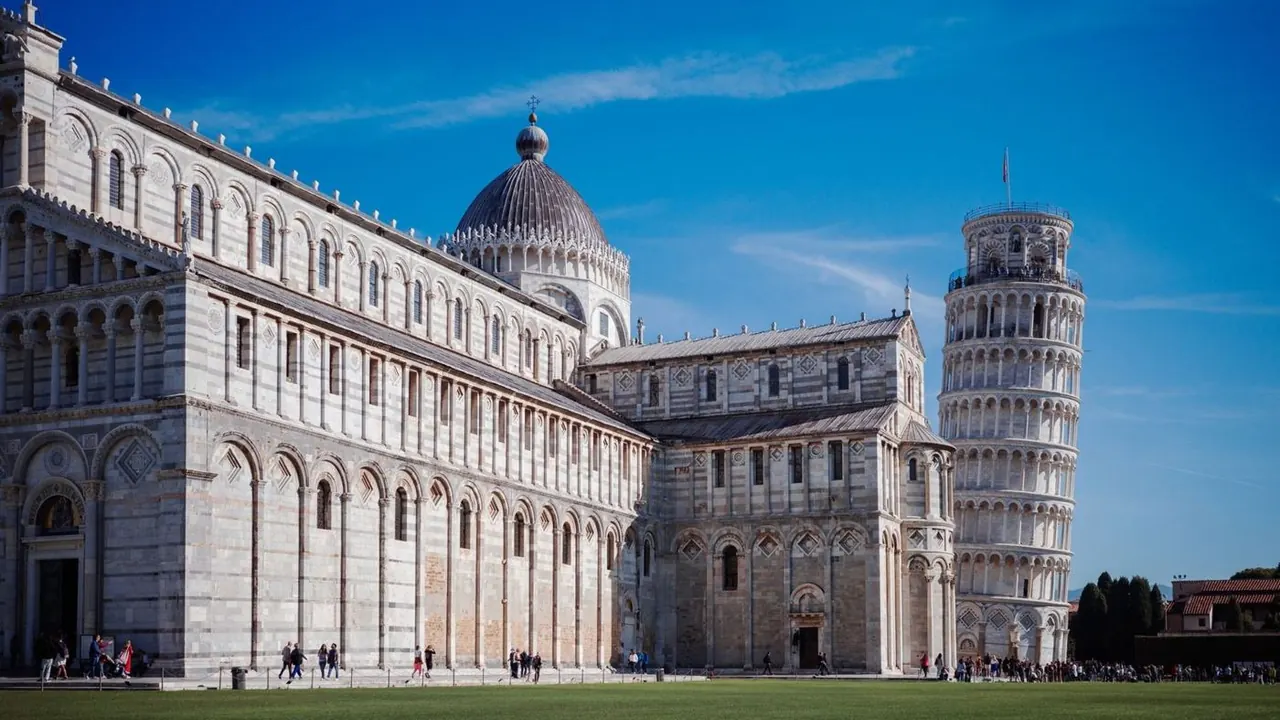
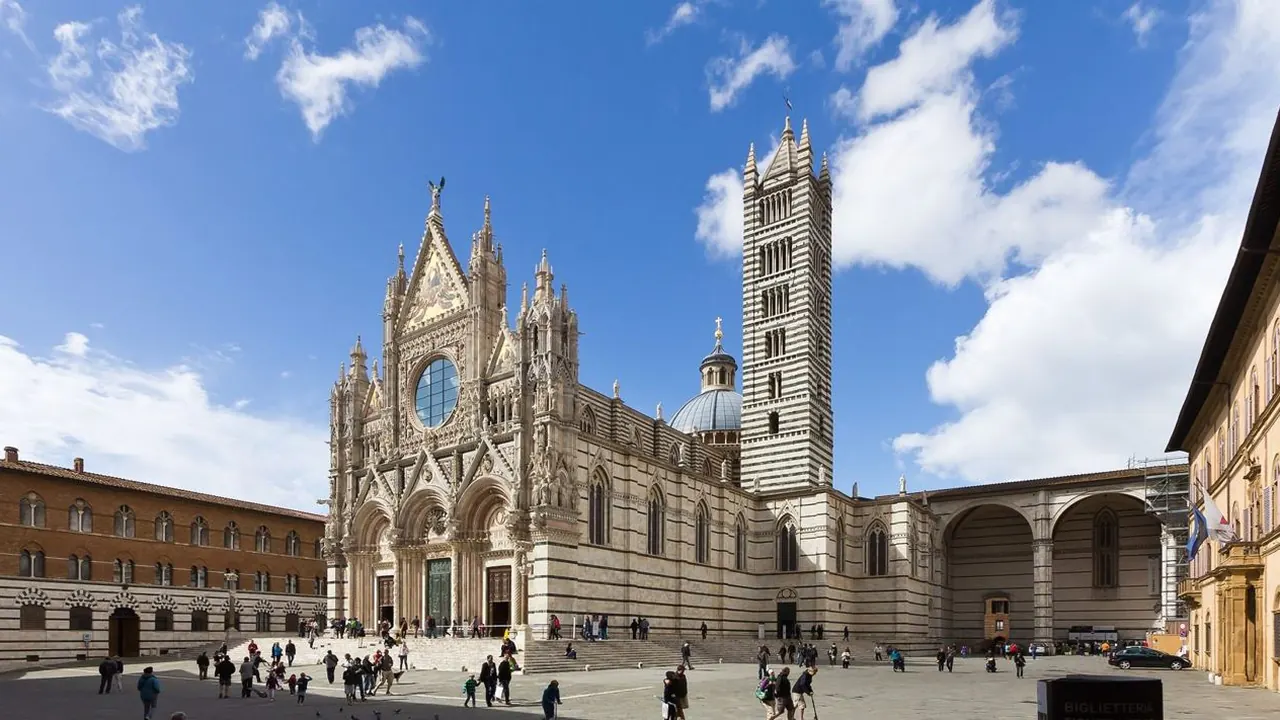
Photos: Pisa by Bruno Kraler, Pexels License; Siena by Raimond Spekking, CC BY-SA 4.0, cropped.
Pisa or Siena?
Our verdict in twelve categories, each scored against the same fixed benchmark cities, and the climate month by month, so you can choose for your trip.
Choose Pisa for
- beaches
- getting around
- families
Pisa suits travellers who want a practical, easy base with the sea close by. It is flat, small and next to its airport, and its station makes Florence, Lucca and the Cinque Terre simple without a car. Families, people on a tighter budget and anyone who wants a beach afternoon between sights will find it the easier choice, and student evenings around the old market keep it livelier after dark.
Choose Siena for
- culture and sights
- wellness
- food and drink
Siena is for the traveller who wants to live inside a medieval city rather than visit one landmark. The whole walled centre, the Sienese painting and the contrade give it more depth, and the food, wine and hot springs of the surrounding hills reward a slower trip. It works best with a hire car and some patience on the steep lanes, and it is no place for anyone who wants to swim in the sea.
Scoreboard
Twelve categories on one fixed scale from 0 to 100. The shaded stretch is the gap between the two.
Your match
Pick a travel style or drag the sliders, and both match scores follow your weighting.
Wins on beaches and getting around with your weighting.
Wins on culture and sights and wellness with your weighting.
What matters to you?
Category by category
What the scores mean for a trip.
Beaches & swimming
This is the starkest difference between the two. Pisa has real coast about 12km away: rocky breakwaters and coves at Marina di Pisa, then wide sandy beaches backed by pines at Tirrenia and Calambrone, with Viareggio and Versilia a short train ride further. It is easy to work an afternoon swim into a sightseeing day.
Siena is an inland hill town, and the Maremma beaches are well over an hour away by car, so the sea means giving up a whole day. For most visitors there, swimming means a hotel or farmhouse pool.
Food & drink
Both cities cook in the Tuscan way and share dishes such as ribollita and pappa al pomodoro, but Siena eats better. Its hand-rolled pici, cinta senese pork and long baking tradition of panforte and ricciarelli give it more character, and with Chianti Classico to the north and Brunello and Vino Nobile to the south, a glass of wine in Siena is something to look forward to.
Pisa's strengths are simpler: hot cecina from wood ovens and student-priced trattorias around the Piazza delle Vettovaglie market, with better seafood out on the coast. Neither city offers much variety beyond its own cooking.
Culture & sights
Pisa has one of Italy's most famous ensembles in the Piazza dei Miracoli, and the quieter city beyond it, Piazza dei Cavalieri, Santa Maria della Spina and the San Matteo museum, rewards anyone who keeps walking. Still, the visit centres on a single lawn.
Siena has more to offer because the whole walled city is the monument. The Campo and Palazzo Pubblico, the Duomo with its Piccolomini Library, Duccio's Maestà and the vast Santa Maria della Scala add up to a richer body of medieval art, and the seventeen contrade give its streets a living identity that Pisa lacks.
Nightlife
Neither is a nightlife city, but Pisa has more going on. In term time students crowd the small squares around the old market until past midnight, Borgo Stretto and the riverbanks fill for aperitivo, and in summer the evening moves to the beach bars.
Siena's evenings are a long dinner and a walk through the lit streets, and the centre is quiet before midnight for most of the year. The exception is the Palio, when the contrade feast outdoors until late.
Nature & outdoors
The two are about equal outdoors, but the landscapes differ. Pisa sits beside the San Rossore park, a wild stretch of pine forest, wetland and dunes running to the sea, and it has true mountain hiking in the Apuan Alps and the Cinque Terre cliff paths within reach.
Siena's countryside is farmed and gentle: the bare clay hills of the Crete Senesi and the rolling Val d'Orcia. Its outdoor speciality is cycling on the white gravel strade bianche straight from town, with walks on the Via Francigena and the beech woods of Monte Amiata further off.
Day trips
Both are superb bases, and the difference is how you travel. From Pisa the trips run by train: Florence in about an hour, Lucca in under half an hour, and the Cinque Terre, Viareggio and the marble towns along the coast, all without a car.
Siena sits right among the hill towns, with San Gimignano, Monteriggioni, the Chianti villages, Montalcino, Pienza and abbeys such as Sant'Antimo and San Galgano close at hand. Most of them are far easier to reach by car than by bus.
Good for families
Pisa is the easier of the two with children. The flat centre suits pushchairs, the tower lawn gives them space to run and pose for the classic photo, and the shallow sandy beaches and bike rides in San Rossore make good family days.
Siena is safe and mostly car-free, and older children enjoy the tower climb and the contrada drummers, but its steep, stepped streets wear out small legs. Families there usually do better at a countryside farmhouse with a pool.
Getting around
Pisa is simpler to get around. It is small and flat, the airport is a short shuttle-train ride from the central station, and that station is a rail hub for western Tuscany, so day trips need no car.
Siena's car-free centre is compact, but it spreads over three ridges, with steep climbs and an escalator chain up from the valley station. Trains are slow and infrequent, buses do the job to Florence, and the wine country really needs a hire car.
Shopping & style
Neither is a shopping destination, and the difference is in what you buy. Pisa is better for everyday clothes, with chains along Corso Italia, smarter shoe and clothes shops under the Borgo Stretto arcades and a monthly antiques market by the river.
Siena is better for things to take home: hand-painted majolica, contrada scarves and flags, panforte, pecorino and wine, plus a large weekly market by the Fortezza.
Affordability
Pisa is easier on the wallet. Its rooms are mid-range, the trattorias that serve the students are good value and walking costs nothing, and the main extra is the tower climb.
Siena has few rooms inside its walls, and they get much dearer in summer and around the Palio, while separate tickets for the cathedral complex and civic museums add up. Osteria lunches are reasonable, and staying in an agriturismo outside town often saves money.
Live music & performing arts
Both have modest programmes, but at different times of year. Pisa's draw is opera at the 19th-century Teatro Verdi, with a season of opera, ballet and concerts from autumn to spring.
Siena has no opera house of note, but it hosts the Accademia Chigiana's summer concerts in palaces and churches and performances by the Siena Jazz school. Pick Pisa for a winter night at the opera and Siena for summer chamber music or jazz.
Wellness & relaxation
Siena is the better place to unwind, mainly because of the thermal water around it. There are travertine pools at Rapolano, the steaming medieval bath at Bagno Vignoni, free woodland pools at Bagni San Filippo and Petriolo's hot river, and rural spa hotels make it easy to build a slow stay among the hills.
Pisa has its own historic springs at San Giuliano Terme and a public thermal pool at Casciana Terme, but beyond those its calm comes from being small and quiet once you leave the cathedral square.
When should you go?
Pick your month. The climate figures are measured averages, not a forecast.
Pisa in July
Siena in July
Daytime high, °C
Rainfall in the month, mm
Where the figures come from
Siena's temperatures are measured 45 km from the centre, at Arezzo.
Siena has no rain gauge within 25 km of the centre, so its rainfall comes from a gridded climate dataset read at the city rather than from a gauge further away.
Temperature and rainfall are climate normals, averaged over the years shown. Pisa: 1991-2020 normals, Pisa / S. Giusto (3.9 km from centre). Siena: 2006-2017 (rainfall 1991-2020) normals, Arezzo (45 km from centre).
Both cities are at their best in May, June and late September, when the days are warm enough to sit outside but the streets are still comfortable to walk. July and August are hot in both, with Siena slightly hotter at about 31°C, which makes midday climbs through its lanes hard work. Pisa then has the advantage of the sea, which reaches about 24°C in July and stays warm into September, and its summer is very sunny and dry.
The rain arrives differently. In Pisa it sets in hard from September, peaking at about 132mm in November, so autumn visits need an umbrella. Siena is wetter in spring too, with around 51mm in March, and its winters are colder on the hilltop, with January highs near 9°C, though often clear.
Which traveller are you?
On a beach and sun trip, Pisa is the clear choice. The long sandy beaches of Tirrenia and Calambrone are a short bus ride away, with shallow water and pine woods behind, while from Siena the Maremma coast takes a full day.
For a culture and arts trip, Siena goes deeper. Its entire medieval centre is the attraction, from Lorenzetti's frescoes in the Palazzo Pubblico to Duccio's Maestà and the Duomo floor, whereas Pisa's great monuments are concentrated on a single square.
On a relaxing and wellness trip, Siena has the better surroundings. Rapolano, Bagno Vignoni and the free limestone pools of Bagni San Filippo sit among quiet hills with farmhouse stays, while Pisa's thermal options are limited to two spa towns.
Before you go
| Measure | Pisa | Siena |
|---|---|---|
| Official language | Italian | Italian |
| Currency | Euro (EUR) | Euro (EUR) |
| Sockets | CFL230 V, 50 Hz | CFL230 V, 50 Hz |
| Driving side | Right | Right |
| Time zone | UTC+1, UTC+2 in summer | UTC+1, UTC+2 in summer |
| Emergency number | 112 | 112 |
| Elevation | 4 m | 322 m |
| Main airport | Pisa International Airport (PSA)4 km from centre82 non-stop destinations | Florence Airport, Peretola (FLR)55 km from centre46 non-stop destinations |
| Public holidays this year | 13 days | 13 days |
By the numbers
| Measure | Pisa | Siena |
|---|---|---|
| City population | 88,737 | 52,812 |
| People per km² | 479 | 446 |
| Museums within 10 km | 27 | 30 |
| UNESCO World Heritage sites within 50 km | 3 | 5 |
| Swim season, months above 21 °C | 4 months | - |
Where else could you go?
Every comparison below shares a destination with this one, so you can follow Pisa or Siena somewhere new.