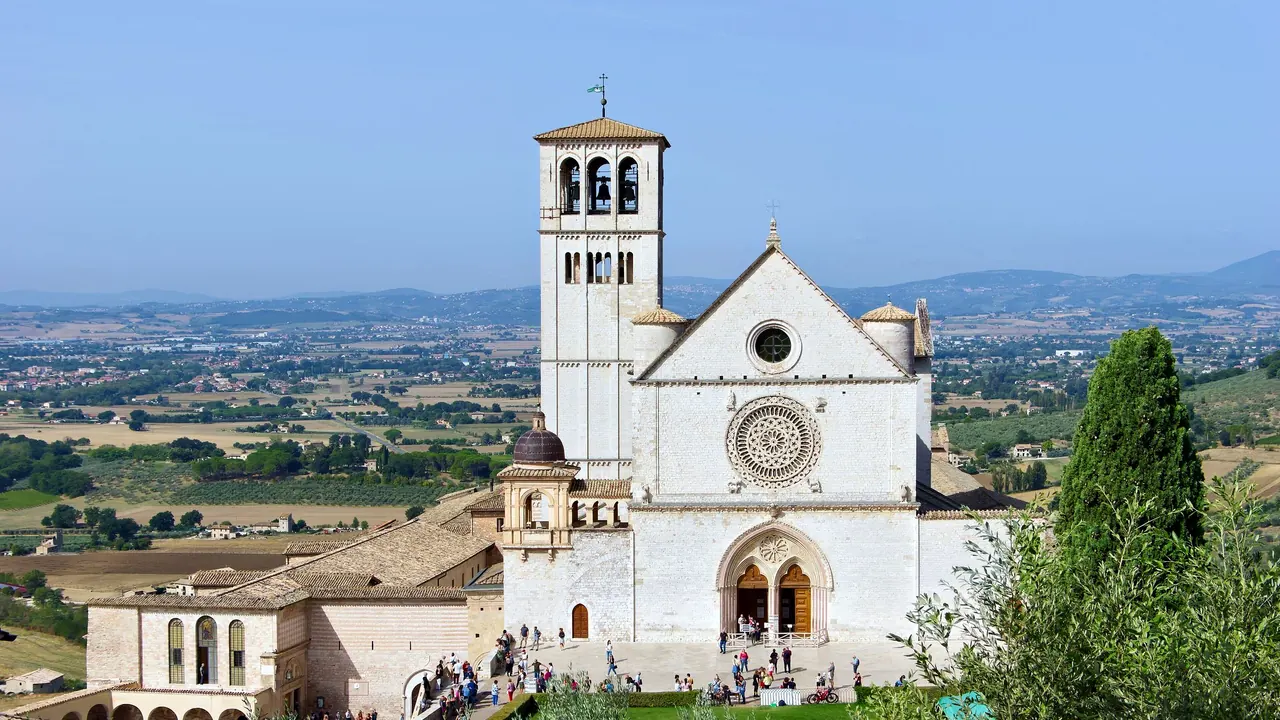
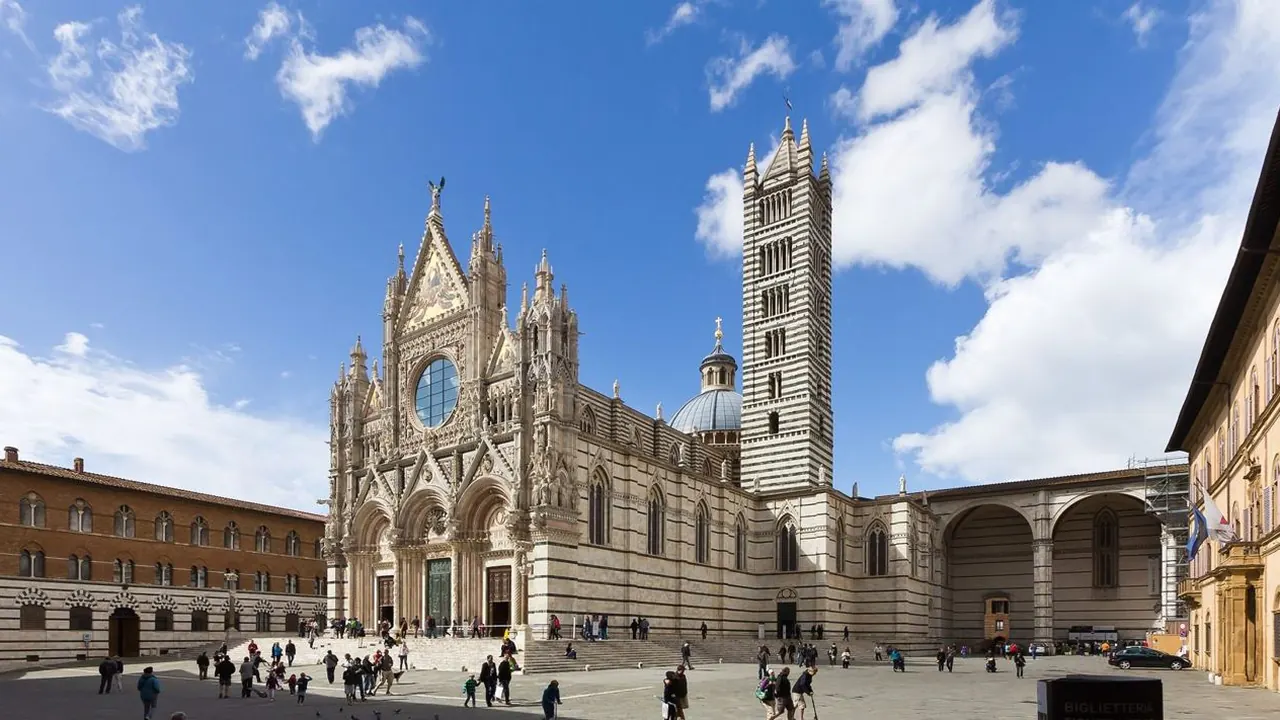
Photos: Assisi by Berthold Werner, CC BY-SA 4.0, cropped; Siena by Raimond Spekking, CC BY-SA 4.0, cropped.
Assisi or Siena?
Our verdict in twelve categories, each scored against the same fixed benchmark cities, and the climate month by month, so you can choose for your trip.
Choose Assisi for
- prices
Assisi suits a slower, quieter trip built around one extraordinary monument. If you want the Giotto and Cimabue frescoes of the Basilica of San Francesco, early walks up Monte Subasio to the Eremo delle Carceri and evenings with almost nobody in the lanes, it gives you that at a gentler cost, especially if you sleep in a convent guesthouse. It also makes a good base for the Umbrian hill towns strung along the railway.
Choose Siena for
- food and drink
- nightlife
- wellness
Siena is the better choice for travellers who want more from their evenings and their table. It has a larger medieval city to explore, from the Campo to the Duomo and Santa Maria della Scala, stronger cooking and wine, a real concert life and the warm springs of southern Tuscany within easy reach. You pay more for a room inside the walls, but Florence, Chianti and the Val d'Orcia are all close enough for day trips.
Scoreboard
Twelve categories on one fixed scale from 0 to 100. The shaded stretch is the gap between the two.
Your match
Pick a travel style or drag the sliders, and both match scores follow your weighting.
Wins on prices with your weighting.
Wins on food and drink and nightlife with your weighting.
What matters to you?
Category by category
What the scores mean for a trip.
Beaches & swimming
Neither is a swimming destination, and both send you to a pool at your hotel or agriturismo. The difference is the water you can reach. From Assisi it is Lake Trasimeno, under an hour away, with small lido beaches at Passignano and Castiglione del Lago and warm, shallow, slightly cloudy water. From Siena it is the real sea on the Maremma coast around Castiglione della Pescaia, but that takes a full day there and back.
Food & drink
Both towns cook simple country food from good produce, but Siena does it better and with more variety. Assisi offers strangozzi with black truffle, Castelluccio lentils, torta al testo and fine Subasio olive oil. Its best meals are in side-lane trattorias or agriturismi, because set menus for tour groups dominate near the basilica.
Siena has pici with duck ragù, ribollita, cinta senese salumi and a baking tradition of panforte and ricciarelli that Assisi cannot match. Its enoteche pour Chianti Classico, Brunello and Vino Nobile, where Assisi relies on Sagrantino from Montefalco. Neither has much international food.
Culture & sights
Assisi is about one great building. The stacked Lower and Upper Churches of San Francesco hold some of the finest frescoes in Italy, and Santa Chiara, the Temple of Minerva and the Porziuncola fill out a calm two days.
Siena gives you more, a whole medieval city rather than a shrine. Lorenzetti's Good and Bad Government in the Palazzo Pubblico, the inlaid floor and Piccolomini Library of the Duomo, Duccio's Maestà and the Pinacoteca make a richer run of art and buildings. The seventeen contrade, each with its own church, fountain and flag, also give the streets a character you do not find in Assisi.
Nightlife
Assisi is quiet once the day visitors leave. After a glass of Sagrantino and a walk through the floodlit lanes, it is asleep by eleven, and for bars you would go to Perugia.
Siena is not lively either, but the university gives it a handful of pubs and wine bars, and an evening drink on the Campo has more going on around it. Around the Palio the contrade dinners keep the streets full until late, which is something Assisi never has.
Nature & outdoors
The countryside is equally good around both towns, but it is different. Assisi has a mountain on its doorstep: Monte Subasio rises straight behind the town, with oak woods, the hermitage path and open summit meadows, and the Valnerina and Sibillini make wilder days out.
Siena's outdoors is gentler and more open. The bare clay hills of the Crete Senesi and the Val d'Orcia are good for touring, and the strade bianche gravel roads draw serious cyclists. Walkers here follow the Via Francigena rather than climbing.
Day trips
Both are excellent bases, and Siena is slightly better. From Assisi you have Spello, Perugia, Spoleto, Gubbio, Todi and Orvieto, several of them on the valley railway, plus the wine villages of Montefalco and Bevagna.
Siena has Florence, San Gimignano, Volterra, the Chianti villages, Pienza, Montalcino and Montepulciano, as well as the abbeys of Monte Oliveto Maggiore, Sant'Antimo and San Galgano. From either town, a car makes the smaller places much easier to reach.
Good for families
Neither town is built for children, and in both, families do best at a countryside farmhouse with a pool. Siena keeps them interested for longer, though. Climbing the Torre del Mangia, walking out onto the unfinished cathedral façade and watching contrada drummers are more fun than Assisi's frescoed churches, where children are expected to keep quiet. In Assisi the Rocca Maggiore castle is the main draw for older children.
Getting around
On foot they are much alike: compact, mostly closed to cars and steep. Assisi's centre stretches along one slope, from the basilica up to Piazza del Comune, with lifts from the car parks. Siena spreads across three ridges, and a chain of escalators brings you up from the station.
For onward travel, Assisi has the better train line, with regional trains running along the valley to Perugia, Spello and Spoleto. Siena's trains are slow and infrequent, so buses are the better way to reach Florence.
Shopping & style
Assisi's streets are mainly devotional: rosaries and Tau crosses, along with embroidered Umbrian linen, Deruta ceramics and truffle products. Siena gives you more choice. Banchi di Sopra and Via di Città have Italian clothing, shoe and leather shops, and there is majolica, contrada scarves and a big weekly market by the Fortezza Medicea. Neither has luxury streets.
Affordability
Assisi is the cheaper stay. Entry to its basilicas and churches is free, convent guesthouses cost little and agriturismi in the valley are good value, with prices rising mainly around Easter and the big feast days.
Siena costs more. There are few rooms inside the walls, they get expensive around the Palio and in summer, and tickets for the cathedral complex and civic museums add up. Osteria lunches are still good value, and staying in the countryside brings the cost down.
Live music & performing arts
In Assisi, live music is mostly sacred: organ recitals and choirs in the basilicas, plus the costumed Calendimaggio festival in spring. Siena has an actual concert life. The Accademia Chigiana holds summer concerts in palaces and churches, Siena Jazz adds performances by its teachers and students, and the Rinnovati and Rozzi theatres put on drama through the winter. For opera, Assisi visitors go to Perugia and Sienese go to Florence.
Wellness & relaxation
Assisi offers stillness rather than spas. Convent retreats, silent walks to the Eremo delle Carceri and empty evening lanes are its kind of rest, and treatments are limited to a few country hotels.
Siena has the thermal water. You can soak in the travertine pools of Rapolano Terme, the medieval bath at Bagno Vignoni, the free limestone pools of Bagni San Filippo and Petriolo's sulphur river. That makes it the better choice if rest means a warm soak, though its centre is busier by day than Assisi's.
When should you go?
Pick your month. The climate figures are measured averages, not a forecast.
Assisi in July
Siena in July
Daytime high, °C
Rainfall in the month, mm
Where the figures come from
Assisi's temperatures are measured 51 km from the centre, at Frontone.
Assisi has no rain gauge within 25 km of the centre, so its rainfall comes from a gridded climate dataset read at the city rather than from a gauge further away.
Siena's temperatures are measured 45 km from the centre, at Arezzo.
Siena has no rain gauge within 25 km of the centre, so its rainfall comes from a gridded climate dataset read at the city rather than from a gauge further away.
Temperature and rainfall are climate normals, averaged over the years shown. Assisi: 1991-2020 normals, Frontone (50.5 km from centre). Siena: 2006-2017 (rainfall 1991-2020) normals, Arezzo (45 km from centre).
Assisi and Siena follow the same pattern through the year, but Siena is warmer in every month, by 1°C to 3°C. The gap is widest in spring and early autumn, so Siena's March, April, September and October feel noticeably milder. It is narrowest in high summer, when both towns are hot. Spring and early autumn are the best times to walk the steep lanes of either town. From June to August it is warm enough to swim outdoors, in a pool or, near Assisi, in Lake Trasimeno. July and August are hot in both, so plan your sightseeing for mornings and evenings.
Rain builds through October in both towns, but Siena's November is much wetter, at about 127mm against 94mm in Assisi. Summers are the driest time in both. Winters are cold and quiet, with Assisi's January highs only around 7°C and Siena's slightly higher, so bring a warm coat.
Which traveller are you?
On a trip on a tight budget, Assisi is the easier choice. Its basilicas are free to enter, convent guesthouses offer clean, simple rooms cheaply, and you avoid Siena's paid cathedral and civic museum tickets and the high summer prices for rooms inside the walls.
For a food and nightlife trip, Siena is clearly better. Pici, cinta senese pork, panforte from old bakeries and Chianti or Brunello by the glass beat Assisi's narrower table, and student pubs and Palio dinners give it life after dark, which Assisi lacks.
On a relaxing and wellness trip, Siena gives you more to do. Assisi's calm is spiritual and comes from retreats and silent walks, while Siena adds warm travertine pools at Rapolano Terme and the thermal baths of Bagno Vignoni and Bagni San Filippo.
Before you go
| Measure | Assisi | Siena |
|---|---|---|
| Official language | Italian | Italian |
| Currency | Euro (EUR) | Euro (EUR) |
| Sockets | CFL230 V, 50 Hz | CFL230 V, 50 Hz |
| Driving side | Right | Right |
| Time zone | UTC+1, UTC+2 in summer | UTC+1, UTC+2 in summer |
| Emergency number | 112 | 112 |
| Elevation | 424 m | 322 m |
| Main airport | Perugia San Francesco d'Assisi – Umbria International Airport (PEG)9 km from centre17 non-stop destinations | Florence Airport, Peretola (FLR)55 km from centre46 non-stop destinations |
| Public holidays this year | 13 days | 13 days |
By the numbers
| Measure | Assisi | Siena |
|---|---|---|
| City population | 27,605 | 52,812 |
| People per km² | 147 | 446 |
| Museums within 10 km | 14 | 30 |
| UNESCO World Heritage sites within 50 km | 2 | 5 |
Where else could you go?
Every comparison below shares a destination with this one, so you can follow Assisi or Siena somewhere new.