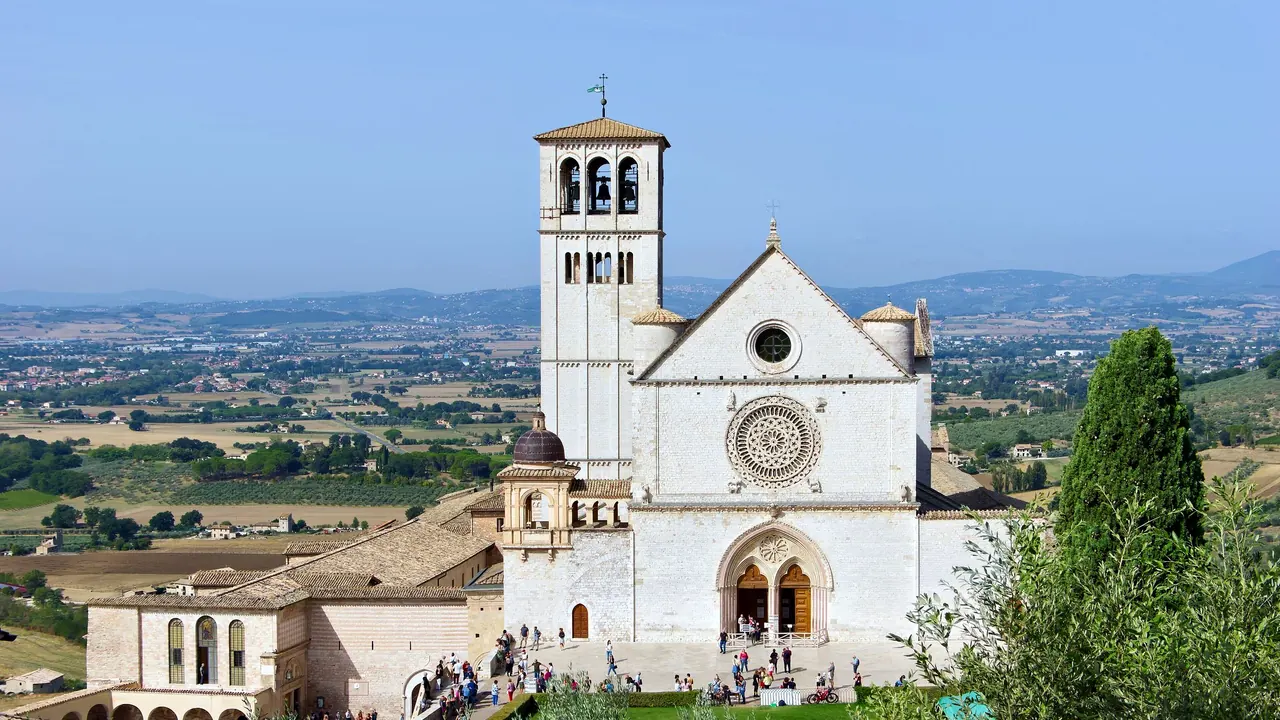
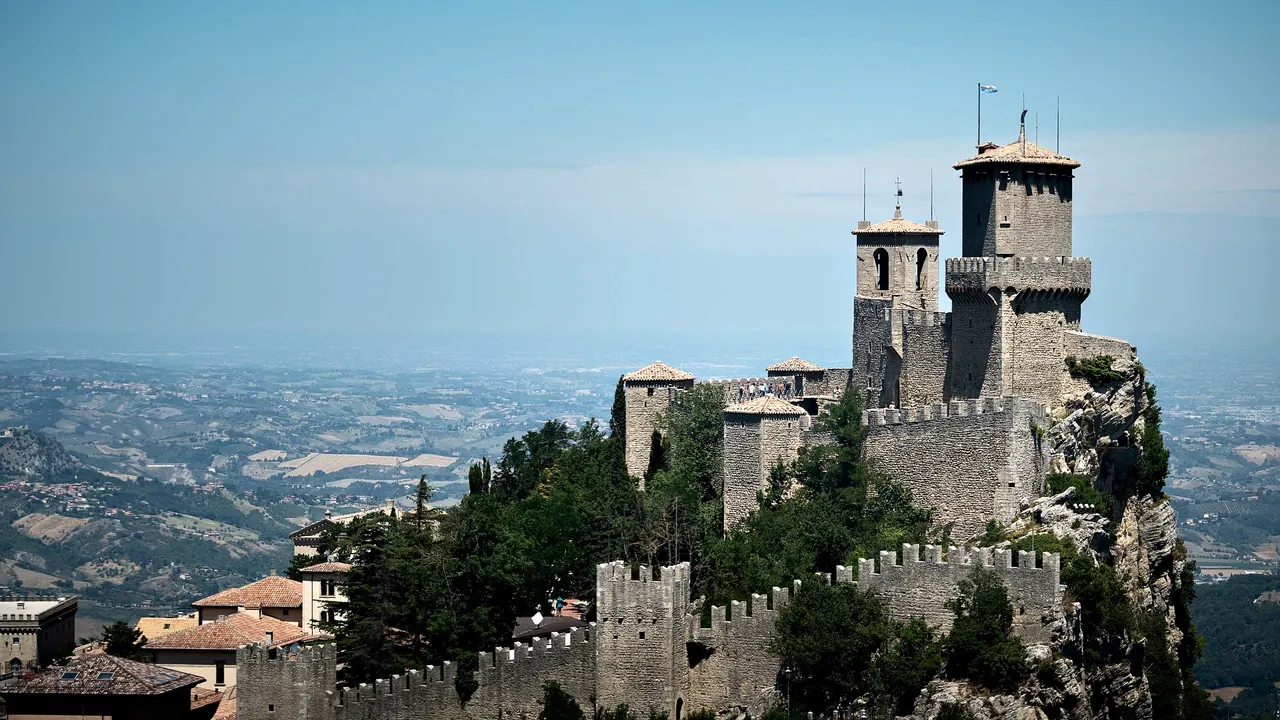
Photos: Assisi by Berthold Werner, CC BY-SA 4.0, cropped; San Marino by Tibor Szabo, Pexels License.
Assisi or San Marino?
Our verdict in twelve categories, each scored against the same fixed benchmark cities, and the climate month by month, so you can choose for your trip.
Choose Assisi for
- culture and sights
- nature and the outdoors
- wellness
Choose Assisi for a slower, deeper trip into central Italy. The Basilica of San Francesco and its frescoes reward two unhurried days, Monte Subasio starts right behind the town, and a whole circuit of Umbrian hill towns sits within easy reach, several of them by train. It suits travellers who want art, walking and quiet evenings more than a lively place to stay.
Choose San Marino for
- beaches
- families
- shopping
San Marino works better when the trip mixes a dramatic sight with time by the sea. The towers on Monte Titano and the story of the old republic fill a morning, and the sandy Adriatic beaches, waterparks and Riviera nightlife of Rimini and Riccione are just down the hill. Families with a car, and anyone who wants the mountain and the coast in one stay, will get more out of it.
Scoreboard
Twelve categories on one fixed scale from 0 to 100. The shaded stretch is the gap between the two.
Your match
Pick a travel style or drag the sliders, and both match scores follow your weighting.
Wins on culture and sights and nature and the outdoors with your weighting.
Wins on beaches and families with your weighting.
What matters to you?
Category by category
What the scores mean for a trip.
Beaches & swimming
San Marino is far better for swimming. From its walls you can see the Adriatic, and the long sandy beaches of Rimini and Riccione, with rows of umbrellas, beach clubs and shallow water for children, are an easy half-day trip in summer. You still drive or take the bus down rather than staying by the sea.
Assisi offers no such option. The closest water is Lake Trasimeno, where small lido beaches at Passignano and Castiglione del Lago have warm but murky water, so most visitors settle for a pool at an agriturismo.
Food & drink
The two eat about equally well, from different regional kitchens. Assisi cooks in the Umbrian way: strangozzi with black truffle, Castelluccio lentils, torta al testo, olive oil from Monte Subasio and Sagrantino from Montefalco. San Marino leans to Romagna, with passatelli, strozzapreti, piadina and cassone, plus the Tre Monti wafer cake and wines from the republic's own small vineyards.
The same problem appears in both, with the restaurants nearest the sights feeding the crowds. In Assisi, look for trattorias on the side lanes or country agriturismi. In San Marino the better tables are down in Borgo Maggiore and the lower villages.
Culture & sights
Assisi has one of Europe's great monuments. The Basilica of San Francesco stacks a dim Lower Church painted by Cimabue, Simone Martini and Lorenzetti beneath an Upper Church lined with the Saint Francis cycle attributed to Giotto. Santa Chiara, the Temple of Minerva, the Rocca and the Porziuncola chapel inside Santa Maria degli Angeli bring the visit to two full days.
San Marino's appeal lies more in its setting and history than in its art. The three towers on the cliff edge and the Palazzo Pubblico of an ancient republic make a memorable half day, but the museums are small.
Nightlife
Neither town stays up late. An evening in Assisi is a glass of Sagrantino and a walk through floodlit, emptying lanes, and on San Marino's summit it is a terrace drink with the lights of the coast below. The real difference is the escape route. Assisi's nearest bars are in Perugia, the student city half an hour away, while San Marino looks down on the Riviera clubs and seafront bars of Rimini and Riccione, which run late all summer.
Nature & outdoors
Assisi has the bigger outdoors. A path leaves town into Monte Subasio's regional park, through holm oaks to the Eremo delle Carceri and up to open summit meadows at about 1,290m. Beyond lie the Valnerina, the gorges of Monte Cucco and the Sibillini mountains for full days out.
San Marino's Monte Titano is a ridge of about 740m with cliffs and wide views to the sea. Its paths between the towers and down to Borgo Maggiore make pleasant morning walks, and the Montefeltro hills suit quiet cycling, but nothing here compares with a day on the Umbrian mountains.
Day trips
Assisi sits at the centre of a remarkable cluster of towns. Spello is ten minutes away, Perugia and Spoleto are on the railway line, and Gubbio, Todi, Orvieto and Deruta fill further days, with Cortona and Montepulciano across the Tuscan border.
San Marino's trips are strong too: the rock fortress of San Leo, ducal Urbino, Ravenna's mosaics and Gradara's castle. Getting to them is the weak point, since only the bus to Rimini runs regularly, so most of these outings depend on a car.
Good for families
San Marino is the easier place to bring children. The cliff-top towers, battlements and the cable car up from Borgo Maggiore all go down well, and the coast below adds Italia in Miniatura, Fiabilandia, waterparks and gently shelving beaches.
In Assisi, the frescoed churches need hushed voices, and the stepped lanes are hard going with a pushchair. Older children may enjoy the Rocca Maggiore and the climb up Subasio, but families usually stay at a valley agriturismo with a pool and visit the town in short trips.
Getting around
Both old towns are compact and steep, with stairs, car-free cores and car parks on the edges. Assisi is the easier place to explore without a car. Its station lies about 4km below in Santa Maria degli Angeli, a short bus ride from the walls, and regional trains run along the valley to Perugia, Spello, Foligno and Spoleto.
San Marino has a cable car between the summit and Borgo Maggiore, but its only real link outward is the bus to Rimini, which takes under an hour. Village buses are sparse, so a car matters more here.
Shopping & style
There is little serious shopping in either, though San Marino has slightly more choice. Lower taxes than in Italy fill its main streets with perfume, watches, leather and spirits, an outlet centre on the valley floor stocks fashion brands, and collectors look for its stamps and coins.
Assisi's lanes are dominated by rosaries and Tau crosses, but the goods worth taking home are more rooted in local craft: Assisi-embroidered linens, Deruta ceramics, Subasio olive oil and Sagrantino.
Affordability
Both cost what provincial central Italy costs, with a premium on the most central tables and beds. Assisi stretches a budget a little further, because the basilicas are free and convent guesthouses offer simple rooms cheaply, though Easter and feast days push hotel prices up. In San Marino the summit view terraces cost more, while lower taxes make fuel and spirits cheaper than across the border.
Live music & performing arts
Assisi has the richer programme, and most of it is sacred. Organ recitals and choirs fill the Basilica of San Francesco around the feasts, the Calendimaggio festival pits the town's two quarters against each other in costume and song each spring, and Perugia's opera and summer jazz are half an hour away.
San Marino offers a small theatre, open-air music in summer and its Medieval Days, with crossbow contests and flag-throwers. For anything bigger, you have to travel to Bologna or Rossini's Pesaro.
Wellness & relaxation
Neither is a spa destination, but Assisi does more for anyone seeking rest. Its stillness has a purpose: retreats in convent guesthouses, silent walks to the Eremo delle Carceri and quiet early mornings, with a few spas at country hotels in the valley.
San Marino is calm only after the day visitors go, and its summer afternoons are crowded around the towers. Wellness there means a hotel spa, or a separate trip to thermal baths on the coast or in the Apennines.
When should you go?
Pick your month. The climate figures are measured averages, not a forecast.
Assisi in July
San Marino in July
Daytime high, °C
Rainfall in the month, mm
Where the figures come from
Assisi's temperatures are measured 51 km from the centre, at Frontone.
Assisi has no rain gauge within 25 km of the centre, so its rainfall comes from a gridded climate dataset read at the city rather than from a gauge further away.
San Marino's temperatures are measured 52 km from the centre, at Frontone.
San Marino has no rain gauge within 25 km of the centre, so its rainfall comes from a gridded climate dataset read at the city rather than from a gauge further away.
Temperature and rainfall are climate normals, averaged over the years shown. Assisi: 1991-2020 normals, Frontone (50.5 km from centre). San Marino: 1991-2020 normals, Frontone (51.5 km from centre).
Assisi and San Marino follow almost exactly the same temperature curve, so their best seasons line up. May and September are ideal for walking steep lanes and hillsides, with warm days that are rarely tiring. July and August reach about 30°C, so sightseeing is best done early or late in the day. From December to February the days stay in single figures in both, and the two towns feel raw and quiet.
Rain is where they differ. Assisi is the drier of the two in almost every month, and the gap is clearest in autumn. November brings about 94mm in Assisi and 105mm in San Marino, and October is not far behind. In high summer Assisi means a pool or Lake Trasimeno. Only San Marino has the sea within easy reach, and the Adriatic below it is warm enough for comfortable swimming from late June to September, reaching about 26°C in August.
Which traveller are you?
For a beach and sun trip, San Marino is the only real option. Assisi lies two hours from either coast, with only shallow Lake Trasimeno nearby, while the sandy Riviera at Rimini and Riccione is about half an hour below San Marino's walls.
On a culture and arts trip, Assisi is clearly the place. Its Franciscan basilica holds some of the finest medieval painting in Italy, and the town around it rewards two slow days. San Marino's towers and the story of its old republic are absorbing, but a morning covers them.
On a family trip with children, San Marino makes the days easier to plan. Assisi is a town made for adults, which children have to sit through. In San Marino a short, lively morning on the summit can be followed by an afternoon on a coast built around children, just down the hill by car.
Before you go
| Measure | Assisi | San Marino |
|---|---|---|
| Official language | Italian | Italian |
| Currency | Euro (EUR) | Euro (EUR) |
| Sockets | CFL230 V, 50 Hz | CFL230 V, 50 Hz |
| Driving side | Right | Right |
| Time zone | UTC+1, UTC+2 in summer | UTC+1, UTC+2 in summer |
| Emergency number | 112 | 112 |
| Elevation | 424 m | 675 m |
| Main airport | Perugia San Francesco d'Assisi – Umbria International Airport (PEG)9 km from centre17 non-stop destinations | Bologna Guglielmo Marconi Airport (BLQ)114 km from centre98 non-stop destinations |
| Public holidays this year | 13 days | 18 days |
By the numbers
| Measure | Assisi | San Marino |
|---|---|---|
| City population | 27,605 | 4,040 |
| People per km² | 147 | 569 |
| Museums within 10 km | 14 | 19 |
| UNESCO World Heritage sites within 50 km | 2 | 2 |
| Swim season, months above 21 °C | - | 4 months |
Where else could you go?
Every comparison below shares a destination with this one, so you can follow Assisi or San Marino somewhere new.
- Florencevs San Marino
- Sienavs Assisi
- Bolognavs San Marino
- Sienavs San Marino
- Romevs Assisi
- Florencevs Assisi