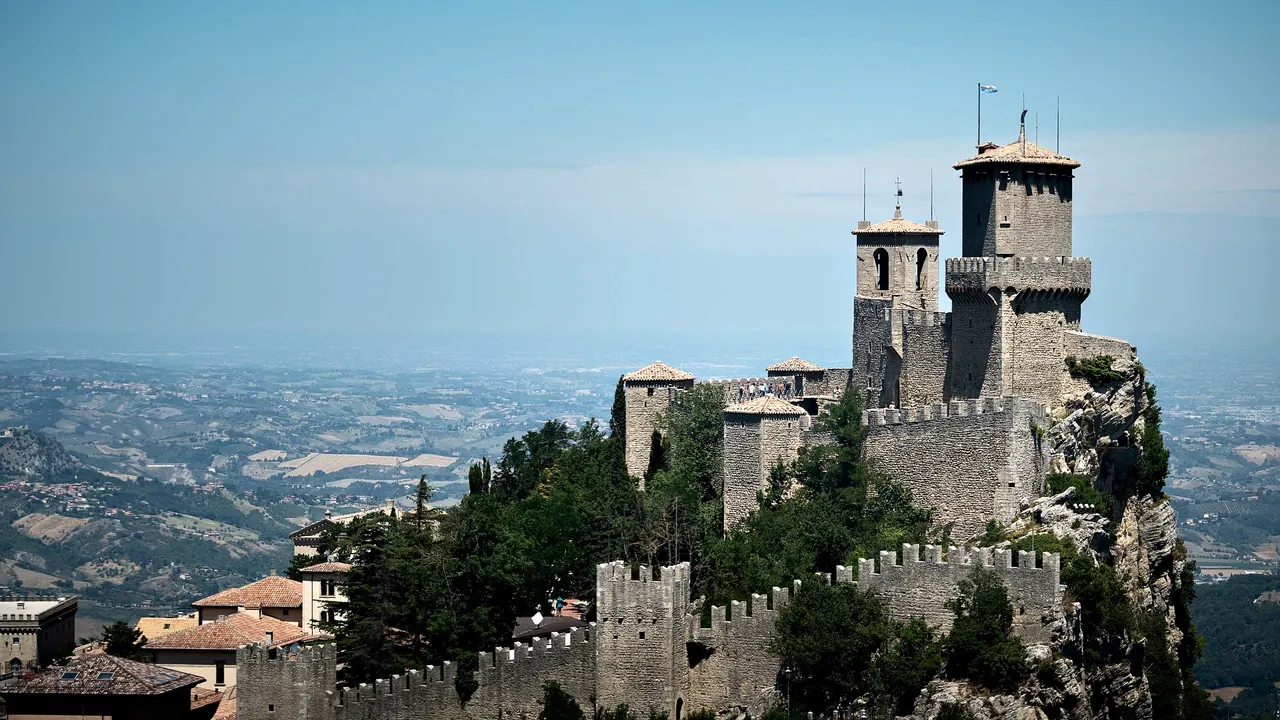
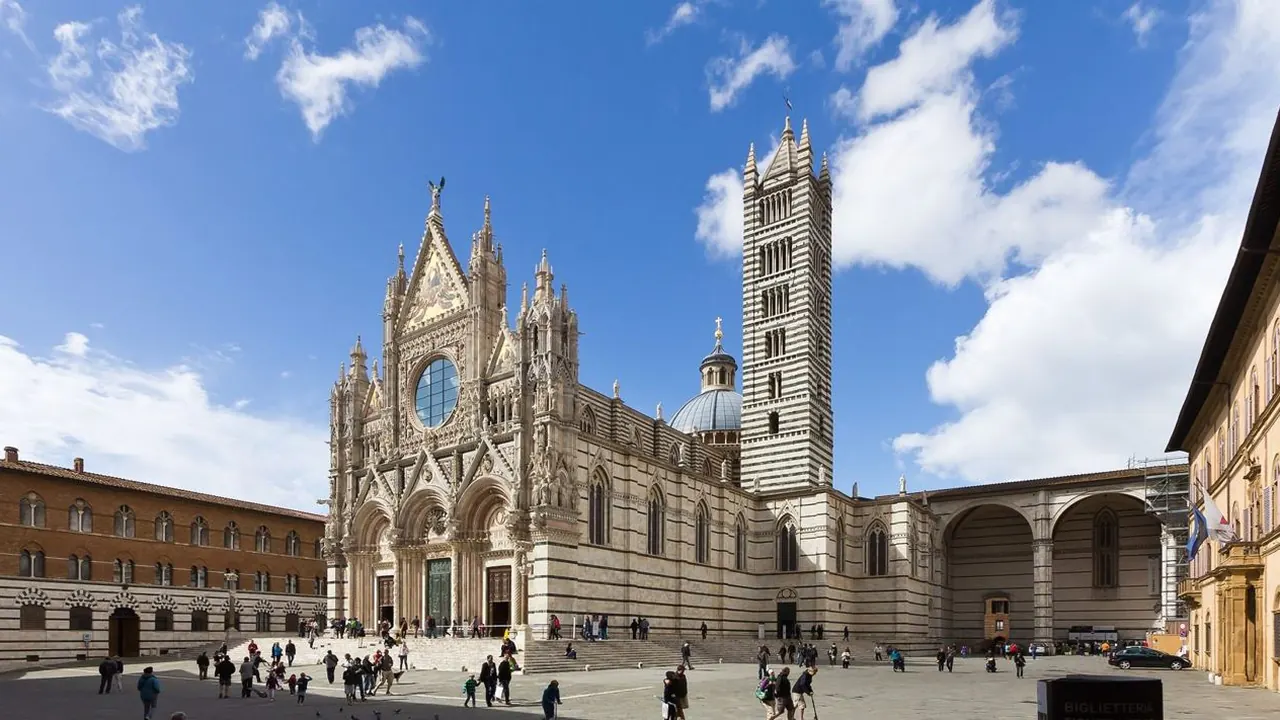
Photos: San Marino by Tibor Szabo, Pexels License; Siena by Raimond Spekking, CC BY-SA 4.0, cropped.
San Marino or Siena?
Our verdict in twelve categories, each scored against the same fixed benchmark cities, and the climate month by month, so you can choose for your trip.
Choose San Marino for
- beaches
- families
- prices
San Marino suits a summer trip that pairs a walled clifftop with the Adriatic. The Riviera beaches, waterparks and children's attractions around Rimini and Riccione are just below the mountain, and day to day it costs a little less than Siena. A family with a car can spend mornings on the towers and afternoons in the sea. Go knowing that the summit itself is seen in half a day.
Choose Siena for
- culture and sights
- wellness
- food and drink
For almost every other kind of trip, Siena is the stronger choice. It is a deep medieval city with the Duomo, the Lorenzetti frescoes and the life of the contrade, and it has proper Tuscan cooking and wine. Around it lie the Crete Senesi, the Val d'Orcia and a ring of hot springs. It rewards a stay of several days and a hire car, though it does nothing for anyone who wants the sea.
Scoreboard
Twelve categories on one fixed scale from 0 to 100. The shaded stretch is the gap between the two.
Your match
Pick a travel style or drag the sliders, and both match scores follow your weighting.
Wins on beaches and families with your weighting.
Wins on culture and sights and wellness with your weighting.
What matters to you?
Category by category
What the scores mean for a trip.
Beaches & swimming
San Marino has the clear advantage here, because the Romagna shore at Rimini and Riccione is about half an hour below the mountain. The beaches have wide sand, shallow water and orderly rows of umbrellas, and they fit easily into an afternoon from July to early September.
From Siena, the Maremma beaches around Castiglione della Pescaia are well over an hour away, so a swim costs a whole day and most swimming happens in an agriturismo pool. The sea is about equally warm at both in high summer. The difference is the distance.
Food & drink
Both cook in the central Italian tradition of hand-rolled pasta, but Siena does it with more conviction. Pici with duck ragù, cinta senese pork, panforte and ricciarelli from long-established pastry shops, and Chianti, Brunello and Vino Nobile by the glass make eating a real part of a stay.
San Marino's piadina, passatelli and Tre Monti cake are honest food. But the summit terraces sell the view more than the cooking, so a good meal means going down to Borgo Maggiore or into Romagna. Neither town offers much beyond its own regional food.
Culture & sights
San Marino's appeal is its setting and its story: three towers on a cliff edge and the ceremonies of an ancient republic in the Palazzo Pubblico, seen comfortably in half a day.
Siena is in another league. Its whole medieval centre is UNESCO-listed, with the Campo, the Duomo's inlaid floor and Piccolomini Library, Duccio's Maestà and Lorenzetti's frescoes of Good and Bad Government. It needs two or three days, and the seventeen contrade give its streets a living civic identity that San Marino's small museums cannot match.
Nightlife
Neither town is the place for a night out, but Siena at least has evenings. There is wine on the Campo, students fill a handful of pubs and wine bars, and around the Palio the contrade hold long outdoor dinners that run late.
San Marino's summit empties when the coaches leave, leaving a few terraces looking down on the lights of the coast. A real night out there means driving down to the Riviera clubs at Rimini and back up the mountain afterwards.
Nature & outdoors
Monte Titano gives San Marino cliffs, wooded paths between the towers and wide views to the Adriatic, which are enough for a morning walk or a drive through the Marecchia valley.
Siena's surroundings offer far more outdoors. There are the bare clay hills of the Crete Senesi and the Val d'Orcia, and white strade bianche gravel roads that draw cyclists straight from the edge of town. Walkers can follow stretches of the Via Francigena or head for the beech forests of Monte Amiata. Neither has high mountains.
Day trips
Both make good bases, and this is San Marino's strongest suit. The fortress of San Leo, Renaissance Urbino, Ravenna's mosaics, Gradara and Rimini's Roman arch and bridge are all within about an hour and a quarter.
Siena's circle is denser still. Florence, San Gimignano, Monteriggioni, the Chianti villages, Volterra, Pienza, Montalcino and Montepulciano are all within reach, along with abbeys such as Sant'Antimo and San Galgano. From either town a car opens up the hill towns, but Siena's fast bus to Florence beats anything San Marino has beyond its bus to Rimini.
Good for families
San Marino works better with children, mainly because of what lies below it: Italia in Miniatura, Fiabilandia, waterparks and shallow sandy beaches. Up top there are the cable car and the battlements.
Siena has no attractions built for children, so it suits older ones who will climb the Torre del Mangia or stand on the unfinished cathedral façade. In both towns steep, stepped streets make pushchairs hard work, and around Siena a farmhouse with a pool usually does more for a family than the town itself.
Getting around
Both centres are largely car-free and steep, but Siena is easier to use. Everything inside the walls is a few minutes' walk apart, escalators lift you up from the station, and buses run to Florence and nearby towns.
San Marino's core is small, with a cable car down to Borgo Maggiore. Without a car, though, you arrive on the bus up from Rimini, and buses between the villages are infrequent. Around both towns the hill country really calls for a car.
Shopping & style
Neither is a shopping destination, and what differs is the kind of shopping. San Marino sells on its lower taxes, with perfume, watches, spirits and leather along the main streets and an outlet centre in the valley. Collectors come for its stamps and coins, but there is little real craft.
Siena is the slightly better place to browse. Banchi di Sopra and Via di Città have Italian clothing and leather, and there is majolica, contrada scarves, panforte and pecorino to take home. A large weekly market fills the area around the Fortezza Medicea.
Affordability
San Marino is gentler on the wallet. Hotels are moderate outside August, the trattorias in the lower villages are fair, the sights are inexpensive, and lower taxes make fuel and spirits cheaper. Only the summit terraces carry a premium.
Siena costs more, chiefly for rooms inside the walls, which are scarce and rise in summer and around the Palio. The tickets for the cathedral complex and the civic museums also add up. An osteria lunch or a bed in an agriturismo outside town keeps the bill in check.
Live music & performing arts
San Marino's stage life amounts to a small theatre, occasional local concerts and the costumed musicians and crossbow contests of its summer Medieval Days.
Siena has far more for a town its size. The Accademia Chigiana holds summer concerts in palaces and churches, Siena Jazz adds concerts by its teachers and students, and the Teatro dei Rinnovati and Teatro dei Rozzi run winter seasons. For opera, both send you elsewhere: Siena to Florence, San Marino to Bologna or Pesaro.
Wellness & relaxation
Both share the same evening calm once the day visitors leave, and both have crowded streets on summer days. The real difference is thermal water.
San Marino has a few hotel spas, and thermal resorts only as a separate outing. Siena has the travertine pools of Rapolano Terme half an hour away, the medieval bath at Bagno Vignoni, the free limestone pools of Bagni San Filippo and Petriolo's hot river, all of which fit easily into a stay among the hills.
When should you go?
Pick your month. The climate figures are measured averages, not a forecast.
San Marino in July
Siena in July
Daytime high, °C
Rainfall in the month, mm
Where the figures come from
San Marino's temperatures are measured 52 km from the centre, at Frontone.
San Marino has no rain gauge within 25 km of the centre, so its rainfall comes from a gridded climate dataset read at the city rather than from a gauge further away.
Siena's temperatures are measured 45 km from the centre, at Arezzo.
Siena has no rain gauge within 25 km of the centre, so its rainfall comes from a gridded climate dataset read at the city rather than from a gauge further away.
Temperature and rainfall are climate normals, averaged over the years shown. San Marino: 1991-2020 normals, Frontone (51.5 km from centre). Siena: 2006-2017 (rainfall 1991-2020) normals, Arezzo (45 km from centre).
For San Marino, the summer heat is the beach season, enjoyed on the coast below the mountain. The Adriatic is warm from June to September and reaches about 26°C in August, while daytime highs on the ridge climb to about 30°C in July. Rain stays moderate through the summer, then builds from September to a wet November. Winters on Monte Titano are cold, with January highs around 7°C, so May, June and September are the best months for walking the towers.
Siena runs a degree or two warmer through most of the year and is noticeably drier in July and August. That makes high summer hot and tiring in its steep streets. Spring and early autumn are the time for walking the town and cycling the countryside, before the rain comes in earnest in November, its wettest month at around 127mm.
Which traveller are you?
For a beach and sun trip, San Marino is the clear choice. The sandy, shallow Romagna shore at Rimini and Riccione is about half an hour below the walls. From Siena, the Maremma coast takes a full day there and back.
On a culture and arts trip, Siena wins easily. Its UNESCO-listed centre, the Duomo, Duccio's Maestà and the Lorenzetti frescoes fill two or three days. Add the Accademia Chigiana concerts, and San Marino's half-day of towers looks slight.
For a relaxing and wellness trip, Siena has the thermal water San Marino lacks. Rapolano Terme, Bagno Vignoni and the limestone pools of Bagni San Filippo are all within reach, and you can sleep at a quiet farmhouse among the Crete Senesi.
Before you go
| Measure | San Marino | Siena |
|---|---|---|
| Official language | Italian | Italian |
| Currency | Euro (EUR) | Euro (EUR) |
| Sockets | CFL230 V, 50 Hz | CFL230 V, 50 Hz |
| Driving side | Right | Right |
| Time zone | UTC+1, UTC+2 in summer | UTC+1, UTC+2 in summer |
| Emergency number | 112 | 112 |
| Elevation | 675 m | 322 m |
| Main airport | Bologna Guglielmo Marconi Airport (BLQ)114 km from centre98 non-stop destinations | Florence Airport, Peretola (FLR)55 km from centre46 non-stop destinations |
| Public holidays this year | 18 days | 13 days |
By the numbers
| Measure | San Marino | Siena |
|---|---|---|
| City population | 4,040 | 52,812 |
| People per km² | 569 | 446 |
| Museums within 10 km | 19 | 30 |
| UNESCO World Heritage sites within 50 km | 2 | 5 |
| Swim season, months above 21 °C | 4 months | - |
Where else could you go?
Every comparison below shares a destination with this one, so you can follow San Marino or Siena somewhere new.