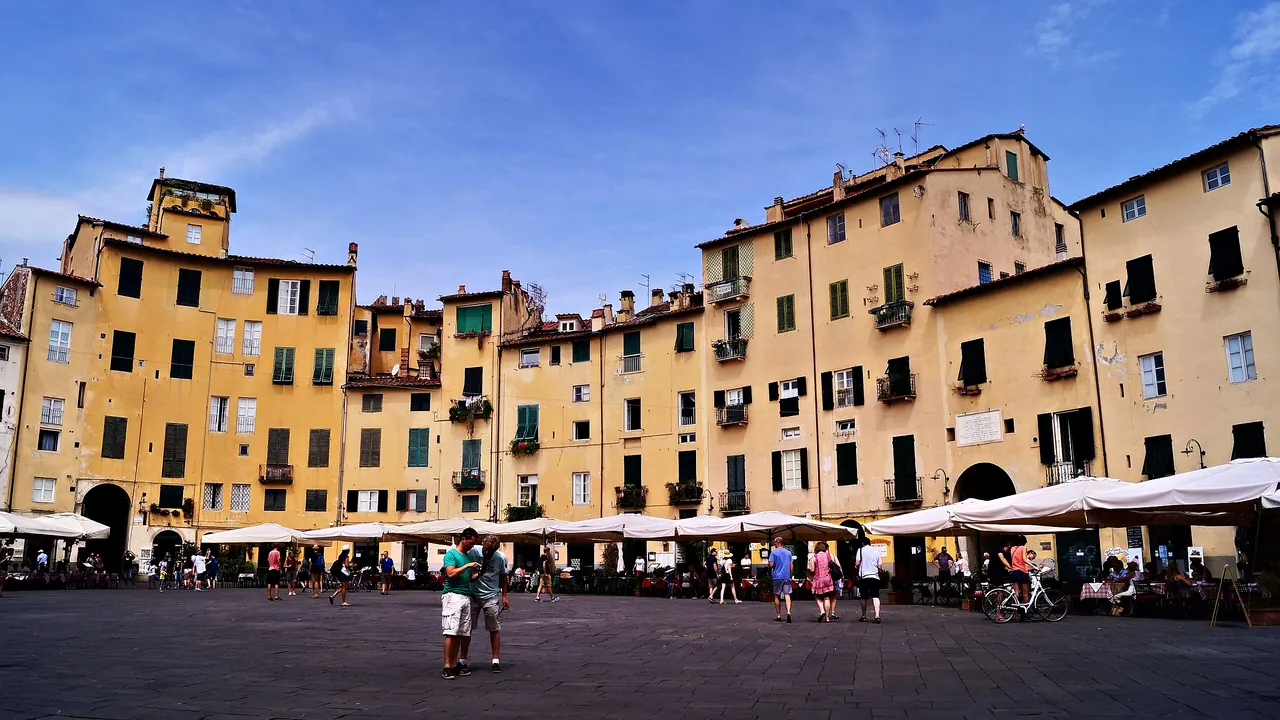
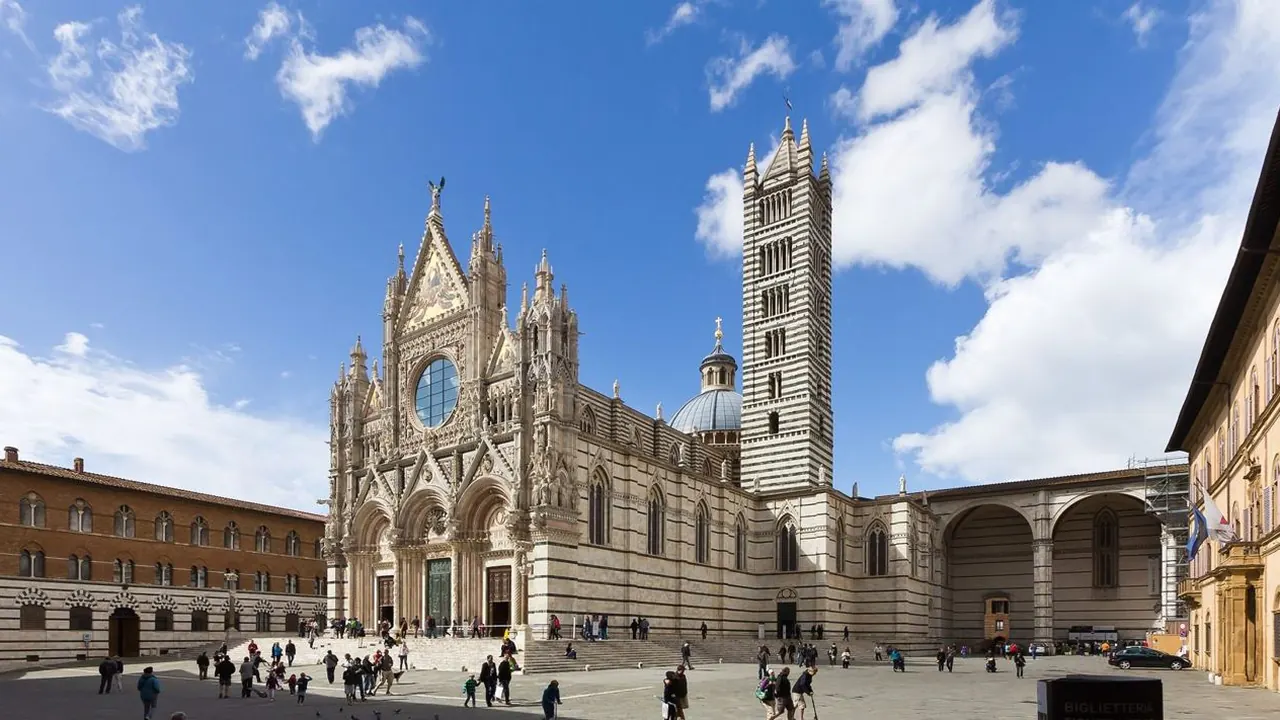
Photos: Lucca by Stefano Sansavini, CC BY-SA 4.0, cropped; Siena by Raimond Spekking, CC BY-SA 4.0, cropped.
Lucca or Siena?
Our verdict in twelve categories, each scored against the same fixed benchmark cities, and the climate month by month, so you can choose for your trip.
Choose Lucca for
- beaches
- families
- live music and the arts
Lucca suits travellers who want an easy, flat base with options in every direction. You can cycle the walls, go to an evening of Puccini and take the train to Pisa or to a sandy Versilia beach the same afternoon. Families and anyone without a car will find it the simpler of the two, and it is the only one where a swim fits into an ordinary day.
Choose Siena for
- culture and sights
- nightlife
- food and drink
Siena is the stronger choice for travellers who come for medieval art and the Tuscan landscape itself. Its Duomo, the Campo and the Sienese painters outclass anything inside Lucca's walls, and the Crete Senesi, Val d'Orcia and the hot springs lie close by. The streets are steep and the coast is far away, so it rewards adults with time to linger and ideally a car for the hill towns.
Scoreboard
Twelve categories on one fixed scale from 0 to 100. The shaded stretch is the gap between the two.
Your match
Pick a travel style or drag the sliders, and both match scores follow your weighting.
Wins on beaches and families with your weighting.
Wins on culture and sights and nightlife with your weighting.
What matters to you?
Category by category
What the scores mean for a trip.
Beaches & swimming
Lucca has a real beach option and Siena does not. The Versilia coast starts at Viareggio, a short train ride away, with long, gently shelving sand that runs up to Forte dei Marmi, and there are wilder dunes at the Lecciona. A morning in town and an afternoon swim is easy.
From Siena, the nearest good beaches are around Castiglione della Pescaia on the Maremma, well over an hour by car. Swimming there means a full day out, so most visitors settle for a hotel or agriturismo pool.
Food & drink
Both cities eat well in a rustic Tuscan style, and in both, variety beyond the local kitchen is thin. Lucca's table is plainer and leans on its province, with farro soup from the Garfagnana, meat-filled tordelli, chickpea cecina and chestnut flour in the colder months.
Siena has the edge in wine and baking. Chianti Classico grows to the north and Brunello and Vino Nobile to the south, and the enoteche pour them by the glass. Hand-rolled pici and cinta senese pork turn up on the menus, and old pastry shops sell panforte and ricciarelli.
Culture & sights
Siena is the richer cultural stop. The Campo and Palazzo Pubblico, Lorenzetti's Good and Bad Government, the Duomo with its Piccolomini Library and Duccio's Maestà make up a set of medieval masterpieces that Lucca cannot match. The contrade give each neighbourhood its own identity.
Lucca's appeal is more about the whole town than about single works. It has its complete Renaissance walls, the carved arcades of San Michele in Foro, the oval Piazza dell'Anfiteatro and the Torre Guinigi with trees on top. Its museums are modest, and two days cover it comfortably.
Nightlife
Neither is a place for late nights, and both centres quieten before midnight. Lucca's evenings run to aperitivo in its piazzas and a stroll along the walls, and in summer the dancing happens on the Versilia coast, which means a late drive back.
Siena has a slightly busier student bar scene thanks to the university. Its one real exception is the Palio, when the contrade hold long outdoor dinners and the streets stay full late into the night.
Nature & outdoors
These are two different landscapes of roughly equal appeal. Lucca has more variety. The walls and the Serchio cycle paths are right in town, the steep marble peaks of the Apuan Alps are within an hour for serious hiking, and the wetlands of Massaciuccoli and San Rossore are good for birdwatching.
Siena offers the classic postcard Tuscany: the bare clay hills of the Crete Senesi, the Val d'Orcia and cypress-lined lanes. Its strength is cycling on the strade bianche gravel roads, but there are no high mountains and no coast.
Day trips
Both make superb bases, but they face in different directions. Lucca has Pisa, Florence, Pistoia and the Montecatini spas along a single rail line, plus the villa gardens, Pietrasanta's sculptors and the Cinque Terre at a stretch.
Siena sits among the hill towns and the wine country: San Gimignano, Monteriggioni, the Chianti villages, Montalcino, Pienza and abbeys such as Sant'Antimo and San Galgano. Many of these are hard to reach without a car, whereas much of Lucca's list works by train.
Good for families
Lucca is noticeably easier with children. The centre is flat and car-free, renting a family quadricycle on the walls is a ready-made outing, Pinocchio Park at Collodi and the beaches are both close, and Lucca Comics & Games delights teenagers in autumn.
Siena is safe and welcoming, and older children enjoy the Torre del Mangia and the contrada drummers. Its steep, stepped lanes are hard work with a pushchair, though, and there is nothing aimed at children, so families often stay in a farmhouse with a pool instead.
Getting around
Lucca is the easier town to move around. It is flat inside its walls, bikes are the local transport, and the station sits just outside the southern gate with regular trains along the coast and to Florence.
Siena is just as walkable but much steeper, spread over three ridges, with escalators climbing from a valley station served by slow, infrequent trains. Buses are the better link to Florence. In both, the countryside is far simpler with a hire car.
Shopping & style
Lucca has a little more to offer. Via Fillungo combines fashion and jewellery behind old Liberty shopfronts, and the monthly antiques market around the cathedral is one of the oldest in Italy and worth planning a weekend around.
Siena's shopping centres on local crafts and food: majolica ceramics, contrada scarves, panforte and pecorino, plus the weekly market by the Fortezza. Away from Banchi di Sopra, the lanes near the Campo are mostly souvenir stalls.
Affordability
The two cost much the same, both cheaper than Florence and neither cheap, with rooms inside the walls as the main expense. Lucca is slightly kinder overall, because its walls and many of its churches are free to visit.
In Siena, entry to the cathedral complex and the civic museums adds up, and room prices jump around the Palio. In both, staying outside the walls or in an agriturismo saves money.
Live music & performing arts
Lucca has more live music. As Puccini's birthplace, it holds recitals of his arias most evenings in a central church, an opera season at the Teatro del Giglio and big outdoor concerts in Piazza Napoleone in July. The lakeside Puccini Festival at Torre del Lago is close by.
Siena's music is more academic: summer chamber concerts from the Accademia Chigiana, jazz from Siena Jazz and a winter programme at its two historic theatres. For opera, you have to go to Florence.
Wellness & relaxation
Neither town has baths of its own, so a soak means a trip out of town from either. From Lucca you can take the train to the grand belle époque spa halls of Montecatini or drive to the steam grottoes of Bagni di Lucca and the cave pools of Monsummano.
Siena's springs are wilder and more rural. Rapolano's travertine pools, the steaming village bath at Bagno Vignoni and the free limestone pools of Bagni San Filippo suit a stay at a countryside spa better than a quick train trip.
When should you go?
Pick your month. The climate figures are measured averages, not a forecast.
Lucca in July
Siena in July
Daytime high, °C
Rainfall in the month, mm
Where the figures come from
Siena's temperatures are measured 45 km from the centre, at Arezzo.
Siena has no rain gauge within 25 km of the centre, so its rainfall comes from a gridded climate dataset read at the city rather than from a gauge further away.
Temperature and rainfall are climate normals, averaged over the years shown. Lucca: 1991-2020 normals, Pisa / S. Giusto (21.4 km from centre). Siena: 2006-2017 (rainfall 1991-2020) normals, Arezzo (45 km from centre).
Both cities are at their best for walking in May and from late September into October, when the days sit in the low to mid twenties. July and August are hot in both, with Siena a degree warmer at about 31°C and its hills making the heat harder work on foot. Lucca has the summer advantage of the sea nearby, which warms to about 25°C in July and August and is pleasant for swimming from June to September, and July there is the sunniest month of the year.
Autumn turns wet in both, but Lucca turns sooner. Its rain climbs steeply from September and peaks in October and November at around 130mm a month, while Siena stays drier through October before catching up in November. Winters are cool in each, though Siena on its ridges is the colder, with January highs near 9°C.
Which traveller are you?
On a beach and sun trip, Lucca is the clear pick. Trains reach the wide sandy beaches of the Versilia in under half an hour, so a swim fits around sightseeing. From Siena, the Maremma coast takes a full day.
For a culture and arts trip, Siena gives more to see. Lorenzetti's frescoes, Duccio's Maestà, the Duomo's inlaid floor and the Pinacoteca make up a deeper collection than Lucca's Romanesque churches and its modest museums, and the whole medieval centre is UNESCO-listed.
On a family trip with children, Lucca is easier. Its flat, traffic-free centre is good for pushchairs and for bike rides on the walls, and Pinocchio Park and the beaches are close by. Siena's steep lanes and lack of children's attractions are harder going.
Before you go
| Measure | Lucca | Siena |
|---|---|---|
| Official language | Italian | Italian |
| Currency | Euro (EUR) | Euro (EUR) |
| Sockets | CFL230 V, 50 Hz | CFL230 V, 50 Hz |
| Driving side | Right | Right |
| Time zone | UTC+1, UTC+2 in summer | UTC+1, UTC+2 in summer |
| Emergency number | 112 | 112 |
| Elevation | 19 m | 322 m |
| Main airport | Pisa International Airport (PSA)21 km from centre82 non-stop destinations | Florence Airport, Peretola (FLR)55 km from centre46 non-stop destinations |
| Public holidays this year | 13 days | 13 days |
By the numbers
| Measure | Lucca | Siena |
|---|---|---|
| City population | 88,798 | 52,812 |
| People per km² | 478 | 446 |
| Museums within 10 km | 20 | 30 |
| UNESCO World Heritage sites within 50 km | 4 | 5 |
| Swim season, months above 21 °C | 4 months | - |
Where else could you go?
Every comparison below shares a destination with this one, so you can follow Lucca or Siena somewhere new.