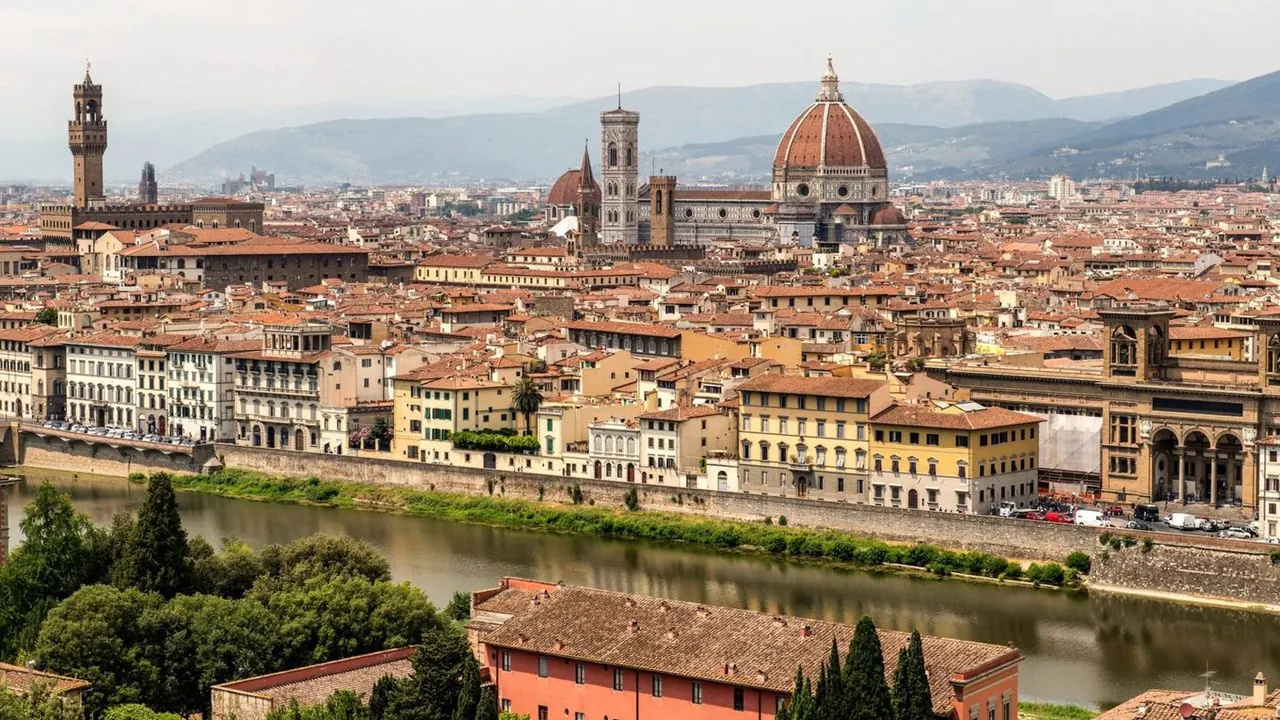
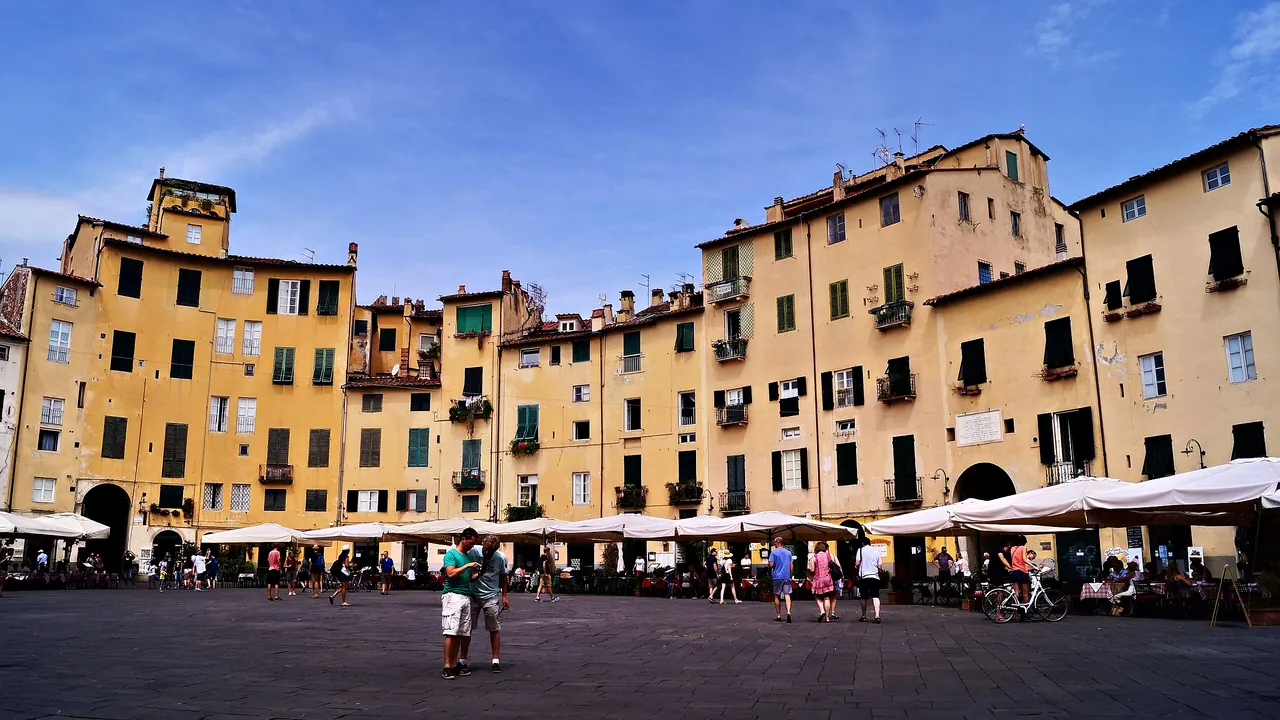
Photos: Florence by Wolfgang Weiser, Pexels License; Lucca by Stefano Sansavini, CC BY-SA 4.0, cropped.
Florence or Lucca?
Our verdict in twelve categories, each scored against the same fixed benchmark cities, and the climate month by month, so you can choose for your trip.
Choose Florence for
- shopping
- culture and sights
- nightlife
Florence is the choice for a first trip to Tuscany built around art. The Uffizi, the Accademia, the Bargello and Brunelleschi's dome are all a short walk apart. When the museums close, there are market lunches, craft workshops and long evenings in the Oltrarno. It costs more, the summer crowds test your patience, and the sea is a full day's outing away.
Choose Lucca for
- beaches
- families
- prices
Travellers who want a slower, quieter base will find it in Lucca. You can walk its walled streets and Romanesque churches without hurrying, and from there the Versilia beaches, the Apuan Alps and Pisa are each close enough for half a day. It is easier with children and a little gentler on the budget, and it is the better pick if a swim matters as much as a fresco.
Scoreboard
Twelve categories on one fixed scale from 0 to 100. The shaded stretch is the gap between the two.
Your match
Pick a travel style or drag the sliders, and both match scores follow your weighting.
Too close to call, 2 points apart
Wins on shopping and culture and sights with your weighting.
Wins on beaches and families with your weighting.
What matters to you?
Category by category
What the scores mean for a trip.
Beaches & swimming
Lucca is the one for a swim. The Versilia sand at Viareggio is about 25 minutes by train, so it is easy to spend the morning in town and the afternoon at a beach club or on the pine-backed dunes of the Lecciona.
From Florence the same coast is about an hour and a half each way, which makes the sea a full day's outing. Most visitors there cool off in a hotel or public pool instead.
Food & drink
Florence eats with more range. It has bistecca, ribollita and lampredotto from street carts, two working markets at San Lorenzo and Sant'Ambrogio, Chianti reds from just outside the city and a fine-dining tier for a special night. The catch is the set menus around the Duomo, so the better meals are in the trattorie of the Oltrarno.
Lucca's cooking is more rustic and more local. It is built on Garfagnana spelt, tordelli, chestnut flour, cecina and buccellato, and it is reliable and fairly priced. On a longer stay, though, its menus start to repeat in a way Florence's do not.
Culture & sights
Florence holds the Renaissance at full strength: the Uffizi, David at the Accademia, the Bargello's sculpture and the Pitti. Smaller treasures such as the San Marco frescoes and the Brancacci Chapel add more, and you could fill a week as long as you book ahead and accept summer queues.
In Lucca the appeal is the whole townscape rather than the collections. The intact, tree-lined walls, the carved façades of San Michele and San Frediano, the oval Piazza dell'Anfiteatro and the Torre Guinigi are the highlights. Its museums are modest, and two unhurried days cover it.
Nightlife
Neither is a city for clubbing, but Florence stays up later. Piazza Santo Spirito fills with people drinking outside on warm nights, Sant'Ambrogio draws locals, student pubs cluster near the centre, and in summer bars open along the Arno.
Lucca's evening is an aperitivo in Piazza San Michele, a long dinner and a walk on the walls, and the centre is quiet by midnight. Anyone who wants to dance has to go to the Versilia clubs and arrange a late ride back.
Nature & outdoors
Lucca has the wilder country within reach. The Apuan Alps, with their limestone peaks and marble quarries, rise about an hour to the north. The Garfagnana and the Orecchiella park have chestnut and beech woods, and Lake Massaciuccoli and San Rossore suit birdwatchers. Closer in, the 4km ring of the walls is where the town runs and cycles.
Florence's outdoors is gentler and more cultivated: olive terraces at Fiesole, the view from San Miniato and Chianti lanes for walking and cycling. The Casentino forests are further out.
Day trips
Both are excellent bases, and Florence has a slight edge in reach. Siena, Pisa, Lucca itself, San Gimignano, the Chianti villages and the Val d'Orcia are all within range, and Bologna is under forty minutes by fast train. That gives you a week of different places.
Lucca's options lean west and north instead. Pisa is half an hour away, and there are the villas of Marlia and Torrigiani, Collodi, Pietrasanta, Carrara and the Garfagnana villages, with Florence just over an hour off. The southern hill towns are much further from it, and San Gimignano or the Cinque Terre need an early start.
Good for families
Lucca is the easier city with children. It is small, flat and mostly car-free, and riding the walls on bikes or a family quadricycle is the classic outing. Collodi's Pinocchio park is about 20 minutes away and the beaches are under half an hour, and Lucca Comics & Games in autumn delights older children and teenagers.
Florence can work if you choose hands-on outings: the dome climb, the secret passages of Palazzo Vecchio, the Museo Galileo and the Boboli. Still, narrow pavements, summer crowds and the July heat make it harder going.
Getting around
You walk in both, and in both a car is a burden in the centre. Florence's main sights lie within a twenty-minute walk on crowded stone pavements, with trams to the airport and small buses up to Fiesole. Lucca, flat and traffic-free inside its walls, is easiest on a rented bike, but its buses to the countryside are sparse, so a car helps more there.
Shopping & style
Florence is much the stronger for shopping. It has leather from the San Lorenzo stalls to proper workshops, marbled paper, goldsmiths on the Ponte Vecchio, Oltrarno gilders and framers, and the fashion houses of Via de' Tornabuoni. Lucca has the old Liberty-style shopfronts of Via Fillungo, good delicatessens and a monthly antiques market worth planning a visit around, but nothing like Florence's luxury or craft depth.
Affordability
Neither city is cheap, but Lucca is gentler on the budget. The walls and many churches are free, the paid sights are modest, and the main expense is a room, which is often better value just outside the walls.
Florence costs more in the ways a visitor feels most: central hotels from spring to autumn, entry fees at the Uffizi, the Accademia and the dome, and restaurants near the sights. Street food, market lunches and a bed across the river or near the station keep costs in check.
Live music & performing arts
Both have a real opera heritage and little live music beyond it, so the difference is in character. Florence, where opera was born around 1600, has the Teatro del Maggio with its own orchestra and the Maggio Musicale festival every spring.
Lucca's music belongs to Puccini. Recitals of his arias are held in a central church for most of the year, the Teatro del Giglio has a season, and summer brings open-air opera by the lake at Torre del Lago and the big Lucca Summer Festival concerts in Piazza Napoleone.
Wellness & relaxation
Lucca is the more restful of the two, mostly because of its pace: quiet streets with no traffic, long lunches and an evening walk on the shaded walls. It is also closer to the baths. Montecatini is about half an hour by train, and there are cave pools at Monsummano and steam grottoes at Bagni di Lucca.
Florence in high season is crowded, and you find calm only in pockets such as the Boboli and Bardini gardens. The sulphur pools of Bagno Vignoni and Saturnia need a longer day out.
When should you go?
Pick your month. The climate figures are measured averages, not a forecast.
Florence in July
Lucca in July
Daytime high, °C
Rainfall in the month, mm
Where the figures come from
Florence has no rain gauge within 25 km of the centre, so its rainfall comes from a gridded climate dataset read at the city rather than from a gauge further away.
Florence's sunshine is measured 71 km from the centre, at Pisa / S. Giusto.
Temperature and rainfall are climate normals, averaged over the years shown. Florence: 1995-2020 (sunshine 1991-2020, rainfall 1991-2020) normals, Firenze / Peretola (5.6 km from centre). Lucca: 1991-2020 normals, Pisa / S. Giusto (21.4 km from centre).
Both cities are at their best in spring and autumn, when the days are mild enough for long walks and May already brings long, sunny evenings. Summer is where they part. Florence sits in a hot valley and reaches about 33°C in August, which makes afternoon sightseeing hard going. Lucca stays a little cooler, and from June to September its nearby coast is warm enough for swimming, with the sea at about 25°C in July and August.
Florence turns damper in September, with about 74mm, more than any of its spring months. Lucca is wetter still at about 102mm, so its autumn rain sets in sooner, and October and November are the wettest months in both. Winters are cool and grey in both, with highs around 11°C. That is fine for museums and churches, but not for long days outdoors.
Which traveller are you?
On a culture and arts trip, Florence is the obvious pick. The Renaissance was made here, and its masterpieces stayed in the city. Lucca's churches and streets make a lovely stroll, but you see its art quickly, while Florence still has more to show on a fifth or sixth day.
For a shopping trip, Florence is worth the journey in its own right. Many of its crafts are still made in the city, often by the person selling them, and Italian fashion has deep roots here. Lucca's shops are better for a browse between sights than for a dedicated day.
For a beach and sun trip, Lucca is the clear choice, because the sea fits into an ordinary day instead of taking one over. You can spend the morning in the old streets, swim in the afternoon and be back inside the walls for dinner. Florence makes you choose between the two.
Before you go
| Measure | Florence | Lucca |
|---|---|---|
| Official language | Italian | Italian |
| Currency | Euro (EUR) | Euro (EUR) |
| Sockets | CFL230 V, 50 Hz | CFL230 V, 50 Hz |
| Driving side | Right | Right |
| Time zone | UTC+1, UTC+2 in summer | UTC+1, UTC+2 in summer |
| Emergency number | 112 | 112 |
| Elevation | 50 m | 19 m |
| Main airport | Florence Airport, Peretola (FLR)6 km from centre46 non-stop destinations | Pisa International Airport (PSA)21 km from centre82 non-stop destinations |
| Public holidays this year | 13 days | 13 days |
By the numbers
| Measure | Florence | Lucca |
|---|---|---|
| City population | 360,930 | 88,798 |
| People per km² | 3,528 | 478 |
| Museums within 10 km | 141 | 20 |
| UNESCO World Heritage sites within 50 km | 6 | 4 |
| Swim season, months above 21 °C | - | 4 months |
Where else could you go?
Every comparison below shares a destination with this one, so you can follow Florence or Lucca somewhere new.