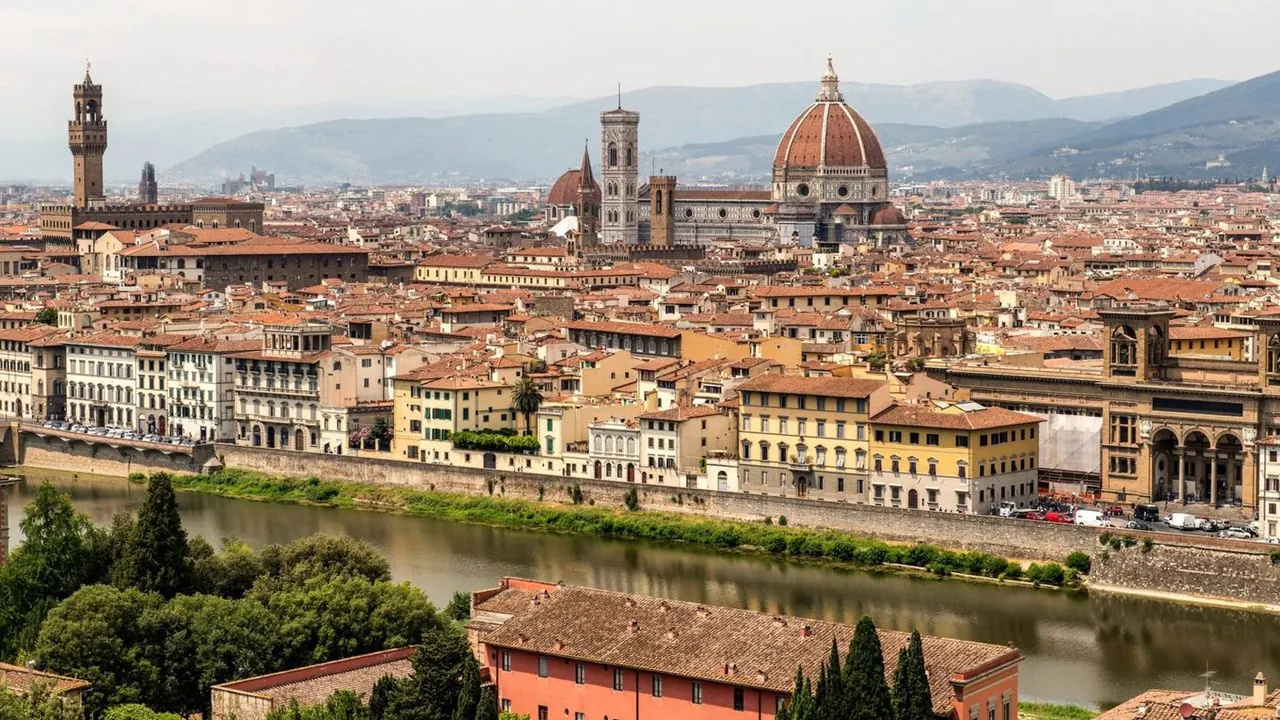
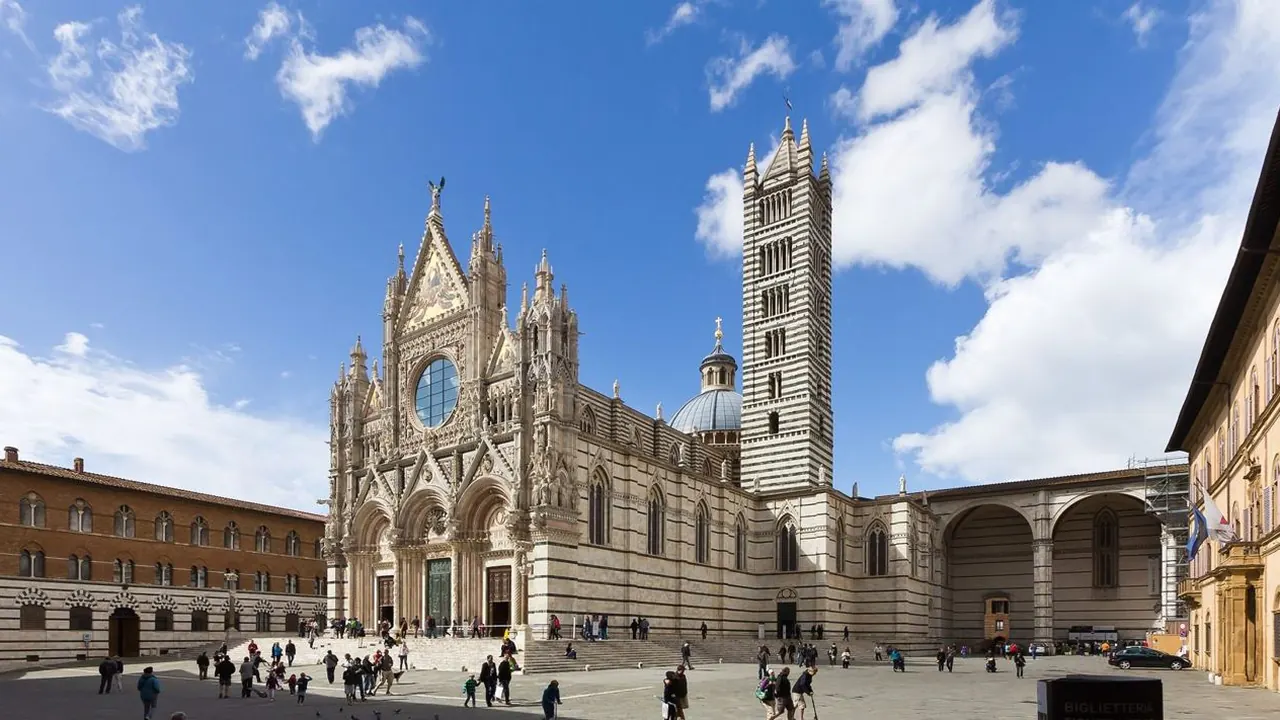
Photos: Florence by Wolfgang Weiser, Pexels License; Siena by Raimond Spekking, CC BY-SA 4.0, cropped.
Florence or Siena?
Our verdict in twelve categories, each scored against the same fixed benchmark cities, and the climate month by month, so you can choose for your trip.
Choose Florence for
- shopping
- live music and the arts
- getting around
Florence suits the traveller who wants the most in one place: the great Renaissance collections, a broader table, a proper classical season, serious craft and fashion shopping, and a flat centre where everything is a short walk apart. It is the better base for a first visit to Tuscany, and its main station puts Pisa, Lucca and Bologna within easy reach by train.
Choose Siena for
- wellness
- nature and the outdoors
- prices
Choose Siena for a slower, more rural trip. It is a medieval town rather than a Renaissance city, quieter at night and a little kinder on the budget, and it sits closer to the Crete Senesi, the Val d'Orcia and the hot springs of southern Tuscany. Cyclists, walkers and anyone who plans to unwind in thermal pools and stay on a farm will find it the better fit, especially with a hire car.
Scoreboard
Twelve categories on one fixed scale from 0 to 100. The shaded stretch is the gap between the two.
Your match
Pick a travel style or drag the sliders, and both match scores follow your weighting.
Wins on shopping and live music and the arts with your weighting.
Wins on wellness and nature and the outdoors with your weighting.
What matters to you?
Category by category
What the scores mean for a trip.
Beaches & swimming
Neither city has a beach, and in both a swim means a hotel pool. The difference is the coast you would head for. From Florence the train runs to the sandy, lounger-lined Versilia around Viareggio. From Siena you need a car for the quieter Maremma shore at Castiglione della Pescaia or Follonica. Either way it takes a full day, so if the sea matters, book a few nights on the coast.
Food & drink
Florence eats better and more widely. Lampredotto carts, bistecca in Oltrarno trattorie, the Mercato Centrale and Sant'Ambrogio market, a fine-dining tier and gelato taken seriously all give it more range than Siena.
Siena's strength is its own tradition: hand-rolled pici, cinta senese pork, wild boar and the bakeries' panforte and ricciarelli. It also sits between Chianti Classico and the Brunello and Vino Nobile country, so the wine by the glass is excellent. Beyond the Sienese table, though, there is little choice.
Culture & sights
Florence has the deeper collections. Brunelleschi's dome, Botticelli and Leonardo at the Uffizi, the David, the Bargello's sculpture and the San Marco frescoes can fill a week, though the big museums need booking and the summer queues are long.
Siena gives you the Middle Ages instead, and in a more complete form. The Campo, Lorenzetti's Good and Bad Government frescoes, the inlaid floor of the Duomo and Duccio's Maestà are covered well in two or three days, and the seventeen contrade give the town a living identity that sightseeing alone does not explain.
Nightlife
Neither is a club town, but Florence has more going on after dinner. Piazza Santo Spirito fills with people drinking outdoors, Sant'Ambrogio draws locals, the student pubs stay loud and summer brings bars along the Arno.
Siena is mostly quiet before midnight: a glass of wine on the Campo, a few student bars and an evening walk. The exception is Palio time, when the contrade dinners keep the streets full late into the night.
Nature & outdoors
Siena is closer to the landscape that people picture when they think of Tuscany. The bare clay hills of the Crete Senesi and the UNESCO-listed Val d'Orcia are on its doorstep, and the white gravel strade bianche start at the edge of town, which makes it a real cycling base. The Via Francigena and the Montagnola woods are there for walkers.
Florence's green escapes are gentler and closer in: the olive terraces of Fiesole, the paths of Monte Morello and the Chianti lanes. For something wilder it can reach the Casentino forests and the Apuan Alps.
Day trips
Both sit in the heart of Tuscany and you will not run out of outings from either. Florence's advantage is the railway. Pisa, Lucca and Bologna are easy by train, and Bologna is under forty minutes away.
Siena is closer to the south: Montalcino's cellars, Pienza, Montepulciano and the abbeys of Monte Oliveto Maggiore, Sant'Antimo and San Galgano. Most of those really need a car.
Good for families
Florence has a slight edge with children because it has more hands-on things to do: the secret passages of Palazzo Vecchio, the globes at the Museo Galileo, the dome climb and the open space of the Boboli. The Pinocchio park at Collodi is about an hour away.
Siena has the tower climb and the contrada drummers, which older children enjoy, but nothing is built for them, and its steep streets are hard work with a pushchair. Families there often stay at a country farmhouse with a pool and come into town for half days.
Getting around
Both centres are best on foot, but Florence is the easier of the two. It is flat, its main sights are within about twenty minutes of each other, trams run to the airport, and Santa Maria Novella station sits right in the centre.
Siena stands on three ridges, so walking means climbs and stepped lanes. The station is down in the valley, reached by escalators, and regional trains are slow, so buses are the better link to Florence. A car parked outside the walls is close to essential for the countryside.
Shopping & style
This is one of the widest gaps between the two. Florence is a craft and fashion city: leather from market stalls and workshops, marbled paper, goldsmiths on the Ponte Vecchio, gilders in the Oltrarno, antiques on Via Maggio and luxury houses on Via de' Tornabuoni.
Siena's shopping is modest. Banchi di Sopra has Italian clothing and shoe shops, and the souvenirs worth taking home are majolica, contrada flags, pecorino and panforte. The weekly market by the Fortezza Medicea is the liveliest it gets.
Affordability
Siena is a little easier on the budget, though neither city is cheap. Its osteria lunches are good value, and an agriturismo or a room in a nearby town costs less than one inside the walls, except around the Palio, when room prices jump.
Florence's central hotels and museum fees add up faster. Street-stall lampredotto, market counters and a room across the river or near the station help a lot.
Live music & performing arts
Florence has the bigger stage. Opera more or less began here, the Maggio Musicale company has its own orchestra and puts on opera and ballet through the season, and its spring festival is one of Europe's oldest.
Siena's music comes from its schools. The Accademia Chigiana holds summer concerts in palaces, and Siena Jazz brings in teachers and students. It is a good programme for a town of its size, but for opera you would go to Florence.
Wellness & relaxation
Siena is closer to the hot springs. Rapolano Terme is about half an hour away, and Bagno Vignoni, the free limestone pools of Bagni San Filippo and Petriolo's sulphur river are all within reach, which makes thermal days an easy part of a stay.
From Florence, the handiest option is the grand old spa town of Montecatini Terme by train, while the outdoor pools of the south mean a long day or a night away. Inside the city, calm comes mainly from the Boboli and Bardini gardens.
When should you go?
Pick your month. The climate figures are measured averages, not a forecast.
Florence in July
Siena in July
Daytime high, °C
Rainfall in the month, mm
Where the figures come from
Florence has no rain gauge within 25 km of the centre, so its rainfall comes from a gridded climate dataset read at the city rather than from a gauge further away.
Florence's sunshine is measured 71 km from the centre, at Pisa / S. Giusto.
Siena's temperatures are measured 45 km from the centre, at Arezzo.
Siena has no rain gauge within 25 km of the centre, so its rainfall comes from a gridded climate dataset read at the city rather than from a gauge further away.
Temperature and rainfall are climate normals, averaged over the years shown. Florence: 1995-2020 (sunshine 1991-2020, rainfall 1991-2020) normals, Firenze / Peretola (5.6 km from centre). Siena: 2006-2017 (rainfall 1991-2020) normals, Arezzo (45 km from centre).
The two share a climate, and both are at their best in late April, May, late September and early October, when days of about 20°C to 24°C make the streets and hills comfortable. July and August are hot in both. Florence, down in its valley, is the hotter of the two, reaching 33°C in August with long sunny days, and afternoons are hard going on its stone paving. Siena on its ridges runs a degree or two cooler, though it is still too hot for long walks in the middle of the day.
The wet seasons differ. Florence stays fairly dry until September, then turns wet through October and November, with around 120mm in November. Siena's rain is spread more evenly, with damp spells in March and May as well as a wet November and December. Winters are cool in both, and Siena is slightly colder, with January highs of about 9°C.
Which traveller are you?
On a culture and arts trip, Florence is the clear choice. Its museums can fill a week where Siena's medieval sights take two or three days, and evenings of opera and orchestral music round out the days in a way Siena cannot match.
On a shopping trip, choose Florence. You can buy what the city's old trades still make by hand, and top-end Italian fashion as well. Siena has good gifts and food to take home, but not enough to plan a trip around.
For a relaxing and wellness trip, Siena is the better base. The nearest thermal springs are close enough for an afternoon soak rather than a full day out, the town goes quiet once day visitors leave, and a farm stay in the hills makes slowing down easy.
Before you go
| Measure | Florence | Siena |
|---|---|---|
| Official language | Italian | Italian |
| Currency | Euro (EUR) | Euro (EUR) |
| Sockets | CFL230 V, 50 Hz | CFL230 V, 50 Hz |
| Driving side | Right | Right |
| Time zone | UTC+1, UTC+2 in summer | UTC+1, UTC+2 in summer |
| Emergency number | 112 | 112 |
| Elevation | 50 m | 322 m |
| Main airport | Florence Airport, Peretola (FLR)6 km from centre46 non-stop destinations | Florence Airport, Peretola (FLR)55 km from centre46 non-stop destinations |
| Public holidays this year | 13 days | 13 days |
By the numbers
| Measure | Florence | Siena |
|---|---|---|
| City population | 360,930 | 52,812 |
| People per km² | 3,528 | 446 |
| Museums within 10 km | 141 | 30 |
| UNESCO World Heritage sites within 50 km | 4 | 5 |
Where else could you go?
Every comparison below shares a destination with this one, so you can follow Florence or Siena somewhere new.