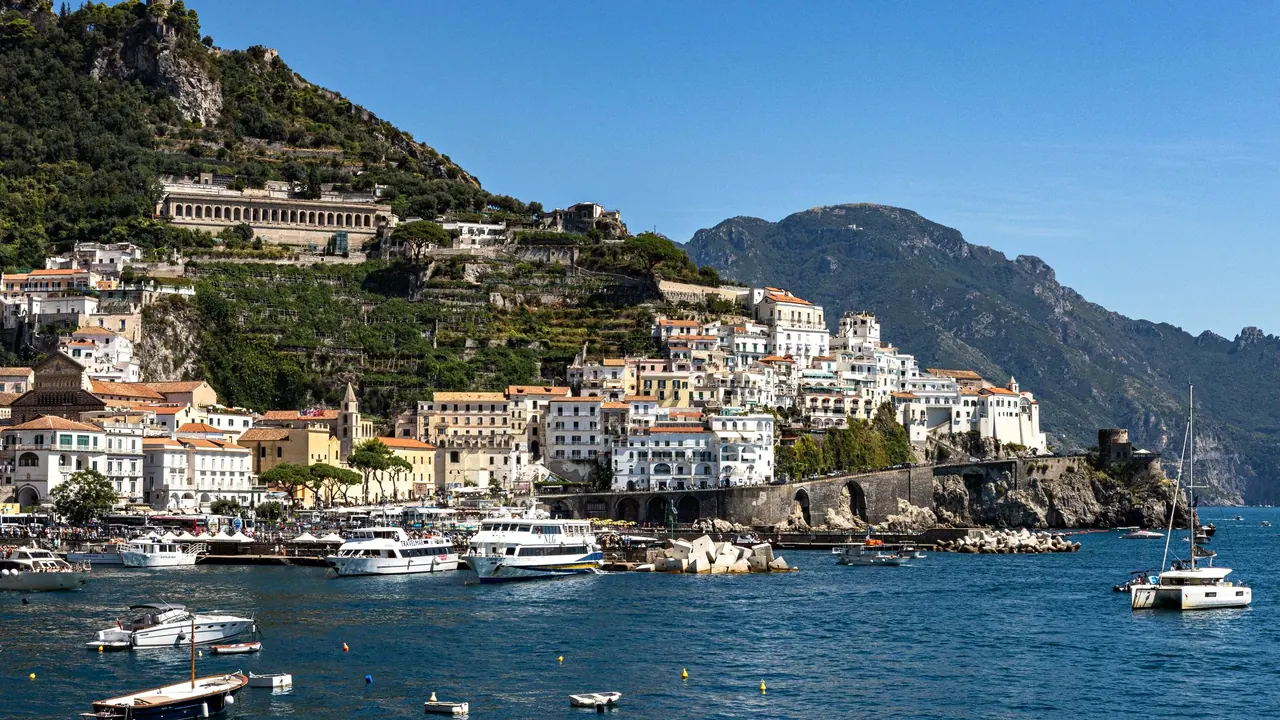
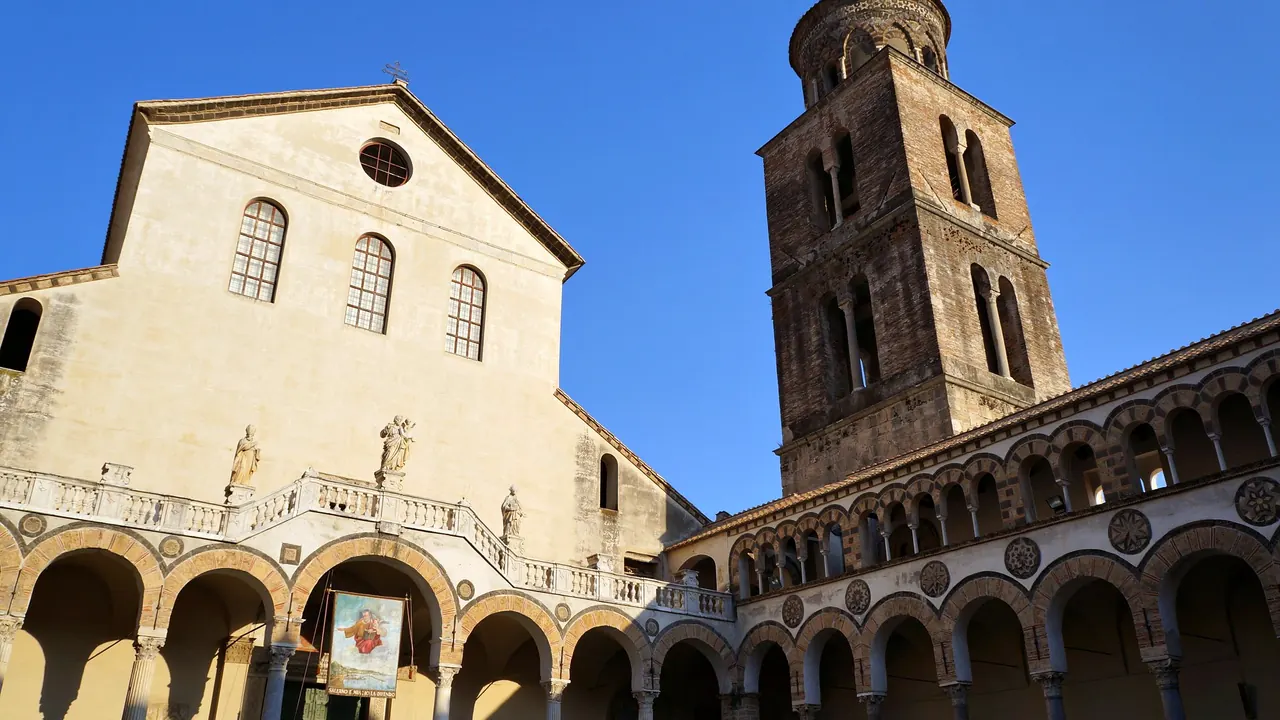
Photos: Amalfi by Oleksandra Zelena, Pexels License; Salerno by Leandro Neumann Ciuffo, CC BY 2.0, cropped.
Amalfi or Salerno?
Our verdict in twelve categories, each scored against the same fixed benchmark cities, and the climate month by month, so you can choose for your trip.
Choose Amalfi for
- nature and the outdoors
Amalfi suits travellers who want to wake up inside the scenery itself and are willing to pay for it. The gorge of the Valle delle Ferriere starts behind the town, the Path of the Gods is a short bus ride away, and boats leave the harbour for coves and sea caves. Evenings are a long dinner and a quiet piazza. It is best for couples and walkers without small children who value setting over variety.
Choose Salerno for
- prices
- nightlife
- families
Salerno is the practical choice for almost everyone else. It costs far less, eats better and more widely, has lively evenings in the old town and a flat seafront that works with a pushchair. Trains run straight to Paestum, Pompeii and Naples, and ferries take you to the Amalfi Coast for the day. Pick it if you want the region rather than one postcard view, or if budget and children shape the trip.
Scoreboard
Twelve categories on one fixed scale from 0 to 100. The shaded stretch is the gap between the two.
Your match
Pick a travel style or drag the sliders, and both match scores follow your weighting.
Wins on nature and the outdoors with your weighting.
Wins on prices and nightlife with your weighting.
What matters to you?
Category by category
What the scores mean for a trip.
Beaches & swimming
Both towns give you equally good swimming, but on very different shores. Amalfi is pebbles. Marina Grande sits right below the Duomo and is packed with rows of beach-club loungers in summer, so the best swims are in Atrani or in coves such as Santa Croce, reached by stairs or small boats, where the water is very clear.
Salerno's own beaches are grey sand, and the water near the port is less clean. The real draw is the long sandy shore towards Paestum, backed by pine woods, which suits a whole lazy day by the sea in a way Amalfi's coves never can.
Food & drink
Salerno eats better and more widely. The two share a pantry of terrace lemons, Cetara's colatura and lemon cakes, but in Amalfi the choice is small and the piazza cafés are mostly average. The best meals here come from finding a careful trattoria up an alley, ordering scialatielli with seafood and a white from Furore.
Salerno has a proper city's depth: wood-fired pizza, friggitorie, sfogliatelle in the old town, and buffalo mozzarella brought in the same day from the Battipaglia plain. The cooking is everyday rather than refined, but it is consistently good.
Culture & sights
Each town is built around a medieval cathedral holding an apostle's relics, Andrew in Amalfi and Matthew in Salerno, but Salerno has more around it. Amalfi's striped Duomo, the Chiostro del Paradiso, the Arsenale and the paper mill museum fill about half a day.
Salerno adds the Giardino della Minerva, linked to Europe's earliest medical school, the Arechi Castle above the gulf and small diocesan and archaeological museums. That is a day or two of sightseeing rather than a morning.
Nightlife
Amalfi effectively shuts down after dinner. A drink on Piazza Duomo or a gelato by the harbour is the whole evening, and the town empties once the day visitors leave.
Salerno has a real going-out scene, if a modest one. On weekends and summer nights, young locals spill out of wine bars and pubs into the squares around Largo Campo and Via dei Mercanti until late. Neither town has clubs worth the name, and both send you to Naples for a big night.
Nature & outdoors
This is Amalfi's strongest suit, and it has the slight edge because the landscape starts at its door. You can walk from your room into the Valle delle Ferriere, climb the old mule stairways to Pontone and Ravello, or kayak out to the Emerald Grotto. Agerola, the start of the Path of the Gods, is a short bus ride away.
Salerno reaches the same trails by ferry or bus, which costs time. In return, it has the Cilento to the south, with wooded hills, the Calore gorges and the wild headlands around Palinuro, best explored with a car.
Day trips
Both are excellent bases, but they point in different directions. Amalfi is the hub of the coast. Ravello, Positano, Atrani and Cetara are close by bus or boat, and Capri is a ferry ride away in season, but Pompeii and Paestum take planning along the slow coast road.
Salerno is on the railway, so Paestum's temples and Pompeii are each about half an hour away, and Naples, Herculaneum and the palace at Caserta are easy days out. Its own trips to the Amalfi Coast rely on seasonal ferries.
Good for families
Salerno is much kinder to children. Its flat seafront promenade has gardens, playgrounds and gelato, the beaches towards Paestum are shallow sand, and the Luci d'Artista lights give winter visits a draw of their own. It still has no zoo or theme park.
Amalfi is a town of stairs where pushchairs are useless, the pebble beach is crowded, and the winding buses unsettle carsick children. It works for older children who swim well and enjoy boats and sea caves.
Getting around
Salerno is the easier place to move about. The station, the Corso, the seafront and the old town lie along one walkable strip, a short metro line and buses cover the rest, and regional trains run direct to Naples, Pompeii and Paestum.
Amalfi is tiny and walkable but built on steps, which makes it hard for anyone with limited mobility. Its buses and ferries are useful, but in summer the buses fill up and the single cliff road clogs. In neither town is a car worth it on the coast.
Shopping & style
Salerno has the edge simply because it has a real high street. Corso Vittorio Emanuele has Italian chains and clothing, and Vietri's majolica is close by.
Amalfi has a single street of limoncello, lemon soap and ceramics that repeat from shop to shop. Its one genuine find is handmade cotton paper from the valley mills, along with sandals made to measure. Neither town has much luxury shopping.
Affordability
There is a big gap here. Amalfi is among the most expensive places to stay in Italy: sea-view rooms are priced like the dearest capitals, and piazza meals, loungers and boat hire add up fast. Only the local buses are cheap.
Salerno is a working city with local prices for rooms, pizza and trains. Many people stay there and visit Amalfi for the day for exactly that reason. Its costs rise in summer with ferries and lido sunbeds, but it never approaches Amalfi's level.
Live music & performing arts
Salerno has a stage of its own. The gilded Teatro Verdi, modelled on Naples's San Carlo, puts on a proper season of opera, concerts and ballet.
Amalfi has no theatre, only church concerts and the band music of the Sant'Andrea feast. It does sit closer to the Ravello Festival's summer concerts on the Villa Rufolo terrace, which guests from either town can reach for a memorable evening.
Wellness & relaxation
Both towns are equally restful, in different ways, and neither has a bathing tradition. In Amalfi, calm comes from luxury cliff hotels whose spas mostly serve their own guests, from swims off the rocks and from the hill hamlets in May and October, as the centre gets noisy in high summer.
Salerno's version is a slow sunset walk along its palm-lined promenade. It is also within about an hour of the open-air sulphur pools at Contursi Terme, though traffic on the main roads means it is never a retreat.
When should you go?
Pick your month. The climate figures are measured averages, not a forecast.
Amalfi in July
Salerno in July
Daytime high, °C
Rainfall in the month, mm
Where the figures come from
Amalfi's temperatures are measured 65 km from the centre, at Grazzanise.
Amalfi has no rain gauge within 25 km of the centre, so its rainfall comes from a gridded climate dataset read at the city rather than from a gauge further away.
Salerno's temperatures are measured 71 km from the centre, at Grazzanise.
Salerno has no rain gauge within 25 km of the centre, so its rainfall comes from a gridded climate dataset read at the city rather than from a gauge further away.
Temperature and rainfall are climate normals, averaged over the years shown. Amalfi: 1991-2020 normals, Grazzanise (64.7 km from centre). Salerno: 1991-2020 normals, Grazzanise (71.3 km from centre).
The two share almost the same climate, so the choice of town does not change the timing. The sea is warm enough for proper swimming from June to September, peaking around 26°C in August, and May and October are still fine for a bracing dip. July and August reach about 31°C with long, sunny days, which suits the beach but makes the exposed coastal trails and the stepped lanes of both old towns hard going in the middle of the day.
For walking and sightseeing, aim for late April to early June or for early October, when it is warm without the summer heat. The rain returns in September and builds through autumn, with November the wettest month at roughly 150mm, Salerno a little wetter than Amalfi. Winter is mild but grey and damp. That matters more in Amalfi, where ferries stop and little else happens, than in Salerno, which keeps its normal city life.
Which traveller are you?
On a trip with a tight budget, Salerno is the obvious choice. Rooms cost a fraction of what Amalfi charges for a sea view, trattorias and pizzerias charge local prices, and cheap regional trains reach Pompeii and Paestum without paying for Amalfi's accommodation.
For a food and nightlife trip, choose Salerno. Its old-town lanes have friggitorie, pastry shops and buffalo mozzarella fresh from the plain, and later on young locals fill the bars around Largo Campo. Amalfi's dining is narrower, and the town is quiet once the ferries leave.
On a family trip with young children, Salerno is far easier. Its long car-free promenade has playgrounds, and the shallow sandy beaches to the south suit small swimmers. Amalfi's stairways defeat pushchairs, and its crowded pebble beach is better left to confident older swimmers.
Before you go
| Measure | Amalfi | Salerno |
|---|---|---|
| Official language | Italian | Italian |
| Currency | Euro (EUR) | Euro (EUR) |
| Sockets | CFL230 V, 50 Hz | CFL230 V, 50 Hz |
| Driving side | Right | Right |
| Time zone | UTC+1, UTC+2 in summer | UTC+1, UTC+2 in summer |
| Emergency number | 112 | 112 |
| Elevation | 6 m | 4 m |
| Main airport | Naples International Airport (NAP)38 km from centre131 non-stop destinations | Naples International Airport (NAP)46 km from centre131 non-stop destinations |
| Public holidays this year | 13 days | 13 days |
By the numbers
| Measure | Amalfi | Salerno |
|---|---|---|
| City population | 4,729 | 127,186 |
| People per km² | 830 | 2,123 |
| Museums within 10 km | 8 | 9 |
| UNESCO World Heritage sites within 50 km | 5 | 5 |
| Swim season, months above 21 °C | 5 months | 5 months |
Where else could you go?
Every comparison below shares a destination with this one, so you can follow Amalfi or Salerno somewhere new.