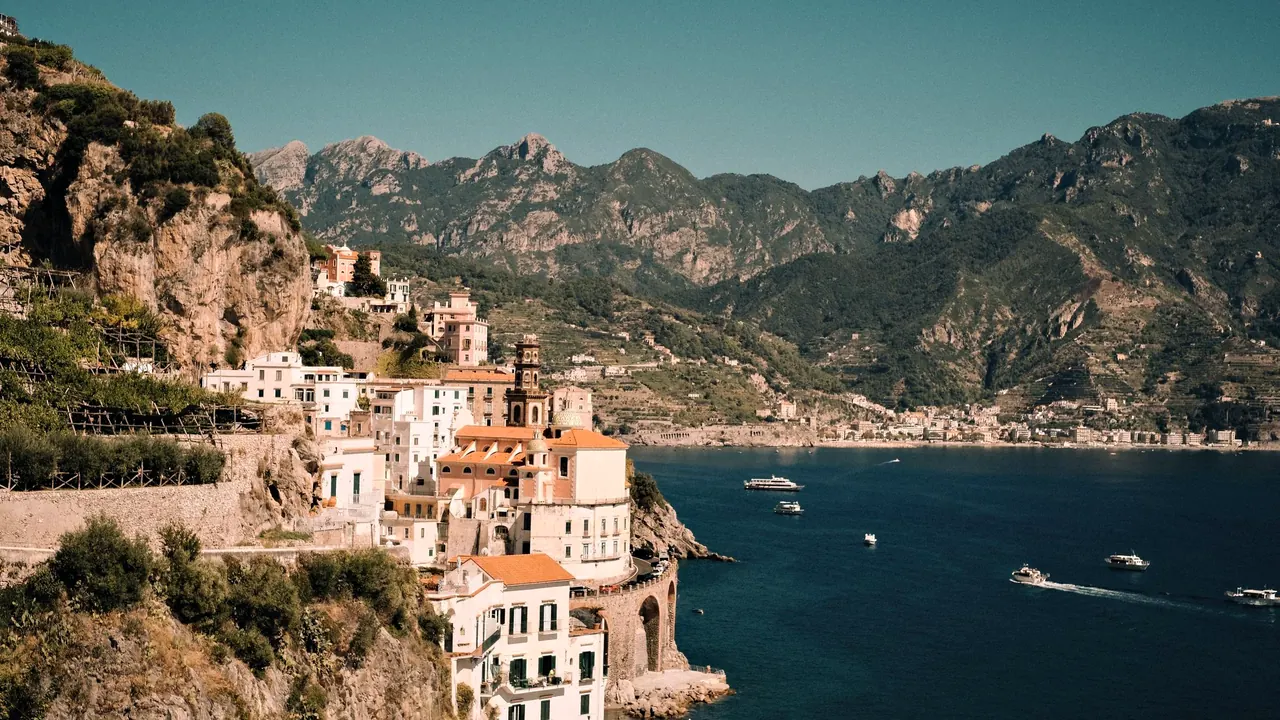
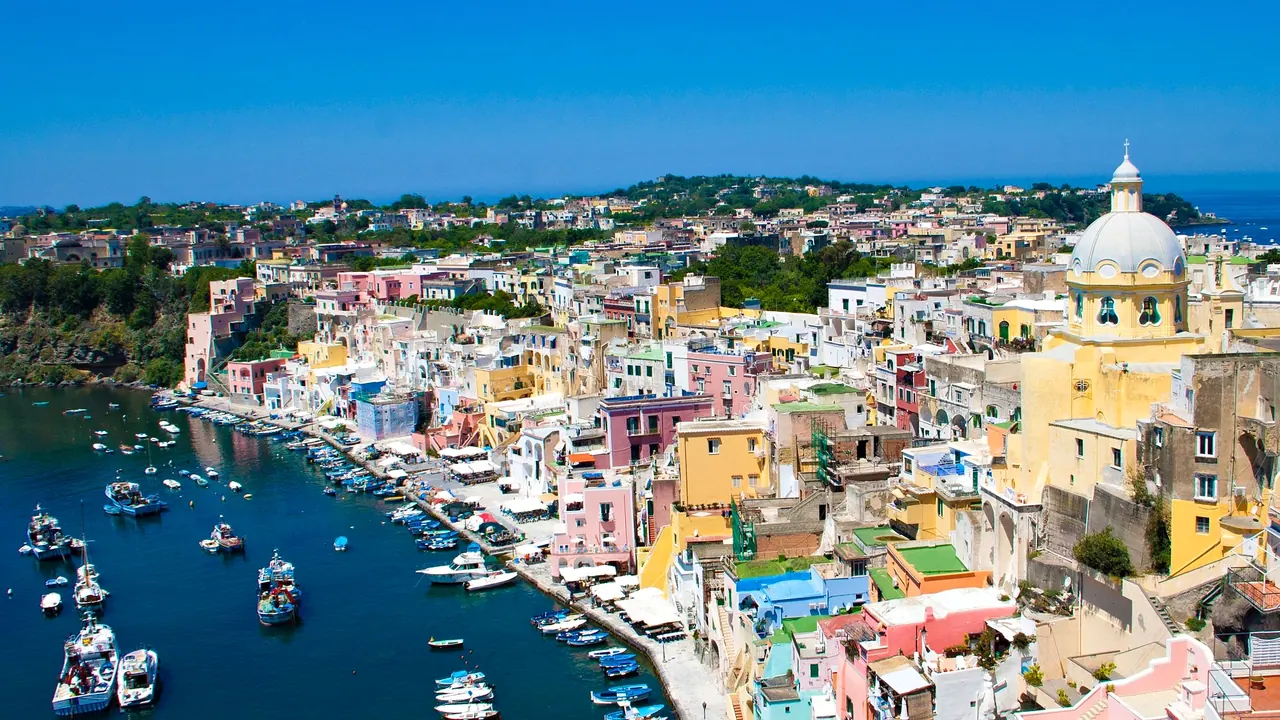
Photos: Amalfi Coast by Alina Chernii, Pexels License; Procida by DIANA.GRYGAROVA, CC BY-SA 4.0, cropped.
Amalfi Coast or Procida?
Our verdict in twelve categories, each scored against the same fixed benchmark cities, and the climate month by month, so you can choose for your trip.
Choose Amalfi Coast for
- shopping
- nature and the outdoors
- culture and sights
The Amalfi Coast is the stronger pick for travellers who want drama and variety and will pay for it. Its cliffs, the Path of the Gods, Ravello's villa gardens and the cathedral at Amalfi give more to see and do, the food goes from village trattorias to grand terrace dining, and Pompeii, Capri and Paestum are all within a day. It suits couples and active walkers who don't mind steps, slow roads and some of the highest prices in southern Italy.
Choose Procida for
- prices
- getting around
- families
Procida is for a smaller, slower trip at lower cost. You can cross the island in no time without a car, the sand beaches at Chiaiolella and Ciraccio slope gently enough for young children, and Ischia, Naples and the Phlegraean Fields are a short boat ride away when you want more. You give up range: the sights, the food and the walking run out within a few days, and there is very little to do in the evenings.
Scoreboard
Twelve categories on one fixed scale from 0 to 100. The shaded stretch is the gap between the two.
Your match
Pick a travel style or drag the sliders, and both match scores follow your weighting.
Wins on shopping and nature and the outdoors with your weighting.
Wins on prices and getting around with your weighting.
What matters to you?
Category by category
What the scores mean for a trip.
Beaches & swimming
Both give a good swim in clear, warm water, but the shores differ underfoot. The Amalfi Coast has grey-pebble coves under the cliffs at Positano, Atrani and the Furore fjord, many reached only by boat or long stairways. For many visitors the best swimming there is from a hired boat anchored below the rocks.
Procida's coves are dark volcanic sand. Chiaiolella and the long curve of Ciraccio are easy to reach and gentle, and Pozzo Vecchio is the sheltered one to look for. Both are small and crowded in August. On the coast, Maiori is the escape for sand and space.
Food & drink
The Amalfi Coast eats better and more widely. There is Cetara's colatura and cured anchovies, scialatielli with clams, fish baked in lemon leaves and Conca dei Marini's sfogliatella, served everywhere from Agerola farm kitchens to Ravello's hotel terraces. The trick is to avoid the day-tripper menus on the Positano and Amalfi waterfronts.
Procida keeps it simple. You get the morning's catch at Corricella, the island's own lemon salad with mint and chilli, and a lingua pastry by the ferries. It is good but soon exhausted, and many kitchens shut out of season.
Culture & sights
The Amalfi Coast has much more to show. There is the Arab-Norman cathedral and Cloister of Paradise from Amalfi's years as a maritime republic, the villa gardens of Rufolo and Cimbrone in Ravello and a Roman villa at Minori, all set in a UNESCO-listed cliff landscape.
Procida's heritage sits mainly at Terra Murata, with the abbey's ex-votos and the old prison of Palazzo d'Avalos, plus the pastel harbour at Corricella below. It makes a lovely day or two of slow walking. Neither has major museums, so the great collections mean a trip to Naples.
Nightlife
Neither is a place to go out, but the Amalfi Coast gives a little more. Positano has cocktail bars and the odd late summer spot, and the cathedral square in Amalfi keeps its café tables busy towards midnight. On Procida, the night ends with a drink on the harbour at Marina Grande or Chiaiolella, and a proper night out means a ferry to Ischia or Naples and a careful eye on the last boat back.
Nature & outdoors
This is the Amalfi Coast's great strength. The Lattari mountains fall straight to the sea, and the Path of the Gods above Positano is among Europe's finest coastal walks. Below it are terraced mule tracks, the shaded Valle delle Ferriere and sea caves such as the Grotta dello Smeraldo to explore by kayak.
Procida is low and gentle, a place of viewpoints rather than trails. Vivara, a reserve reached by a bridge, opens only for guided visits, and snorkelling and a boat circuit fill out the rest. A few days covers it.
Day trips
Both make excellent bases, the Amalfi Coast slightly the better. From it, Pompeii and Herculaneum are around an hour away, Capri and Sorrento are a ferry ride, and Paestum's Greek temples are within reach to the south. The slow coast road makes the sea the quickest way out.
Procida looks the other way, towards the Phlegraean Fields. Pozzuoli's amphitheatre, the sunken villas at Baia and Cuma are close, Ischia is a quarter of an hour by boat and Naples is under an hour away. Pompeii is a long haul, and every outing runs to the ferry timetable.
Good for families
Procida works better with young children. The sandy beaches shelve gently, nothing is far and a simple beach routine is easy to keep, though the walled lanes without pavements make pushchairs hard work.
The Amalfi Coast is built for couples. Positano and Amalfi mean hundreds of steps, pebble shores and crowded buses. Families who choose it should base themselves in flatter Maiori or Minori and plan around boat trips and the emerald grotto. Older children who like walking will manage the Path of the Gods.
Getting around
Procida is far easier. The island is only a few kilometres across, small buses and three-wheeled taxis cover it, and no one needs a car. Frequent ferries and hydrofoils link it to Naples, Pozzuoli and Ischia.
On the Amalfi Coast, a single cliff road with blind bends ties everything together, and it jams for hours in summer. Buses fill fast and parking barely exists. From spring to autumn the ferries between Positano, Amalfi and Salerno are the sane option, and every town is a climb on foot.
Shopping & style
The Amalfi Coast gives shoppers far more reason to browse. Positano has linen boutiques and sandal makers who fit while you wait, Amalfi sells paper from its old mills, and Vietri sul Mare is the place for majolica. Procida has only the small shops of Via Roma by the port, with ceramics, lemon goods and beachwear to look at while you wait for the ferry. Serious shopping from there means Naples.
Affordability
Procida is clearly kinder on the wallet. It is not cheap in high summer, and its few guesthouses fill and charge more in July and August. Even so, pizzas, pastries, buses and free beaches keep the days modest.
The Amalfi Coast in season is among Europe's priciest. Sea-view rooms, sunbeds, boats and coast-road taxis add up quickly. Staying in Minori, Atrani or Agerola and coming in late September brings it closer to reach.
Live music & performing arts
The Amalfi Coast has the one real draw here. Ravello's summer festival puts orchestras on a stage hung over the cliff at Villa Rufolo, with chamber concerts in churches and halls through the warm months. Elsewhere it is feast-day bands and the odd piano bar.
Procida has no stage at all. Its great moment is the Good Friday procession of the Misteri, carrying tableaux down from Terra Murata, plus occasional summer concerts in the squares.
Wellness & relaxation
Both rest on pace rather than bathing culture, but they get there differently. The Amalfi Coast's spas belong to its luxury cliff hotels, and the calm comes from Ravello's gardens or quieter Praiano and Atrani. Positano in high summer is anything but restful.
Procida is simply a place for doing very little, with quiet lanes and evenings over Corricella. Its real advantage is Ischia's thermal springs, a quarter of an hour by boat, which make an easy day of soaking. From the coast they are a long ferry day away.
When should you go?
Pick your month. The climate figures are measured averages, not a forecast.
Amalfi Coast in July
Procida in July
Daytime high, °C
Rainfall in the month, mm
Where the figures come from
Amalfi Coast's temperatures are measured 65 km from the centre, at Grazzanise.
Amalfi Coast has no rain gauge within 25 km of the centre, so its rainfall comes from a gridded climate dataset read at the destination rather than from a gauge further away.
Procida's temperatures are measured 32 km from the centre, at Grazzanise.
Temperature and rainfall are climate normals, averaged over the years shown. Amalfi Coast: 1991-2020 normals, Grazzanise (64.7 km from centre). Procida: 1991-2020 (rainfall 1971-2000) normals, Grazzanise (32.2 km from centre).
The two share the same warmth and the same long, sunny summers. Daytime highs reach about 31°C in July and August, and the sea is warm enough to swim from June into early October, at its warmest around 26°C in August. Midsummer is beach weather but hard going on foot, and that matters more on the Amalfi Coast, where the trails and stairways are steep. For walking, May, June and late September suit both, and on the coast October is still pleasant, if showery. From November to March both are cool and often wet.
Rain is where they differ. On the Amalfi Coast the dry spell runs from June to August, and August is the driest month of all at about 22mm. On Procida, June and July are the driest months. August there is noticeably wetter at about 46mm, and autumn turns wet sooner and harder, reaching about 163mm in November. October on the island is already rainy, so September is the safer end of its season, while the coast stays dry a little longer.
Which traveller are you?
For an outdoors trip, choose the Amalfi Coast. The Path of the Gods, the mule tracks between lemon terraces and the waterfall gorge of the Valle delle Ferriere give days of real walking, and the sea caves and the Li Galli islets add kayaking and snorkelling.
On a family trip with young children, Procida is the easier choice. The beaches at Chiaiolella and Ciraccio shelve gently, distances are short and trattorias are relaxed. On the Amalfi Coast, steep stairways, roads without pavements and packed buses wear families down outside Maiori and Minori.
On a trip with a tight budget, Procida goes much further. Guesthouses, pizzas, pastries and buses cost less, and a beach day is cheap if you skip the sunbeds. The Amalfi Coast prices its sea-view rooms, waterfront meals and boats among the highest in Europe.
Before you go
| Measure | Amalfi Coast | Procida |
|---|---|---|
| Official language | Italian | Italian |
| Currency | Euro (EUR) | Euro (EUR) |
| Sockets | CFL230 V, 50 Hz | CFL230 V, 50 Hz |
| Driving side | Right | Right |
| Time zone | UTC+1, UTC+2 in summer | UTC+1, UTC+2 in summer |
| Emergency number | 112 | 112 |
| Main airport | Naples International Airport (NAP)131 non-stop destinations | Naples International Airport (NAP)131 non-stop destinations |
| Public holidays this year | 13 days | 13 days |
By the numbers
| Measure | Amalfi Coast | Procida |
|---|---|---|
| Population | - | 10,092 |
| People per km² | - | 2,347 |
| Swim season, months above 21 °C | 5 months | 5 months |
Where else could you go?
Every comparison below shares a destination with this one, so you can follow Amalfi Coast or Procida somewhere new.
- Ischiavs Procida
- Caprivs Procida
- Caprivs Amalfi Coast
- Naplesvs Amalfi Coast
- Ischiavs Amalfi Coast
- Pugliavs Amalfi Coast