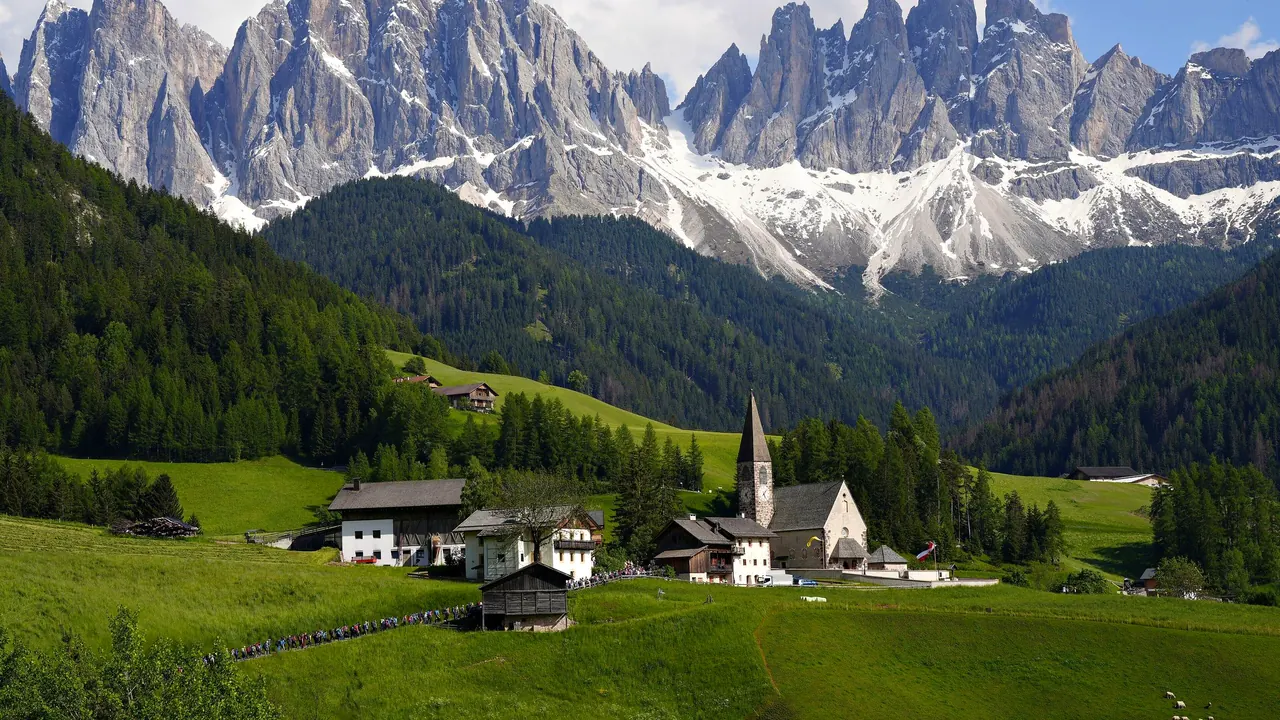
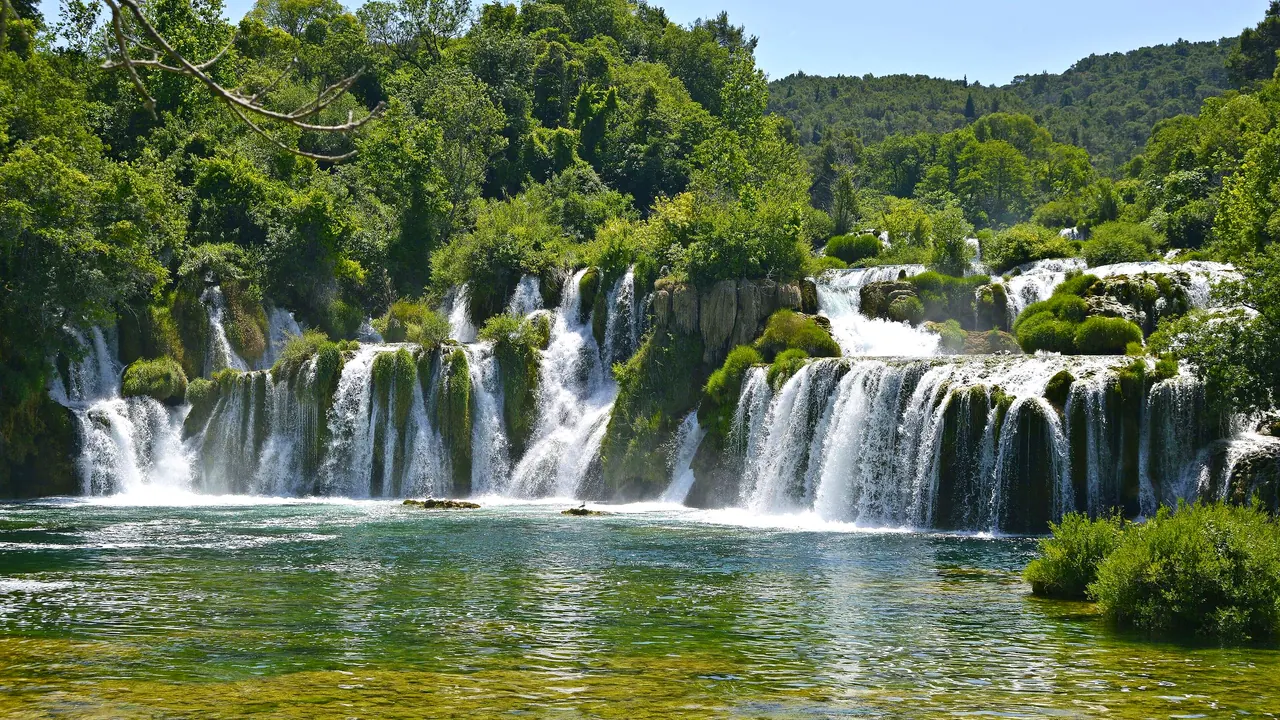
Photos: Dolomites by Chensiyuan, CC BY-SA 4.0, cropped; Krka by Alberto-g-rovi, CC BY 4.0, cropped.
Dolomites or Krka?
Our verdict in twelve categories, each scored against the same fixed benchmark cities, and the climate month by month, so you can choose for your trip.
Choose Dolomites for
- wellness
- shopping
- nature and the outdoors
The Dolomites suit a traveller for whom the mountains are the whole point. Lifts from almost every village lead to high meadows, via ferrata and the Sella Ronda ski circuit, and lunch on a hut terrace is part of the day. Add the best of Alpine and Italian cooking, South Tyrol's wine and hotels built around their spas, and you have a week-long mountain stay that works in summer and in winter. What you give up is warm sea, and you pay noticeably more in the main seasons.
Choose Krka for
- beaches
- prices
- culture and sights
Krka is the better choice for a gentler, sunnier Dalmatian trip where the river is one highlight among several. The waterfalls at Skradinski Buk, the island monastery of Visovac and Šibenik's stone old town fill a few days, and the Adriatic coves, Trogir and Zadar fill the rest. It costs less and the sea is close. The catch is that the park is a day or two of boardwalks and boats rather than real hiking, and away from Šibenik the choice of food and things to do is narrow.
Scoreboard
Twelve categories on one fixed scale from 0 to 100. The shaded stretch is the gap between the two.
Your match
Pick a travel style or drag the sliders, and both match scores follow your weighting.
Wins on wellness and shopping with your weighting.
Wins on beaches and prices with your weighting.
What matters to you?
Category by category
What the scores mean for a trip.
Beaches & swimming
Krka has the clear edge here, because the Adriatic is close even though the river itself is not for swimming. Šibenik's coves at Banj and on the Solaris peninsula, the rocky shores of Zlarin and Prvić and the bays around Primošten give pebbles and clear salt water through the summer.
In the Dolomites, bathing is a side activity. The famous high lakes are too cold, so swimmers head down to Lake Caldaro's lidos and lawns, the valley pools or the north end of Lake Garda, about an hour from Trento.
Food & drink
The Dolomites eat better and more variedly. Speck, canederli and strudel are served alongside proper Italian espresso, the Ladin valleys add their own dishes, and Alta Badia has an unusual number of high-end kitchens for its size. Hut lunches at altitude and autumn Törggelen evenings with Lagrein and Schiava make eating one of the pleasures of the trip.
Krka's cooking is honest Dalmatian fare: fish and lamb cooked under the iron bell, estuary mussels and oysters in Skradin, the town's slow veal risotto and Babić red from the hills. Outside Šibenik's old town, though, it comes down to a few family taverns.
Culture & sights
Krka comes out a little ahead, mainly thanks to Šibenik at the river mouth, where the Renaissance Cathedral of St James and the sea fortress of St Nicholas are both UNESCO-listed. Upriver, the boat to the Franciscan monastery on Visovac, the Orthodox Krka Monastery with its catacombs and the Roman arches of Burnum make the sights part of the journey along the river.
The Dolomites' UNESCO listing is for the landscape, and their heritage is spread through the valley towns: Ötzi in Bolzano's archaeology museum, the frescoed rooms of Trento's Castello del Buonconsiglio, Bressanone's cloister and the First World War tunnels on the passes. Good for rainy days, but rarely a reason to come.
Nightlife
Neither place is for going out, but the Dolomites have a little more to offer in winter, with après-ski at the foot of the slopes in Selva, Canazei and Cortina, plus the student and wine bars of Bolzano and Trento. It winds down early, and summer villages sleep by eleven.
Around Krka, evenings mean a long dinner and a drink on Skradin's harbour among the yachts, or a few lively bars in Šibenik's lanes on summer nights, with no clubs of note.
Nature & outdoors
This is where the Dolomites are hard to beat. The Tre Cime, Sassolungo, Sella massif and Seceda ridge rise from green meadows, lifts lift walkers high from nearly every village, the via ferrata cables open the rock to non-climbers, and the same mountains become a linked ski area in winter.
Krka's appeal is smaller and gentler: travertine falls at Skradinski Buk and Roški Slap, a deep karst canyon seen from park boats, rim trails, kayaking on the upper river and birdlife in the estuary reeds. Boats also reach the bare Kornati islands. It makes a lovely few days, but it is walking rather than hiking.
Day trips
The two offer about as much, but of very different kinds. From Bolzano, the Dolomites reach the spa town of Merano, Bressanone, Trento and the wine route easily, with Verona, Lake Garda and Innsbruck over the Brenner a longer outing. From the high villages, though, every trip starts with a winding pass road.
Krka sits in central Dalmatia, so the outings are coastal and mostly short drives: walled Trogir, Split's Roman palace, Zadar's forum, Primošten, island ferries from Šibenik and the Kornati from Murter, plus the fortress at Knin inland.
Good for families
The Dolomites are much better set up for children in summer. Flat paths across the Alpe di Siusi and Armentara meadows, lifts that take out the climbing, huts with playgrounds and farm animals, toboggan runs and hotels with children's clubs make long stays easy, and winter adds well-run ski schools.
At Krka the boardwalks over rushing water and the boat rides to Visovac are a real treat for children, but there is little else made for them. Families usually stay at coastal resort hotels near Šibenik, and the midsummer heat and crowds on the loop wear small legs down.
Getting around
The Dolomites are a little easier without a car, at least within South Tyrol, where trains run along the Adige and Puster valleys and one regional pass covers buses up to most resorts, and lifts do the rest. Crossing between valleys is another matter: slow hairpin passes, packed in high summer, push most touring visitors into a hire car.
Krka is compact and the roads are good, and inside the park buses and boats link the falls, Visovac and Roški Slap. Getting beyond Skradin by public transport is the weak point, as the upper falls and monasteries need a tour or a car.
Shopping & style
The Dolomites have far more to buy. There are Val Gardena's centuries-old woodcarving workshops in Ortisei, loden and food shops under Bolzano's medieval arcades, Cortina's short strip of boutiques and some of the best-known Advent markets in the Alps, in Bolzano, Merano and Brunico.
Around Krka it comes down to olive oil, honey, figs and wine from small producers, a few craft shops in Šibenik and the coral work of Zlarin.
Affordability
Krka is the easier one on the budget. Prices sit around the middle of Western Europe, apartments inland around Lozovac undercut the Šibenik waterfront, and the park entrance, the biggest single cost, drops outside July and August.
The Dolomites are expensive in the ski season and midsummer, with Cortina and Alta Badia among Italy's costliest resorts and lift passes adding up. Staying in Val di Fassa, Fiemme or Bressanone, or going in June or September, softens it.
Live music & performing arts
Neither is a destination for performance, but the Dolomites have more to offer. Bolzano and Trento keep year-round orchestral and theatre seasons, Bolzano hosts a long-established piano competition, and summer brings concerts on alpine meadows, jazz in castles and wineries, and Merano's autumn festival in its spa halls.
Krka's live music is a summer affair centred on Šibenik, with fortress concerts, the long-running children's festival and a small nineteenth-century theatre, plus klapa singing at village festivities.
Wellness & relaxation
The Dolomites are the place for a spa trip. South Tyrol's mountain hotels build saunas facing rock walls and heated outdoor pools in the snow, the hay bath survives around Völs am Schlern, and Merano's thermal baths stand in the town centre by the river.
Krka has no bathing tradition and only a few resort spas near Šibenik. Its calm comes from Skradin's harbour at dusk, early mornings on the river and silent stone villages inland, which suits a slow trip rather than a pampered one.
When should you go?
Pick your month. The climate figures are measured averages, not a forecast.
Dolomites in July
Krka in July
Daytime high, °C
Rainfall in the month, mm
Where the figures come from
Krka's temperatures are measured 53 km from the centre, at Split / Marjan.
Krka has no rain gauge within 25 km of the centre, so its rainfall comes from a gridded climate dataset read at the destination rather than from a gauge further away.
Krka's sunshine is measured 53 km from the centre, at Split / Marjan.
Temperature and rainfall are climate normals, averaged over the years shown. Dolomites: 1991-2020 normals, Dobbiaco (22.3 km from centre). Krka: 1991-2020 (sunshine 1971-2000) normals, Split / Marjan (52.9 km from centre).
The two run on opposite calendars. In the Dolomites the figures show a mild summer, with highs around 22°C from June to August. That is good walking weather, but conditions change a lot with height: the low valley towns run warmer, and the high passes and ridges are much cooler. Summer is also the wettest stretch, peaking near 130mm in July, so early starts are wise. From December to February days hover around freezing, which is the ski season. Late spring and October are cool and quiet in between, with snow lingering longer the higher you go.
Around Krka the coast is hot in midsummer, near 31°C in July and August, which makes the crowded boardwalks hard going at midday. The sea reaches about 24°C then and the days are at their sunniest, and it is warm enough for swimming from June to September. May and late September are the best months for the falls and for walking. Autumn turns wet, with November the rainiest month at about 106mm, but winter stays mild enough for sightseeing in a way the Dolomites do not.
Which traveller are you?
On an outdoors trip, the Dolomites win clearly. Lifts carry you onto limestone towers and high pasture from almost every village, the Alta Via routes run hut to hut for a week, and winter adds the linked Dolomiti Superski area. Krka offers boardwalks and kayaking, but no mountains.
For a beach and sun trip, Krka is the obvious pick. Šibenik's pebble coves, the car-free islands of Zlarin and Prvić and the bays near Primošten sit on clear Adriatic water that is warm all summer. In the Dolomites, swimming means a valley lake or lido.
On a trip on a tight budget, Krka goes further. Private apartments inland around Lozovac and konoba meals keep costs moderate, especially in spring and autumn. The Dolomites are expensive in season, with lift passes and resorts such as Cortina and Alta Badia among Italy's costliest.
Before you go
| Measure | Dolomites | Krka |
|---|---|---|
| Official language | Italian | Croatian |
| Currency | Euro (EUR) | Euro (EUR) |
| Sockets | CFL230 V, 50 Hz | CF230 V, 50 Hz |
| Driving side | Right | Right |
| Time zone | UTC+1, UTC+2 in summer | UTC+1, UTC+2 in summer |
| Emergency number | 112 | 112 |
| Main airport | Venice Marco Polo Airport (VCE)103 non-stop destinations | Split Saint Jerome Airport (SPU)69 non-stop destinations |
| Public holidays this year | 13 days | 14 days |
By the numbers
| Measure | Dolomites | Krka |
|---|---|---|
| Swim season, months above 21 °C | - | 4 months |
Where else could you go?
Every comparison below shares a destination with this one, so you can follow Dolomites or Krka somewhere new.
- Hvarvs Krka
- Bračvs Krka
- Austrian Alpsvs Dolomites
- Plitvice Lakesvs Krka
- Korčulavs Krka
- Lake Gardavs Dolomites