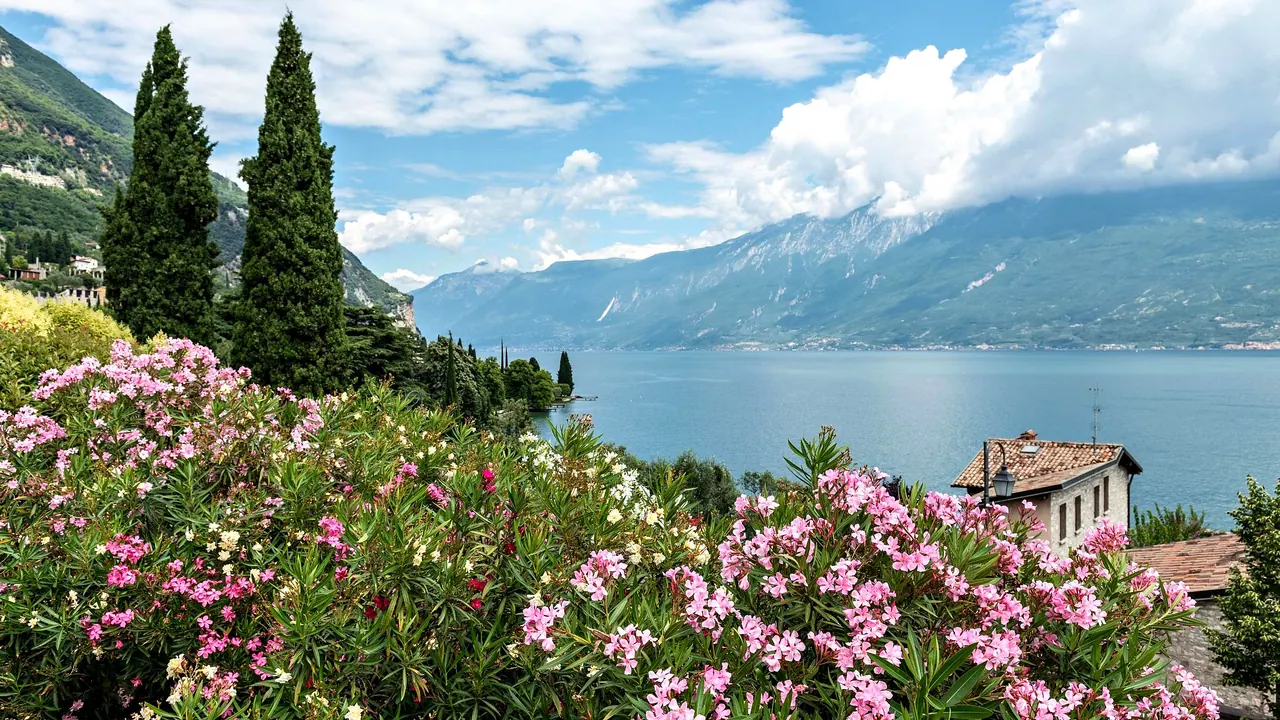
Photos: Lake Garda by Wolfgang Weiser, Pexels License.
Dolomites or Lake Garda?
Our verdict in twelve categories, each scored against the same fixed benchmark cities, and the climate month by month, so you can choose for your trip.
Choose Dolomites for
- shopping
- nature and the outdoors
- getting around
The Dolomites are for travellers who come to be in the mountains: walking the high pastures, clipping onto via ferrate, cycling the great passes or skiing the Sella Ronda in winter. They also have the more interesting food, with hut lunches above the treeline and South Tyrolean wine in the valleys. Evenings are quiet by design. The trade-off is cost and almost no swimming.
Choose Lake Garda for
- beaches
- day trips
- prices
Lake Garda suits a summer that mixes swimming with sightseeing and outings. Warm lake water and lidos, Gardaland and the family resorts of the south-east shore, and the railway to Verona and Venice make for a more varied stay, and it is a little easier on the budget. Around Riva and Arco in the north you can still climb, ride and windsurf, though the peaks are smaller.
Scoreboard
Twelve categories on one fixed scale from 0 to 100. The shaded stretch is the gap between the two.
Your match
Pick a travel style or drag the sliders, and both match scores follow your weighting.
Wins on shopping and nature and the outdoors with your weighting.
Wins on beaches and day trips with your weighting.
What matters to you?
Category by category
What the scores mean for a trip.
Beaches & swimming
Lake Garda is the place for swimming. From June into September the water is warm enough for daily bathing off the pebble shores and grassy lidos at Sirmione, Lazise, Bardolino and the Valtenesi bays. In the Dolomites the famous high lakes such as Braies and Carezza are for looking at, and real bathing means the lidos at Lake Caldaro or the town pools. The nearest big lake swim from there is the northern tip of Garda itself.
Food & drink
The Dolomites have the more distinctive cooking, where Alpine and Italian kitchens meet: speck, canederli dumplings and schlutzkrapfen, followed by a proper Italian espresso, with a hut lunch as part of the day. They also win for a special dinner. A few small villages in Alta Badia and the Puster Valley have ambitious restaurants. At Garda the best cooking is in family trattorias and agriturismi rather than at the top end.
Lake Garda eats lighter, with lake fish, bigoli with sardines and its own olive oil. Its wines, Lugana, Bardolino and the nearby Amarone, are as good a reason to go as South Tyrol's Lagrein and Gewürztraminer. The catch is the pizza and set menus along the busy harbour fronts, so at Garda you have to look harder for a good meal, usually in the hills.
Culture & sights
Neither is a sightseeing destination, and both spread their heritage across small towns. In the Dolomites it is history in the valley towns: Ötzi in Bolzano's archaeology museum, the frescoed rooms of Trento's Buonconsiglio, Novacella Abbey and the First World War tunnels on the passes. Garda's sights sit by the lake and are more eccentric, from Sirmione's moated castle and Roman villa ruins to d'Annunzio's warship set into the hillside at the Vittoriale.
Nightlife
Neither suits late nights, but Garda has a little more going on. Desenzano on the southern shore has lakefront bars and a few large clubs that fill on summer weekends, and Riva and Bardolino keep some bars busy in season.
In the Dolomites the liveliest evenings are winter après-ski in Selva, Canazei or Cortina, and even that winds down early in the evening. In summer the villages are asleep by eleven.
Nature & outdoors
Both are superb outdoor country, but the Dolomites are on another scale. They have the Tre Cime, the Sassolungo and the Sella massif, week-long hut-to-hut routes like the Alta Via 1, the gentle Alpe di Siusi, and the Dolomiti Superski area in winter. Lifts from almost every village put the high rock within reach of ordinary walkers.
Garda's outdoors is concentrated in its narrow north: Arco's limestone climbing walls, Monte Baldo's ridge above Malcesine and the afternoon wind that makes Torbole a classic for windsurfing. It has water sports the mountains cannot offer, but nothing to match their high routes or winter ski circuit.
Day trips
Garda's southern shore sits on the Milan to Venice railway, so Verona is well under an hour away and Venice, Padua, Vicenza and Bergamo all make easy days out. Mantua is about an hour by road, and the ferry turns the other lake towns into outings of their own.
From the Dolomites the best trips run along the Adige valley to Merano, Bressanone, the wine route and, by train, Verona. From the high valleys, though, every outing starts with a slow pass road.
Good for families
Lake Garda gives families more choice in summer, and different parts of the lake suit different ages. The south-east shore is best for younger children, and the north around Riva and Arco suits older ones who want to bike, climb or try windsurfing. The hard part is the heat of July and August and the slow traffic on the shore roads.
The Dolomites are the better choice in winter, with well-run ski schools and gentle nursery slopes. In summer they are cooler and calmer, with summer toboggan runs, huts with playgrounds and family hotels with children's clubs. There is no zoo or theme park, though, so a wet day means a pool, a museum in Bolzano or Trento, or a long drive.
Getting around
Neither is easy to cover without a car, but the Dolomites are better connected within each valley. Trains run along the Adige and Puster valleys, buses climb to the resorts on one regional pass, and lifts link whole ski areas. Crossing from one valley to the next over hairpin passes is the slow part.
At Garda the railway only touches the south, the shore roads are congested in summer and parking is hard. The ferries are the best way between towns, pleasant but slow.
Shopping & style
The Dolomites give you more to bring home. There are carved wooden figures from the Ortisei workshops, loden and food shops under Bolzano's arcades, a short run of luxury boutiques in Cortina, and some of the best-known Advent markets in the Alps. At Garda, shopping means the weekly markets in Desenzano, Lazise and Bardolino, plus olive oil, Lugana wine and lemon products from Limone, and anything more serious means a trip to Verona or Milan.
Affordability
Garda is the gentler on a budget, mainly thanks to the campsites, camping villages and agriturismi back from the water, though the lakefront hotels in Sirmione and Limone still charge high-season prices. The Dolomites are expensive in both winter and summer. Cortina and Alta Badia are among Italy's costliest resorts, and lift passes add up.
In both, the shoulder months help: June and September in the mountains, spring and autumn on the lake.
Live music & performing arts
Neither has much to see, and both liven up mainly in summer. The Dolomites have more that runs all year: Bolzano's orchestra and piano competition, Trento's theatre, concerts on alpine meadows and Merano's autumn festival.
Garda's big night out is just outside the region, at the opera in Verona's Roman arena, under an hour from the southern shore. Closer to hand are the open-air shows in the Vittoriale's amphitheatre.
Wellness & relaxation
Both suit a slow stay, but in different ways. In the Dolomites, wellness lives in the hotel: saunas facing rock walls, outdoor pools in the snow and hay baths near Völs am Schlern. Merano is the one public thermal town.
Garda has public thermal water of its own, from Sirmione's sulphurous springs to the open-air pools in a villa park near Lazise, as well as hotel spas along the western Riviera. The lake is calmest in spring and early autumn. In the mountains, June and September are the quietest months.
When should you go?
Pick your month. The climate figures are measured averages, not a forecast.
Dolomites in July
Lake Garda in July
Daytime high, °C
Rainfall in the month, mm
Where the figures come from
Lake Garda's sunshine is measured 28 km from the centre, at Verona / Villafranca.
Temperature and rainfall are climate normals, averaged over the years shown. Dolomites: 1991-2020 normals, Dobbiaco (22.3 km from centre). Lake Garda: 2005-2025 (sunshine 1991-2020, rainfall 1991-2020) normals, Verona / Rivoltella (1.6 km from centre).
The two run on different calendars. The Dolomites have two seasons. From December to February daytime highs hover around freezing and the skiing is on. In summer the valleys reach about 22°C, ideal for walking but rarely warm enough to swim outside the low valleys. Summer is also the wettest time in the mountains, with July around 130mm, so September, drier and still mild, is often the better month for long hikes.
Lake Garda is warmer all year and at its best for the beach from June to September. Around the main resort area it reaches 29°C in July, with about 310 hours of sunshine that month. That heat can make midday walking hard in high summer, so May and late September suit sightseeing better. November is the wettest month at 121mm, and winter is mild but dull rather than a season to visit for.
Which traveller are you?
For a beach and sun trip, Lake Garda is the clear choice. The water warms well in July and August, the south and east shores have long lidos at Lazise, Bardolino and Desenzano, and its summers are hotter and sunnier than the mountains, where swimming means valley pools.
On an outdoors trip, the Dolomites win for walkers, climbers and skiers. Lifts climb to the high pastures and limestone towers from almost every village, via ferrate open up the rock, and winter brings the Sella Ronda. Garda's north shore is the better pick only for windsurfing.
On a family trip with children, Lake Garda gives you more for the days. Gardaland, an aquarium, water parks and a safari park are all near the south-east shore, along with shallow pebble beaches and ferry rides. The Dolomites suit families who mainly want gentle summer walks.
Before you go
| Measure | Dolomites | Lake Garda |
|---|---|---|
| Official language | Italian | Italian |
| Currency | Euro (EUR) | Euro (EUR) |
| Sockets | CFL230 V, 50 Hz | CFL230 V, 50 Hz |
| Driving side | Right | Right |
| Time zone | UTC+1, UTC+2 in summer | UTC+1, UTC+2 in summer |
| Emergency number | 112 | 112 |
| Main airport | Venice Marco Polo Airport (VCE)103 non-stop destinations | Verona Villafranca Valerio Catullo Airport (VRN)96 non-stop destinations |
| Public holidays this year | 13 days | 13 days |
Where else could you go?
Every comparison below shares a destination with this one, so you can follow Dolomites or Lake Garda somewhere new.
- Austrian Alpsvs Dolomites
- Lake Comovs Lake Garda
- Cinque Terrevs Lake Garda
- Bavariavs Dolomites
- Tuscanyvs Lake Garda
- Austrian Alpsvs Lake Garda